100 pesos 1943
Market Prices
35 salesAbout This Note
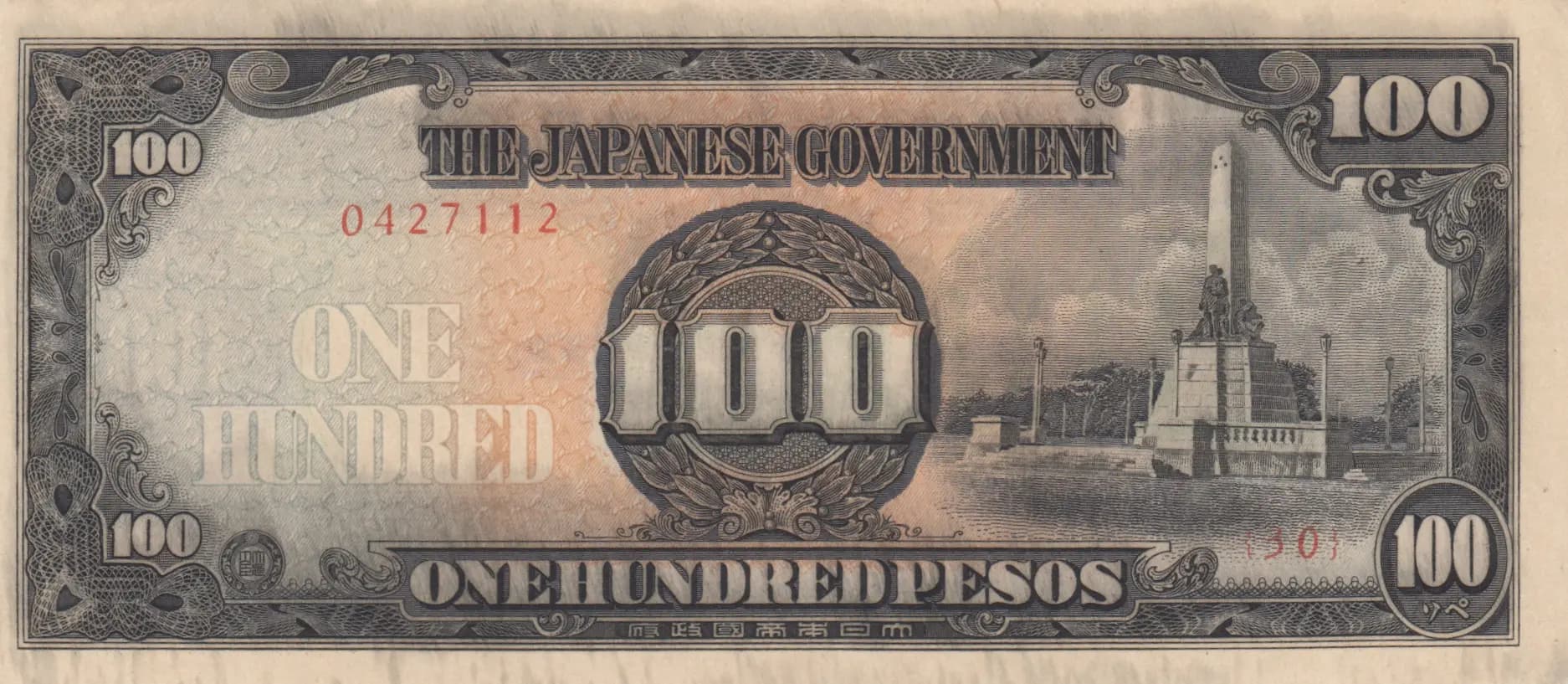
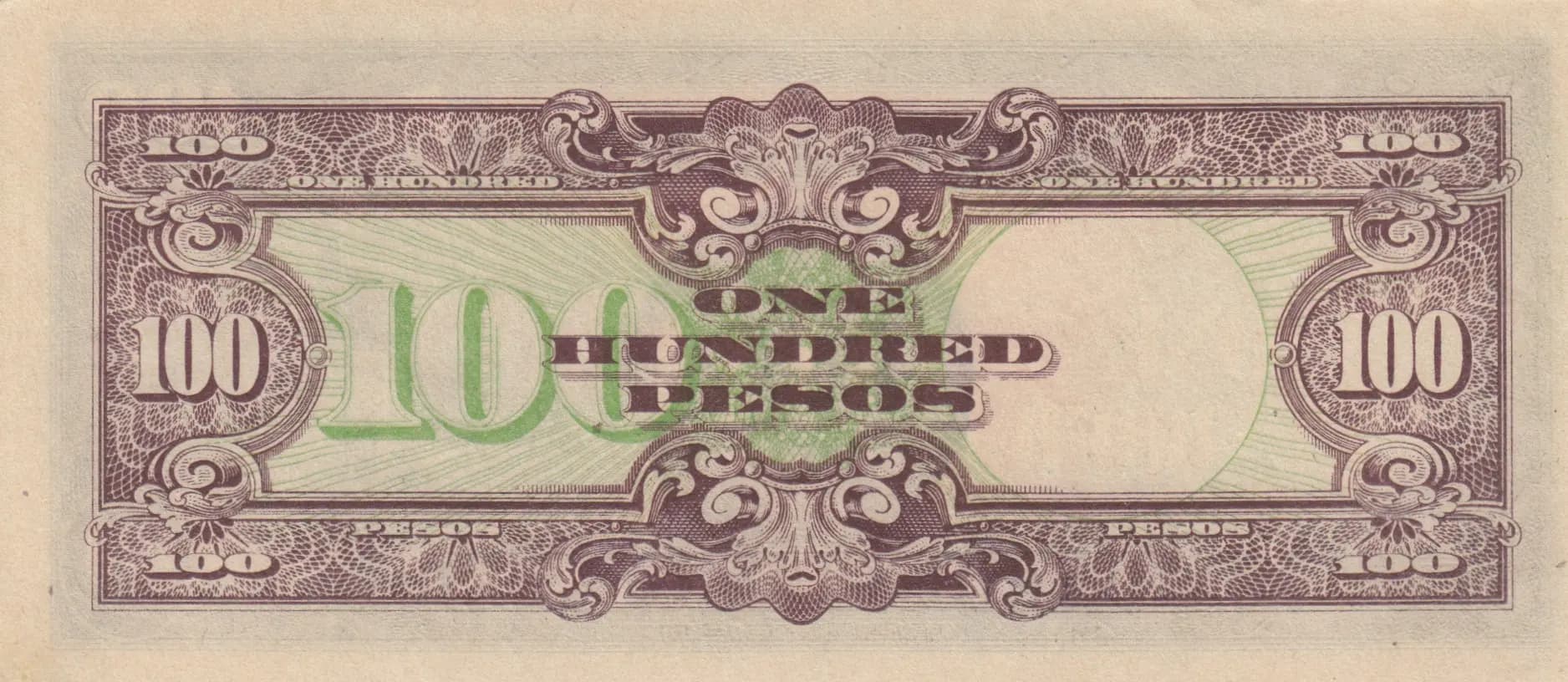
This 100 Pesos note from the Japanese Government (1943-1944) represents an important piece of World War II Philippine occupation currency. Graded AU (About Uncirculated), the note displays exceptional preservation with crisp, clear printing throughout and minimal signs of circulation. The obverse features an ornate design with a prominent Rizal Monument landscape vignette, while the reverse showcases bold green denominations against burgundy decorative borders—a visually striking and historically significant piece of Japanese occupation scrip.
Common. This note regularly appears on the secondary market with consistent sales activity spanning from 2009 to 2025. eBay transaction data shows frequent sales across multiple condition grades (VG through UNC), with recent sales in 2025 and prices ranging from under $1 to approximately $6 USD. Catalogue values from 2016 reflect affordability (VG: $0.25, VF: $0.75, UNC: $2.25), and the consistent low-to-moderate pricing over 15+ years of trading history indicates a readily available note with no print-run scarcity. Japanese occupation currency, while historically important, was produced in substantial quantities and has survived in adequate numbers to remain common in the collector market today.
Issued by the Japanese Government during the occupation of the Philippines in the Pacific War era (1943-1944), this banknote exemplifies the military currency used to establish economic control in occupied territories. The reference to 'Southern Occupation Japanese Government Note' (南方占領地日本銀行券) in the Japanese inscriptions reflects the official designation for notes issued across the Japanese Co-Prosperity Sphere. The Rizal Monument depicted on the obverse—one of Manila's most iconic landmarks—was incorporated into the design as part of the occupation authorities' attempt to present a facade of normalcy and cultural respect while asserting colonial monetary control.
The obverse features an ornate Victorian-style design with elaborate decorative borders composed of fine scrollwork in the corners. The central design showcases a large circular medallion containing the numeral '100' (or possibly '1000' as noted in visual analysis—likely '100' given the denomination) surrounded by a classical laurel wreath. To the right is an engraved landscape vignette depicting the José Rizal Monument on the Manila waterfront, complete with surrounding buildings and trees—a recognizable landmark that would have been familiar to Philippine subjects. The reverse displays a simpler but equally ornate layout with large green '100' numerals dominating the center, framed by burgundy and brown decorative borders featuring baroque-style scrollwork and floral patterns. The entire composition employs fine-line engraving with intricate cross-hatching for security purposes.
FRONT: 'THE JAPANESE GOVERNMENT' (English), '100' and 'ONE HUNDRED' (denomination in English), 'ONE HUNDRED PESOS' (full denomination), Serial number '0427112' (Arabic numerals), '南方占領地日本銀行券' (Japanese: 'Southern Occupation Japanese Government Note' or 'Southern Area Occupied Japanese Government Bank Note'). BACK: '100' and 'ONE HUNDRED PESOS' repeated across the note (English denominations). All inscriptions are in English and Japanese, reflecting the dual-language policy of the occupation authorities.
Intaglio engraving (deep-etch copper plate printing) combined with letterpress, evidenced by the crisp, raised fine-line work, detailed cross-hatching patterns, and the uniform color saturation characteristic of intaglio production. The security printing details—particularly the complex ornamental borders and fine-line patterns—indicate professional security printing standards typical of Japanese Government currency production during the occupation period. The printer is not definitively identified in available catalog data, but Japanese occupation currency was typically produced by the Bank of Japan's currency printing facilities or contracted security printers under strict military oversight.
Serial number observed: 0427112. The visual analysis indicates this specific specimen shows no overprints or obvious date variations. Pick catalog P-112 designation confirms this is the standard issue type. Known varieties for this denomination typically involve serial number prefixes and block variations, but without access to complete variety catalogs for Japanese occupation Philippine currency, specific variety designation cannot be confirmed from the provided data. The AU condition grade and the specific serial number prefix may assist in variety identification for specialized collectors, but the note appears to be a standard mainline issue of the 1943-1944 emission.