10 pesos 1943
“Mindanao”
Market Prices
About This Note
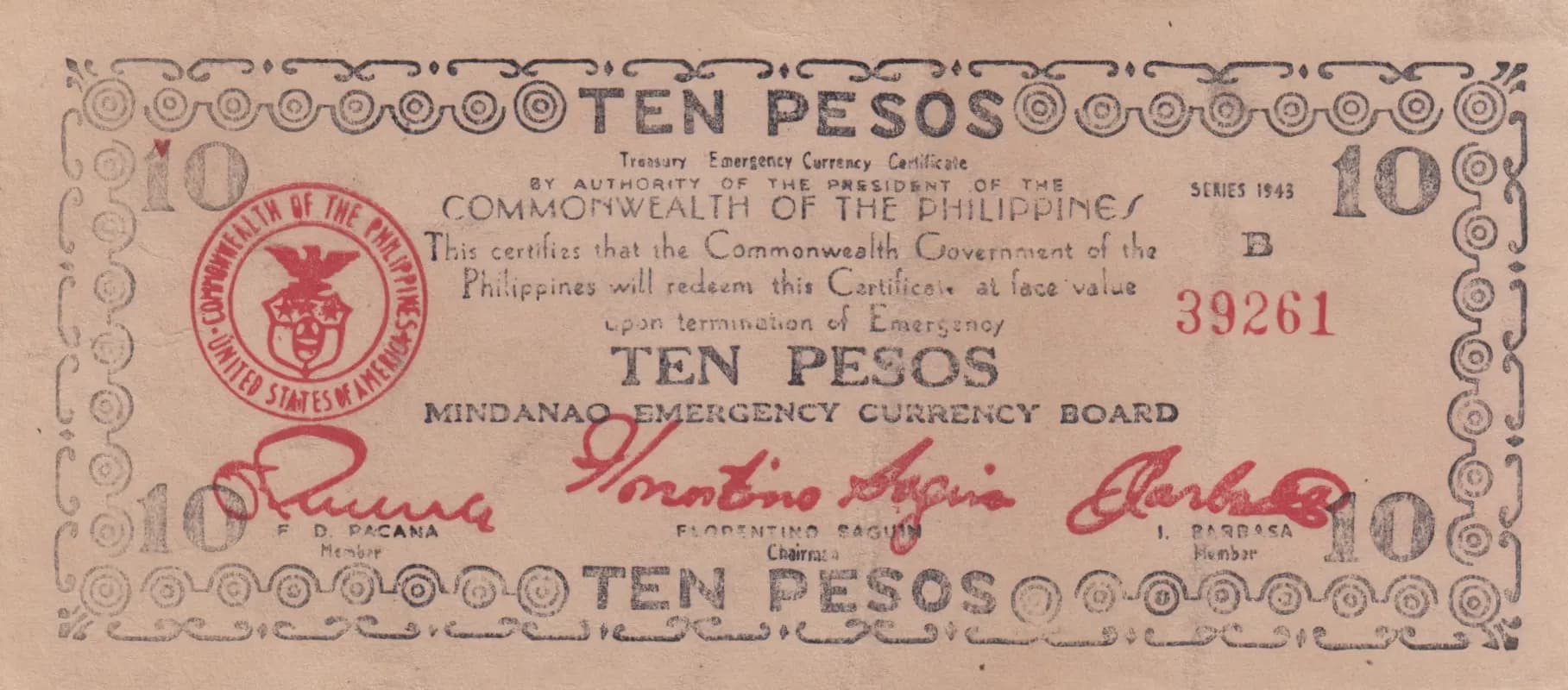
A VF-grade 10 Pesos Treasury Emergency Currency Certificate from the Commonwealth of the Philippines (1943), issued by the Mindanao Emergency Currency Board during wartime disruptions. The note displays the characteristic tan/beige aged patina with black and red printing, featuring a prominent red eagle-and-shield circular seal and decorative circular medallion border patterns. This is a historically significant emergency issue with bilingual English-Filipino inscriptions and authenticated signatures, representing a critical monetary response during WWII in the Philippine theater.
Common. eBay market data shows consistent pricing in the $1.50–$6.95 USD range across multiple condition grades (UNC, AU, XF, CIRC), with VF-grade examples appearing at approximately $2.95–$3.75 USD. This pricing pattern indicates substantial surviving quantities in the collector market. Mindanao Emergency Currency Board notes were produced in significant volume to facilitate regional commerce during the wartime emergency, and many examples have been preserved due to their historical significance and collectibility. The series is readily available to collectors and does not command scarcity premiums.
This note was issued during the Japanese occupation and subsequent liberation of the Philippines in 1943-1944, when the Commonwealth government established emergency currency boards to maintain local monetary systems in isolated regions like Mindanao. The redemption promise printed on both sides—guaranteeing face-value redemption after the emergency concluded—reflects the provisional nature of these wartime issues and the Philippine government's commitment to currency stability during occupation. The Mindanao Emergency Currency Board, represented by Chairman Florentino Bagui and other signatories, operated under presidential authority to provide functional currency when normal monetary systems were disrupted.
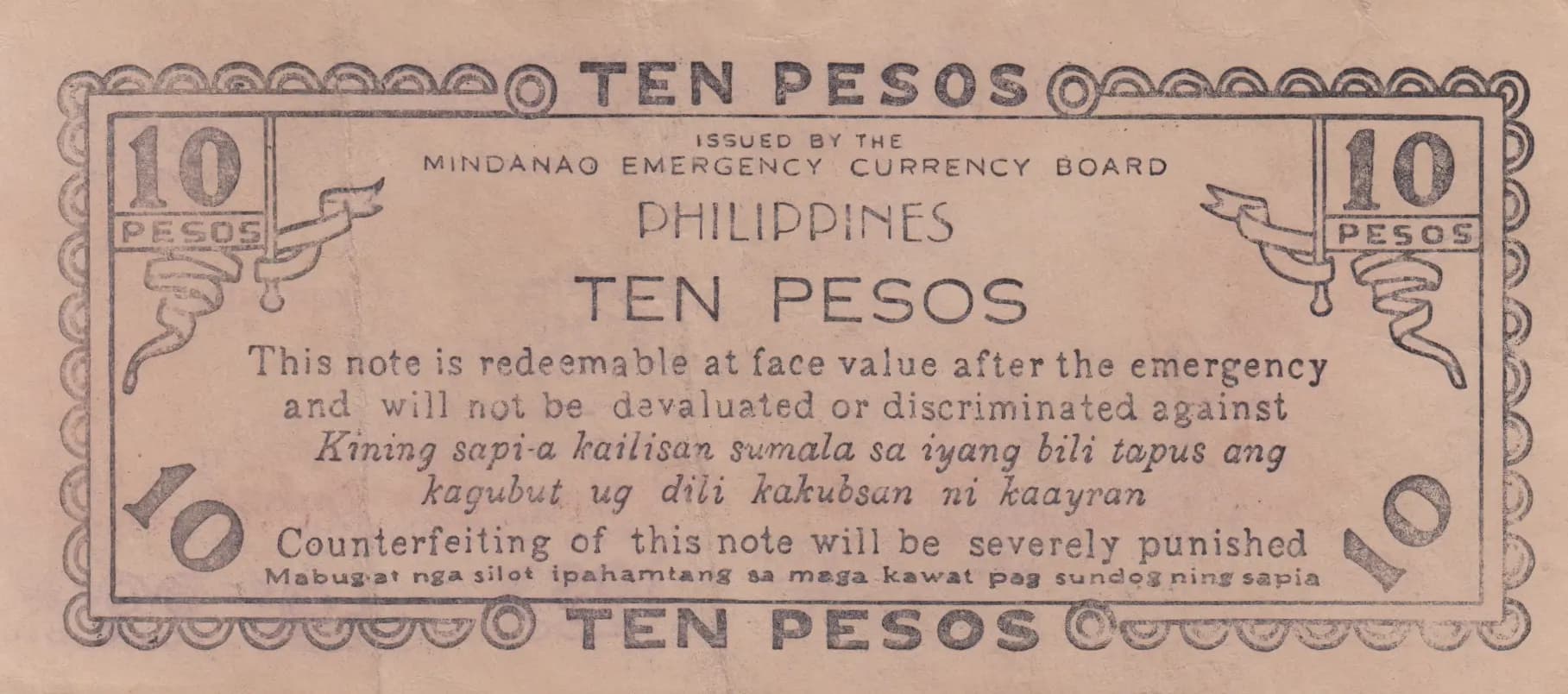
The note features a formal administrative design reflecting its status as an emergency government certificate rather than conventional currency. The obverse (front) is dominated by a red circular seal containing an eagle clutching a shield—the heraldic emblem of the Philippine Commonwealth—positioned in the upper left. A decorative border of interlocking circular medallion patterns frames the entire note in black and red ink. The center field contains the redemption certification text and authenticated signatures of the Mindanao Emergency Currency Board officials. The reverse (back) displays two large caduceus symbols (winged staffs entwined with serpents)—traditionally associated with commerce and governmental authority—positioned flanking the central text area. Large denomination text '10 PESOS' appears in corners and center. The bilingual presentation (English and Filipino/Tagalog) underscores the note's official government status and accessibility to the local population. No portraits or specific landmarks are depicted; the design emphasizes governmental legitimacy through heraldic symbols, official seals, and authenticating signatures rather than personification.
FRONT SIDE: 'TEN PESOS' / 'Treasury Emergency Currency Certificate' / 'BY AUTHORITY OF THE PRESIDENT OF THE COMMONWEALTH OF THE PHILIPPINES' / 'SERIES 1943' / Serial number 'B 39261' / 'This certifies that the Commonwealth Government of the Philippines will redeem this Certificate at face value upon termination of Emergency' / 'MINDANAO EMERGENCY CURRENCY BOARD' / Signatures: 'D. PACANA (Member)', 'FLORENTINO BAGUI (Chairman)', 'I. BARBOSA', 'Fund'. BACK SIDE: 'TEN PESOS' (multiple instances) / '10 PESOS' / 'ISSUED BY THE MINDANAO EMERGENCY CURRENCY BOARD PHILIPPINES' / 'This note is redeemable at face value after the emergency and will not be devaluated or discriminated against' / Filipino text: 'Kining sapi-a kailisan sumala sa iyang bili tapus ang kagubut ug dili kakubsan ni kaayran' (This note will be redeemed at face value after the emergency) / 'Counterfeiting of this note will be severely punished' / Filipino text: 'Mabugat nga silot ipahamtang sa mega kawat pag sundogning sapia' (Severe punishment for counterfeiting this note).
Letterpress or relief printing in black and red inks on tan/beige paper stock. The design shows characteristics consistent with wartime emergency printing: the uniform color of the paper base, the crisp but somewhat austere line work in the decorative borders, and the straightforward typography. The red circular seal and ornamental borders were likely printed in a separate pass from the black text and serial numbering. No evidence of modern security features (watermarks, security threads, or microprinting) is visible, consistent with the 1943 production date and emergency nature of the issue. The printer for Philippine emergency currency issues during this period was typically handled by local government print facilities under wartime restrictions.
This note is identified as series B with serial number 39261. The variety is determined by the series letter (B) and position within the print run indicated by the serial number. Multiple series and signature varieties exist for the 10 Pesos 1943 Mindanao Emergency Currency Board issue (Pick S488). Collectors should note variations in: (1) Series designation (A, B, C, etc.), (2) Signature combinations among board members, and (3) Serial number prefixes. This example represents Series B with the signature trio of Florentino Bagui (Chairman), D. Pacana (Member), and I. Barbosa (Fund). No overprints or subsequent surcharges are evident on this specimen.