10 pesos 1943
“Iloilo”
Market Prices
About This Note
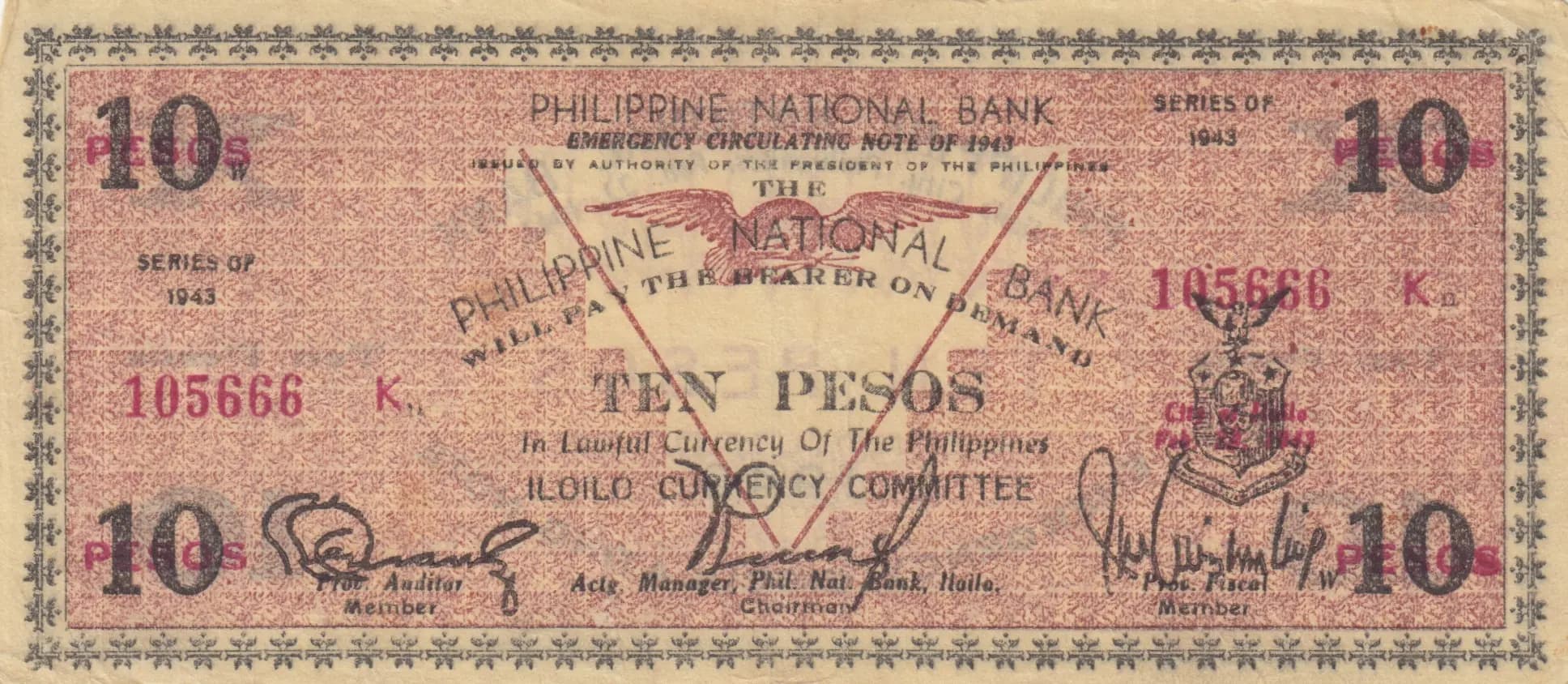
This Philippine National Bank 10 pesos emergency note from 1943 exhibits the characteristic pink/rose coloring and ornamental fleur-de-lis borders typical of wartime Philippine currency. The centered eagle with outstretched wings and the prominent 'Iloilo Currency Committee' designation reflect the localized emergency issuance during Japanese occupation. In VF condition, the note shows expected age-related wear including creasing, foxing, and surface discoloration, with visible signatures and stamps indicating authentic period handling.
Common. The serial number range (1-200,000 as noted in catalog data) indicates a substantial print run for this denomination and series. eBay market pricing shows examples selling in the $1.50-$6.95 USD range across multiple condition grades, with VF examples appearing at $2.99 USD, confirming widespread availability. No scarcity premium is evident for this Pick number in the current market.
This emergency circulating note was issued on February 23, 1943, during the Japanese occupation of the Philippines in World War II. The 'Iloilo Currency Committee' designation and dated inscription reflect the decentralized monetary authority necessitated by wartime conditions, with local committees authorized to issue currency in specific regions. The 'ISSUED BY AUTHORITY OF THE PRESIDENT OF THE PHILIPPINES' inscription maintains the fiction of Philippine sovereignty despite occupation, linking the note to the Commonwealth government-in-exile.
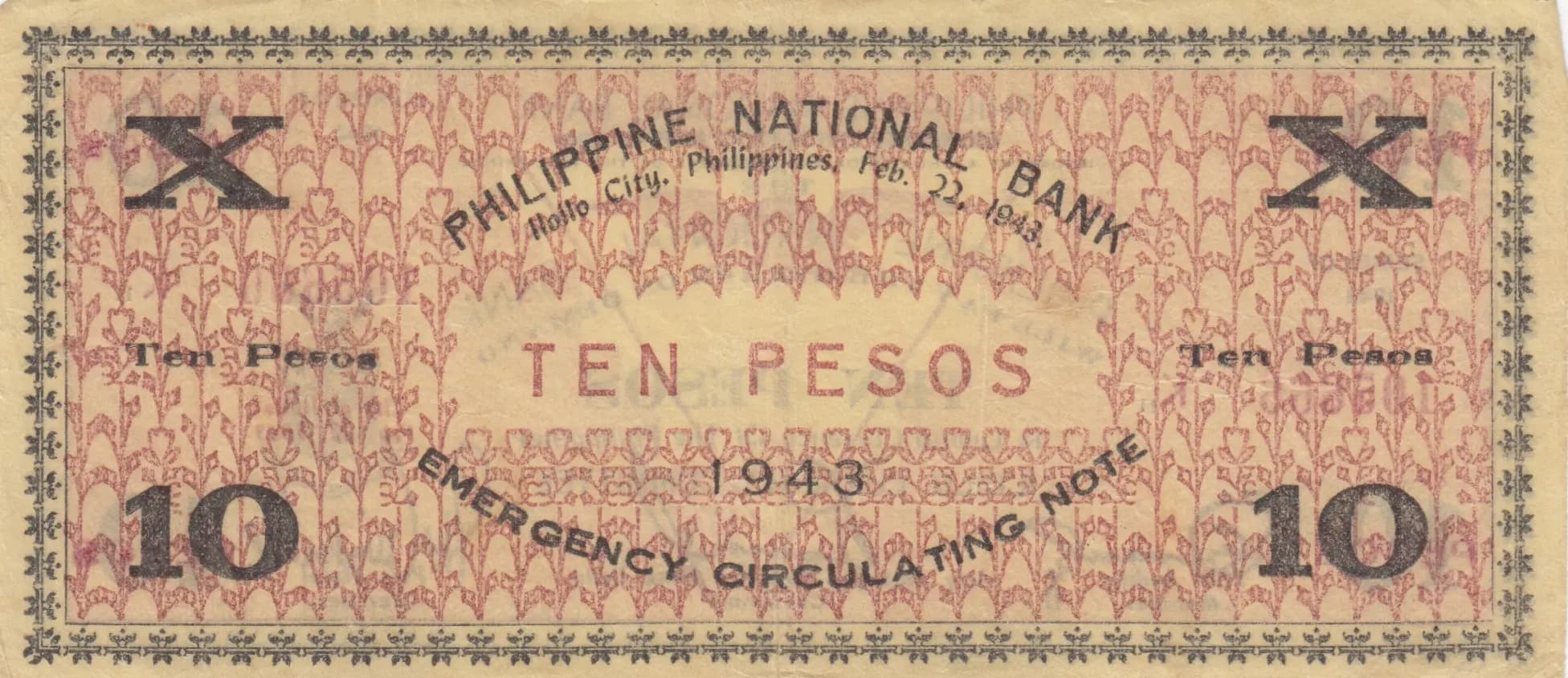
The obverse features a centered Philippine Eagle (Aquila filipinensis) with fully spread wings, a national symbol of the Philippines, rendered in black on a pink/rose underprint with cream-colored ornamental borders. The design employs repeating fleur-de-lis pattern borders framing the composition. Denomination numerals '10' appear in opposite corners. The reverse displays a repeating palm frond or agricultural motif background, also in pink/rose tones, with large 'X' security marks in the top corners and denomination '10' in the bottom corners. The design reflects both international security printing conventions and Philippine iconography appropriate to a wartime emergency issue.
FRONT: 'Philippine National Bank' / 'Emergency Circulating Note of 1943' / 'Series of 1943' / 'Issued by Authority of the President of the Philippines' / 'The Philippine National Bank Treasurer on Demand' / 'Ten Pesos' / 'In Lawful Currency of the Philippines' / 'Iloilo Currency Committee' / Serial number: 105666 with series designation K / 'Acting Manager, Philippine National Bank, Iloilo' / 'Member' (signature line). BACK: 'Philippine National Bank' / 'Iloilo City, Philippines, Feb. 23, 1943' / 'Ten Pesos' (repeated) / 'Emergency Circulating Note' / '1943'
Letterpress or offset lithography with multiple color passes (black, red, and pink/rose inks on colored paper stock). The ornamental borders and repeating background patterns are characteristic of security printing from the period. The red serial numbers and overprints suggest separate press runs. The visible signature lines and committee designations were likely added by hand or local printing facilities in Iloilo, consistent with decentralized wartime production methods.
This example is cataloged as Pick S329b, a variant designation within the 1943 Iloilo issue. The serial number 105666-K places it within the standard range. The note exhibits the characteristic Iloilo Currency Committee overprint and dated inscription (Feb. 23, 1943), which distinguishes it from other regional emergency issues. Multiple signature lines and committee member designations are visible, consistent with formal authority documentation required for local currency committee issuances during Japanese occupation.