10 pesos 1936
Market Prices
4 salesAbout This Note
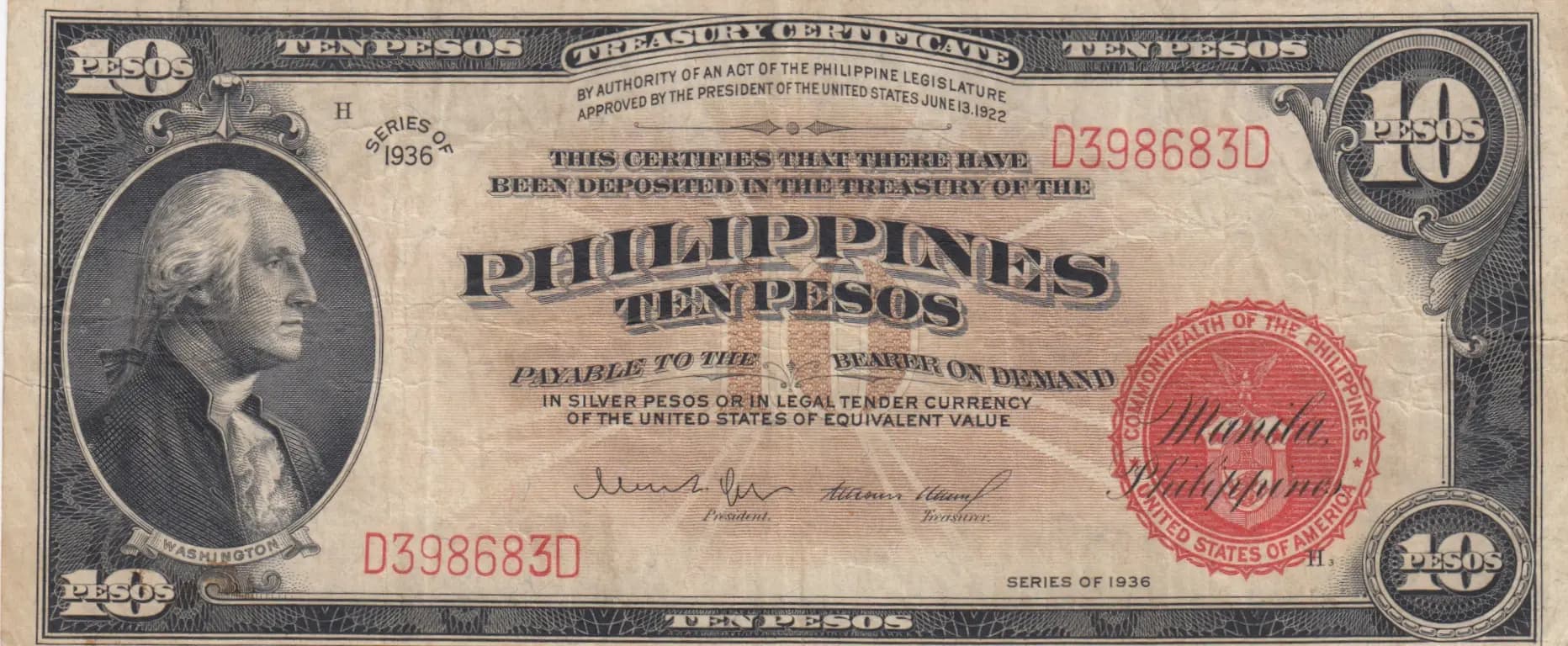
This 1936 Philippine 10 Pesos Treasury Certificate (Pick P-84) features a striking portrait of George Washington on the left side against a cream background with black engraving and red Commonwealth seal elements. The note exhibits typical circulated wear consistent with its age, with aged paper color and minor spotting, placing it solidly in the VF grade range. This is a significant early Commonwealth-era note from the Philippines, combining American and Philippine iconography during the transitional period before independence.
Common. While this is an early Commonwealth-period Philippine note with historical significance, eBay price data indicates robust market supply with consistent sales ranging from $30-$109 in various grades. The 2016 catalog value of $80 for VF specimens and multiple recent sales at or below this level suggest this variety remains readily available to collectors. The relatively large serial number range (D1D to D2 024 000D) indicates substantial print quantities. No evidence of scarcity in the market.
Issued in 1936 during the Commonwealth period of the Philippines (1935-1946), this Treasury Certificate reflects the complex political relationship between the Philippines and the United States. The portrait of George Washington and the authorization text referencing the President of the United States underscore American oversight of Philippine currency during this era. The prominent red Commonwealth of the Philippines seal indicates the islands' increased autonomy while remaining under ultimate U.S. authority, a status that would change dramatically with World War II and the subsequent independence in 1946.
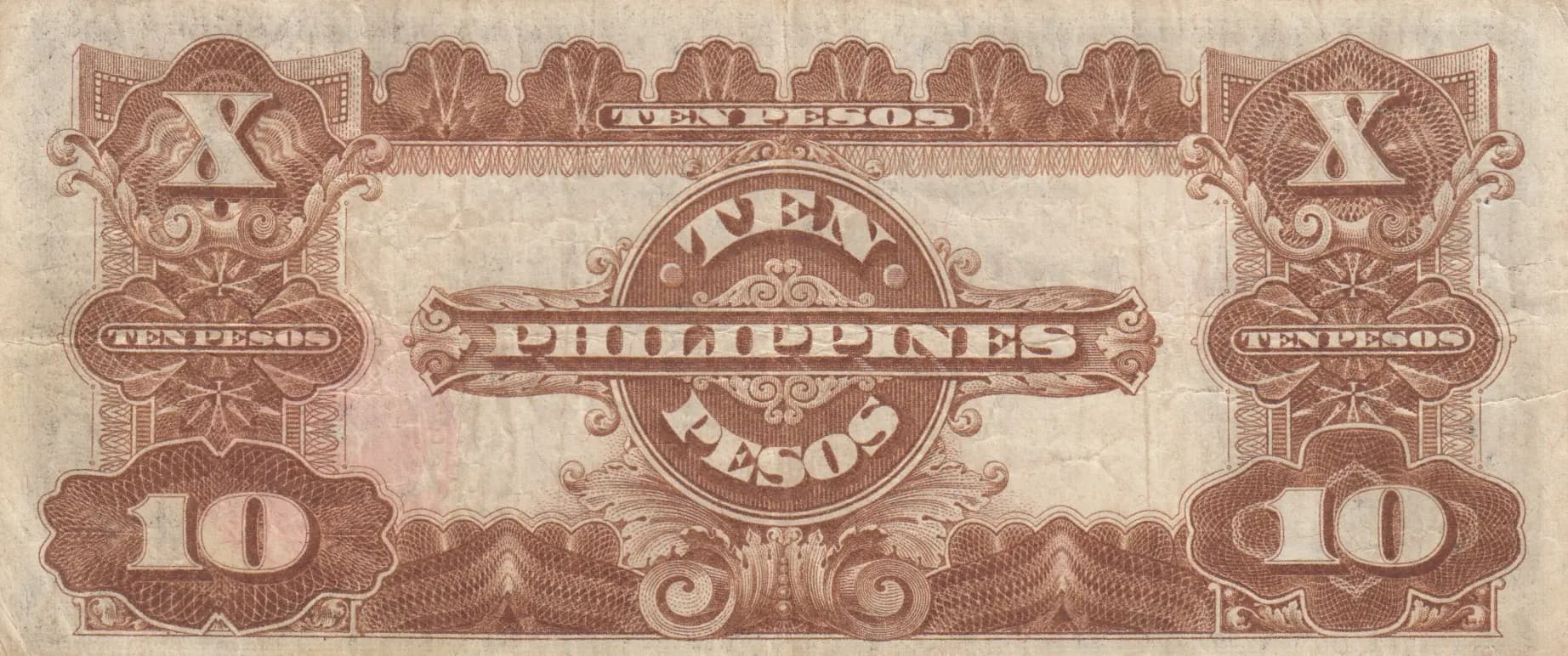
The obverse features a profile portrait of George Washington in formal 18th-century attire positioned at the left side, with his name clearly labeled beneath. The design incorporates ornamental corner pieces with scrollwork and decorative circular emblems displaying peso denominations. The red Commonwealth of the Philippines seal is prominently placed on the right side, signifying official authority. The reverse side employs a symmetrical Art Deco aesthetic with large decorative Roman numeral X symbols in ornate frames on both left and right sides, flanked by a central circular medallion with radiating design elements. Scalloped shell motifs and elaborate ornamental flourishes throughout the border create a security pattern characteristic of high-security banknote design of the era.
Front Side: 'TREASURY CERTIFICATE' / 'BY AUTHORITY OF AN ACT OF THE PHILIPPINE LEGISLATURE APPROVED BY THE PRESIDENT OF THE UNITED STATES JUNE 13, 1922' / 'THIS CERTIFIES THAT THERE HAVE BEEN DEPOSITED IN THE TREASURY OF THE PHILIPPINES' / 'TEN PESOS' / 'PAYABLE TO THE BEARER ON DEMAND' / 'IN SILVER PESOS OR IN LEGAL TENDER CURRENCY OF THE UNITED STATES OF EQUIVALENT VALUE' / 'WASHINGTON' / 'SERIES OF 1936' / 'COMMONWEALTH OF THE PHILIPPINES' / Signature lines for President and Treasurer / Serial number: D398683D. Back Side: 'TEN PESOS' / 'PHILIPPINES' / 'PESOS' / Roman numeral 'X' (representing 10)
Intaglio engraving (also called steel engraving), the standard security printing method for this era. The fine line work, intricate border patterns, and detailed portrait are all characteristic of intaglio engraving. The note was printed by the United States Bureau of Engraving and Printing (USBEP), as confirmed by catalog data, without a printer's imprint visible on the note itself. The red seal and subsequent overprinting were applied separately to create the Commonwealth seal element.
Specific variety: P-84a (USBEP printer without imprint). This example exhibits signatures of Manuel Quezon (President) and Antonio Ramos (Treasurer), consistent with the 1936 issuance. The red Commonwealth seal is noted as 'new' for this issue, distinguishing it from earlier Philippine currency. Serial number prefix 'D' with format D398683D places it within the documented range for this series. The 'SERIES OF 1936' designation with Roman numeral 'II' indicates this is the second printing or series variant of 1936.