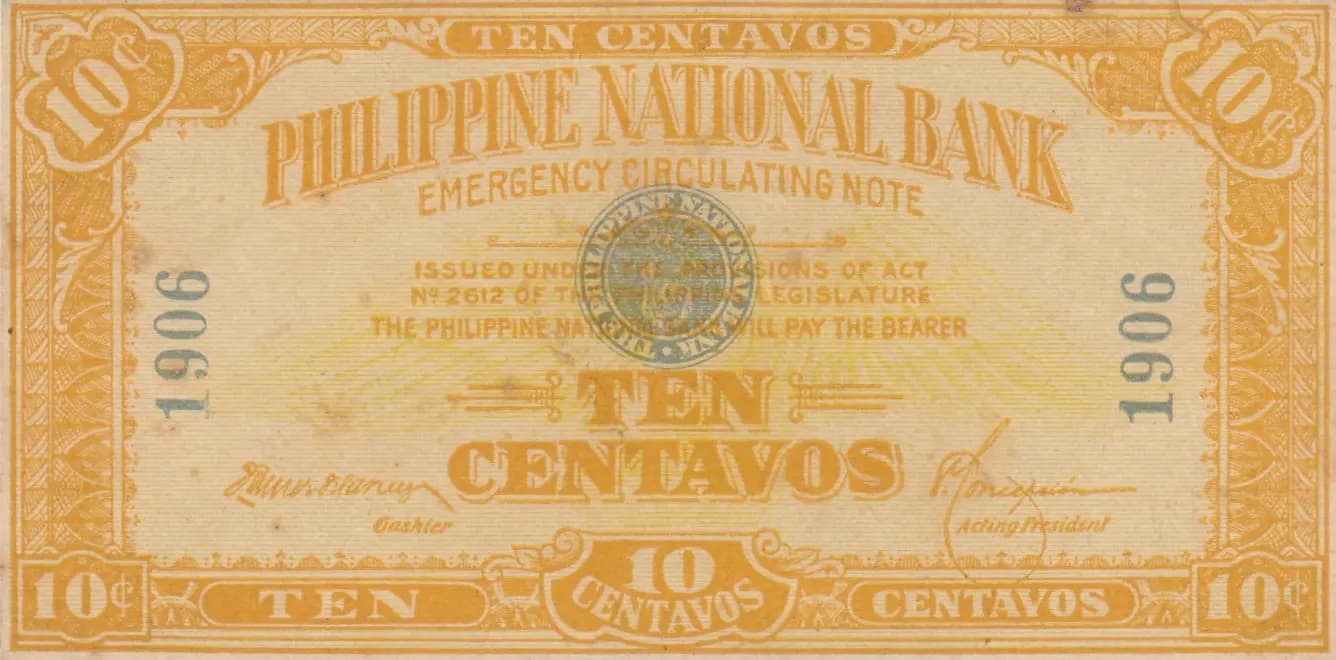
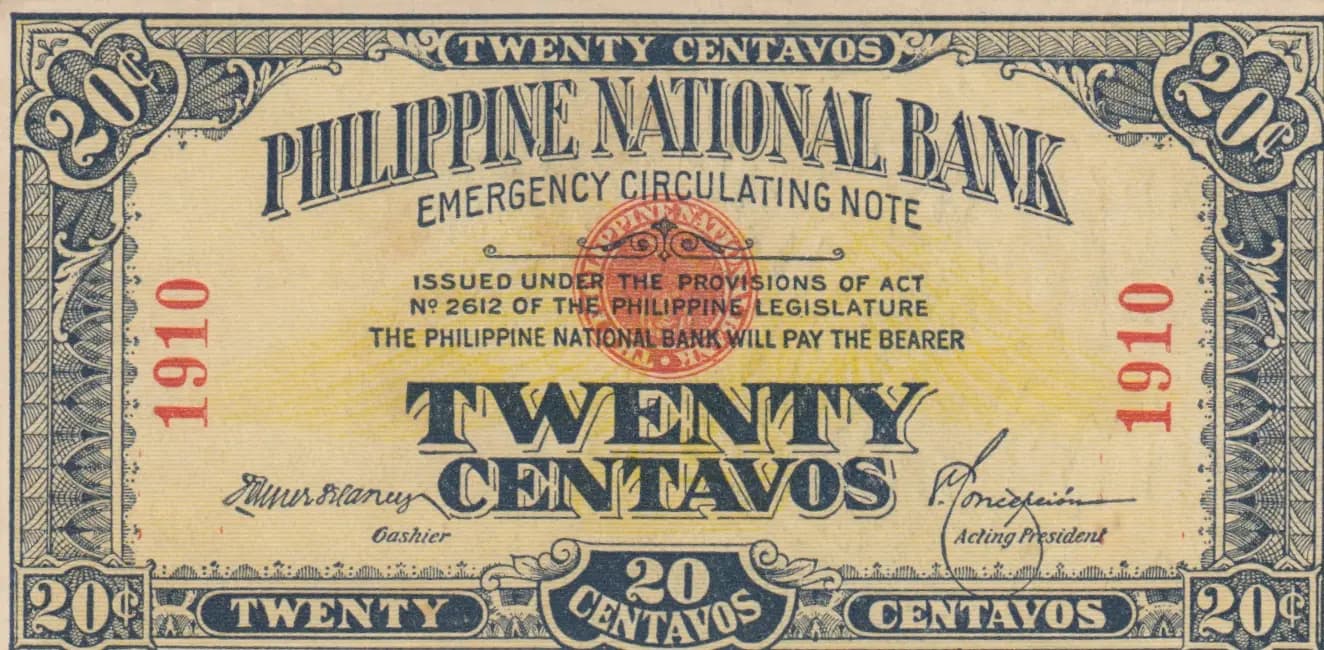
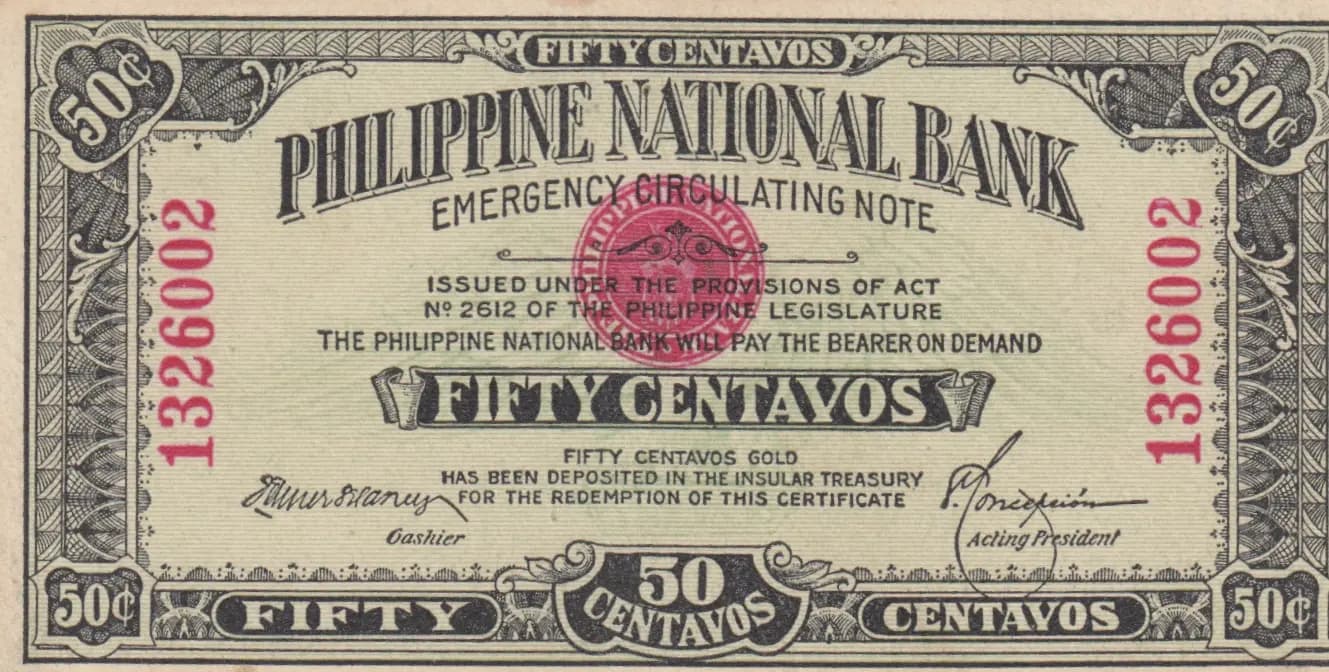
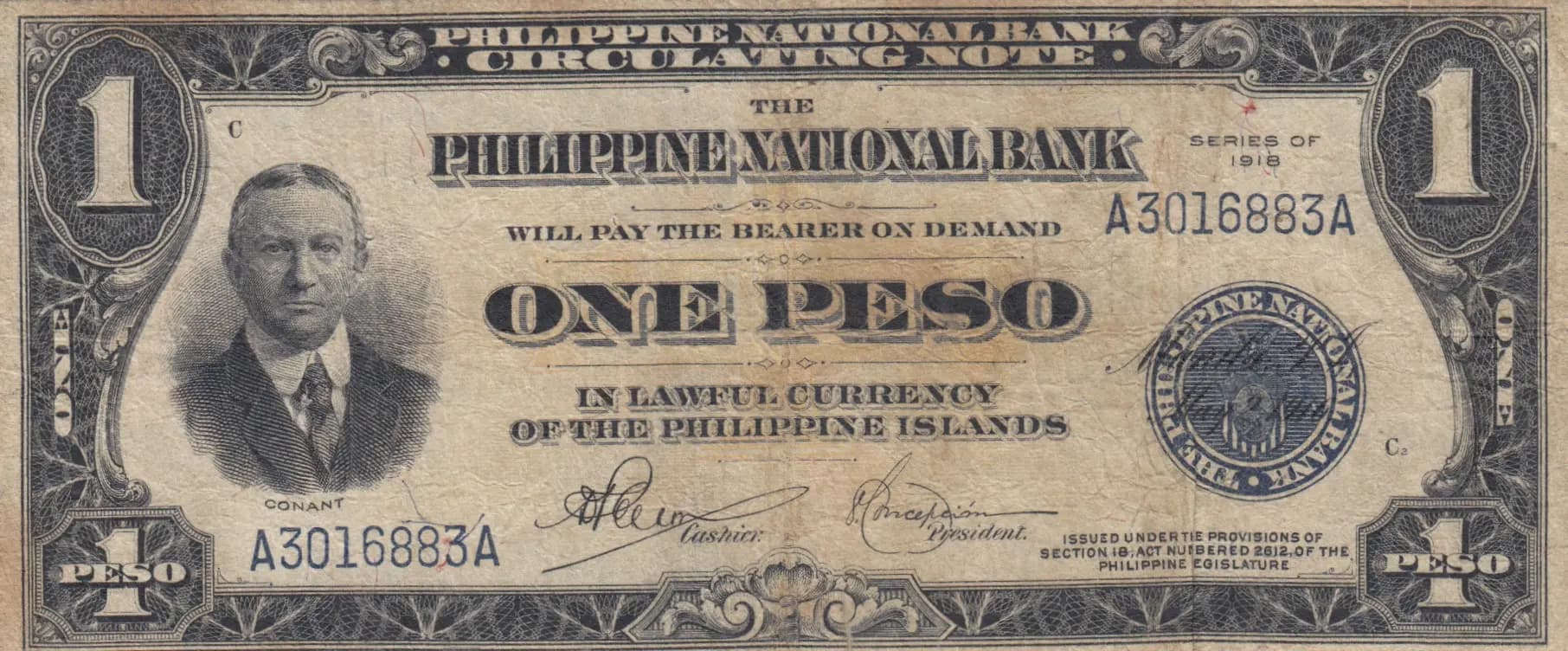
10 centavos 1941
“Iloilo”
Market Prices
About This Note
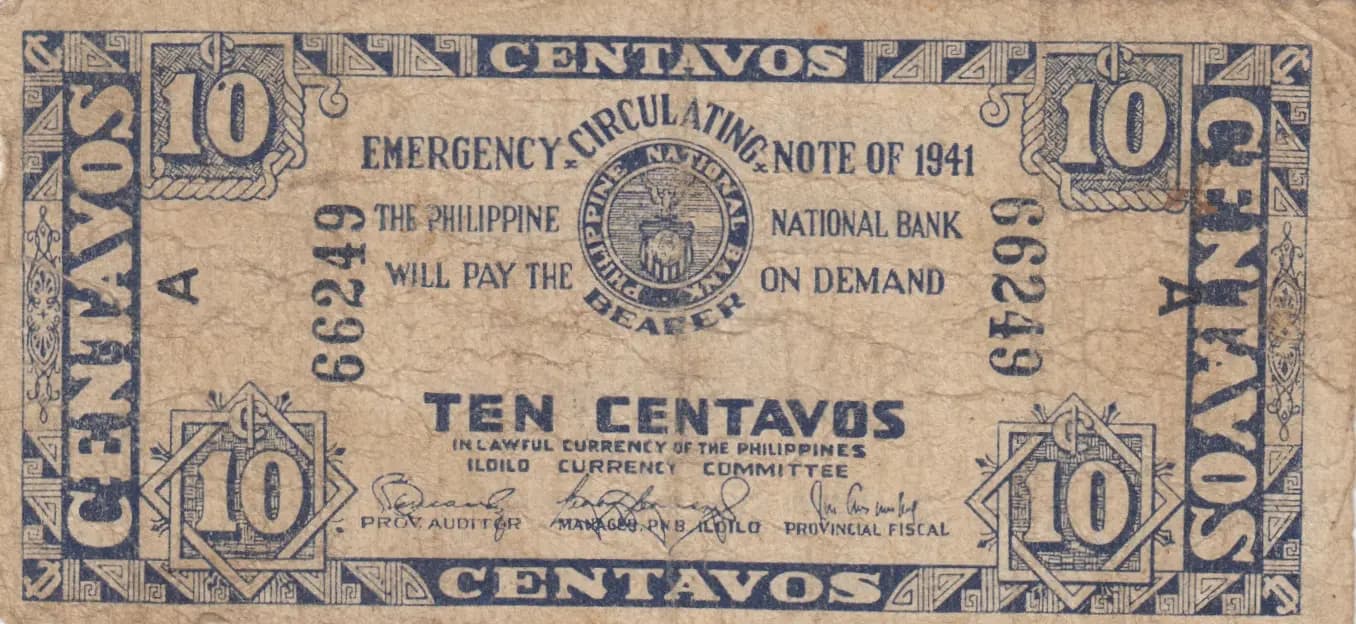
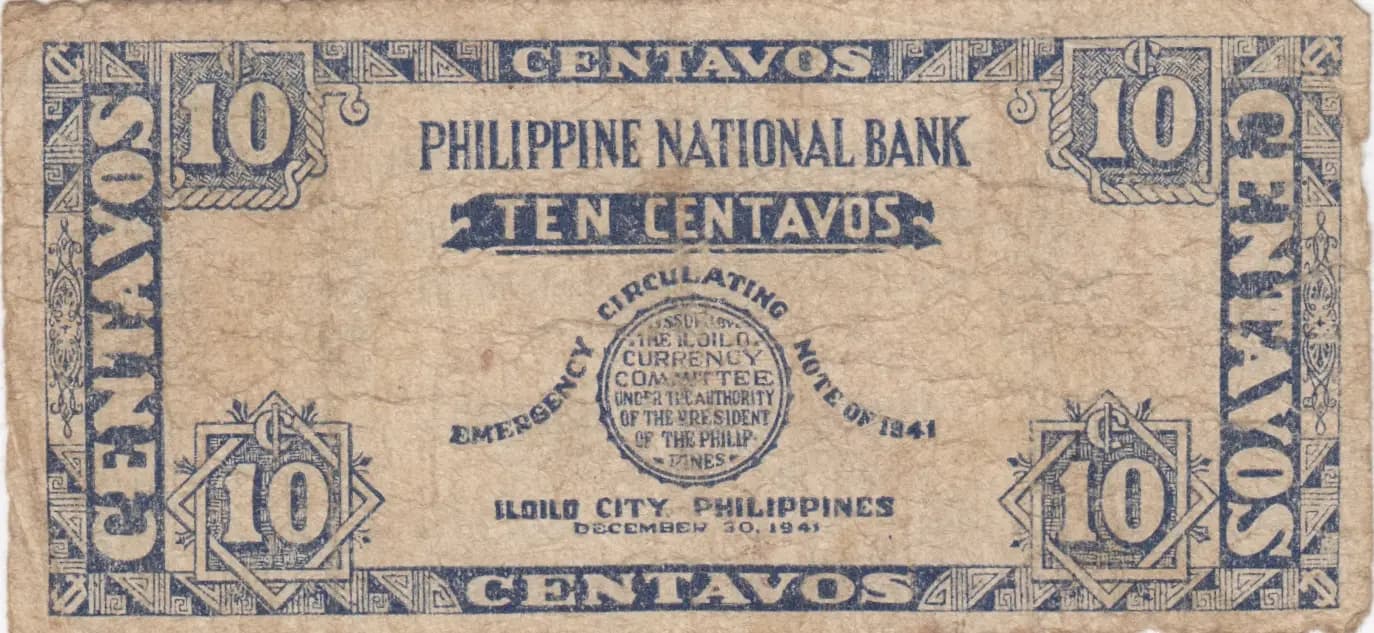
This is a Philippine National Bank emergency circulating note from December 30, 1941, issued during the Japanese occupation of the Philippines. The 10 centavos note features a distinctive beige/tan paper stock with dark blue printing, displaying the bank's circular seal and ornate geometric borders with Greek key motifs. In Fine (F) condition, the note shows moderate wear with visible creases, folds, and age-related foxing, representing an important piece of Philippine WWII-era emergency currency history.
Common. The eBay price tracking data shows market prices ranging from $4.00 to $45.00 USD depending on condition grade, with most circulated examples trading under $20. Emergency Circulating Notes of 1941 from the Philippines were produced in substantial quantities across multiple issuing locations (Iloilo being one of several regional centers). While these notes are historically significant as WWII artifacts, they were not recalled or produced in severely limited quantities relative to regular issues of the period. The Fine condition grade combined with common market availability confirms this is a standard example of its type rather than a scarce variety.
This emergency circulating note was issued by the Iloilo Currency Committee under presidential authority on December 30, 1941, just weeks after Japan's invasion of the Philippines (December 8, 1941). The note's designation as an 'Emergency Circulating Note' reflects the monetary chaos of the early occupation period, when local committees were authorized to issue currency to maintain economic function. The specific Iloilo City issuance and the multiple official signatures (Provincial Auditor, PNB Manager, Provincial Fiscal) demonstrate the collaborative authority structure established to manage currency supply during the Japanese occupation.
The note features a minimalist emergency currency design appropriate to wartime conditions. The obverse (front) displays the Philippine National Bank's circular seal at center, surrounded by ornate geometric border patterns incorporating Greek key motifs—a classical design element reflecting institutional formality. Decorative corner elements feature the numeral '10' in each corner. The reverse maintains the same border design with a simpler layout, featuring a circular seal mark indicating emergency currency status and the issuing committee's authority. No portraits, historical figures, or landmarks are depicted; the design relies entirely on institutional symbolism, geometric ornamentation, and official typography. The tan/beige paper stock with dark blue ink printing was typical of wartime emergency notes produced under resource constraints.
FRONT SIDE: 'CENTAVOS' (denomination designation); 'EMERGENCY CIRCULATING NOTE OF 1941' (note classification); 'THE PHILIPPINE NATIONAL BANK WILL PAY THE ON DEMAND' (promise to pay clause); 'TEN CENTAVOS' (denomination in words); 'IN LAWFUL CURRENCY OF THE PHILIPPINES ILOILO CURRENCY COMMITTEE' (legal tender statement and issuing authority); 'PROV AUDITOR MANAGER P.N.B. ILOILO PROVINCIAL FISCAL' (signature designations of officials); 'B6249' (serial or reference number). REVERSE SIDE: 'CENTAVOS' (denomination); 'PHILIPPINE NATIONAL BANK' (issuing institution); 'TEN CENTAVOS' (denomination in words); 'CIRCULATING NOTE OF 1941' / 'EMERGENCY' (note classification); 'ISSUE BY THE ILOILO CURRENCY COMMITTEE UNDER AUTHORITY OF THE PRESIDENT OF THE PHILIPPINES' (statement of authorization); 'ILOILO CITY, PHILIPPINES' (place of issue); 'DECEMBER 30, 1941' (issue date).
Letterpress printing on tan/beige paper stock using dark blue ink. The crisp lines of the border patterns, geometric designs, and text indicate traditional relief printing methods. No advanced security features are present, consistent with emergency wartime currency that prioritized rapid production and circulation over counterfeit prevention. The specific printer is not identified on the note; production was likely handled by facilities available to Philippine authorities or the Japanese occupation administration.
This specific note is identified as Pick catalog number P-S302, an Iloilo Currency Committee issuance dated December 30, 1941. The serial number 'B6249' is visible on the front. Key variety indicators for this series include the geographic origin (Iloilo City), the specific issue date, and the signature designations of the three authorizing officials (Provincial Auditor, Philippine National Bank Manager, and Provincial Fiscal). Multiple series of Emergency Circulating Notes of 1941 exist from different Philippine regional currency committees; examples from other cities (such as Cebu or Manila) constitute distinct catalog varieties. The prefix 'B' in the serial numbering may indicate a specific printing batch or series within the Iloilo issuance, though this requires confirmation against documented variety catalogs.