1 piso 1969
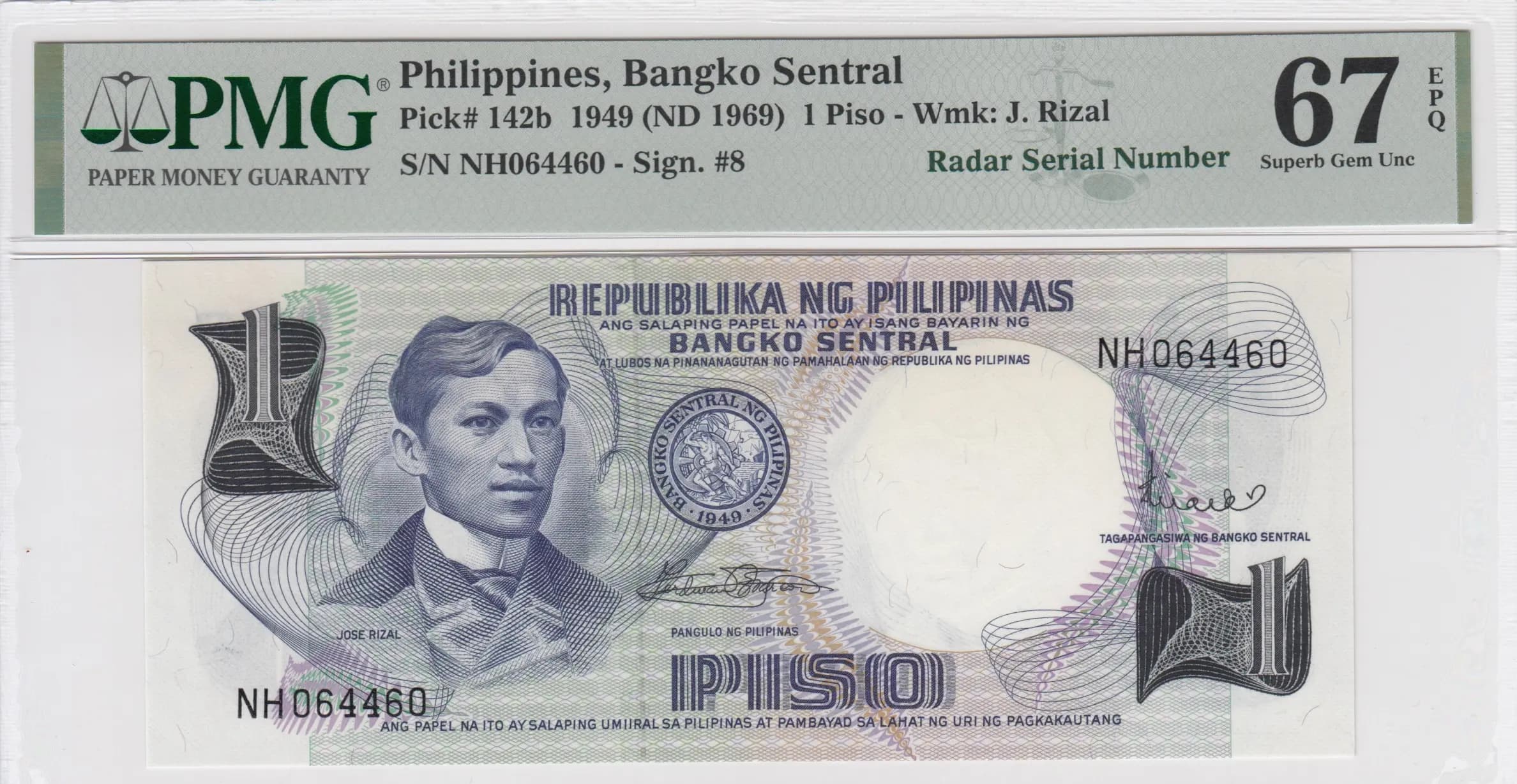
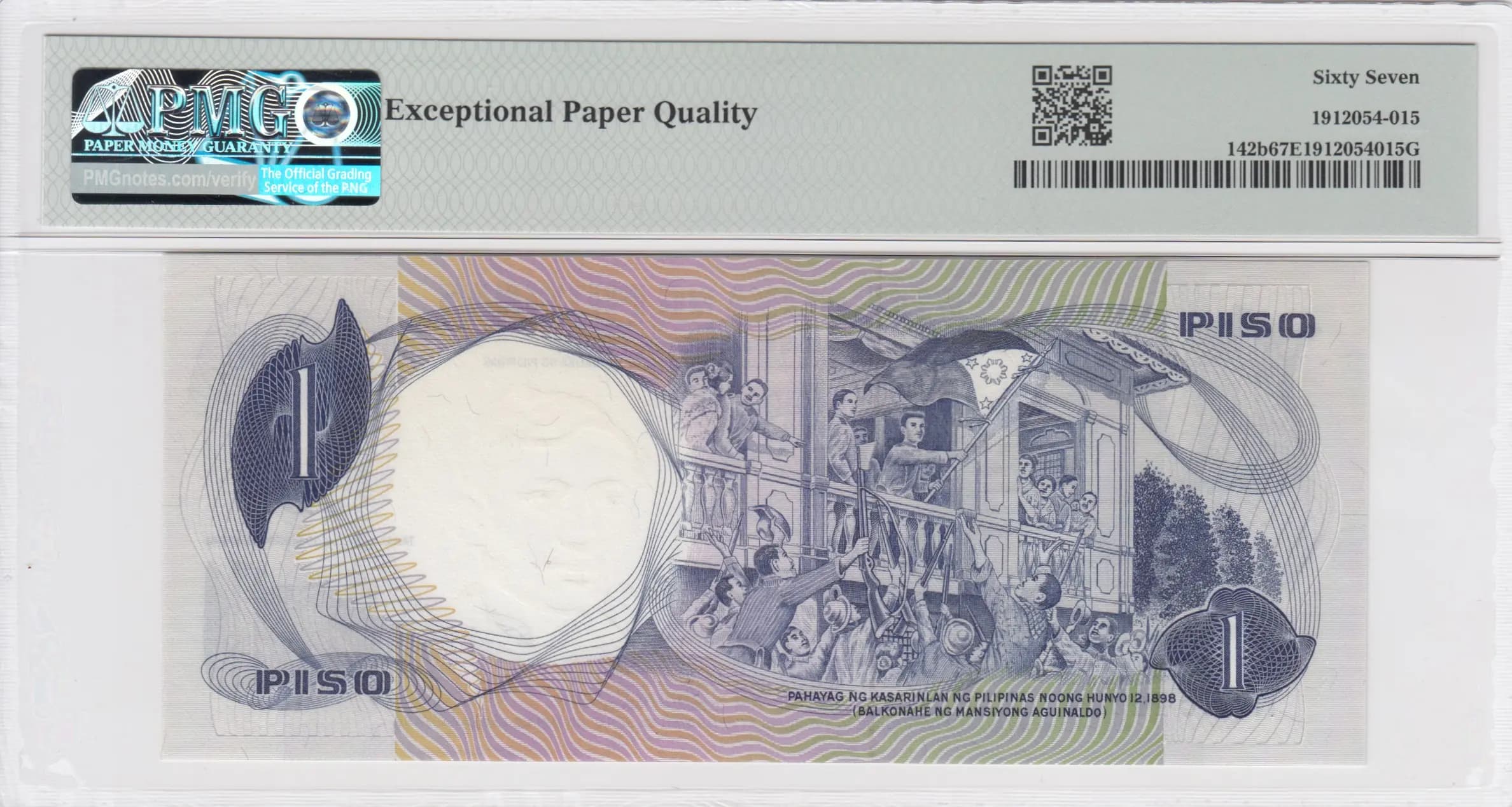
“radar #”
Market Prices
18 salesAbout This Note
This is an exceptionally preserved 1 Piso note from the Central Bank of the Philippines (1969), graded PMG 67 EPQ (Superb Gem Uncirculated). The note features a striking portrait of national hero Jose Rizal on the obverse rendered in blue and purple tones with intricate guilloche patterns, while the reverse displays an elaborate engraved scene of Aguinaldo's Declaration of Independence dated June 12, 1898, set against multicolored wave patterns in green, yellow, and pink. The serial number NH064460 and sharp printing details are hallmarks of this well-preserved example.
Common. This is a regular-issue 1 Piso note from 1969 with substantial print runs. The eBay historical sales data strongly supports this assessment, with examples in various grades (VF through PMG 66) consistently selling for under $20, with most uncirculated examples fetching $2–$4. Even premium graded examples (PMG 65–66) have realized $14–$18. The catalog values listed (VF: $0.50, UNC: $1.50) further confirm this as a readily available, common date and denomination.
Issued in 1969 by the Central Bank of the Philippines, this banknote commemorates two pivotal moments in Philippine national identity: the portrait of Jose Rizal, the nation's greatest reformist intellectual and martyr, and the reverse depicting Emilio Aguinaldo's formal declaration of independence on June 12, 1898. The note's design reflects the Philippines' post-colonial nation-building period, emphasizing national heroes and foundational historical events as symbols of sovereignty and cultural pride.
The obverse features a formal portrait of Jose Rizal (1861–1896), the Philippines' most revered national hero, positioned at left in formal attire. The portrait is framed by ornate guilloche patterns rendered in blue and purple inks on a cream background, with decorative shield emblems positioned in the upper left and lower right corners. The Central Bank Seal (Type 2) bearing '1949' and 'Bangko Sentral' is prominently displayed. The reverse depicts a detailed engraved scene of Emilio Aguinaldo's formal proclamation of Philippine independence at his mansion on June 12, 1898, showing multiple figures gathered on a columned porch or veranda, surrounded by decorative wing and shell motifs in the corners and complex multicolored wavy line patterns (green, yellow, pink, purple) forming the background security design. Both sides display 'PISO' in the corners and the matching serial number.
FRONT: 'Republika ng Pilipinas' (Republic of the Philippines) — 'Ang salaping papel na ito ay isang bayarin ng Bangko Sentral at lubos na pinanaraguutan ng pamahalaang ng Republika ng Pilipinas' (This paper currency is a promissory note of Bangko Sentral and is fully guaranteed by the Government of the Republic of the Philippines) — 'Jose Rizal' — 'Panguló ng Pilipinas' (President of the Philippines) — 'Piso' (Peso) — 'Bangko Sentral' (Central Bank) — 'Ang papel na ito ay salaming umiral sa Pilipinas at pambayad sa lahat ng uri ng pagkakautang' (This paper is legal tender in the Philippines and for payment of all kinds of obligations) — 'Tagapangasiwá ng Bangko Sentral' (Governor of the Central Bank). BACK: 'Piso' — 'Dahayag ng Kasaringan ng Pilipinas noong Hunyo 12, 1898' (Declaration of Independence of the Philippines on June 12, 1898) — 'Ibalknahe ng Mansiyong Aguinaldo' (At the Aguinaldo Mansion).
Intaglio engraving (recess printing) combined with multicolor lithography. The fine guilloche patterns, detailed figurative engraving of the historical scene, and intricate line work are characteristic of high-security intaglio production. The multicolored wave patterns on the reverse indicate supplementary lithographic color printing. This note was produced by the American Bank Note Company (ABNC), the primary security printer for Philippine banknotes during this period, as evidenced by the design sophistication and technical quality consistent with ABNC's standards.
This example carries the serial number prefix 'NH', indicating a regular issue (not a replacement note). Replacement notes for this Pick number carry the prefix '+' according to community catalog references. The specific signature varieties for the Governor of the Central Bank during the 1969 issue period would require examination of the signatures visible on the obverse; variations in signatories would constitute distinct catalog varieties for specialized collectors, though such distinctions are not typically emphasized in the Pick catalog system for Philippine notes of this era.