1 peso 1949 replacement
About This Note
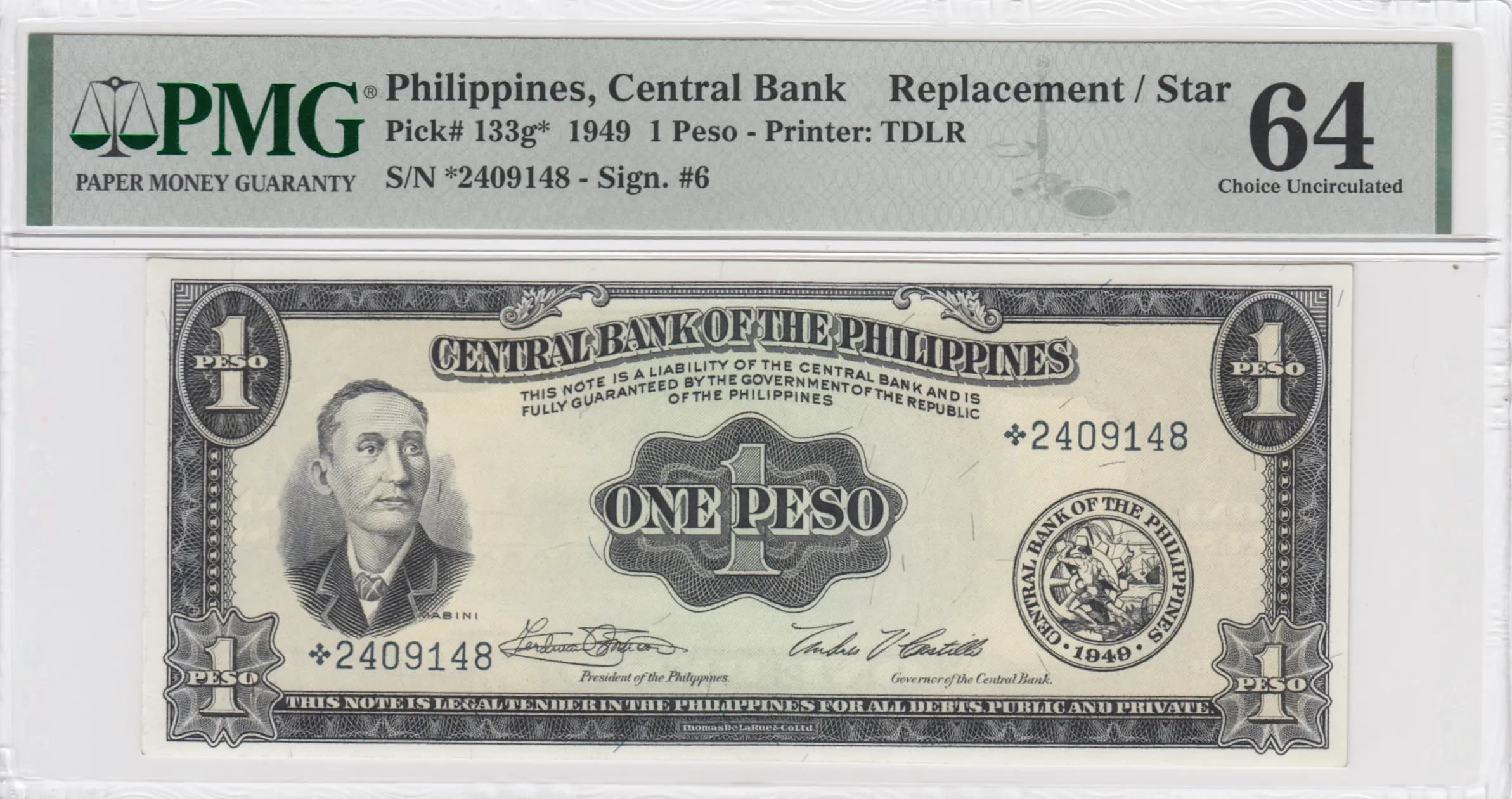
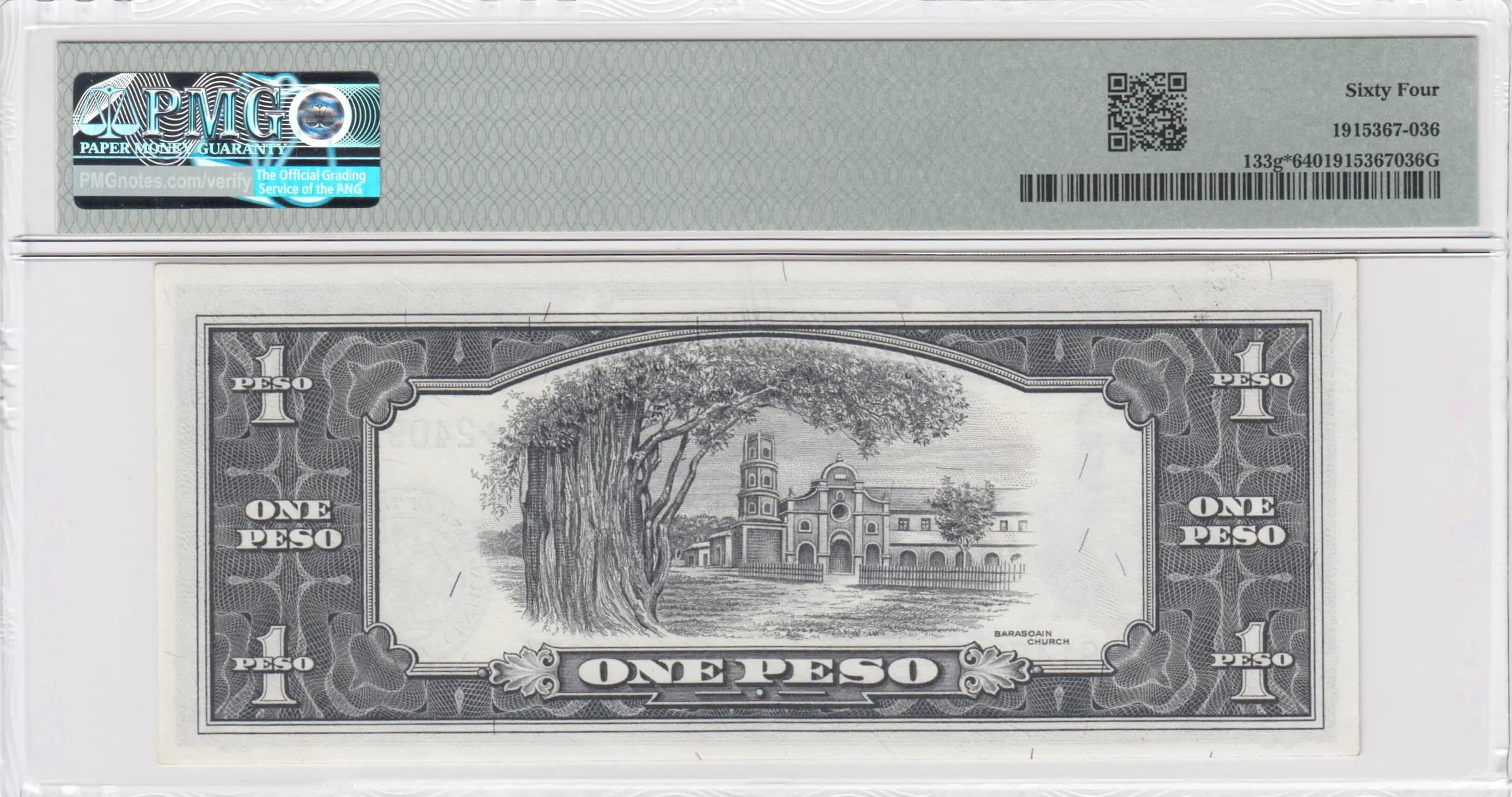
This is a choice uncirculated 1 peso banknote from the Central Bank of the Philippines, dated 1949, graded PMG 64. The note features a formal portrait of Apolinario Mabini on the obverse and the iconic Barasoain Church on the reverse, printed in black and white with fine engraved detail work. This replacement note (indicated by the asterisk prefix in the serial number *2409148) represents an important early emission from the newly-established Central Bank and remains in pristine, uncirculated condition with no visible wear.
Common. While this is a replacement note variant (indicated by the asterisk prefix), 1949 Philippine pesos of this denomination were produced in substantial quantities by Thomas de la Rue for the newly-established Central Bank. The Pick 133g* replacement variety exists in reasonable supply among collectors, and the PMG 64 grade, while attractive, does not command significant premiums. No evidence of restricted print runs, special recall, or scarcity factors applies to this issue.
Issued in 1949, this banknote commemorates the early years of the Central Bank of the Philippines following the country's independence. The obverse portrait of Apolinario Mabini honors the nationalist revolutionary and statesman, while the reverse depicts the Barasoain Church in Malolos, a historically significant location where the First Philippine Republic's constitution was drafted. This note bridges the transitional period between American colonial currency and sovereign Philippine monetary authority.
The obverse features a formal portrait of Apolinario Mabini positioned on the left side of the note, depicted in formal attire with high collar, consistent with period portraiture conventions. The Central Bank of the Philippines seal/emblem appears on the right side, with ornamental corner designs featuring numerical denominations of '1' in each corner. The reverse showcases an engraved landscape composition with a prominent tree on the left side and the Barasoain Church as the central architectural element. The church is rendered with fine architectural detail showing its bell tower and structural features. Decorative border frames and ornamental flourishes frame the composition, with 'ONE PESO' inscriptions in decorative cartouches in all four corners.
Front side: 'CENTRAL BANK OF THE PHILIPPINES' (issuing authority); 'ONE PESO' (denomination); 'THIS NOTE IS A LIABILITY OF THE CENTRAL BANK AND IS FULLY GUARANTEED BY THE GOVERNMENT OF THE REPUBLIC OF THE PHILIPPINES' (legal guarantee); Serial number *2409148; '1949' (date of issue); 'President of the Philippines' and 'Governoress of the Central Bank' (signature titles); 'THIS NOTE IS LEGAL TENDER IN THE PHILIPPINES FOR ALL DEBTS PUBLIC AND PRIVATE' (legal tender declaration). Back side: 'ONE PESO' (appears in all four corners); 'BARASOAIN CHURCH' (landmark identification); 'PESO' (denomination text).
Intaglio engraving, printed by Thomas de la Rue of London. The note exhibits characteristic fine line work, intricate engraved design patterns, and the detailed background hatching typical of high-security intaglio banknote production. The crisp, well-defined edges and fine detail reproduction in both the portrait and landscape elements are consistent with the precision engraving techniques employed by this renowned security printer.
This is specifically cataloged as Pick 133g*, identifying it as a replacement note from the 1949 emission. The asterisk prefix in the serial number (*2409148) denotes its status as a replacement for a note that was damaged or destroyed during distribution. The PMG population report indicates this base Pick number has five documented variants (P-133c, P-133e, P-133f, P-133s10, P-133s6), all printed by Thomas de la Rue, suggesting variations in serial number prefixes, signatures, or other minor typographical differences across the printing run.