1 peso 1936
Market Prices
19 salesAbout This Note
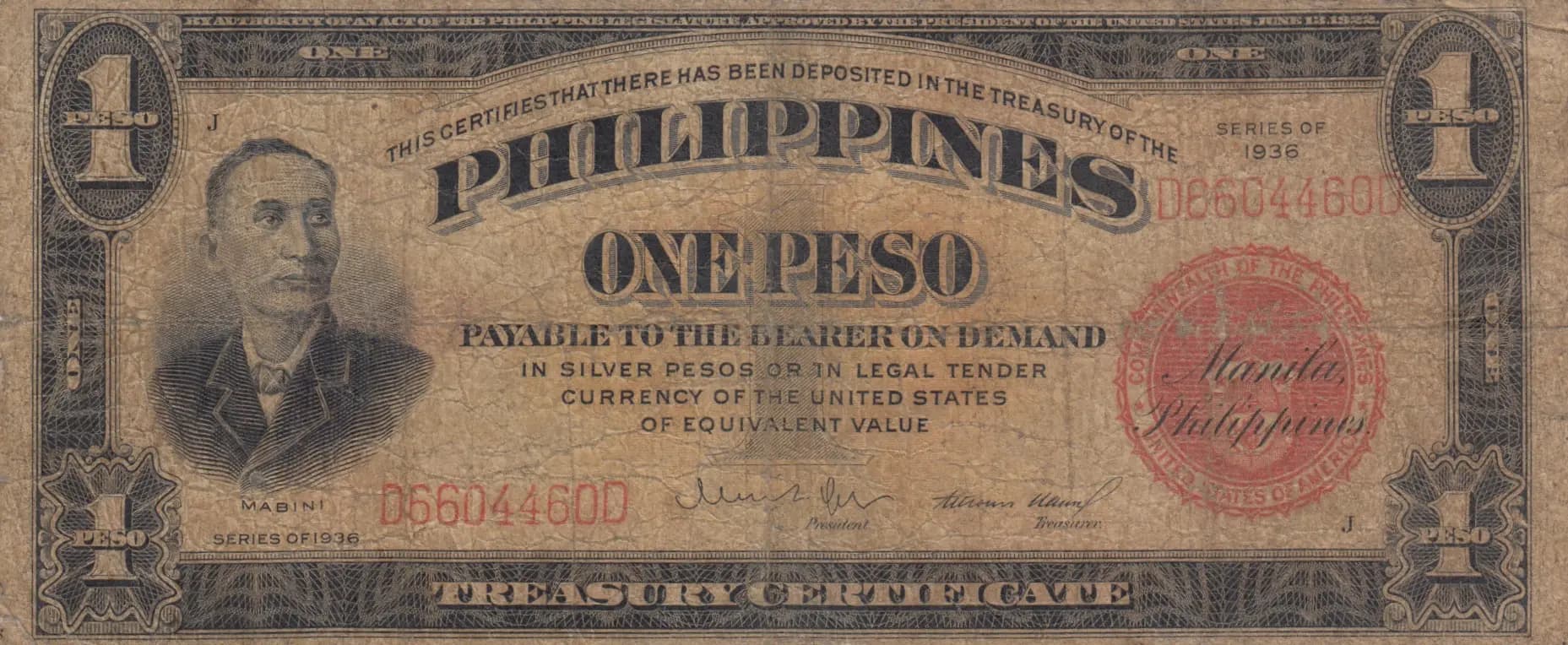
This Philippine Islands 1 Peso Treasury Certificate from 1936 (Pick P-81) features a portrait of Apolinario Mabini in profile on the left side, rendered in black ink on a tan/beige underprint with red Commonwealth seal impressions. The note exhibits moderate to heavy wear consistent with nearly 90 years of circulation, including significant creasing, fading of the red ink elements, foxing, and overall yellowing and darkening of the paper—typical characteristics placing it solidly in the VG (Very Good) condition grade specified in the catalog data.
Common. This note is a regular issue Treasury certificate from a stable Commonwealth period with presumably substantial print runs to meet circulation demands. eBay historical sales data shows consistent, relatively modest pricing even for higher grades (VF typically $10-25, UNC occasionally $30-75), with numerous sales across multiple condition grades. The 2016 catalog value for VG grade is $7.50, and the observed VG specimen in the current collection aligns with typical market expectations for well-circulated examples of this pick number. The circulation history and condition evidence suggest this was a frequently produced and distributed note.
This Treasury Certificate was issued during the Commonwealth period of the Philippine Islands (1935-1946), when the islands were transitioning toward independence. The prominent red Commonwealth seal and the inscription 'Treasury of the Philippines' reflect the establishment of the Philippine Commonwealth under President Manuel Quezon's administration. Apolinario Mabini, depicted on the obverse, was a key figure in Philippine independence movements and served as constitutional advisor during the Revolutionary period, making his portrait a symbolic representation of Philippine national identity during this transitional era.
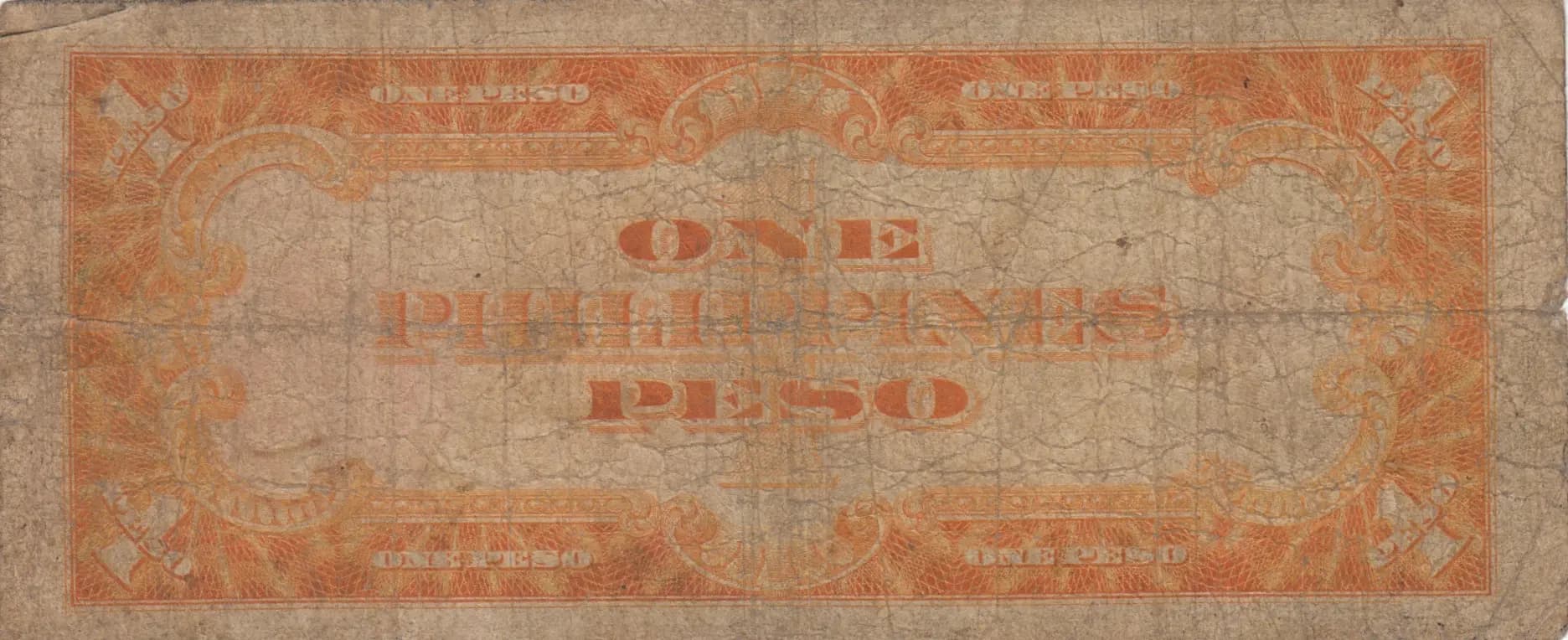
The obverse features Apolinario Mabini in formal attire shown in left-facing profile, enclosed within an ornamental circular frame. The design incorporates classical ornamental elements including guilloché patterns, geometric borders, and floral motifs characteristic of early 20th-century Treasury certificate design. Denomination numerals '1' appear in ornamental circular frames on both left and right margins. The red Manila Philippines seal stamp and serial number in red ink serve as security features. The reverse presents a symmetrical design with 'ONE PESO' and 'PISO' prominently displayed in large text within decorative oval frames, surrounded by classical scrollwork and ornate border elements in orange and red tones on a tan/beige background.
Front (Obverse): 'THIS CERTIFIES THAT THERE HAS BEEN DEPOSITED IN THE TREASURY OF THE PHILIPPINES ONE PESO PAYABLE TO THE BEARER ON DEMAND IN SILVER PESOS OR IN LEGAL TENDER CURRENCY OF THE UNITED STATES OF EQUIVALENT VALUE' / 'TREASURY CERTIFICATE' / 'MABINI' / 'SERIES OF 1936' / Serial number 'D56044G0D' / 'Manila Philippines'. Back (Reverse): 'ONE PESO' / 'PISO' (Spanish/Filipino designation for peso).
Intaglio engraving (recess printing) executed by the U.S. Bureau of Engraving and Printing (USBEP), as is standard for Philippine Treasury certificates of this era. The intricate fine-line engraving throughout the border and design elements, complex guilloché patterns, and the level of detail visible in the portraits and decorative vignettes are characteristic of USBEP's high-security currency production methods. No imprint appears on this note, which is consistent with the referenced catalog data for P-81.
This specimen is identified as Pick P-81 without asterisk notation, confirming it as the standard variety with USBEP printer without imprint. The serial number prefix 'D' and format is consistent with Commonwealth-period Philippine currency. Signatures of Manuel Quezon (President) and Antonio Ramos (Treasurer) as noted in catalog references should be present on the note. No overprints or significant varieties are apparent from the visual analysis. PMG population data confirms only one cataloged variant (P-81*) exists for this base pick number.