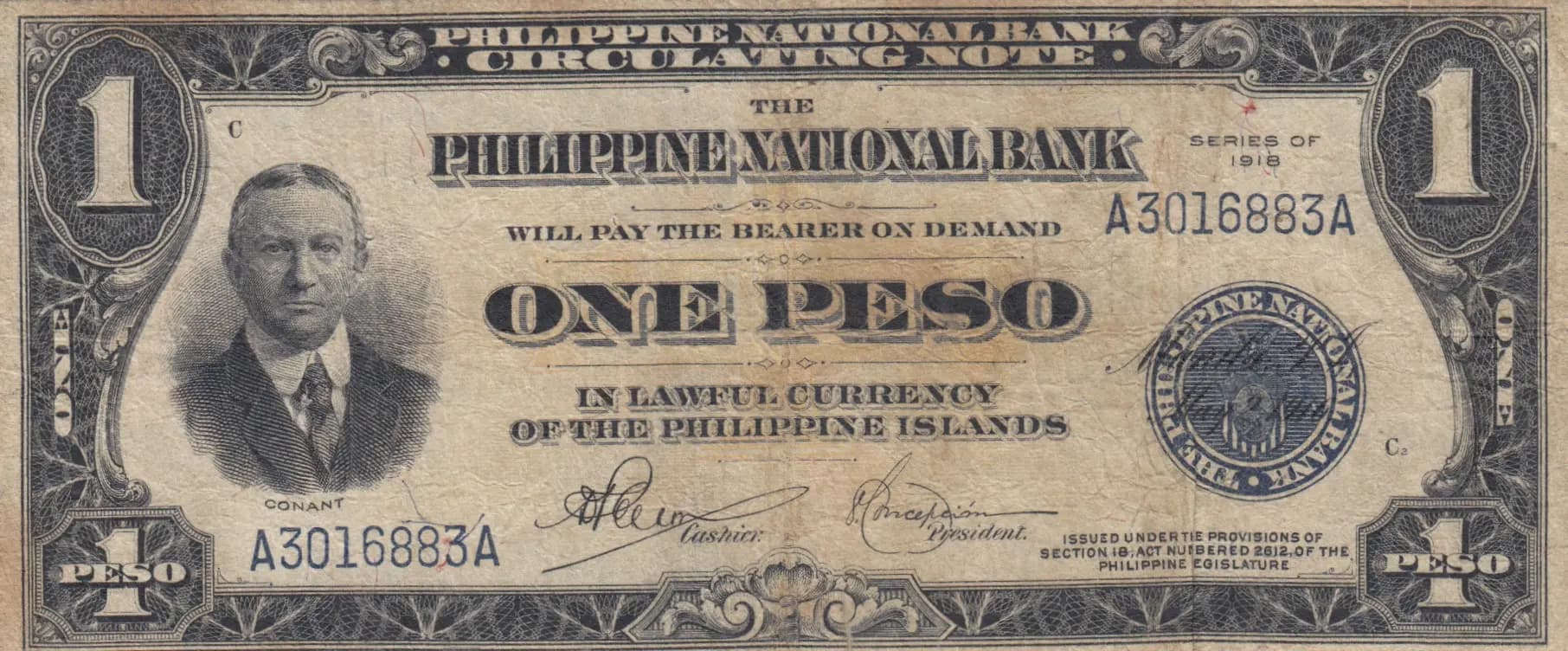
1 peso 1918
Market Prices
2 salesAbout This Note
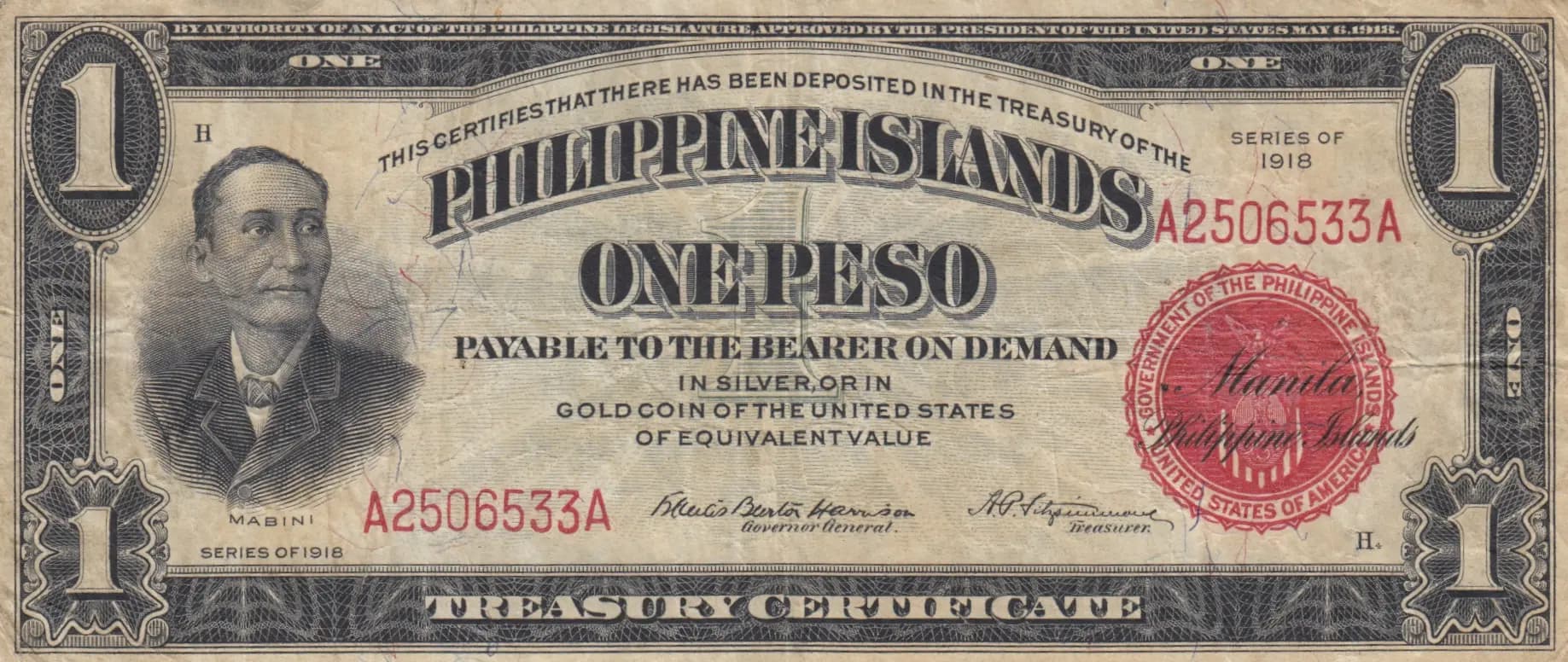
This Philippine Islands 1 Peso Treasury Certificate from 1918 (Pick P-60a) features a portrait of Apolinario Mabini on the left side, rendered in black ink on a green underprint. The note displays moderate circulation wear consistent with its age, including visible creasing, foxing, and discoloration on the tan paper stock, placing it in Fair condition. As an early issue from the initial year of Philippine Treasury Certificates authorized by U.S. presidential approval, this note represents an important piece of Philippine numismatic history during the American colonial period.
Common. While this is an early issue from 1918, the base print run for Philippine 1 Peso Treasury Certificates was substantial. The eBay market data provided shows VF examples selling for approximately $49 and graded PMG 25 notes for $58.57, with catalog values for Fine condition at $60 (2016 pricing). These relatively modest market prices and circulation evidence indicate this is a commonly encountered note among collectors. The denomination and issuer are standard, and no specific reports of short print runs or recalls exist for this Pick number.
This 1918 Treasury Certificate was issued following legislative authority granted by the Philippine Legislature and approved by the U.S. President on May 6, 1918, reflecting the unique political status of the Philippine Islands as a U.S. commonwealth territory. The note's promise to pay in 'silver, or in gold coin of the United States of equivalent value' demonstrates the currency peg to American coinage during this period of American administrative control. Apolinario Mabini, depicted on the note, was a prominent Filipino nationalist and politician, honoring his role in Philippine independence movements and governance during the transition from Spanish to American rule.
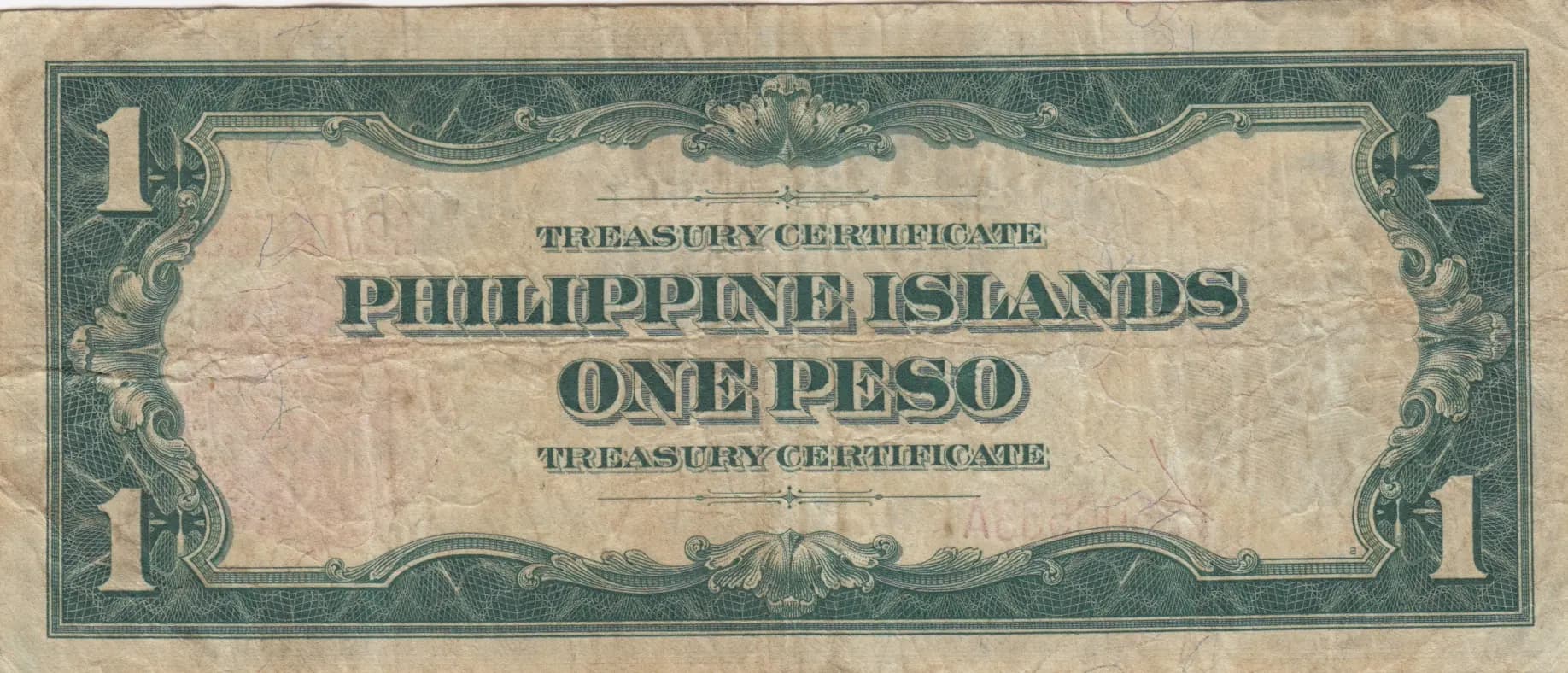
The obverse features a formal portrait of Apolinario Mabini positioned at the left side, rendered in black ink, depicting him in formal 19th/early 20th century dress with a high collar and decorative necklace. The center of the note displays prominent text reading 'PHILIPPINE ISLANDS' and 'ONE PESO,' with constitutional language certifying the Treasury deposit. A red circular seal of the Government of the Philippine Islands appears on the right side, bearing official governmental text. The denomination numeral '1' appears in all four corners with ornamental designs and scrollwork borders. The reverse (back) features a symmetrical design with a decorative shell or fan motif at the top center, the denomination and issuer information repeated, and elaborate scrollwork and ornamental borders throughout, all rendered in teal/blue-green ink on the tan paper stock. The entire note is executed in fine line engraving with intricate decorative patterns.
FRONT: 'BY AUTHORITY OF AN ACT OF THE PHILIPPINE LEGISLATURE APPROVED BY THE PRESIDENT OF THE UNITED STATES MAY 6, 1918' — By authority of an act of the Philippine legislature approved by the president of the United States May 6, 1918. 'ONE PESO' — One peso. 'SERIES OF 1918' — Series of 1918. 'THIS CERTIFIES THAT THERE HAS BEEN DEPOSITED IN THE TREASURY OF THE PHILIPPINE ISLANDS' — This certifies that there has been deposited in the treasury of the Philippine Islands. 'PAYABLE TO THE BEARER ON DEMAND' — Payable to the bearer on demand. 'IN SILVER, OR IN GOLD COIN OF THE UNITED STATES OF EQUIVALENT VALUE' — In silver, or in gold coin of the United States of equivalent value. 'MABINI' — Name of portrayed figure. 'TREASURY CERTIFICATE' — Treasury certificate. Serial number: A2506533A, Series letter: H. 'GOVERNMENT OF THE PHILIPPINE ISLANDS UNITED STATES OF AMERICA' (on red seal). BACK: 'TREASURY CERTIFICATE' — Treasury certificate (top and bottom). 'PHILIPPINE ISLANDS' — Philippine Islands. 'ONE PESO' — One peso.
This note was produced using intaglio (engraved) printing techniques by the United States Bureau of Engraving and Printing (USBEP), as confirmed by the Pick catalog designation P-60a. The fine line engraving throughout, visible in both the portrait work and the decorative scrollwork and borders, is characteristic of intaglio production. The precise registration of the black overprint on the green and teal underprints demonstrates the multi-pass printing typical of USBEP production methods of this era. No printer imprint appears on the note itself, which is consistent with USBEP practice for certain Philippine currency issues.
This note is identified as P-60a, representing the standard variety with USBEP as printer (without imprint). The visible serial number A2506533A with series letter H indicates this is a first-series issue from 1918. The red Treasury seal and signature lines for Governor General and Treasurer are consistent with the standard P-60a design. PMG population records indicate this is the primary cataloged variety for this Pick number, with no known subtypes or significant variants documented.