1 peso 1924
Market Prices
2 salesAbout This Note
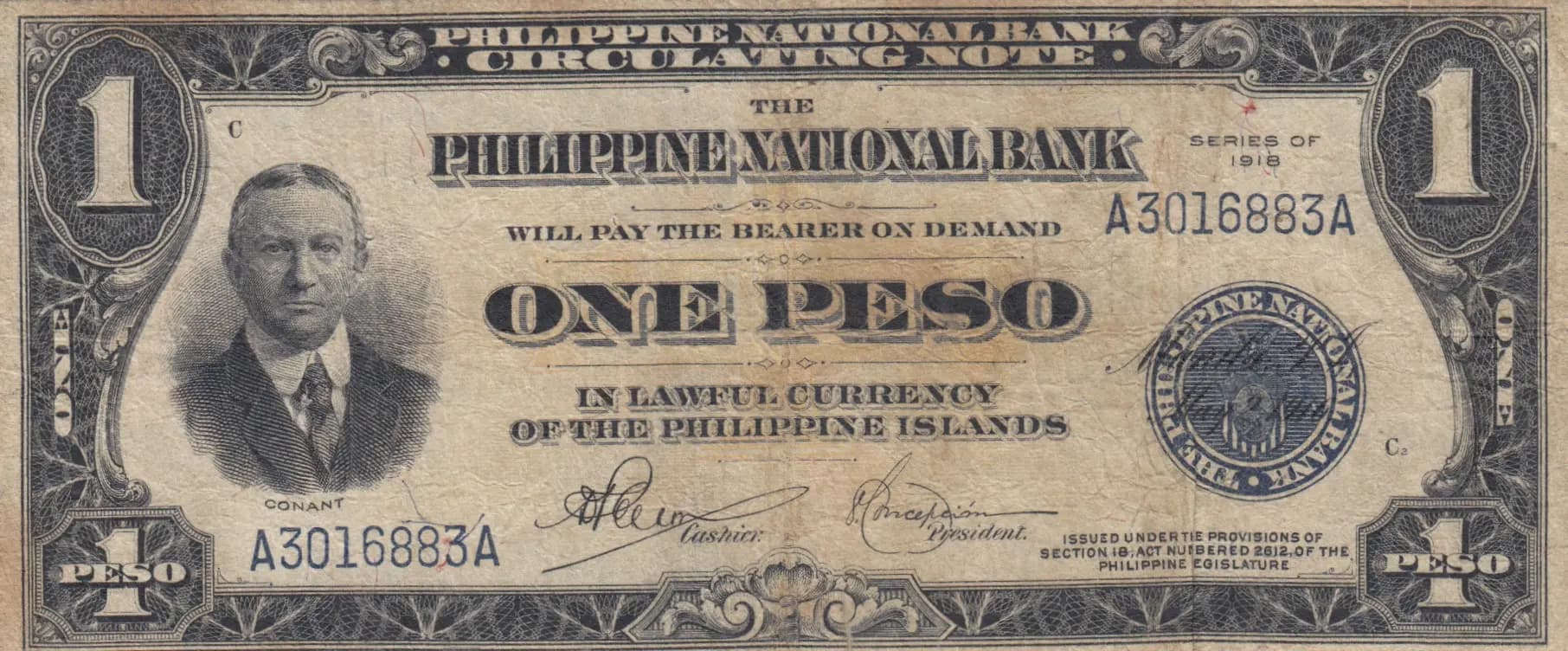
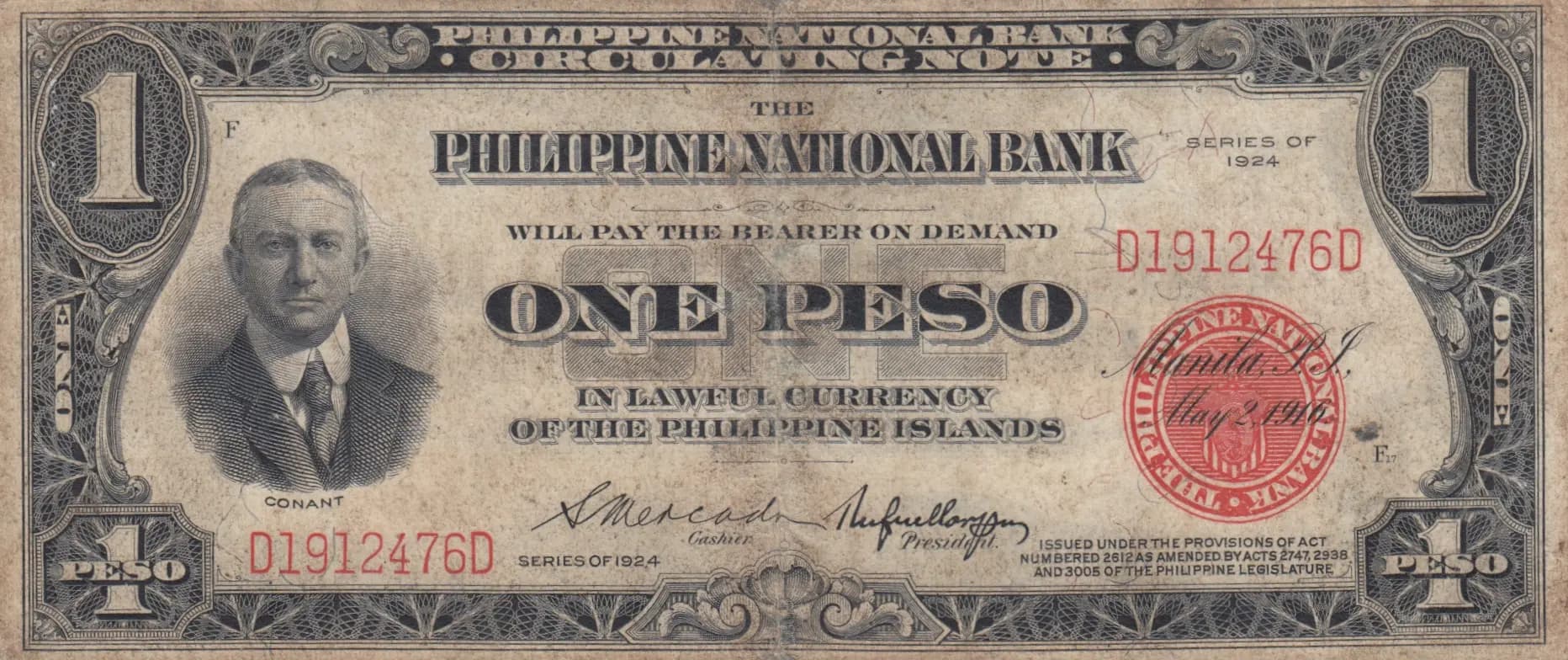
This Philippine National Bank 1 Peso note from the Series of 1924 presents a classic example of early Philippine currency featuring a portrait of Charles A. Conant on the obverse. The note displays authentic period aging with visible foxing, creasing, and staining consistent with circulation, placing it in Fair (F) condition. The red seal dated May 2, 1924, and intricate engraved security features are characteristic of this iconic issue, which remains popular with collectors of Philippine numismatic history.
Common. While this note shows appropriate age-related wear consistent with circulation, the Series of 1924 1 Peso (P-56) was produced in substantial quantities by USBEP for regular circulation in the Philippines. Market data from community catalogs indicates Fair condition examples consistently sell for $85-$100, with PMG 30 graded specimens reaching $275, demonstrating steady but not exceptional collector demand. The absence of scarcity indicators (no restricted print runs, short-lived issuer, or recall documentation) combined with moderate eBay sale volumes confirms this as a readily available note in the collector market.
Issued under the Philippine National Bank's authority during the American colonial period, this note reflects the Philippines' monetary development in the early 20th century. The portrait of Charles A. Conant, a prominent financial advisor and economist involved in Philippine currency reform, underscores the American influence in establishing the Philippine financial system. The legislative authorization cited on the note (Acts 2612 and 3005) demonstrates the formal governance structure of Philippine currency issuance during this era.
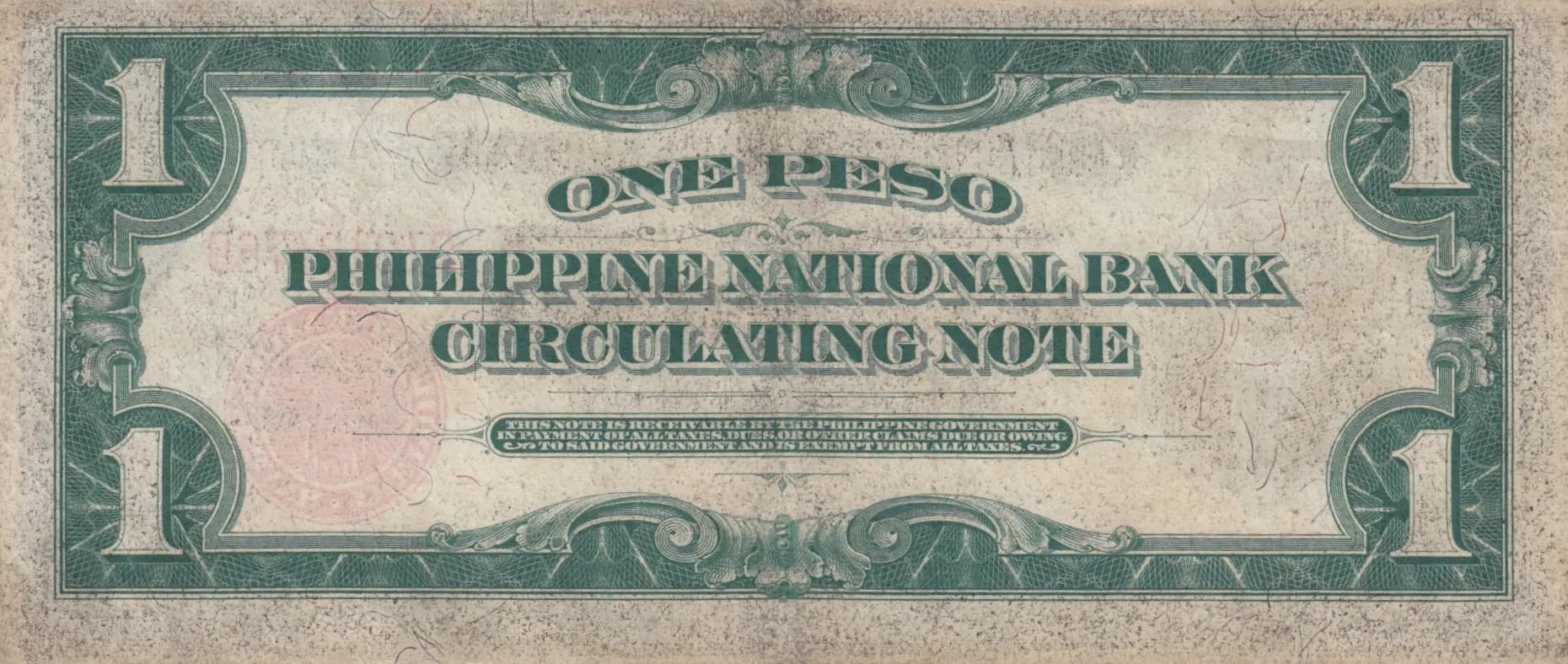
The obverse features a formal portrait of Charles A. Conant positioned at the left, rendered in black on an orange/cream underprint. The central design incorporates the denomination 'ONE PESO' within ornamental frames with elaborate scrollwork corner designs. A prominent red circular seal of the Philippine National Bank dated May 2, 1924, is positioned on the right side with the serial number in red ink below. The reverse presents a predominantly green/teal design with matching ornamental corner elements and a centered laurel wreath or similar ornamental motif, reinforcing the classical aesthetic typical of this series. Text is centrally positioned on both sides with intricate engraved crosshatching patterns throughout serving as anti-counterfeiting measures.
Front side: 'PHILIPPINE NATIONAL BANK' / 'CIRCULATING NOTE' / 'THE PHILIPPINE NATIONAL BANK CIRCULATING NOTE' / 'WILL PAY THE BEARER ON DEMAND' / 'ONE PESO' / 'IN LAWFUL CURRENCY OF THE PHILIPPINE ISLANDS' / 'CONANT' (portrait label) / 'SERIES OF 1924' / 'ISSUED UNDER THE PROVISIONS OF ACT NUMBERED 2612 AS AMENDED AND 3005 OF THE PHILIPPINE LEGISLATURE' / Signature lines for 'Cashier' and 'President' / Serial number: 'D1912476D'. Back side: 'ONE PESO' / 'PHILIPPINE NATIONAL BANK' / 'CIRCULATING NOTE' / 'THIS NOTE IS RECEIVABLE FOR ALL PHILIPPINE GOVERNMENT OBLIGATIONS AND BY ALL BANKS AND PRIVATE INDIVIDUALS IN THE PHILIPPINES AT ITS PAR VALUE AND FOR ALL TAXES'.
This note was produced by the United States Bureau of Engraving and Printing (USBEP), utilizing traditional intaglio engraving and letterpress printing methods characteristic of high-security banknote production in the early 20th century. The intricate engraved patterns, fine crosshatching, and multi-color printing (black and red on obverse; green on reverse) demonstrate the sophisticated security printing standards employed for Philippine currency during this period. The precise registration and detailed ornamental work are hallmarks of USBEP's renowned craftsmanship.
This example displays the standard P-56 variety as cataloged by Pick. The serial number 'D1912476D' with the 'D' prefix is consistent with documented series production. The red seal date of May 2, 1924, aligns with the series designation. No overprints, signature variants, or other distinguishing features are noted that would indicate a major variety classification, though individual collector research of signature combinations may reveal minor sub-varieties within this Pick number.