1 peso 1949
Market Prices
25 salesAbout This Note
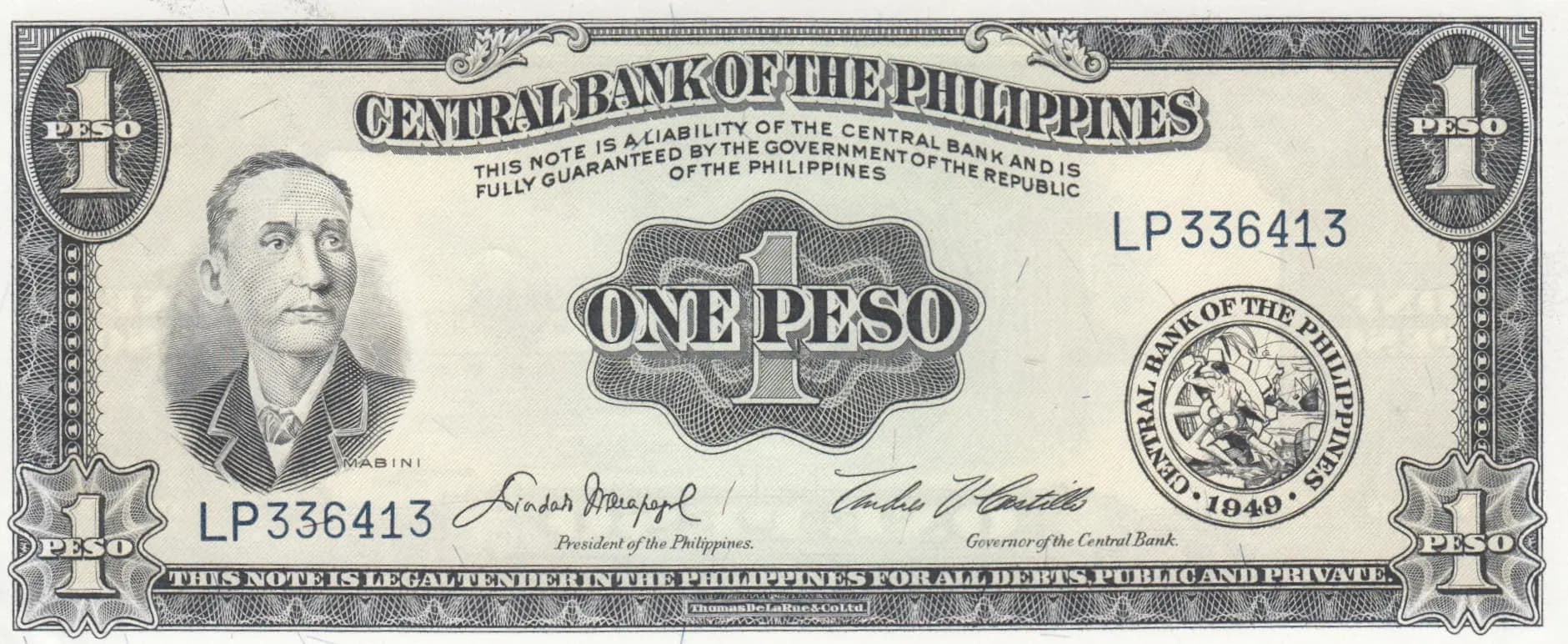
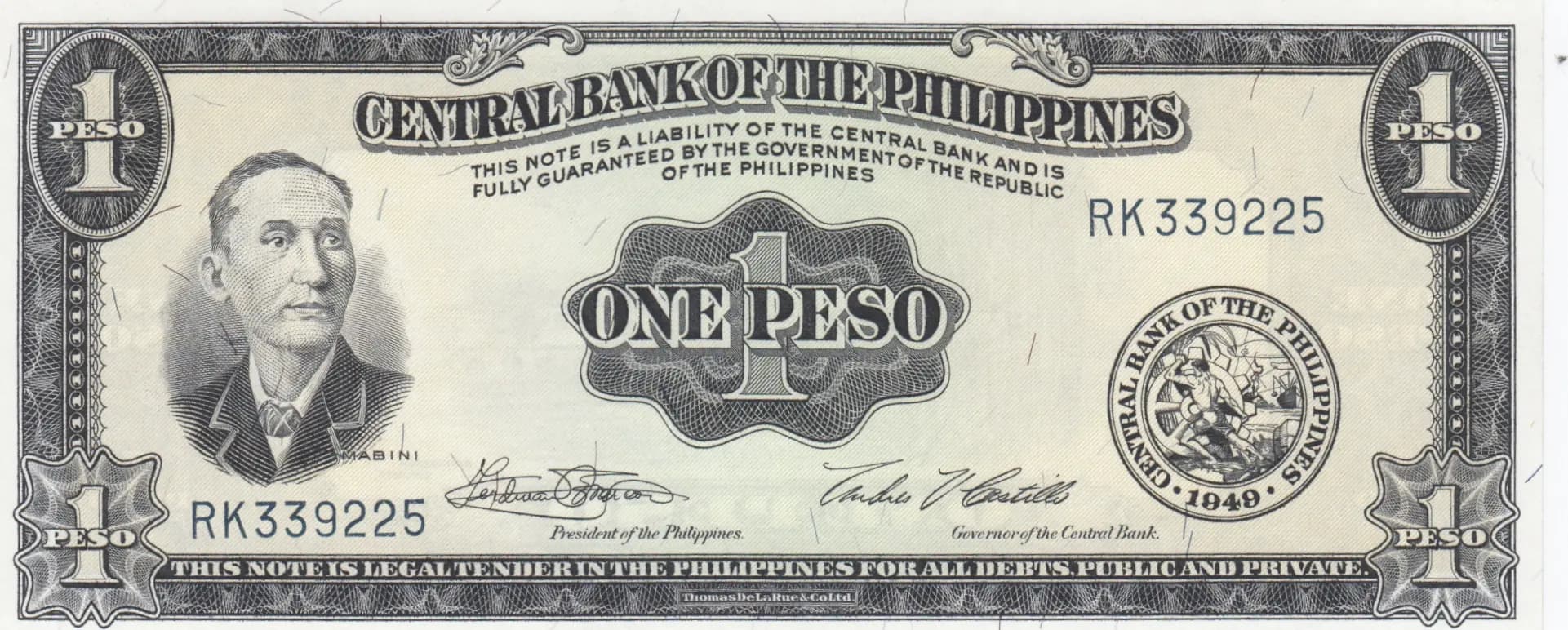
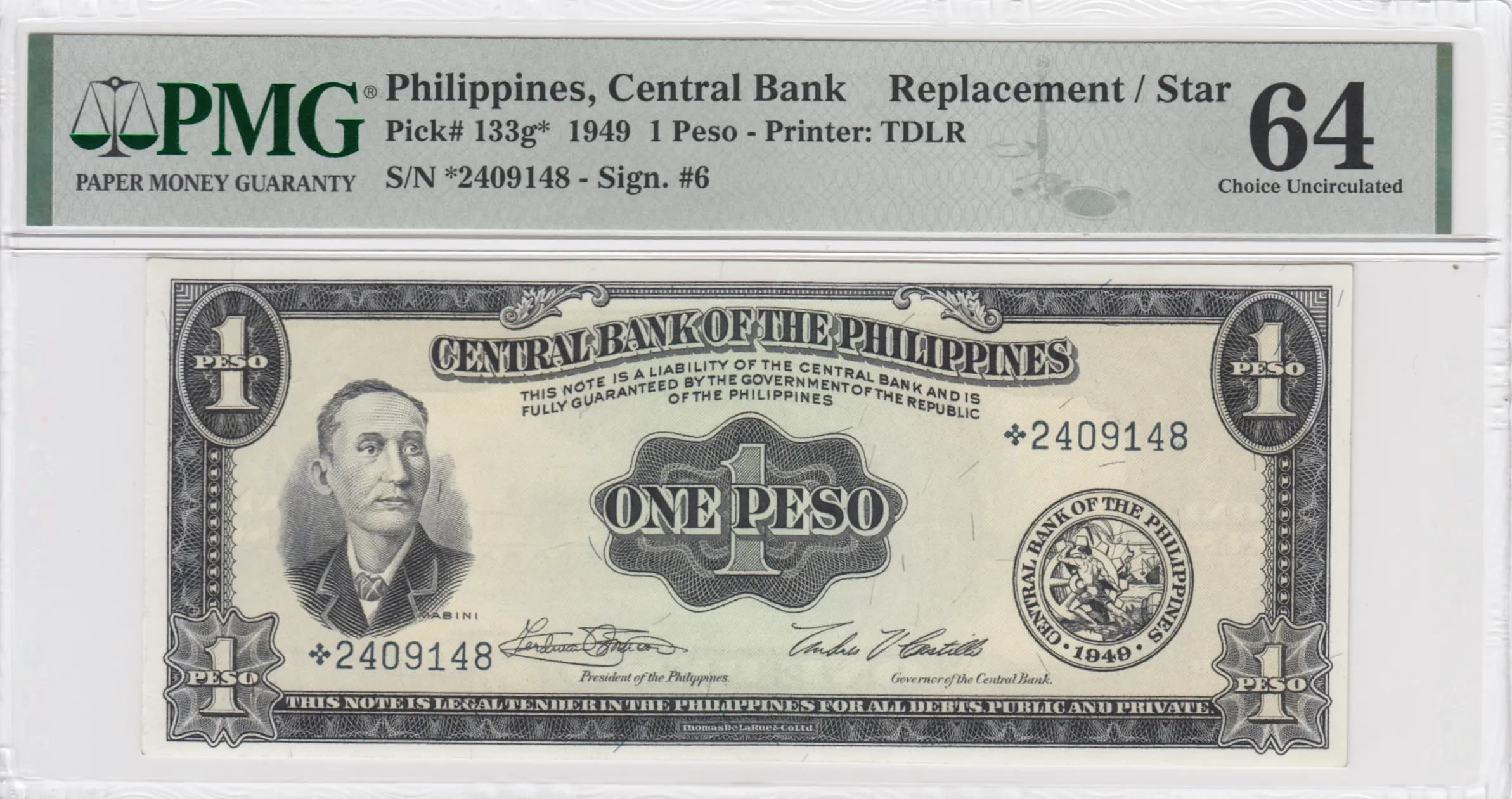
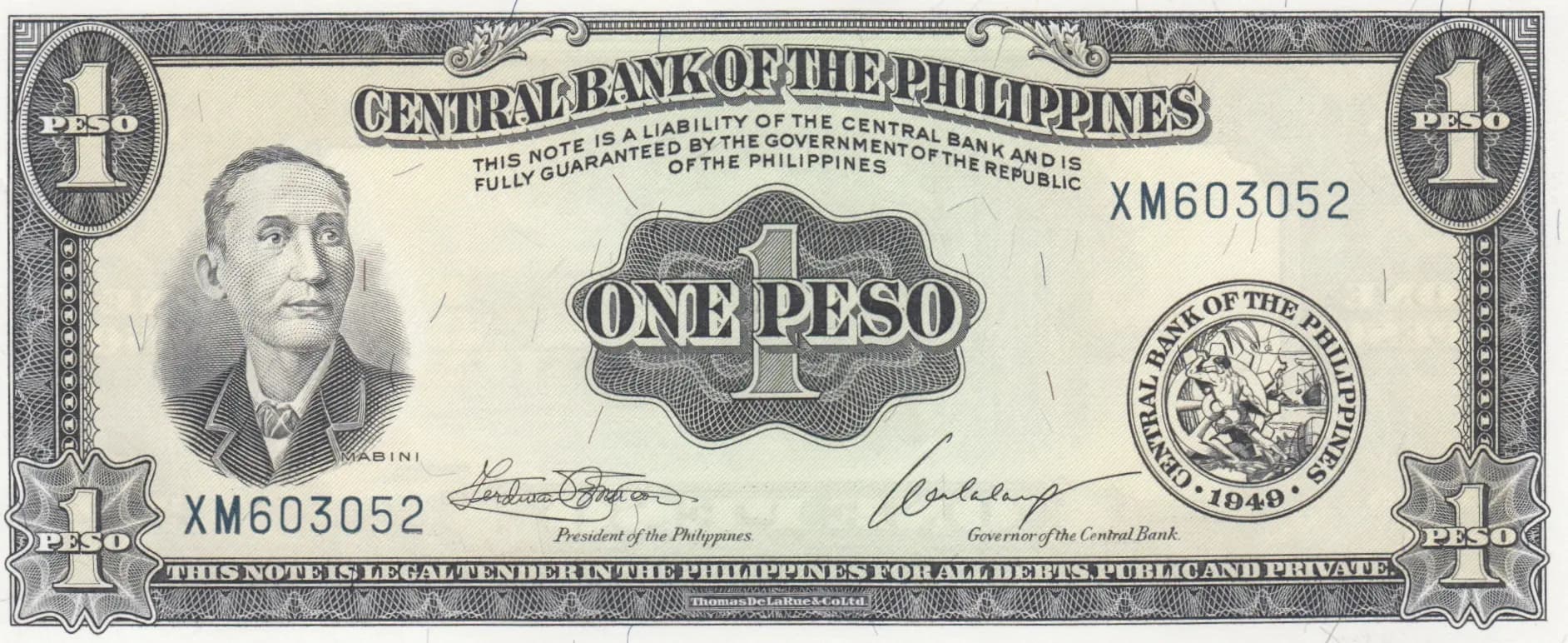
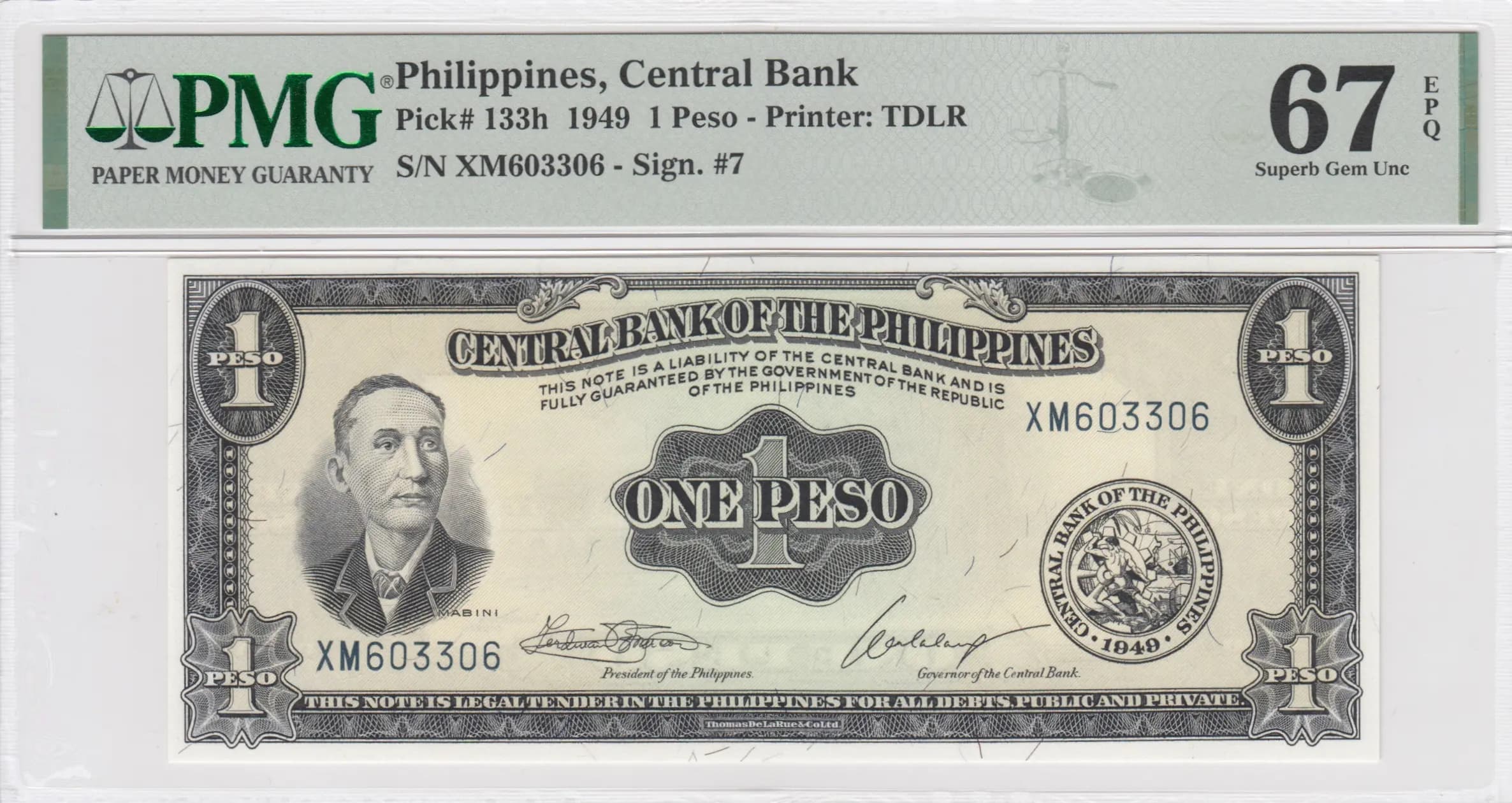
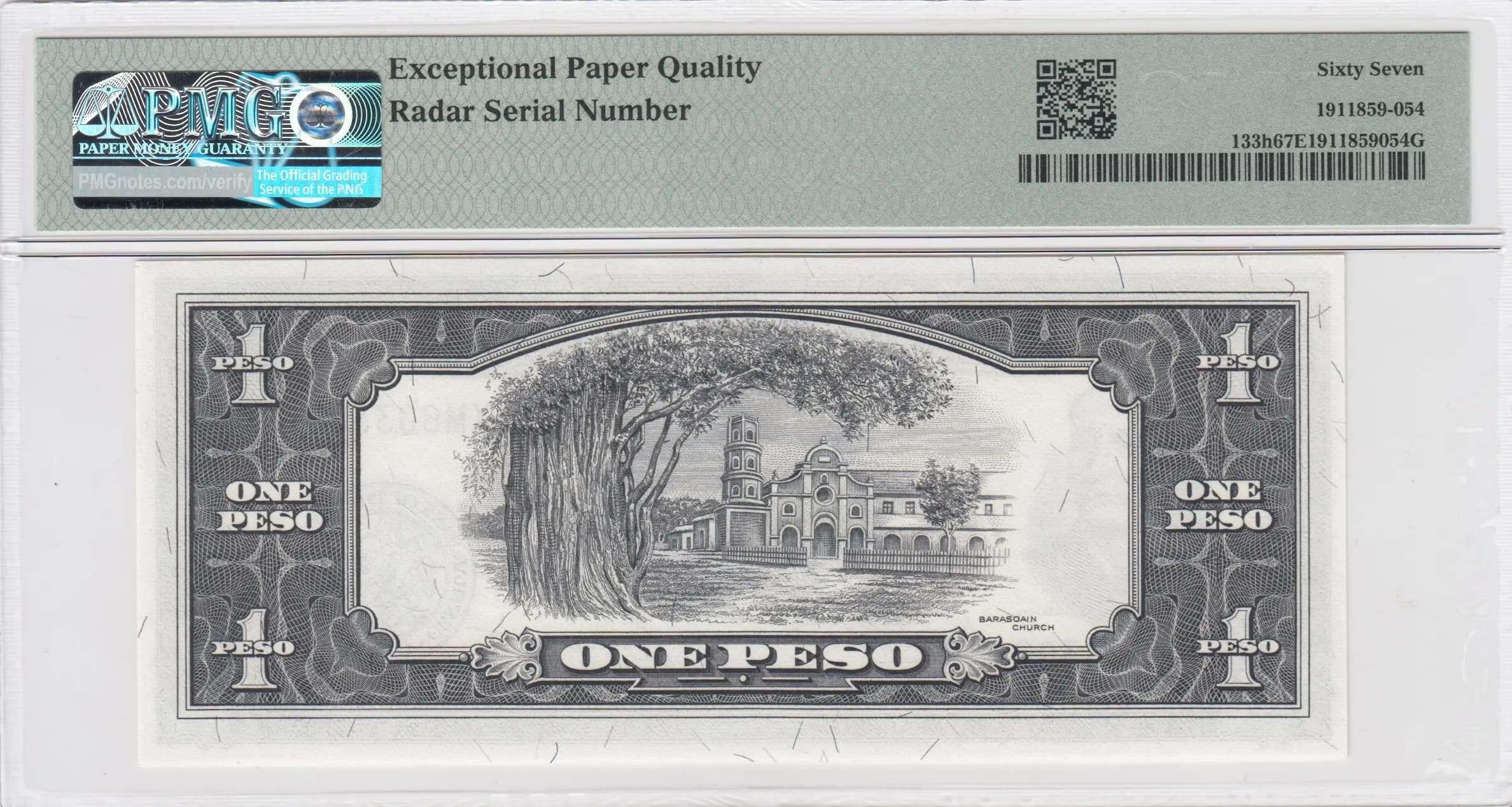
This is a PMG-graded 1 Peso note from the Central Bank of the Philippines (1949), certified as 67 EPQ (Superb Gem Uncirculated), representing an exceptional example of early Philippine post-war currency. The note features a striking portrait of Apolinario Mabini on the obverse and the historically significant Barasoain Church on the reverse, both rendered in fine engraved detail on cream-colored paper with black ink. The pristine condition, combined with the note's historical significance as part of the Philippines' first independent currency issue, makes this a desirable example for collectors.
Common. This note, despite its historical significance, was part of a substantial regular-issue printing by the Central Bank of the Philippines in 1949 and circulated widely. eBay sales data spanning 2014-2026 shows consistent availability at modest prices: uncirculated examples typically sell for $2-12, and even PMG-graded specimens in grades 63-65 sell for $19-34. The PMG 67 EPQ grade is higher quality than most market examples, but the underlying note type itself remains common. The modest valuation even for professionally graded specimens reflects the large original print run and lack of scarcity for this denomination and year.
Issued in 1949 by the newly independent Central Bank of the Philippines following the nation's independence in 1946, this banknote represents a crucial moment in Philippine monetary sovereignty. The portrait of Apolinario Mabini, a key figure in the Philippine Revolution and the First Philippine Republic, honors the nation's struggle for independence. The reverse depicts the Barasoain Church in Malolos, Bulacan, the historic site where the First Philippine Republic's Congress convened in 1899, making this note a tangible connection to the Philippines' revolutionary heritage.
The obverse features a left-positioned formal portrait of Apolinario Mabini (1864-1903), the 'Sublime Paralytic' and intellectual architect of Philippine independence, depicted in suit and tie in classical banknote portraiture style. The Central Bank of the Philippines seal, dated 1949, appears prominently in the lower right. Ornamental corner designs with shield elements and denomination markers frame the composition in traditional haute relief engraving. The reverse depicts the Barasoain Church, a neoclassical colonial-era structure with its distinctive bell tower and cross, set in a rural landscape vignette with a prominent tree in the foreground. The engraved landscape demonstrates the fine detail work characteristic of Thomas de la Rue's security printing, with careful cross-hatching and line work throughout. The paper stock shows a light gold and blue underprint as noted in reference materials.
FRONT SIDE: 'CENTRAL BANK OF THE PHILIPPINES' — Central Bank of the Philippines; 'ONE PESO' / 'PESO' — One Peso (bilingual English/Spanish); 'THIS NOTE IS A LIABILITY OF THE CENTRAL BANK AND IS FULLY GUARANTEED BY THE GOVERNMENT OF THE REPUBLIC OF THE PHILIPPINES' — This note is a liability of the Central Bank and is fully guaranteed by the Government of the Republic of the Philippines; 'THIS NOTE IS LEGAL TENDER IN THE PHILIPPINES FOR ALL DEBTS, PUBLIC AND PRIVATE' — This note is legal tender in the Philippines for all debts, public and private; 'President of the Philippines' and 'Governor of the Central Bank' — Signature authority designations; Serial number: XM603306. BACK SIDE: 'ONE PESO' / 'PESO' — One Peso (denomination, bilingual); 'BARASOAIN CHURCH' — Identifying the depicted landmark. PMG CERTIFICATION: Grade 67 EPQ, certificate reference 1911859-054, with verification available at PMGnotes.com/verify.
Intaglio (recess/engraved) printing by Thomas de la Rue & Company, Limited, London, the premier security printer of the era. The fine line work, detailed cross-hatching, and raised tactile quality visible in the engraving are characteristic of intaglio security printing. The intricate border patterns, portrait rendering, and landscape vignette demonstrate the precision and security advantages of this method, which was standard for central bank note production in the mid-20th century.
This note is identified as Pick P-133h, indicating it is a variant within the 1 Peso 1949 series. The Pick catalog lists at least five variants (P-133c, P-133e, P-133f, P-133s10, P-133s6) for this base denomination and year, with variations likely related to printer marks, signature combinations, or seal types. The 'h' designation and reference to 'Central Bank Seal Type 1' suggest this is distinguished by a specific seal variant. The serial number XM603306 and radar serial number feature noted on the PMG certificate are specific characteristics of this particular physical specimen. No overprints or special markings are evident from the visual analysis.