1 peso 1949
Market Prices
8 salesAbout This Note
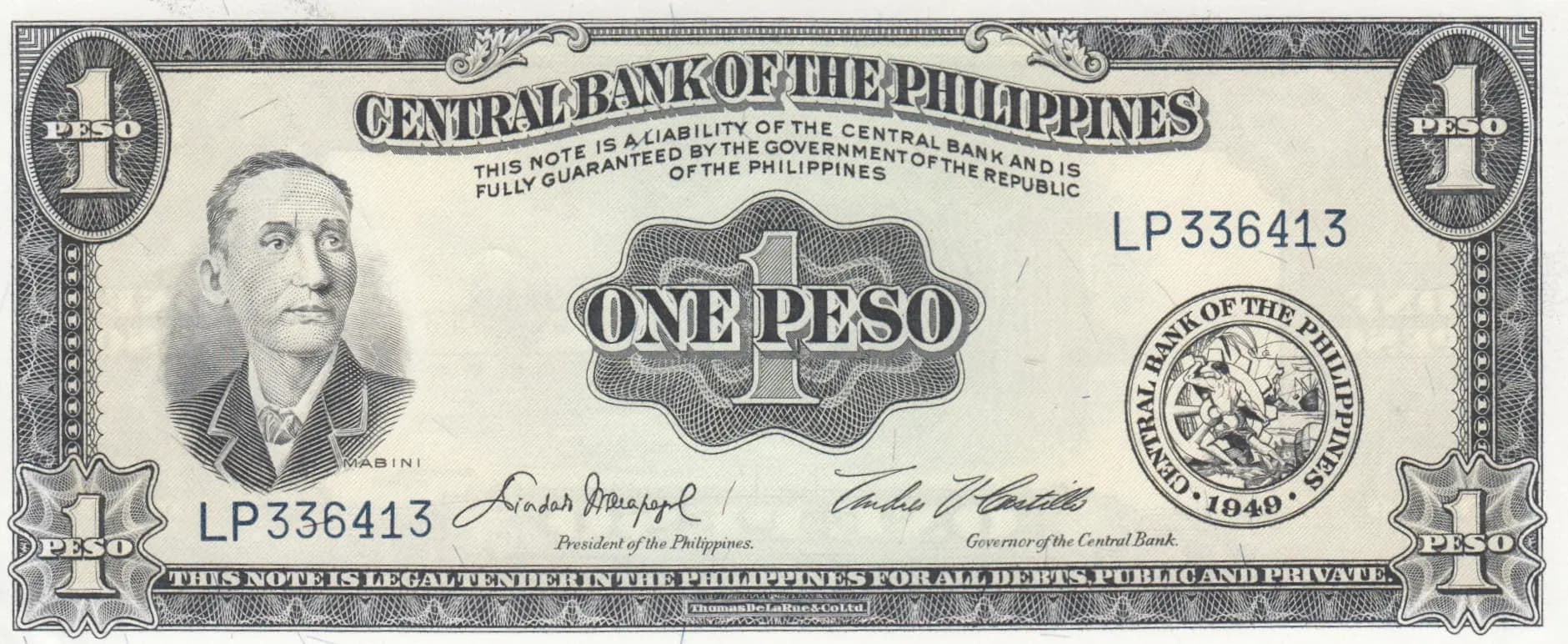
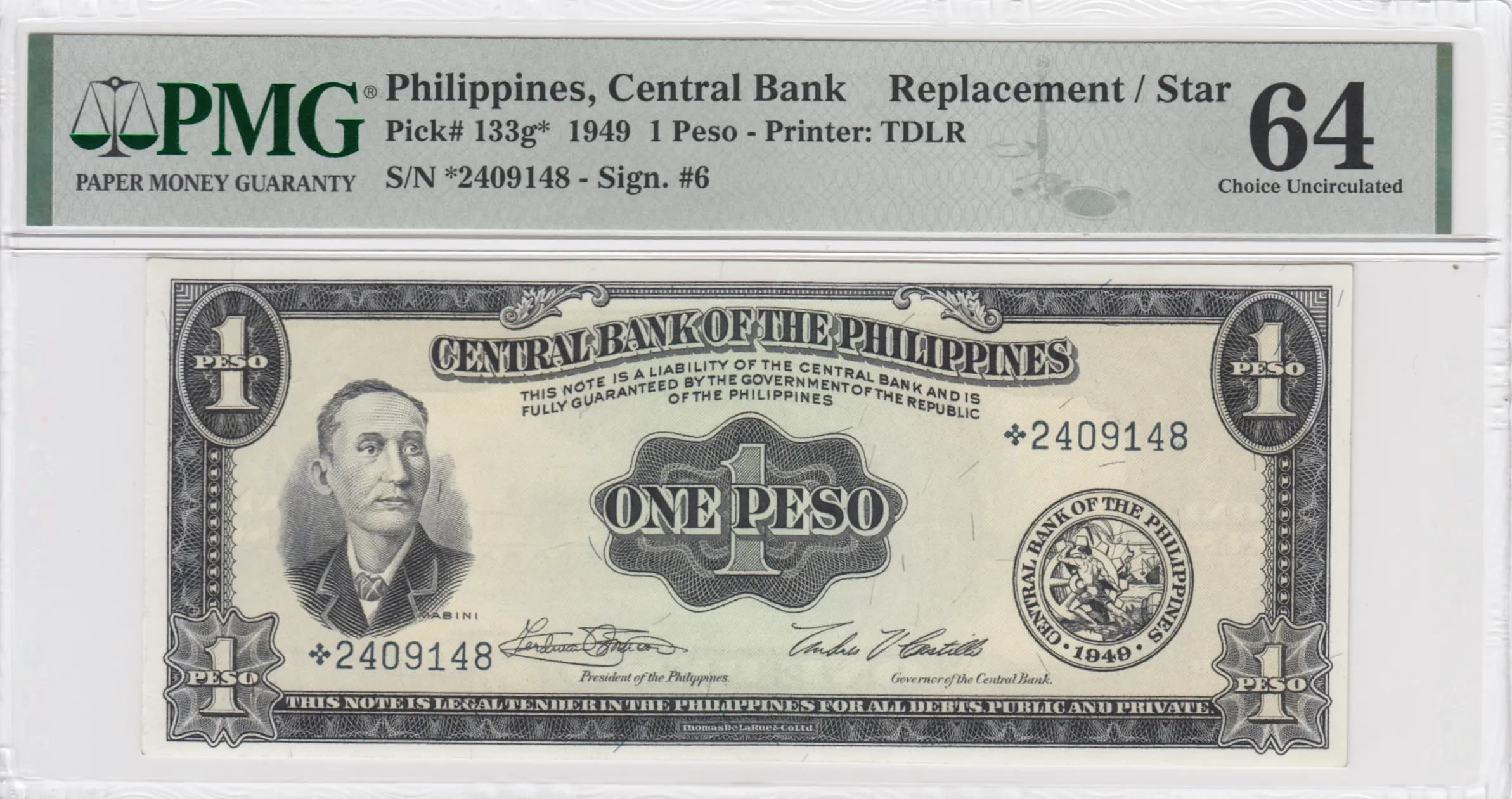
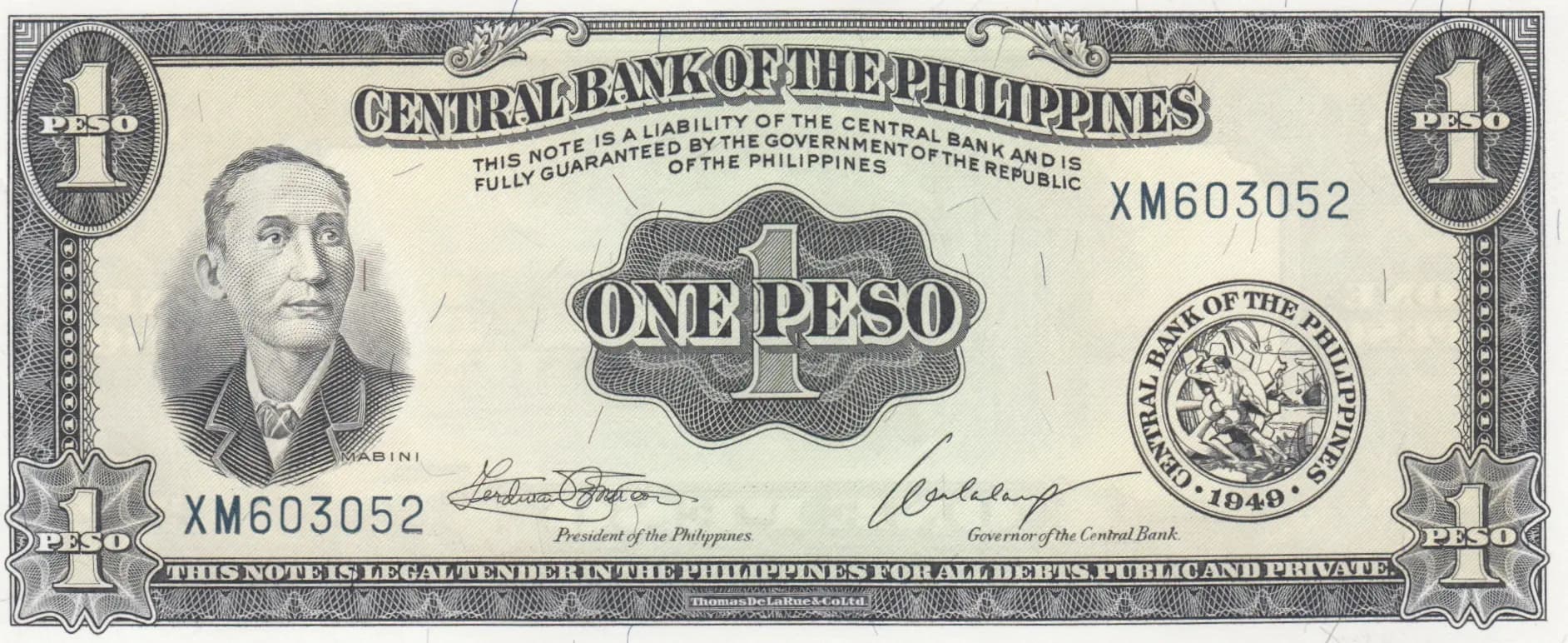
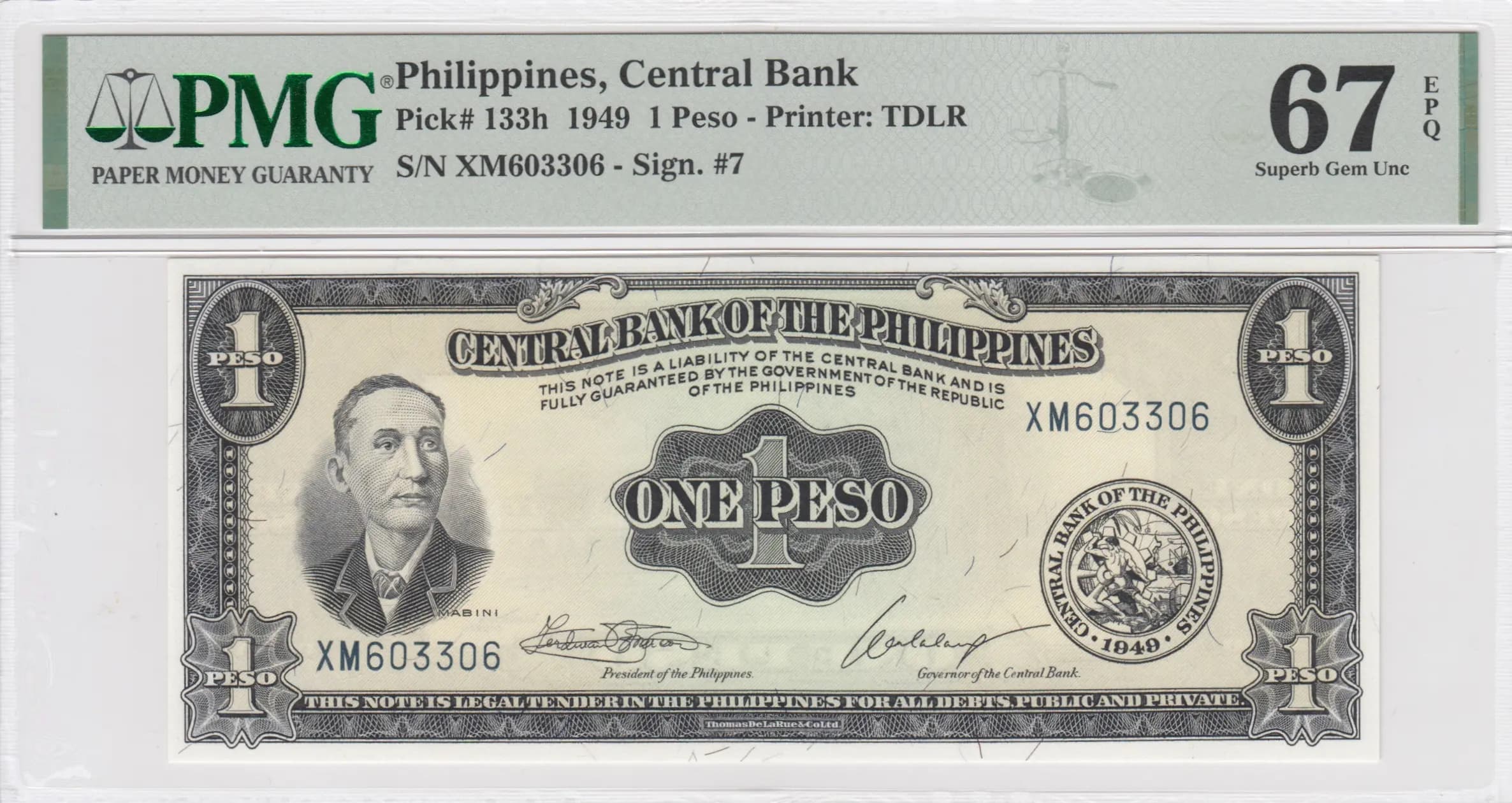
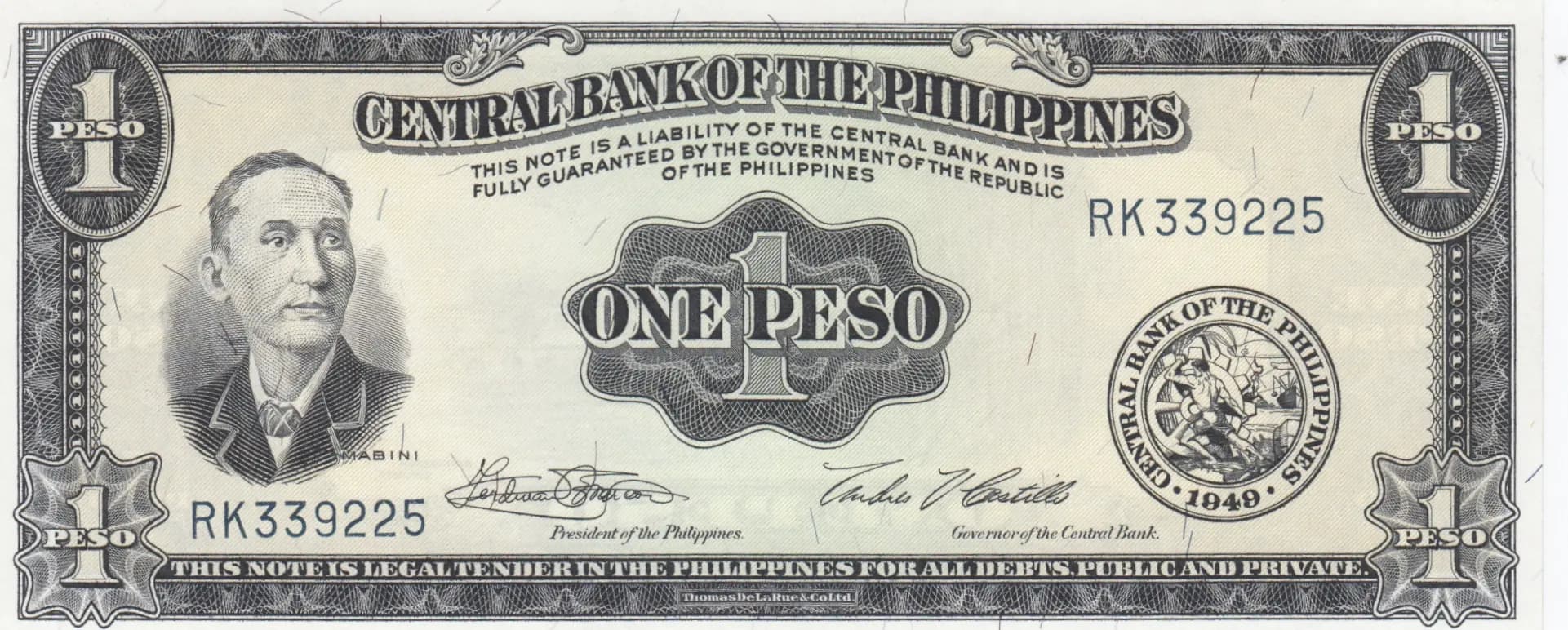
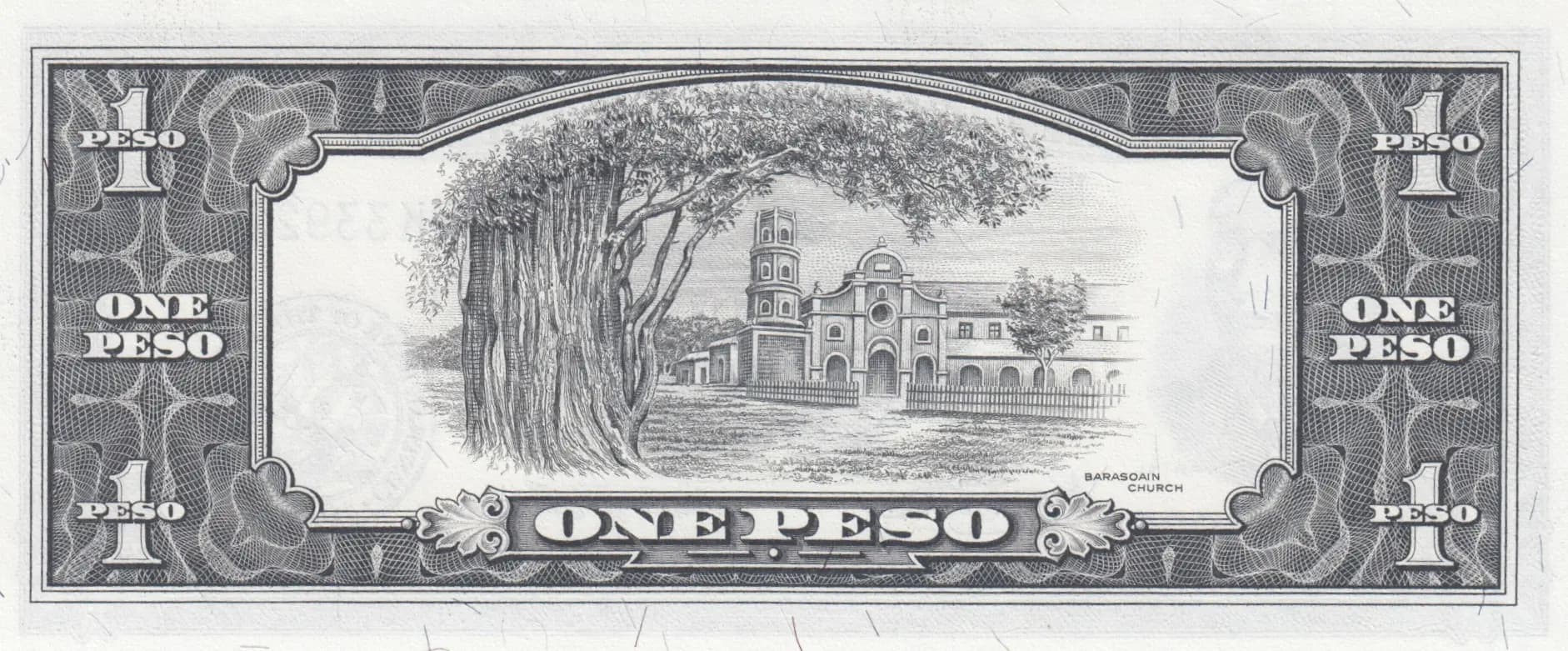
This is a 1949 Central Bank of the Philippines 1 Peso note (Pick P-133g) printed by Thomas de la Rue in London, featuring a portrait of nationalist hero Apolinario Mabini on the obverse and the historic Barasoain Church on the reverse. The note displays characteristic aging consistent with its 75-year history, including creases, fold marks, and minor foxing, though it retains good overall legibility and design clarity typical of notes in circulated condition despite being cataloged as UNC.
Common. This note shows multiple indicators of common circulation status: eBay market data shows consistent sales in the $1.25–$31 range across multiple grades (2015–2024), with UNC examples selling for $2–$3.26, well below collector premium thresholds. The 1949–1969 circulation window and Thomas de la Rue printing (a major international security printer with large production capacity) suggest substantial print runs. The existence of at least five cataloged Pick variants (P-133c, e, f, s10, s6) indicates this was a standard-issue denomination produced in multiple batches. Current catalog value of $2 for UNC confirms common status.
Issued in 1949, the first full year of the Central Bank of the Philippines' independent operation following the country's postwar reconstruction, this note commemorates Apolinario Mabini, a key figure in the Philippine Revolution and independence movement. The Barasoain Church depicted on the reverse holds particular historical significance as the site where the Philippine Constitution was ratified, making this note a tangible record of the nation's founding principles and early central banking authority.
The obverse features a formal three-quarter left-facing portrait of Apolinario Mabini positioned in the left portion of the note, rendered in fine engraved detail typical of Thomas de la Rue's security printing standards. The Central Bank of the Philippines seal appears at lower right with the 1949 date. Ornate decorative borders with floral and geometric patterns frame the entire design, with circular medallic elements containing the numeral '1' positioned in the upper corners and star-shaped security elements in the lower corners. The reverse displays a landscape vignette centered on the Barasoain Church with its distinctive bell tower, flanked by vegetation including a prominent tree, surrounded by matching ornamental border patterns. All four corners carry denomination text 'ONE PESO,' reinforcing the note's value in multiple orientations.
FRONT: 'Central Bank of the Philippines' — issuing authority identifier; 'ONE PESO' / 'PESO' — denomination in English and Spanish; 'MABINI' — portrait identification; 'THIS NOTE IS A LIABILITY OF THE CENTRAL BANK AND IS FULLY GUARANTEED BY THE GOVERNMENT OF THE REPUBLIC OF THE PHILIPPINES' — government guarantee statement; 'THIS NOTE IS LEGAL TENDER IN THE PHILIPPINES FOR ALL DEBTS PUBLIC AND PRIVATE' — legal tender declaration; 'President of the Philippines' and 'Governor of the Central Bank' — signature title lines; 'Thomas de la Rue & Co. Ltd' — printer attribution; 'BANK OF THE PHILIPPINES • 1949 •' — issuing institution and year; Serial number 'RK339225'. BACK: 'ONE PESO' / 'PESO' — denomination; 'BARASQAIN CHURCH' — landmark identification.
Intaglio engraving (recess printing), the signature method of Thomas de la Rue & Co. Ltd, London. The visual analysis reveals the characteristic fine line work, intricate geometric patterns, detailed portrait rendering, and precise border work typical of high-security banknote production. The crisp black impression on light cream/beige stock and the depth of detail observable in both portrait and architectural vignette confirm traditional engraved plate printing rather than lithography.
This note is cataloged as Pick P-133g, indicating it is one of several documented varieties within the 1 Peso 1949 series. The visual analysis confirms Thomas de la Rue printing (TDLR imprint present). The serial number prefix 'RK' and the Large Central Bank Seal Type 1 visible on this specimen are consistent with the P-133g variety classification. Other known variants in this Pick number group (P-133c, P-133e, P-133f, P-133s10, P-133s6) likely represent differences in seal types, signature combinations, or serial numbering systems used across the 1949 production runs.