1/2 peso 1949
Market Prices
31 salesAbout This Note
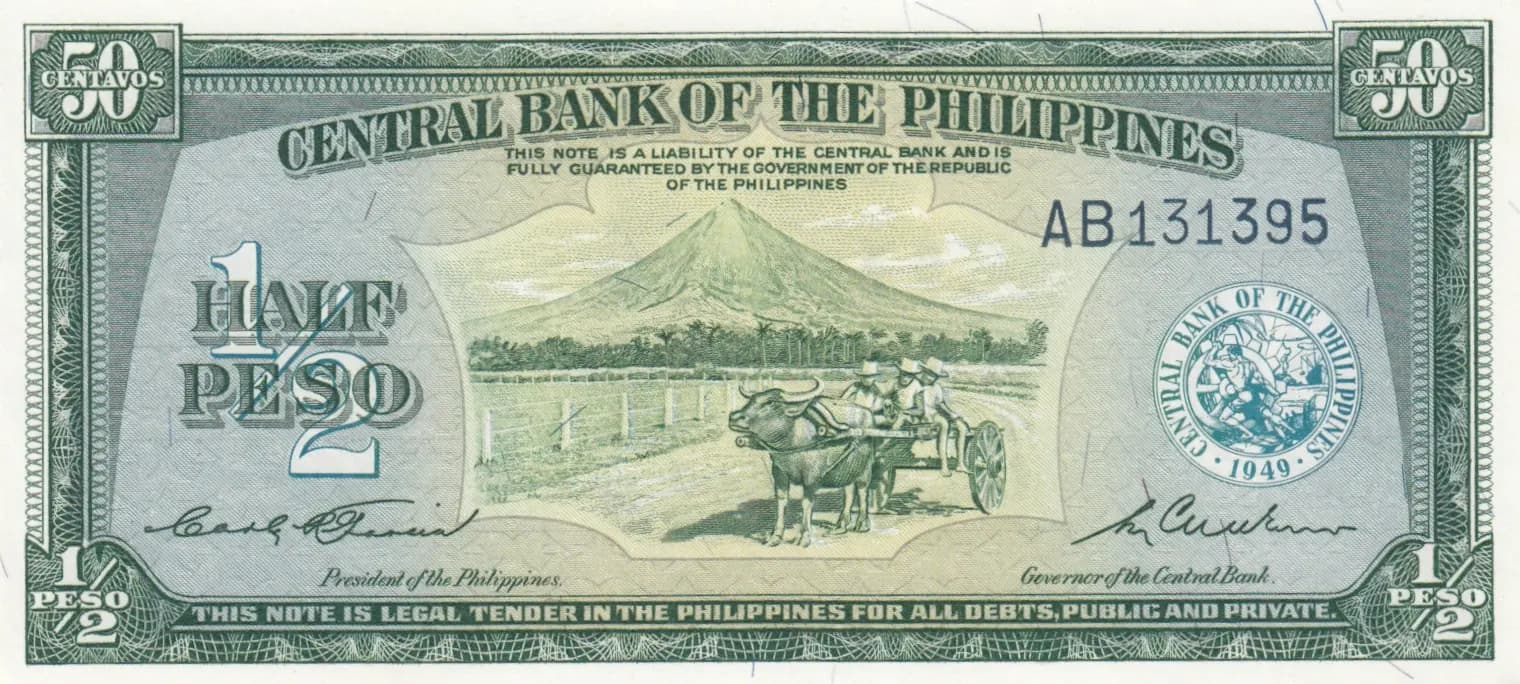
This 1949 Central Bank of the Philippines 1/2 peso note (Pick P-132) presents a charming rural scene featuring an ox-drawn cart beneath Mayon volcano, rendered in green tones on a yellow and blue underprint. The note displays characteristics consistent with UNC grade, though visual inspection reveals minor age-related foxing and light handling marks typical of vintage Philippine currency from this era. This denomination remains popular with collectors of early Central Bank issues and Philippine agricultural imagery.
Common. Secondary market data confirms consistent circulation and availability: multiple UNC examples have sold on eBay at prices ranging from $4.72 to $13.05 in recent years, with 2019 catalog values listing UNC at $12. The regular issue designation and sustained trading volume indicate substantial print runs. While early Central Bank notes have collector appeal, this denomination and year show no evidence of scarcity or print run limitations that would elevate it above common status.
Issued in 1949, shortly after Philippine independence and the establishment of the Central Bank of the Philippines, this note reflects the nation's agrarian economy and cultural heritage. The prominent depiction of Mayon volcano and ox-cart farming methods illustrates the economic foundation of post-war Philippines, while the Central Bank seal dated 1949 documents the early institutional identity of the newly autonomous monetary authority.
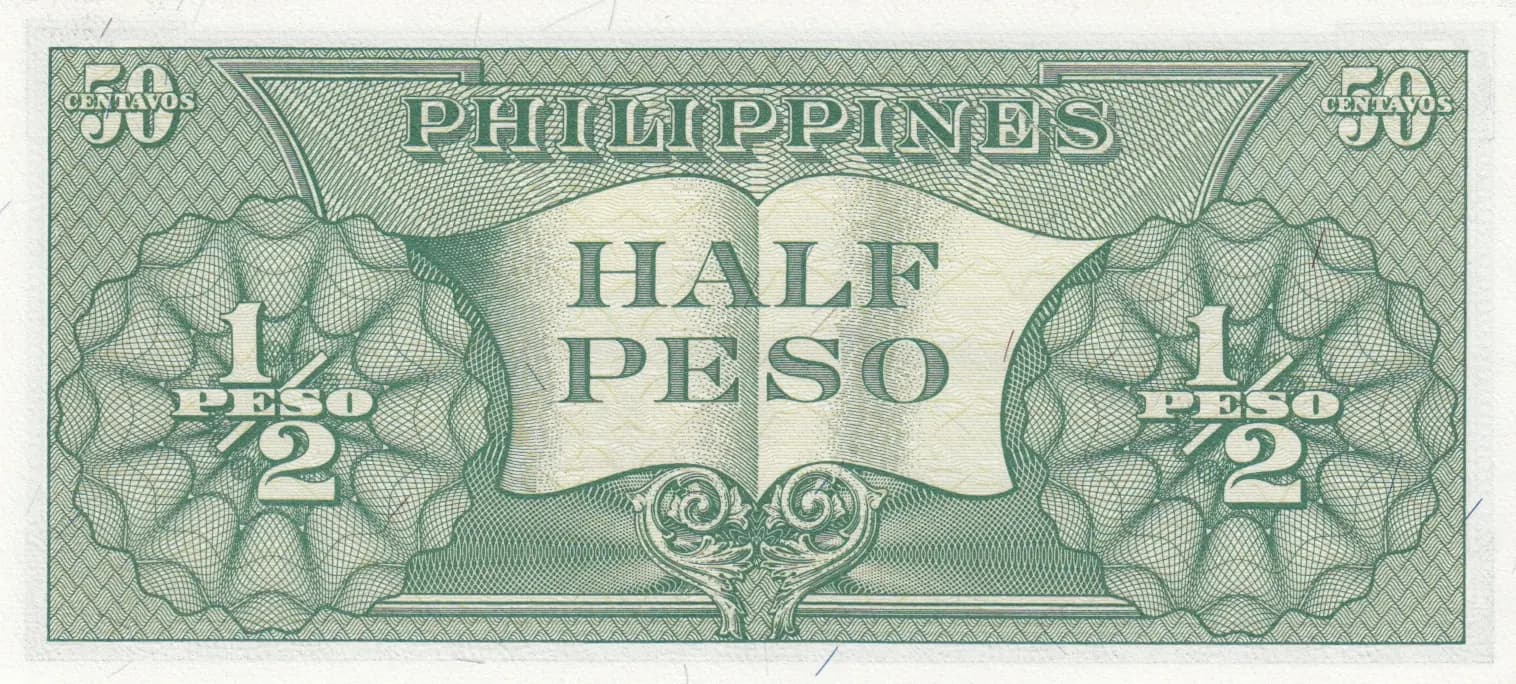
The obverse features a landscape composition with Mayon volcano dominating the background, its distinctive conical form rendered in fine detail. In the foreground, an ox-drawn cart laden with agricultural produce is depicted traversing rural fields with linear fencing, symbolizing the agrarian base of the Philippine economy. The design incorporates ornate engraved borders and corner numerals typical of mid-20th century Central Bank issues. The reverse presents a symmetrical botanical design, possibly depicting hop flowers or similar agricultural plants flanking the central 'HALF PESO' denomination text, with intricate geometric patterns and crosshatching throughout. The Central Bank seal (Type 1) appears prominently on the lower right of the obverse, dated 1949.
Front side: 'CENTRAL BANK OF THE PHILIPPINES' (header); 'HALF PESO' (denomination); 'THIS NOTE IS A LIABILITY OF THE CENTRAL BANK AND IS FULLY GUARANTEED BY THE GOVERNMENT OF THE REPUBLIC OF THE PHILIPPINES' (liability clause); 'THIS NOTE IS LEGAL TENDER IN THE PHILIPPINES FOR ALL DEBTS, PUBLIC AND PRIVATE' (legal tender declaration); 'CENTRAL BANK OF THE PHILIPPINES 1949' (seal inscription); signatures labeled 'President of the Philippines' and 'Governor of the Central Bank'; serial number 'AB131395'. Back side: 'PHILIPPINES' (country name); 'HALF PESO' (denomination); '1 PESO 2 CENTAVOS' / 'PESO' (corner denominations).
Intaglio/engraving process, characteristic of banknote production from this era. The printer is identified as TDLR (likely Thomas De La Rue or affiliated security printer). Fine line work, detailed crosshatching, and the precision of the landscape vignette are consistent with steel plate engraving. The green color scheme is applied through multi-color printing techniques typical of Central Bank of the Philippines issues from 1949.
Serial number prefix 'AB' indicates a standard issue variety from the 1949 production run. The Central Bank Seal Type 1 is noted in reference catalogs as the standard for this issue. No major varieties (signature variants, overprints, or error notes) are documented for Pick P-132 in widely available numismatic references. The note examined represents the standard regular issue variety.