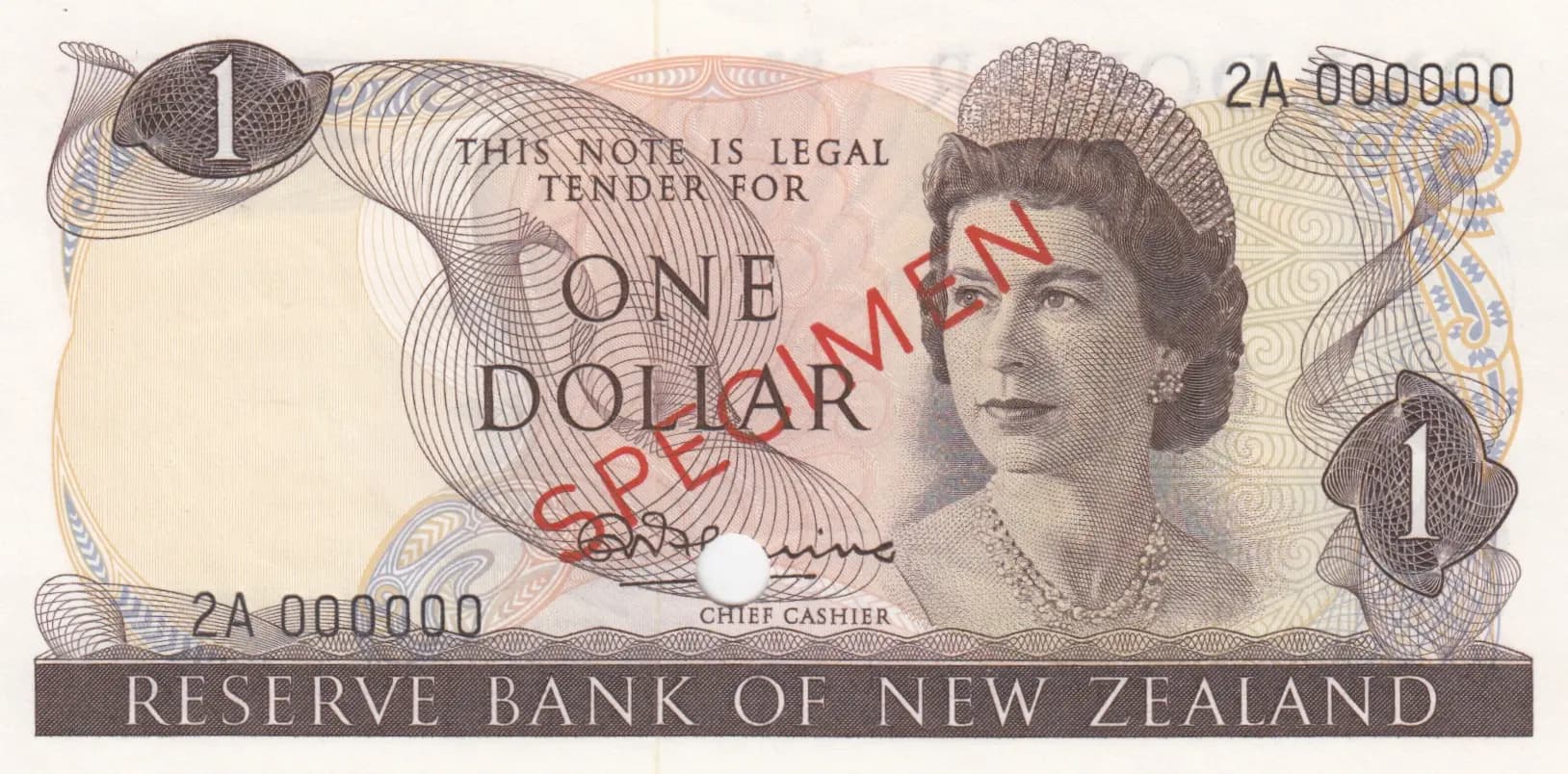
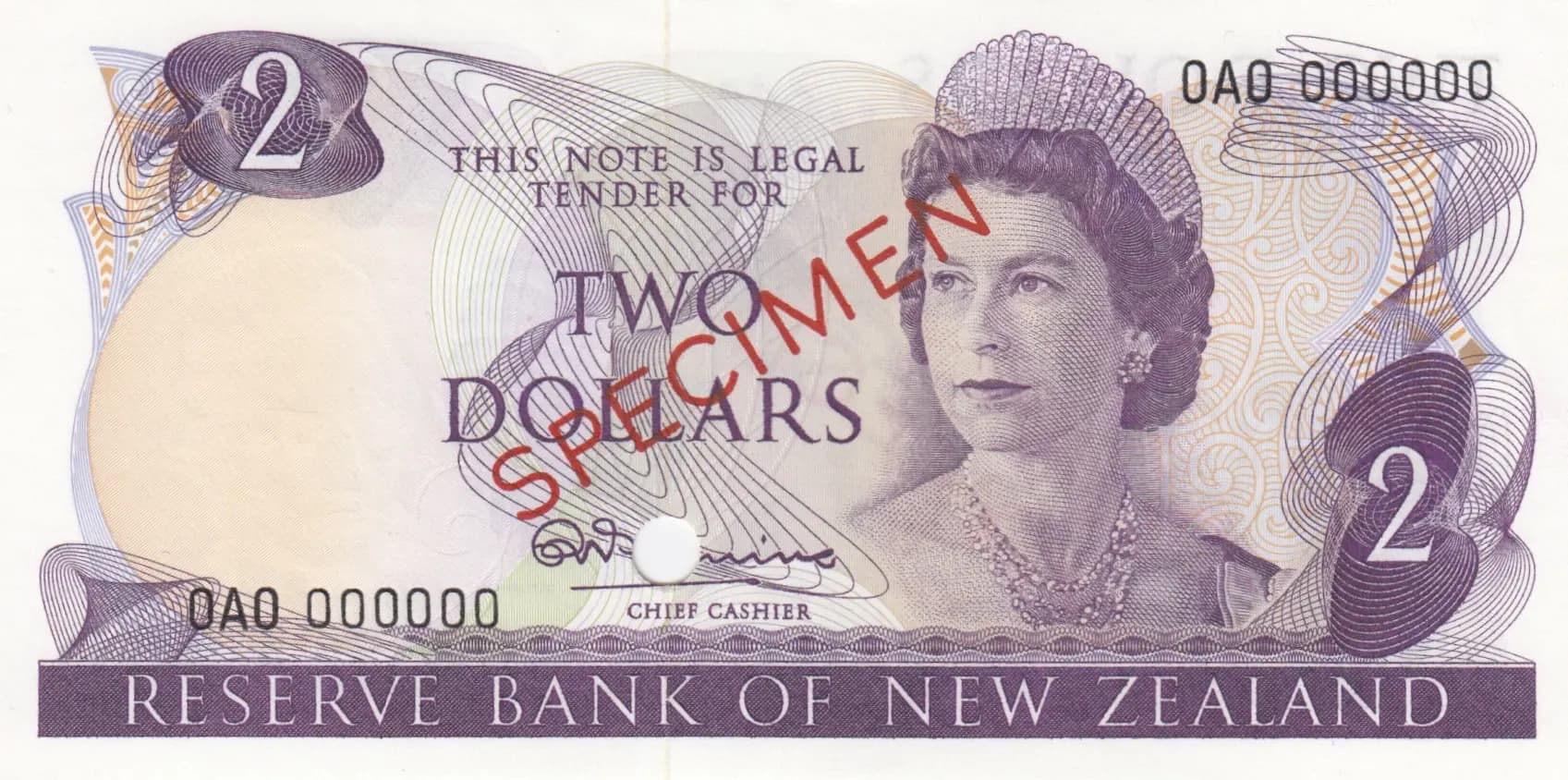
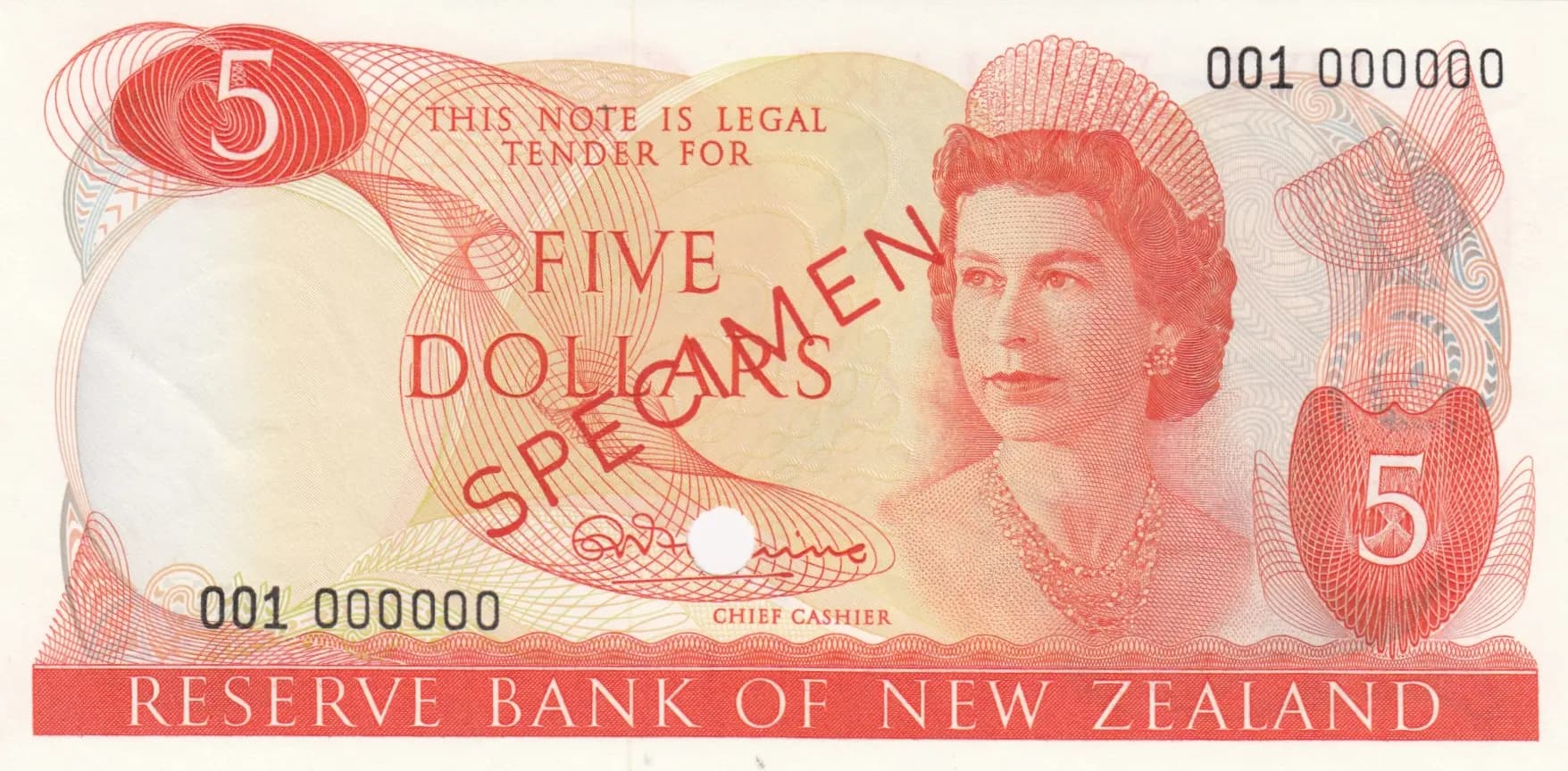
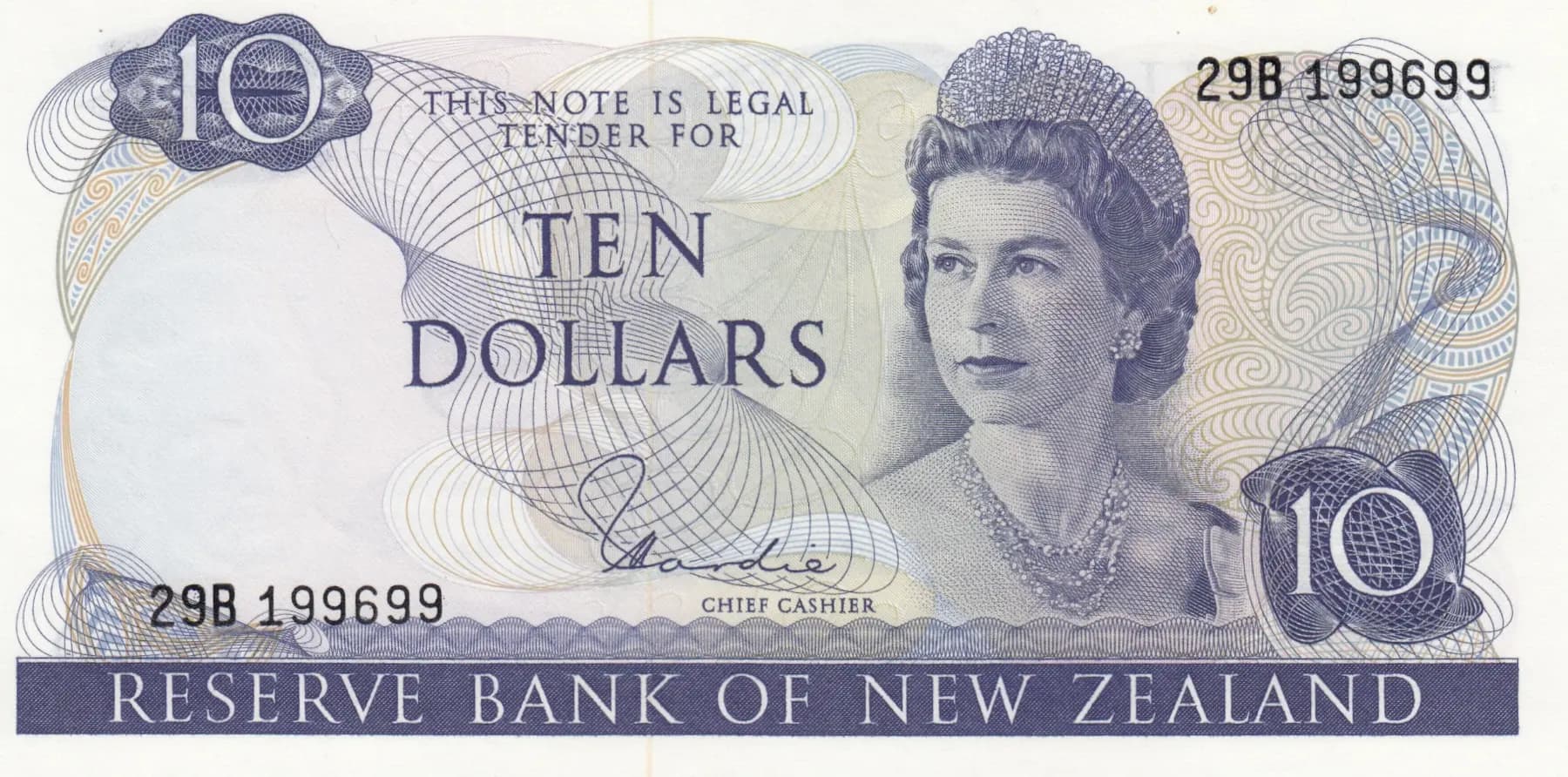
100 dollars 1967 specimen
Market Prices
1 saleAbout This Note
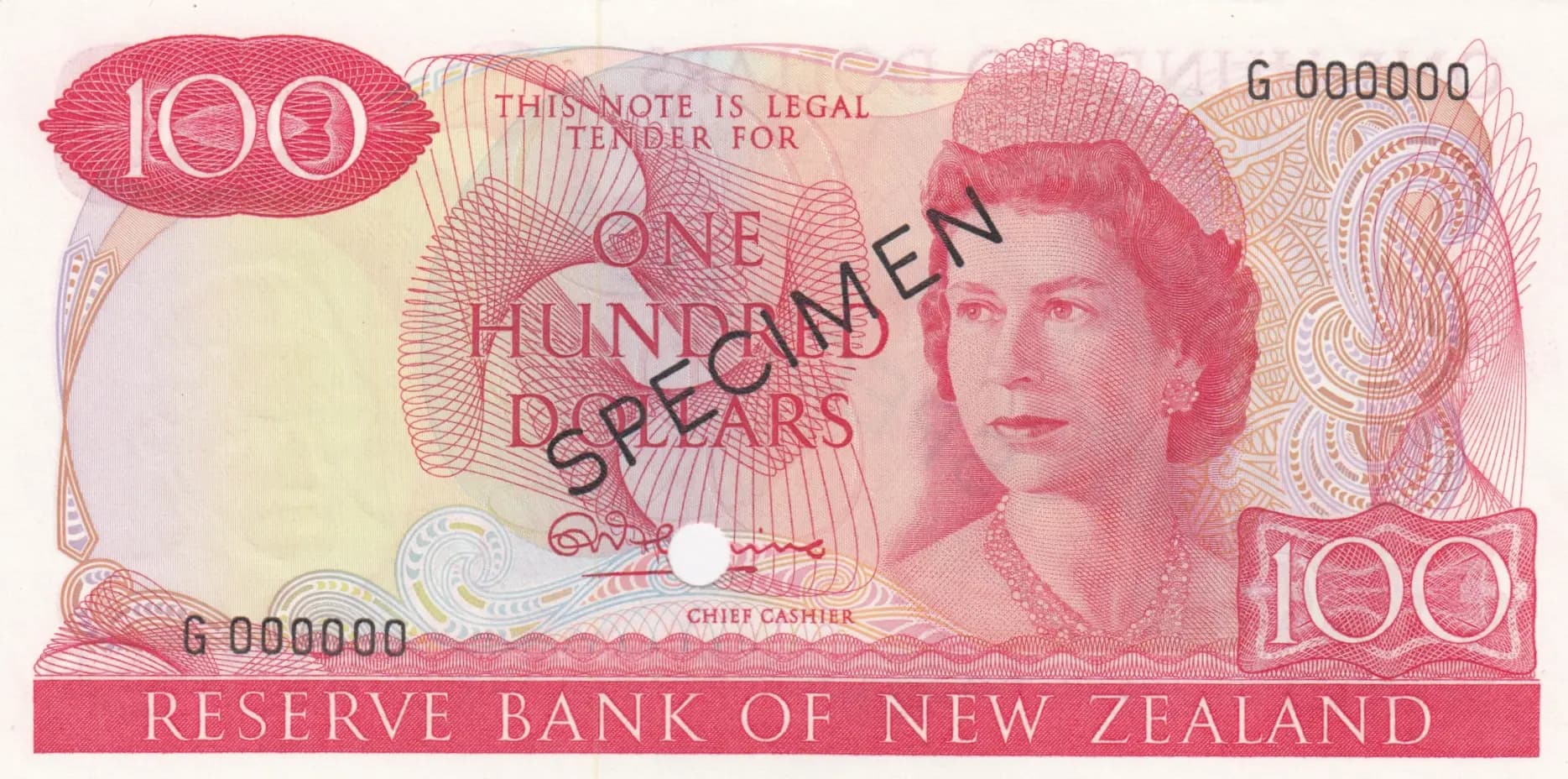
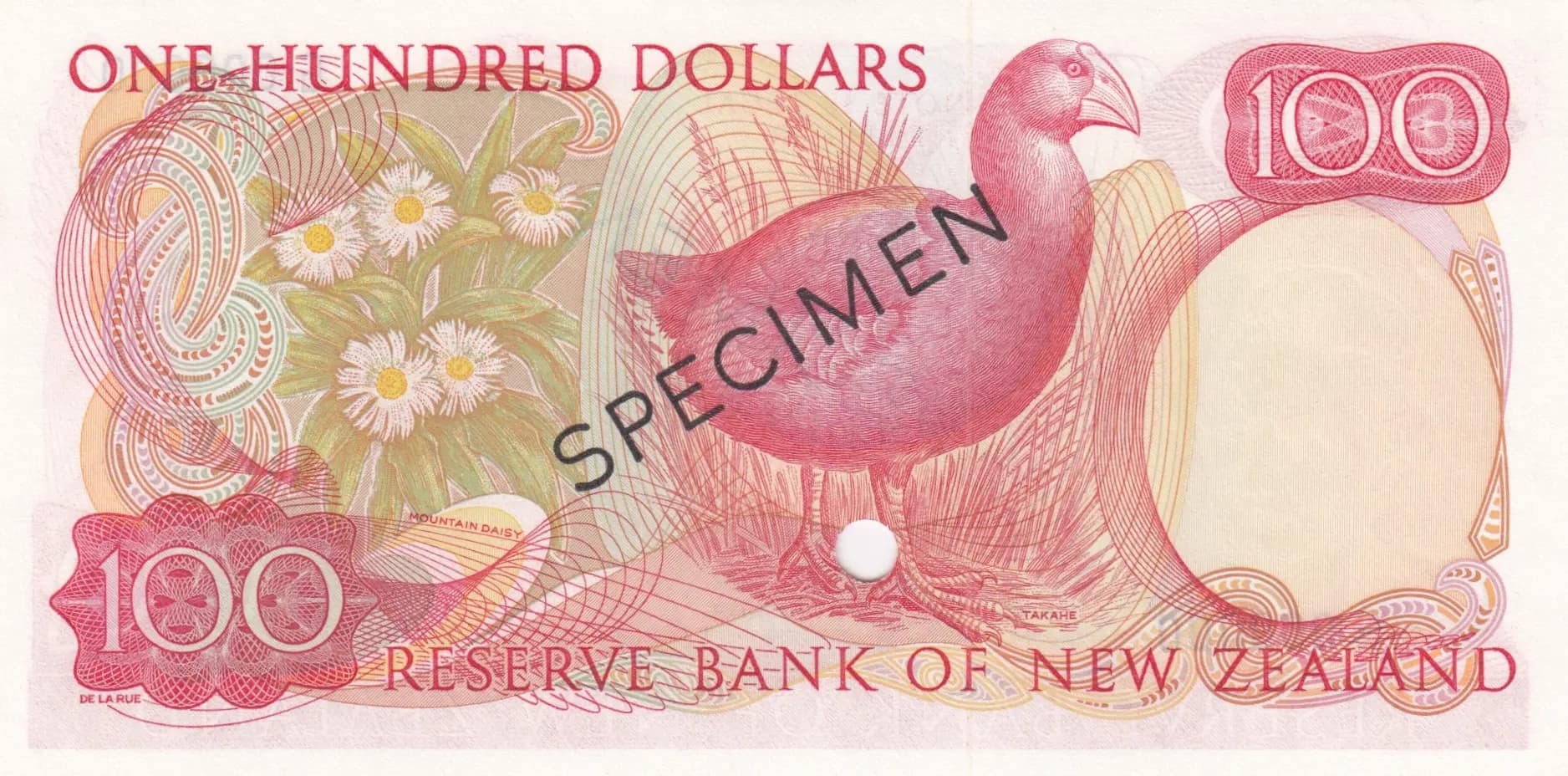
This is a pristine 1967 specimen note of New Zealand's 100 Dollar denomination, issued by the Reserve Bank and printed by De la Rue in London. The note features a striking red and multicolor design with Queen Elizabeth II in profile on the obverse and a detailed illustration of a takahe (flightless rail bird) with mountain daisy flora on the reverse. As an uncirculated specimen note with diagonal 'SPECIMEN' overprint, this non-circulating sample represents an important reference piece from New Zealand's mid-20th century banknote series, notable for its fine engraving quality and preservation.
Common. While this is a specimen note (non-circulating), specimen notes from major Commonwealth banks are typically produced in moderate quantities for distribution to financial institutions, numismatists, and collectors. The 1967 New Zealand 100 Dollar note is well-represented in the numismatic market, with PMG population data showing multiple variants (P-168a, P-168b, P-168s) in circulation within the collecting community. The referenced eBay sale of a PMG 64 graded example at $830 (2017) indicates steady collector demand but not exceptional rarity; comparable specimen notes from this era generally trade in the $500–$1,500 range depending on grade and market conditions.
Issued in 1967, this 100 Dollar note reflects New Zealand's economic status during the post-war Commonwealth period, featuring Queen Elizabeth II as the reigning monarch of the realm. The reverse design celebrates New Zealand's unique natural heritage through the takahe and mountain daisy, symbols of the nation's endemic flora and fauna that became central to New Zealand's identity during this era of growing nationalism and environmental awareness.
The obverse features a left-facing profile portrait of Queen Elizabeth II wearing formal regalia and jewelry, centered against ornamental guilloche background patterns in pink and red tones with cream underprint. Security elements include a circular decorative medallion in the top right corner and a small circular security feature near the center. The reverse displays a detailed naturalistic engraving of a takahe (Porphyrio hochstetteri), New Zealand's iconic flightless rail bird, rendered with fine linework showing plumage detail in pink and red tones. To the left is a botanical illustration of mountain daisy flowers with yellow centers and green foliage and stems. Both sides are framed with ornamental guilloche patterns and include circular security features. The 'SPECIMEN' overprint is applied diagonally across both obverse and reverse.
Front side: 'THIS NOTE IS LEGAL TENDER FOR ONE HUNDRED DOLLARS' (legal tender declaration); 'SPECIMEN' (overprint designation); 'RESERVE BANK OF NEW ZEALAND' (issuing authority); 'CHIEF CASHIER' (signatories line); '100' (denomination numeral); 'G 000000' (specimen serial number). Back side: 'ONE HUNDRED DOLLARS' (denomination text); '100' (denomination numerals, multiple instances); 'SPECIMEN' (overprint designation); 'RESERVE BANK OF NEW ZEALAND' (issuing authority); 'TAKAHÉ' (bird identification); 'MOUNTAIN DAISY' (flora identification); 'DE LA RUE' (printer identification).
Intaglio engraving (line engraving and etching) produced by De la Rue, London, a renowned security printer. The fine guilloche patterns, detailed portrait work, botanical illustrations, and security features are characteristic of high-security banknote production using steel plate engraving. The specimen overprint appears to be applied via offset or lithography after the primary intaglio printing.
This note is cataloged as Pick P-168s, the specimen variant of the 1967 New Zealand 100 Dollar denomination. The 's' suffix denotes specimen status with overprint. PMG recognizes at least three variants under the base Pick number P-168 (P-168a, P-168b, P-168s), likely distinguished by minor design or printing differences. The observed serial number prefix 'G 000000' is typical for specimen notes, which carry non-functional serial numbers rather than sequential circulation numbers. Printer attribution: De la Rue, London (marked as TDLR in PMG records). The watermark identified in the catalog reference is Captain James Cook, consistent with New Zealand banknote design conventions of this period.