50 gulden 1929
About This Note
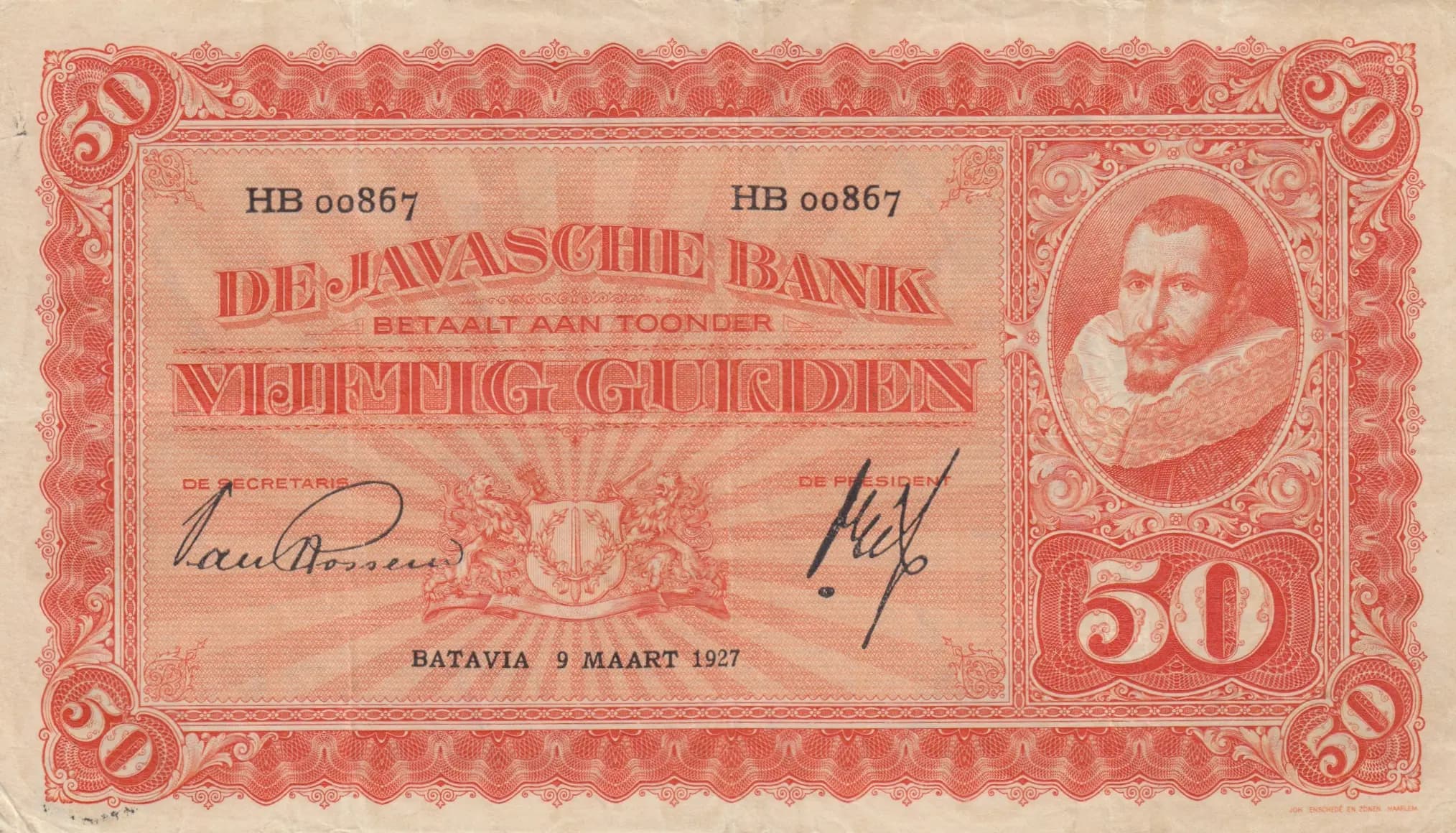
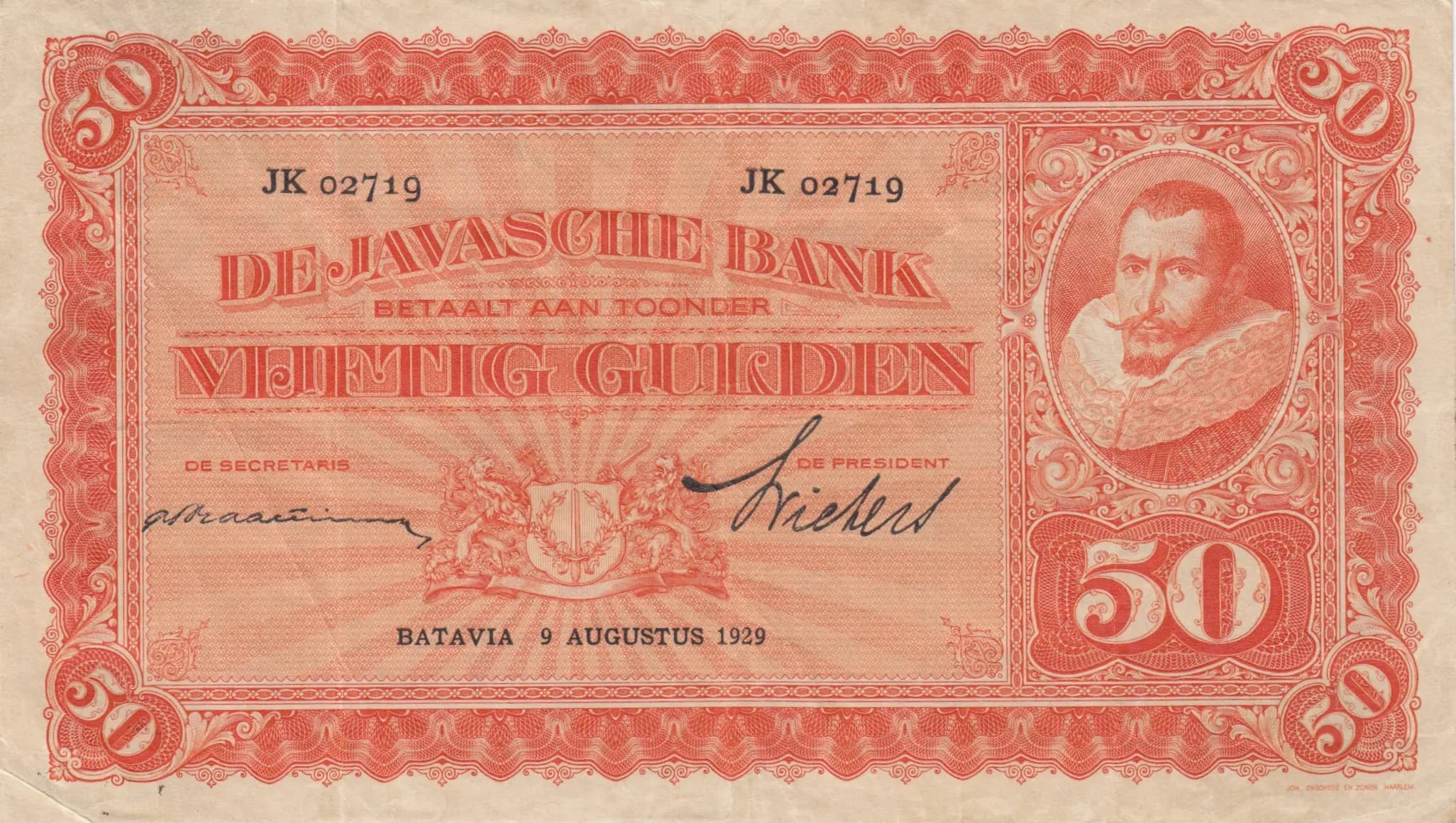
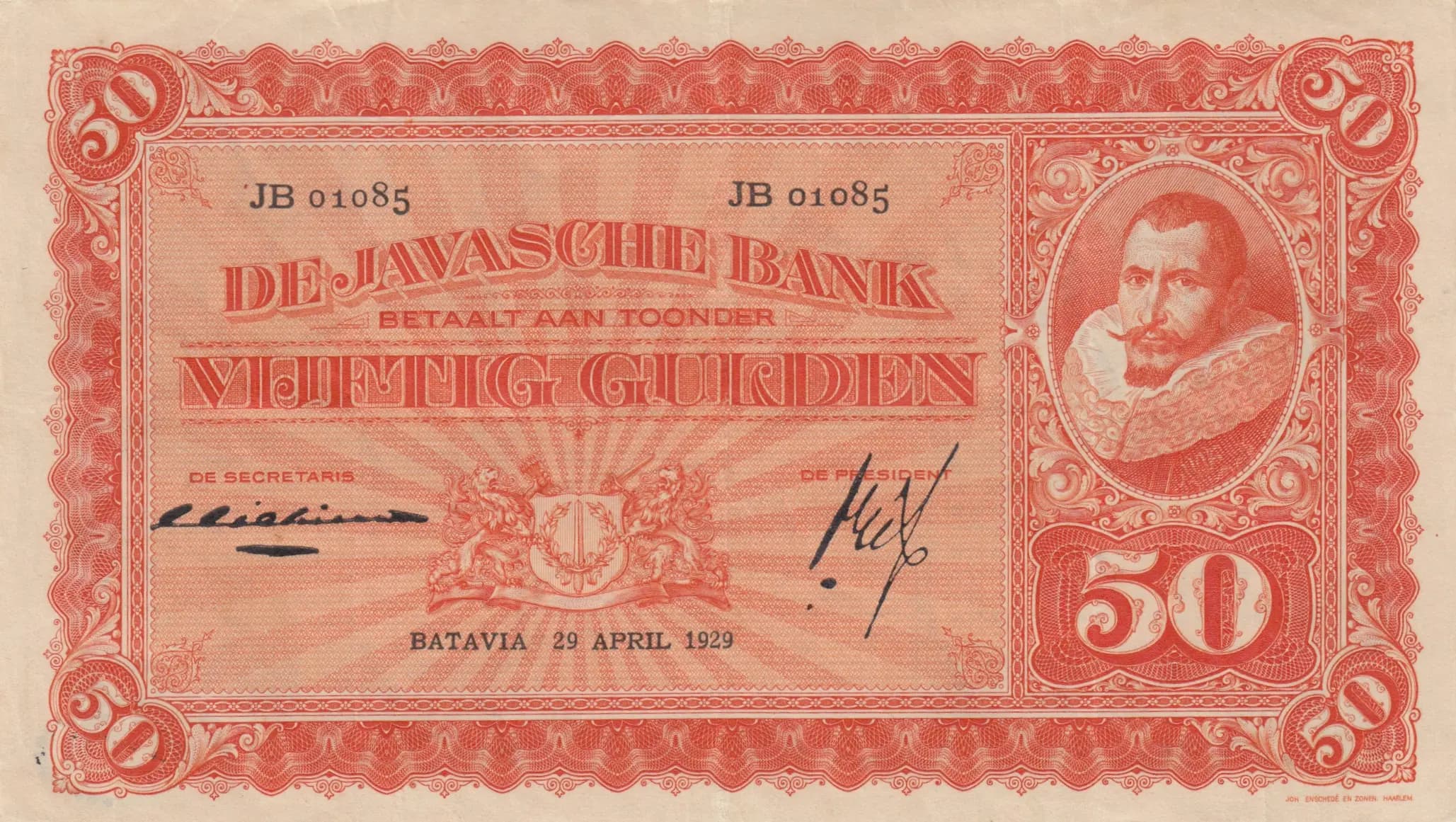
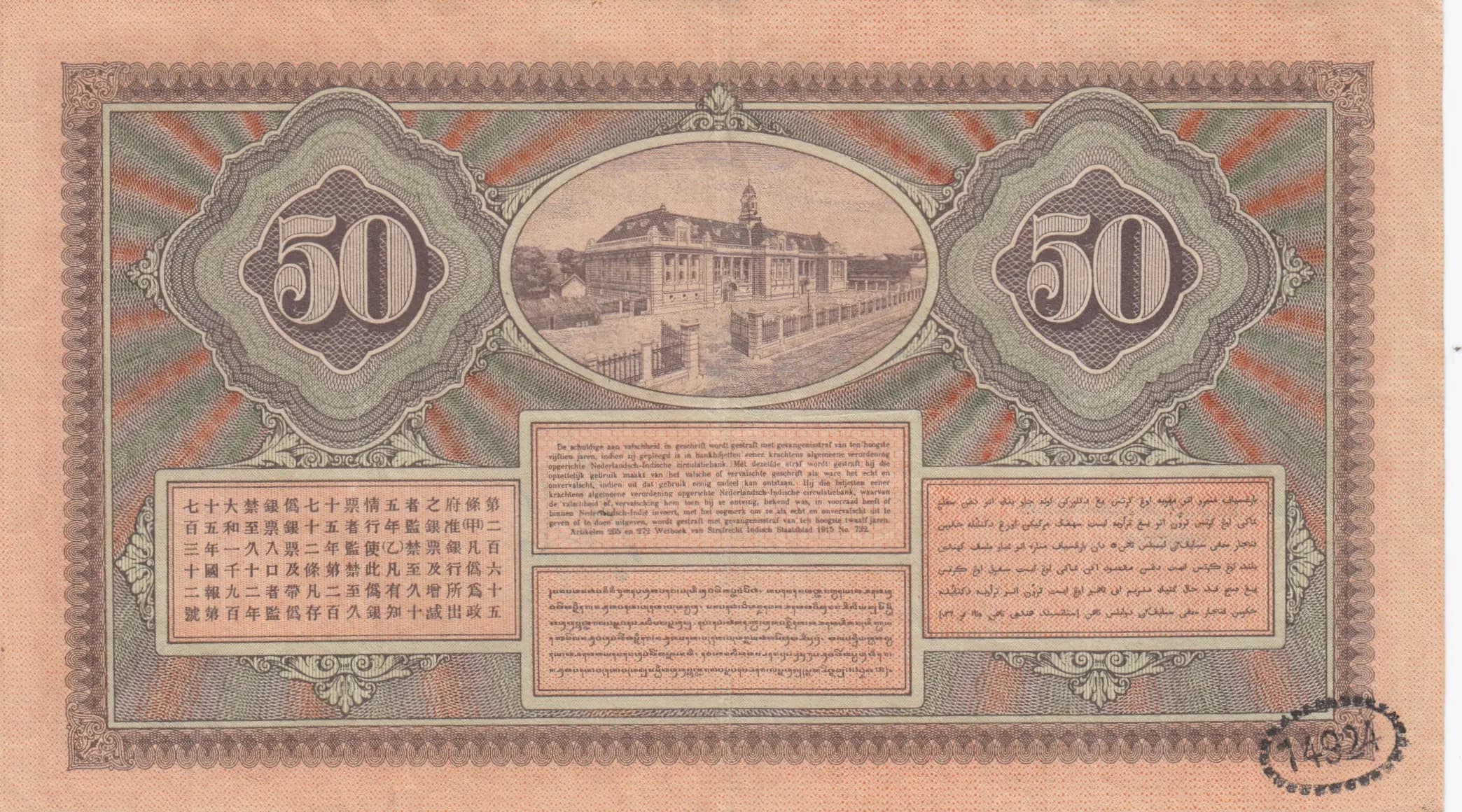
A handsome 50 Gulden note from the Javasche Bank dated 29 April 1929, presented in VF condition with vibrant red and green coloring and excellent detail retention. The note exemplifies the ornate engraving style of late colonial Dutch East Indies currency, featuring a bearded male portrait in historical dress and an institutional building on the reverse. The minimal wear visible in this example, combined with its classical design and colonial-era significance, makes it an appealing example of Netherlands Indies currency.
Common. The Javasche Bank 50 Gulden 1929 (Pick 72b) represents a standard denomination from a significant issuing authority with substantial circulation in the East Indies during the 1930s-1940s. No evidence of an unusually limited print run, early recall, or short-lived issuance exists for this Pick number. While genuinely scarce in very high grades, the VF grade specified is neither exceptional nor indicates particular rarity.
Issued by the Javasche Bank (Java Bank) during the height of the Dutch colonial period in the East Indies, this 1929 note represents the financial infrastructure of colonial Java and the broader Indonesian archipelago under Dutch administration. The prominent institutional building depicted on the reverse—likely the Javasche Bank's headquarters in Batavia (Jakarta)—and the multilingual inscriptions in Dutch, Chinese, and Arabic reflect the cosmopolitan commercial environment and diverse trading networks that characterized colonial Java's economy.
The obverse (front) features an ornate red/coral color scheme with cream background, centered on a portrait of a bearded gentleman in 18th-century style draped clothing, positioned within an ornate oval frame on the right side of the note. A heraldic coat of arms with decorative flourishes is positioned in the center-lower area. Elaborate scrollwork, geometric borders, and corner medallions bearing the denomination '50' frame the design. The reverse displays a multicolored scheme in greens and oranges, dominated by a detailed photographic engraving of a substantial colonial-era institutional building (the Javasche Bank headquarters) within an ornate oval frame. The background features fine geometric radiating line patterns. Both sides showcase exceptional engraving detail consistent with the Dutch East Indies currency standards of the period.
FRONT: 'DE JAVASCHE BANK' (The Java Bank); 'BETAALT AAN TOONDER' (Pays to Bearer); 'VIJFTIG GULDEN' (Fifty Guilders); 'DE SECRETARIS' (The Secretary); 'DE PRESIDENT' (The President); 'BATAVIA 29 APRIL 1929' (Batavia, 29 April 1929); Serial number: JB 01085 (appears twice). BACK: Multiple language inscriptions including Dutch explanatory text, Chinese characters, and Arabic script, positioned in rectangular frames surrounding the central building image. The exact content of the multilingual text on the reverse is partially obscured in the image, but represents standard informational and security text typical of this series.
Intaglio (engraved) printing, utilizing multiple color plates for the polychromatic effect. The fine line work visible throughout the borders, the detailed photographic engraving of the building, and the intricate scrollwork patterns are characteristic of high-security intaglio currency production of the 1920s-1930s era. While the specific printer is not explicitly documented in the provided catalog data, notes of this series were typically produced by Johan Enschedé or similar leading Dutch security printers of the period.
Pick 72b designation indicates this is the second variety of the 1929 50 Gulden issue. Varieties for this series are primarily distinguished by signature combinations and minor design variations. The specific signatures present ('DE SECRETARIS' and 'DE PRESIDENT') and serial number prefix 'JB' are consistent with the standard 1929 production. The date 'BATAVIA 29 APRIL 1929' is fixed for this issue. No overprints or unusual varieties are evident in the visual analysis of this example.