5 gulden 1930
About This Note
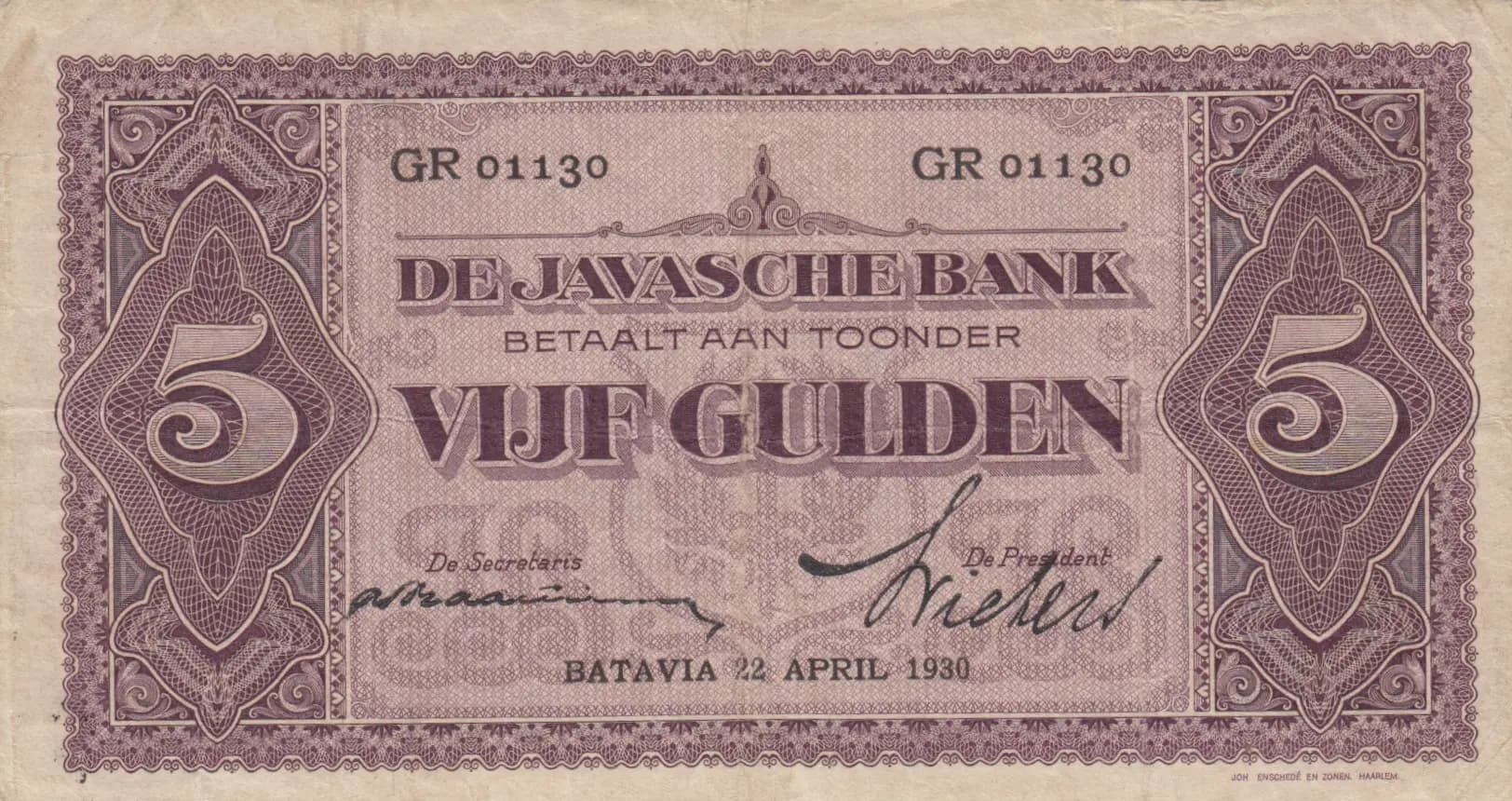
A 5 Gulden note from the Javasche Bank (Java Bank) dated April 22, 1930, representing the colonial-era currency of the Netherlands Indies. The note displays the characteristic purple/mauve coloring of this denomination with ornate geometric and floral border patterns, large decorative numerals, and dual-language inscriptions reflecting the multicultural nature of the Dutch East Indies. In VF condition, this example shows minimal wear with uniform coloration, making it an attractive representation of pre-war Dutch colonial banking.
Common. The Javasche Bank 5 Gulden 1930 (Pick P-69c) was issued in substantial quantities for regular circulation throughout the Dutch East Indies and remains readily available to collectors. No evidence of limited print runs, short-lived issue status, or significant recall exists for this denomination and date. VF condition examples are moderately available in the numismatic market, with typical pricing reflecting common-note valuations rather than scarcity premiums.
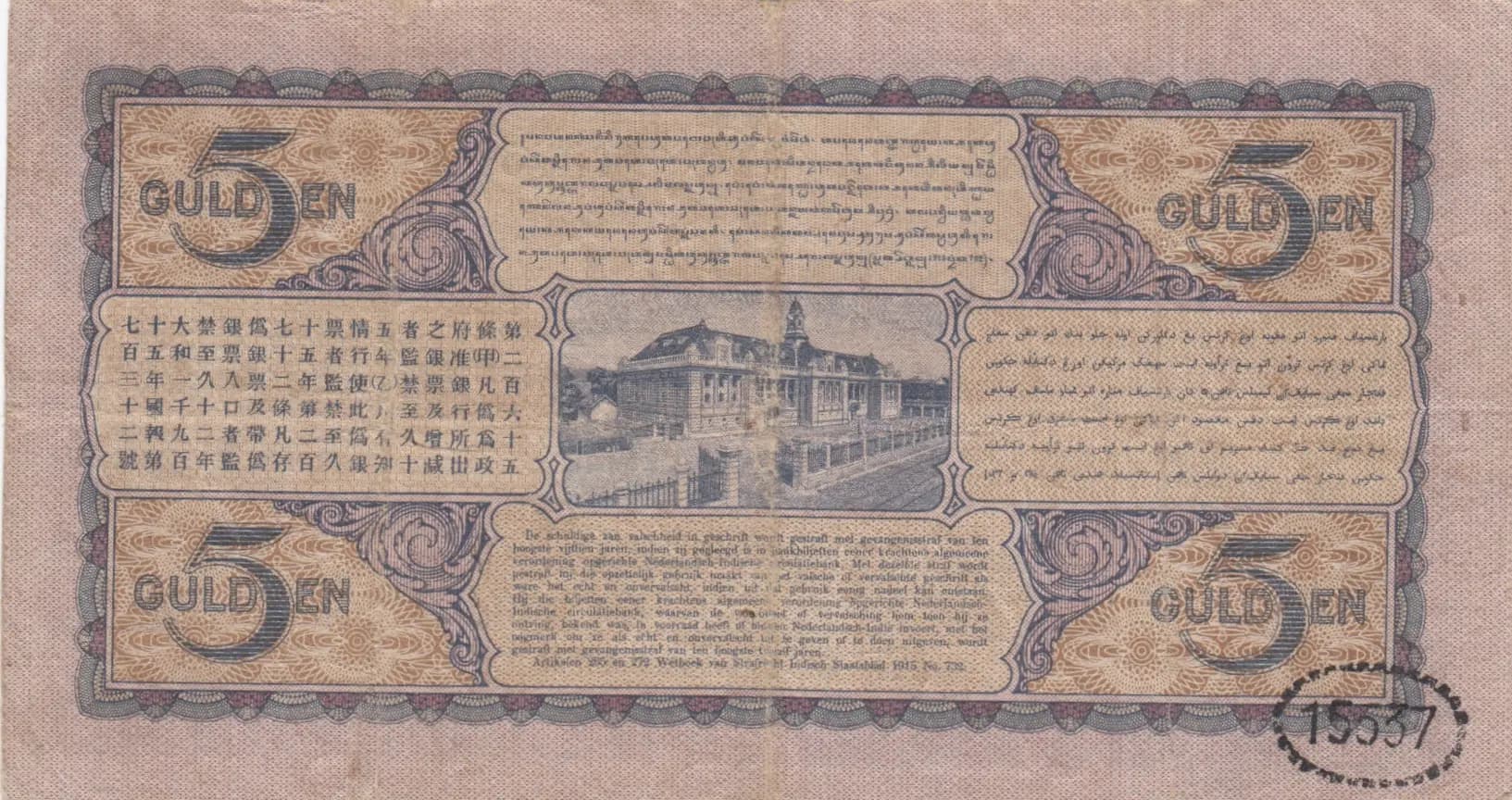
The Javasche Bank was the central bank of the Dutch East Indies (Indonesia), operating under Dutch colonial administration until World War II. This 1930 issue represents the peak of Dutch colonial economic control in Indonesia, with the note's colonial-style architecture depicted on the reverse (the Bank's headquarters in Batavia/Jakarta) serving as a symbol of institutional authority. The presence of Chinese/Japanese text alongside Dutch reflects the cosmopolitan commercial networks of Java during this period of regional economic development.
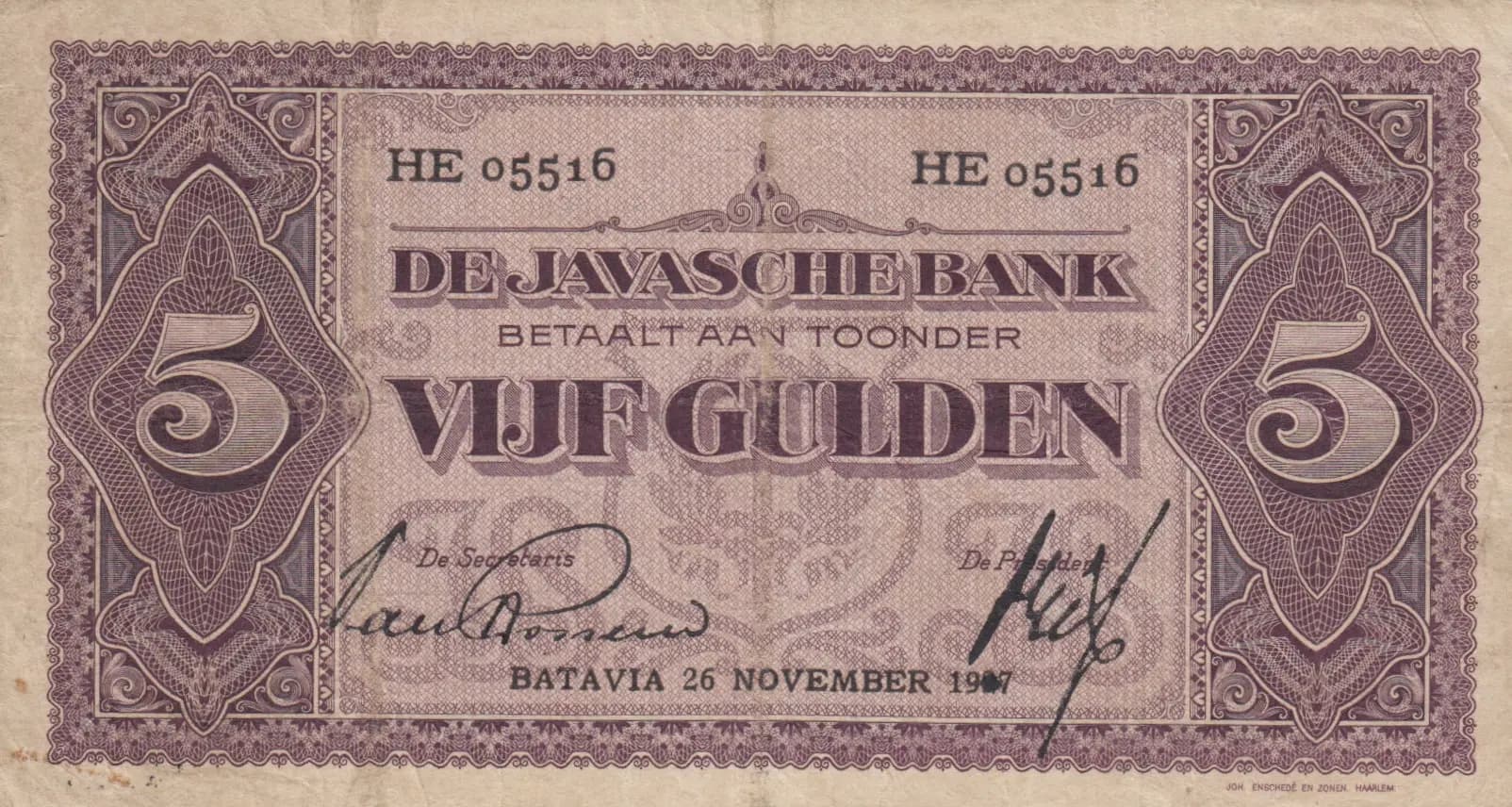
The front of this note features a distinctly classical Dutch design with heavy reliance on engraved ornamentation—symmetrical floral and geometric border patterns frame the composition in cream and purple tones. The central design area contains the bank name and denomination text in formal typography, flanked by large ornamental shields bearing the numeral '5' on both left and right margins. The reverse side depicts the headquarters building of the Javasche Bank in Batavia (now Jakarta), a substantial colonial-era structure with classical Dutch architectural elements including a prominent clock tower and domed cupola, rendered in photographic engraving. The building image is surrounded by multiple text panels and decorative numeral frames, with four large circular frames containing the numeral '5' positioned at the corners. The multilingual text (Dutch, Chinese, and Japanese) reflects the polyglot commercial environment of the Dutch East Indies.
FRONT: 'DE JAVASCHE BANK' (The Java Bank) — issuer identification; 'BETAALT AAN TOONDER' (Payable to Bearer) — legal tender statement; 'VIJF GULDEN' (Five Guilders) — denomination; 'BATAVIA 22 APRIL 1930' (Batavia, April 22, 1930) — place and date of issue; 'De Secretaris' and 'De President' (The Secretary and The President) — signature lines for bank officers; 'JOH. ENSCHEDÉ EN ZONEN, HAARLEM' (Joh. Enschedé and Sons, Haarlem) — printer attribution; 'GR 01130' — serial number. BACK: '5 GULDEN' — denomination (repeated four times); Additional text blocks in Chinese/Japanese and Dutch providing explanatory or regulatory information regarding the note's legal status and use.
Intaglio engraving on banknote paper, produced by Joh. Enschedé and Sons of Haarlem, a renowned Dutch security printer. The front features fine-line engraving with elaborate geometric cross-hatching for security purposes, while the reverse combines photographic engraving of the building with traditional intaglio line work for the decorative frames and numerals. The complexity of the border patterns and multi-color printing (purple on front, tan/cream with blue-gray accents on reverse) demonstrates the high-quality security printing standards of 1930s Dutch colonial banking.
The noted example bears serial number GR 01130, with the 'GR' prefix indicating a specific printing batch. Minor varieties for this Pick number may include different signature combinations for 'De President' and 'De Secretaris' positions, reflecting the multiple terms of bank leadership during 1930. The date 'BATAVIA 22 APRIL 1930' is fixed for this issue. A post-1935 stamp impression is visible on the reverse, likely representing postal or banking handling rather than an official variety marker. No major known varieties have been formally cataloged for Pick P-69c.