50 gulden 1943
About This Note
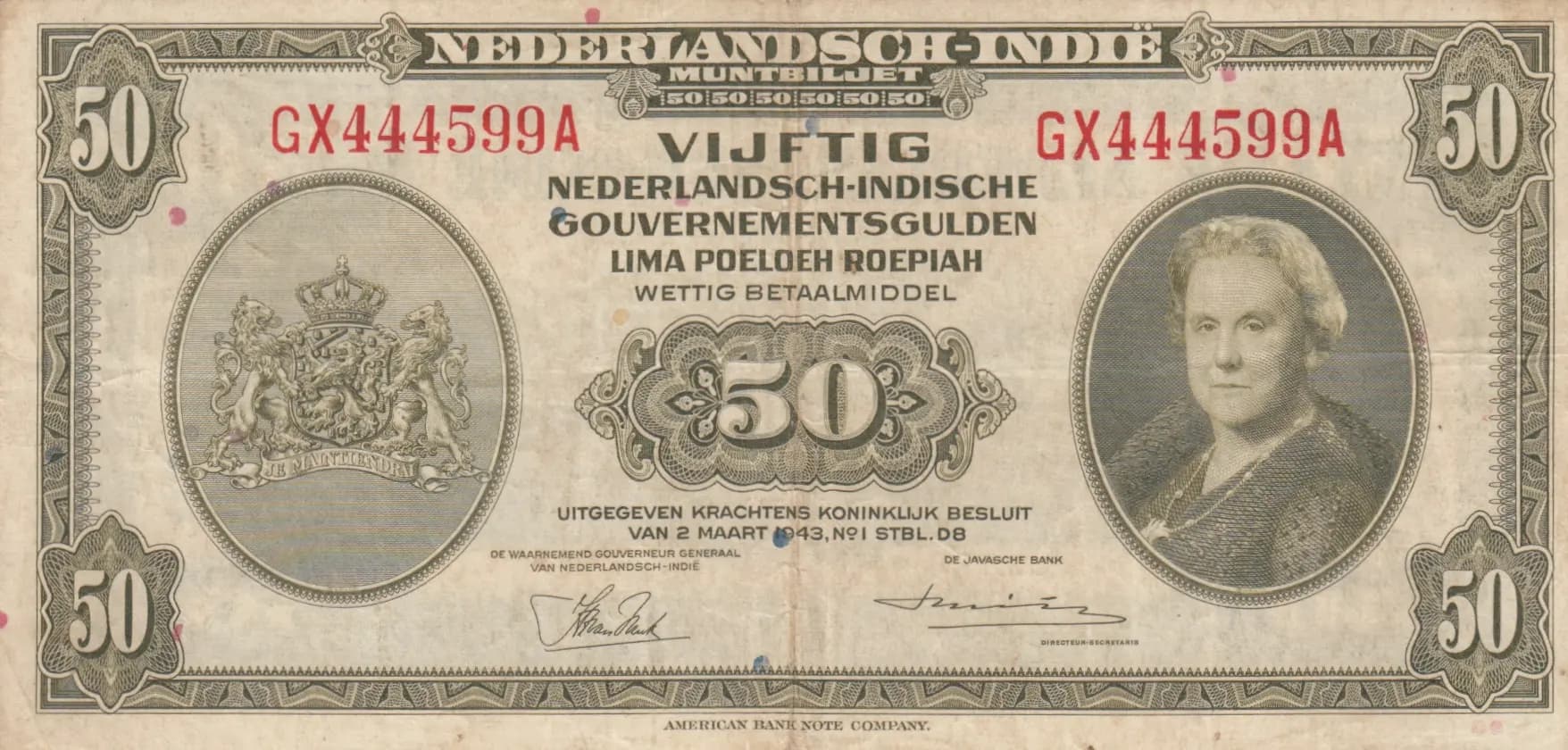
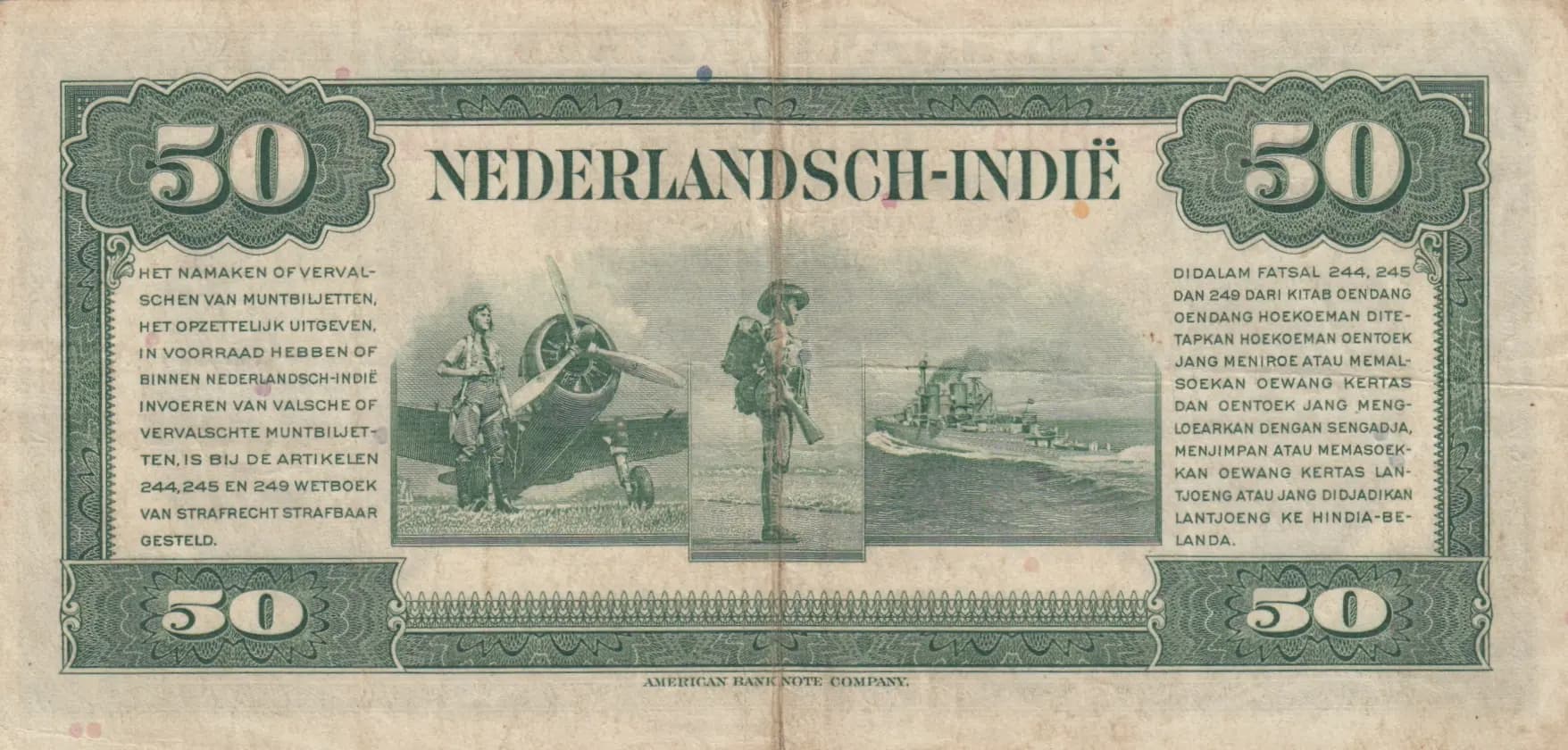
This 1943 Netherlands Indies 50 Gulden (Pick-116) is a wartime currency note issued under royal decree during Japanese occupation, featuring a cream-colored obverse with a woman's portrait and Dutch heraldic coat of arms, and a teal-green reverse depicting military vignettes including soldiers, aircraft, and naval vessels. The note displays VF condition with visible aging characteristics including light foxing, a vertical center fold, and overall yellowing consistent with an 81-year-old note, making it a historically significant example of emergency wartime currency from the Dutch East Indies.
Common. The 1943 Netherlands Indies 50 Gulden (Pick-116) was issued in substantial quantities as an emergency wartime currency during the final years of Dutch colonial rule. While these notes circulated extensively and many were damaged or destroyed, the denomination and issuer produced large print runs typical of wartime necessity currency. The VF condition grade is readily available in the collector market, indicating healthy survivor population. These notes appear regularly in dealer inventories and auction markets at modest valuations, confirming their common status despite their historical significance.
Issued March 2, 1943, during the Japanese occupation of the Netherlands Indies (1942-1945), this Muntbiljet (emergency currency issue) represents the Dutch colonial government's attempt to maintain monetary authority even as the territory was under military occupation. The reverse's military imagery—soldiers, aircraft, and warships—reflects the Netherlands Indies' strategic military importance during World War II, while the bilingual Dutch and Malay text demonstrates the colonial administration's dual-language governance structure that persisted through the war years.
The obverse features a portrait of a woman in formal colonial-era dress positioned within an oval frame on the right side, complemented by the Dutch royal coat of arms (featuring lions and crown) in an oval frame on the left side. The denomination '50' appears in ornate decorative frames in all four corners. The center displays bilingual text in Dutch and Malay reflecting the dual-language administrative structure of the Netherlands Indies. The reverse depicts three military vignettes in the center: a soldier figure with military equipment on the left, a military aircraft in the center, and a naval warship on the right, symbolizing the colonial military forces. The overall design employs cream and beige tones on the obverse with decorative geometric and scrollwork borders, while the reverse uses a teal-green background. Both sides include fine engraved detail and repeated ornamental patterns characteristic of high-security currency printing.
FRONT SIDE: '50' / 'VIJFTIG' (Fifty) / 'NEDERLANDSCH-INDISCHE GOUVERNEMENTSGULDEN' (Netherlands-Indies Government Guilder) / 'WETTIG BETAALMIDDEL' (Legal tender) / 'LIMA POELOEH ROEPIAH' (Fifty Rupiah - Malay/Indonesian equivalent) / Serial number: GX444599A / 'UITGEGEVEN KRACHTENS KONINKLIJK BESLUIT VAN 2 MAART 1943, NO I STBL.DB' (Issued by royal decree of March 2, 1943, No. 1 State Bulletin) / 'DE WAARNEMEND GOUVERNEUR GENERAAL VAN NEDERLANDSCH-INDIE' (The Acting Governor-General of the Netherlands-Indies) / 'DE JAVASCHE BANK' (The Javasche Bank) / 'DIRECTEUR-SECRETARIS' (Director-Secretary) / 'AMERICAN BANK NOTE COMPANY' (Printer attribution). BACK SIDE: '50' / 'NEDERLANDSCH-INDIË' (Netherlands-Indies) / 'HET NAMAKEN OF VERVALSCHEN VAN MUNTBIJZETTEN...' (Counterfeiting or forgery of currency coins, intentional circulation, hoarding or importing of counterfeit or forged currency within the Netherlands-Indies is punishable under articles 244, 245 and 249 of the Criminal Code) / Indonesian equivalent warning in Malay: 'DIDALAM FATSAL 244, 245 DAN 249...' (In sections 244, 245 and 249 of the Criminal Code stipulating penalties for counterfeiters and those who circulate, keep or import counterfeit paper money into the Dutch East Indies) / 'AMERICAN BANK NOTE COMPANY' (Printer attribution).
Intaglio engraving with multi-color letterpress elements, executed by American Bank Note Company (ABNC), the world's premier security printer of the era. The fine engraved detail visible throughout the note, particularly in the portrait and vignette areas, combined with the ornate border designs and decorative frames, demonstrates the sophisticated intaglio process. The two-color printing (cream/black on obverse; teal-green/black on reverse) with red serial numbers indicates sequential application of printing plates, consistent with ABNC's premium security currency production methods of the 1940s.
The observed serial number GX444599A indicates this specific note from the standard production run of this denomination. The red serial number placement and formatting is consistent with the standard 1943 issue. No significant varieties (such as overprints, signature variants, or color variations) are evident in this example. This represents a typical example of the standard 1943 printing without distinguishing variety characteristics.