5 gulden 1943
About This Note
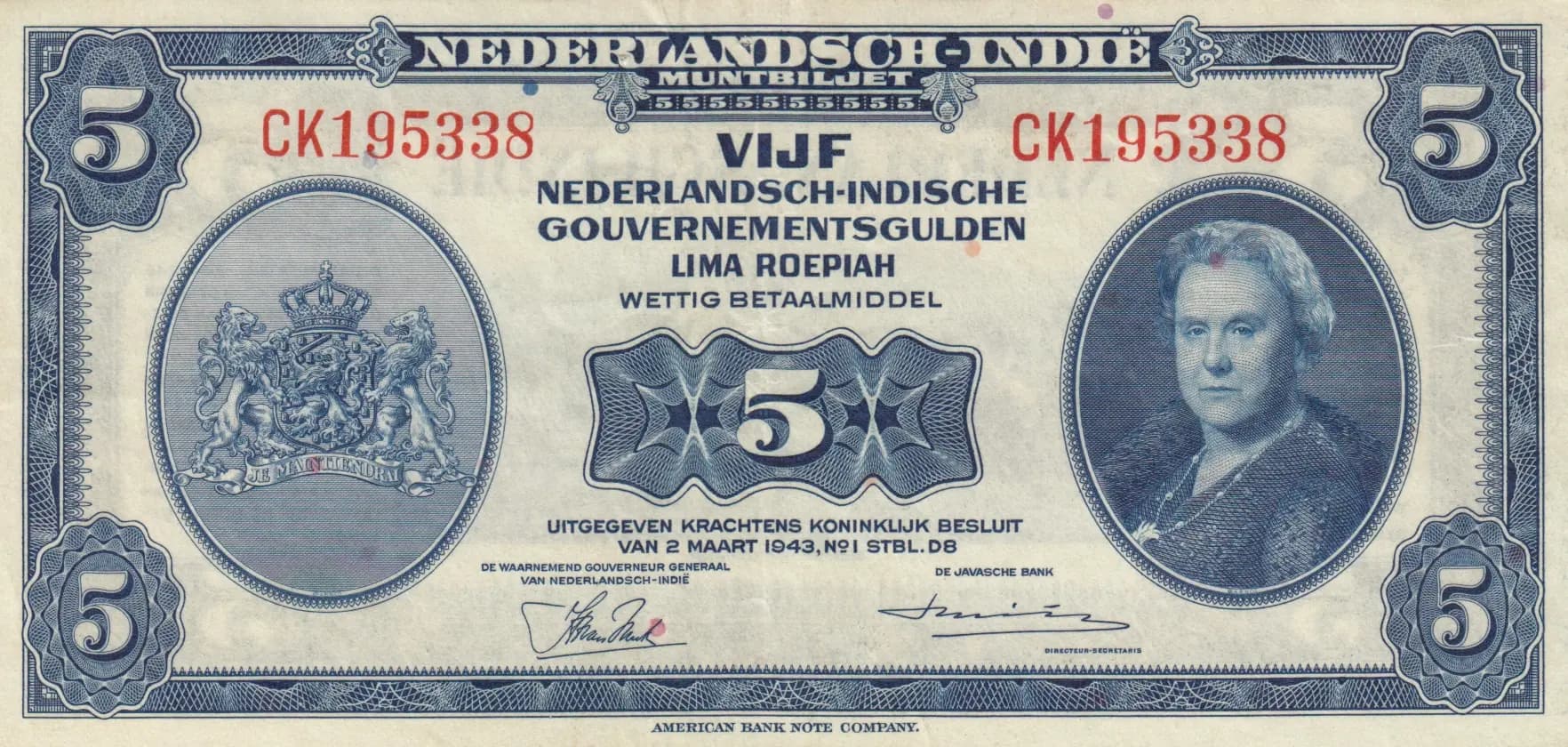
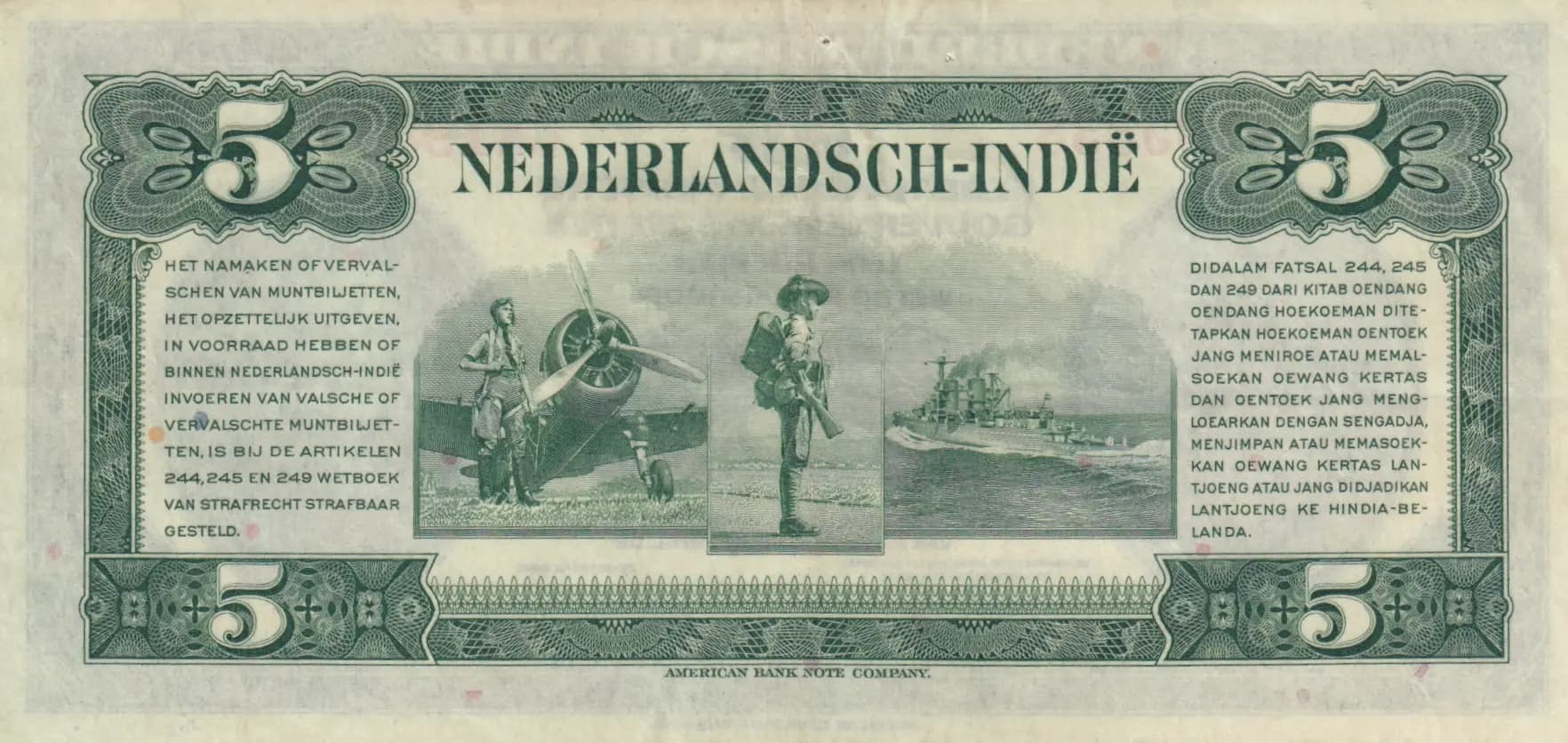
This is a VF-graded 5 Gulden banknote from Netherlands Indies (Pick P-113), issued in 1943 by Muntbiljet under Royal Decree. The front features the Dutch coat of arms and a formal portrait in oval frames with blue ornate borders and red serial number CK195338, while the reverse depicts colonial military scenes including soldiers and a naval vessel in green tones. The note exhibits crisp printing, uniform color, and excellent preservation with no visible circulation wear, making it an attractive example of Japanese occupation-era Netherlands Indies currency.
Common. The 1943 5 Gulden Muntbiljet notes from the Netherlands Indies were issued in significant quantities during the wartime occupation period. While these notes are historically interesting due to their World War II context and dual-language design, they are not scarce in the numismatic market. VF-graded examples appear regularly in collections and dealer inventories, indicating a robust supply relative to collector demand. Typical market pricing for such notes in this condition grade does not suggest rarity.
Issued on March 2, 1943, during the Japanese occupation of the Netherlands Indies in World War II, this banknote represents the transitional monetary period when the Dutch colonial administration's currency remained nominally in use alongside Japanese occupation notes. The reverse imagery depicting Dutch colonial military forces reflects the pre-war iconography of the Netherlands Indies government, while the denomination is expressed in both Dutch guilders and Malay rupiah, symbolizing the hybrid nature of colonial-era currency. This series of Muntbiljet notes (government banknotes) were among the last official Dutch colonial issues before complete Japanese monetary reorganization.
The front of this 5 Gulden note features a symmetrical classical design with the Dutch royal coat of arms (featuring heraldic lions and regalia) positioned in an oval frame on the left side, balanced by a formal portrait of a colonial-era official or dignitary in profile within an oval frame on the right side. The denomination '5' appears in all four corners within decorative frames. The entire design is framed by elaborate blue guilloche borders and ornamental scrollwork. The back depicts a patriotic tableau of Dutch colonial military power, featuring three soldiers in various poses (one with a cannon, one standing at attention, one with a rifle) arranged across the center, with a Dutch naval warship depicted on the right side, all rendered in fine engraved detail against a pale green background. The dual-language text (Dutch and Malay) reinforces the colonial administrative nature of the note. All inscriptions are rendered in serif typeface with professional clarity.
FRONT: 'NEDERLANDSCH-INDIE' (Netherlands Indies); 'VIJF' (Five); 'NEDERLANDSCH-INDISCHE GOUVERNEMENTSGULDEN LIMA ROEPIAH' (Netherlands Indies Government Guilders, Five Rupiah); 'WETTIG BETAALMIDDEL' (Legal Tender); 'UITGEGEVEN KRACHTENS KONINKLIJK BESLUIT VAN 2 MAART 1943, N°1 STBL. D8' (Issued by Royal Decree of March 2, 1943, No. 1 State Journal D8); 'DE WAARNEMEND GOUVERNEUR GENERAAL VAN NEDERLANDS-INDIË' (The Acting Governor General of the Netherlands Indies); 'DE JAVASCHE BANK' (The Javanese Bank); 'DIRECTEUR-SECRETARIS' (Director-Secretary); Serial number: CK195338; Printer: 'AMERICAN BANK NOTE COMPANY.' BACK: 'NEDERLANDSCH-INDIË' (Netherlands Indies); 'HET NAMAKEN OF VERVALSCHCHEN VAN MUNTBIJJETTEN, HET OPZETTELIJK UITGEVEN, IN VOORRAAD HEBBEN OF BINNENLANDS-INDIË INVOEREN VAN VALSCHE OF VERVALSCHTE MUNTBIJJETTEN, IS BIJ DE ARTIKELEN 244, 245 EN 249 WETBOEK VAN STRAFRECHT STRAFBAAR GESTELD.' (The counterfeiting or forging of banknotes, the intentional issuance, possession in the Netherlands Indies or importation of false or forged banknotes is punishable under Articles 244, 245 and 249 of the Penal Code); 'DIDALAM FATSAL 244, 245 DAN 249 DARI KITAB OENDANG OENDANG HOEKOEMAN DITE-TAPKAN HOEKOEMAN OENTOESK JANG MENIROAE ATAU MEMAALSOEKAN OEWANG KERTAS DAN OENTOESK JANG MENGLOARKAN DENGAN SENGADJA, MENIMPAN ATAU MEMASOEIKAN OEWANG KERTAS LANTIJOENG ATAU JANG DIDJADIKAN LANTJOENG KE HINDIA-BELANDA.' (Malay version of counterfeiting penalties); Printer: 'AMERICAN BANK NOTE COMPANY.'
This banknote was produced using traditional intaglio engraving (copperplate printing), as evidenced by the crisp, finely detailed line work, the intricate guilloche patterns, the precise portraiture, and the detailed military and naval scenes visible on the reverse. The American Bank Note Company, credited as the printer, was renowned for this security printing technique. The multi-color printing (blue on front, green on back) was achieved through successive passes of the engraved plates, a hallmark of high-security currency production of the era.
The observed variety is identified by serial number prefix 'CK' and the specific serial number CK195338. The 1943 issue features the Royal Decree date of March 2, 1943, with State Journal reference N°1 STBL. D8. The note is signed by the Acting Governor General (position indicated but specific signatory not clearly legible in this image). Different serial number prefixes and signature variations exist within the 1943 5 Gulden series, though the primary distinguishing characteristics for collectors are the serial letter combinations. No overprints or exceptional varieties are apparent on this example.