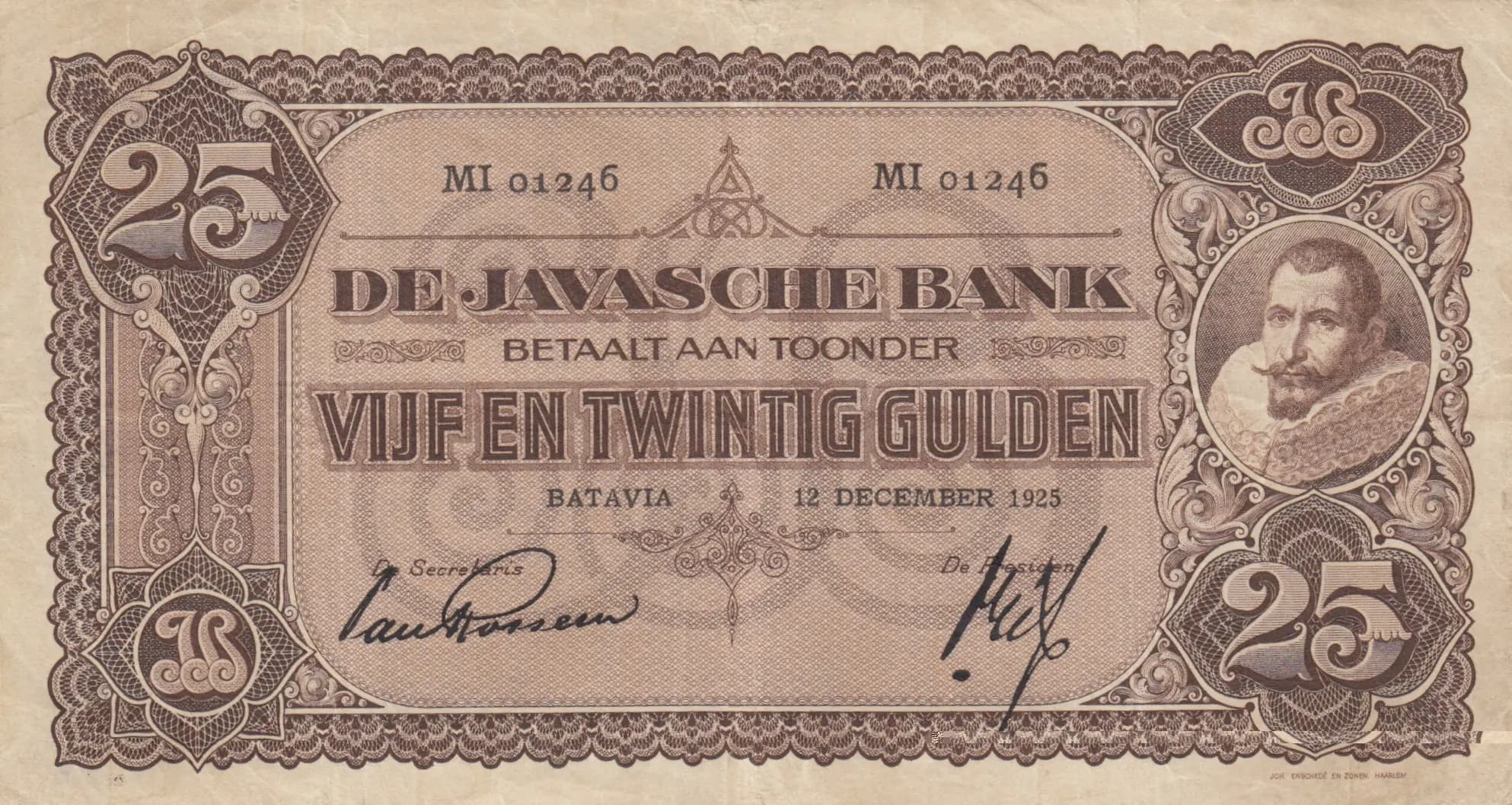
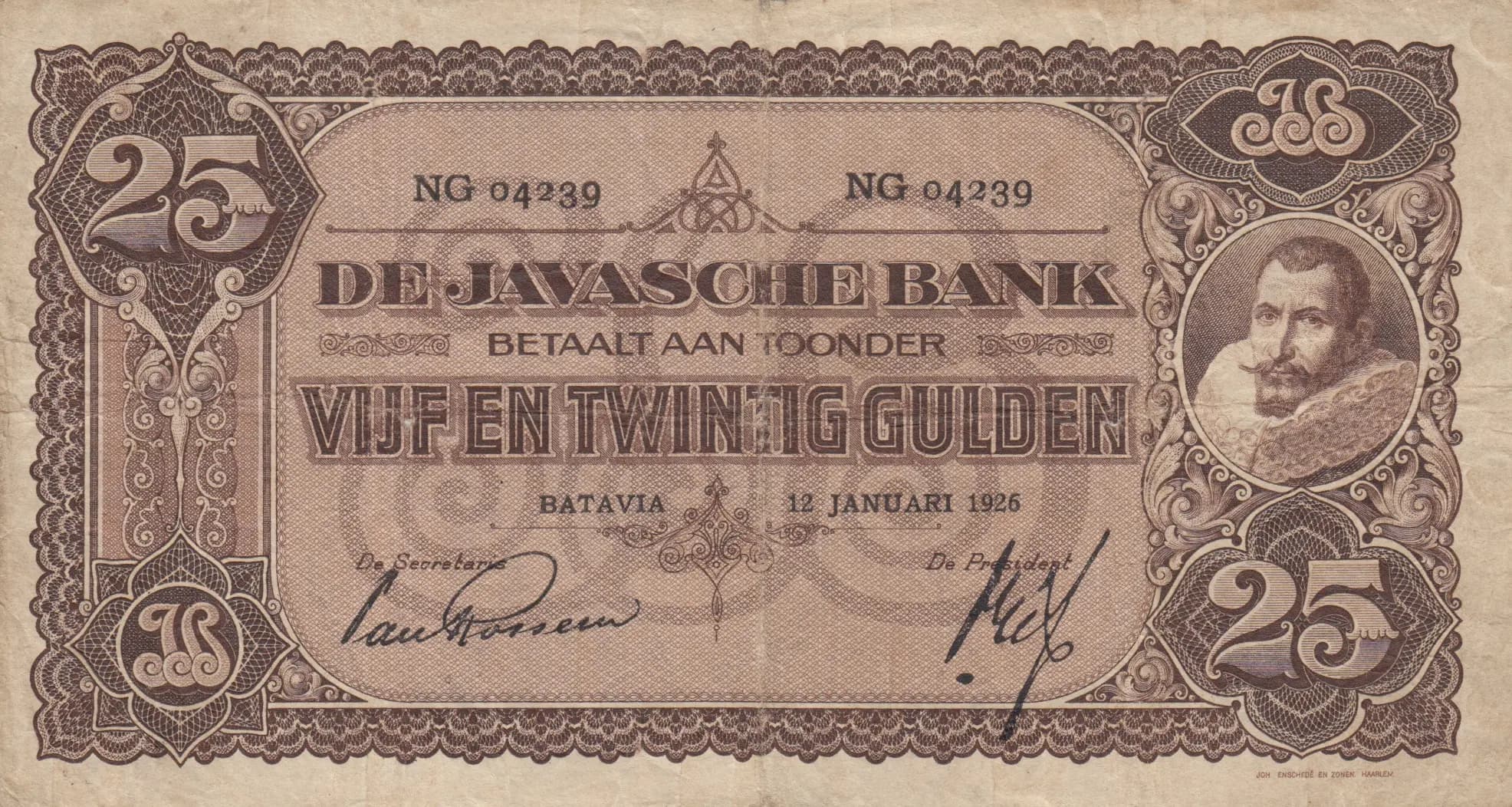
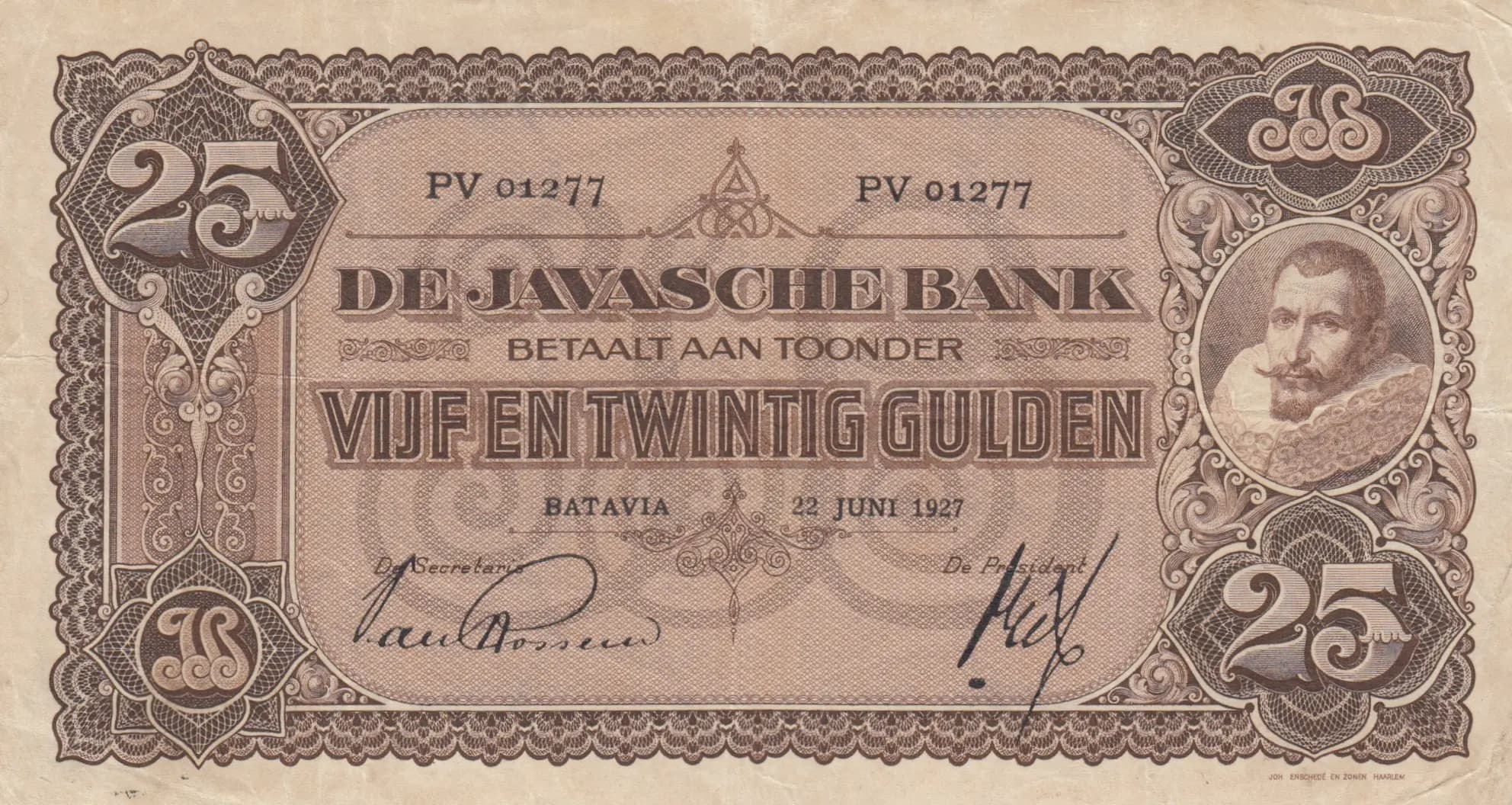
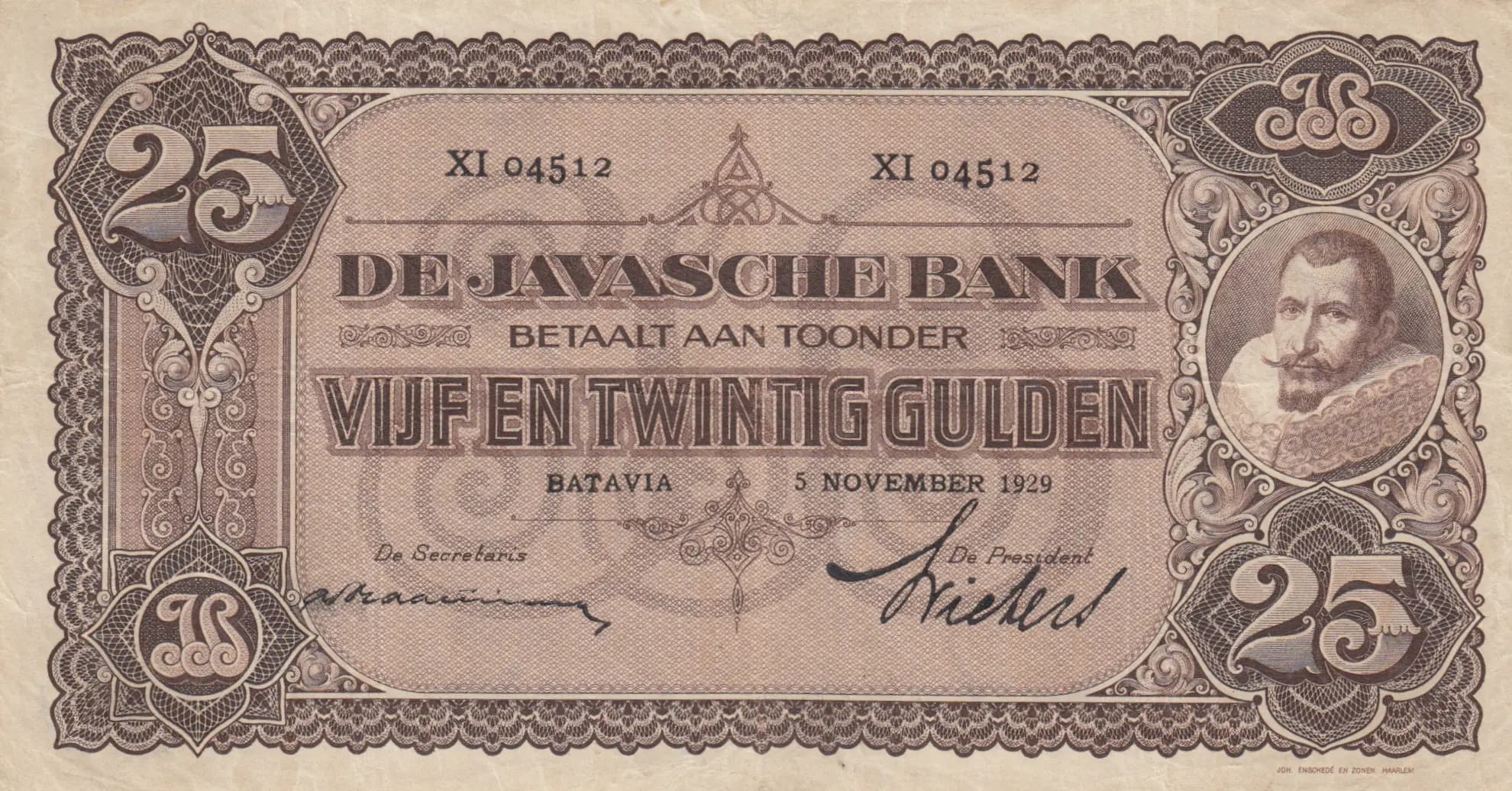
25 gulden 1929
About This Note
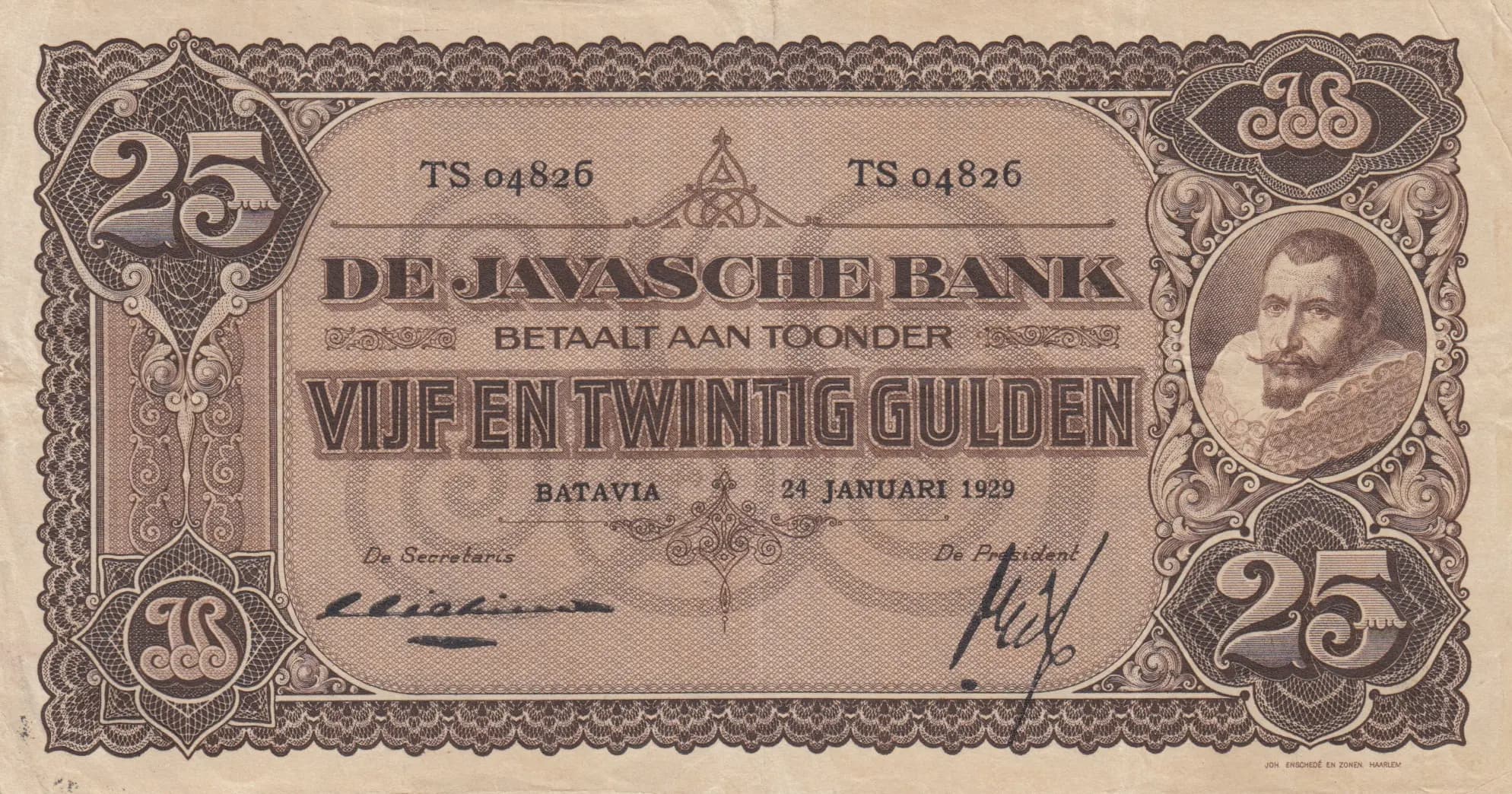
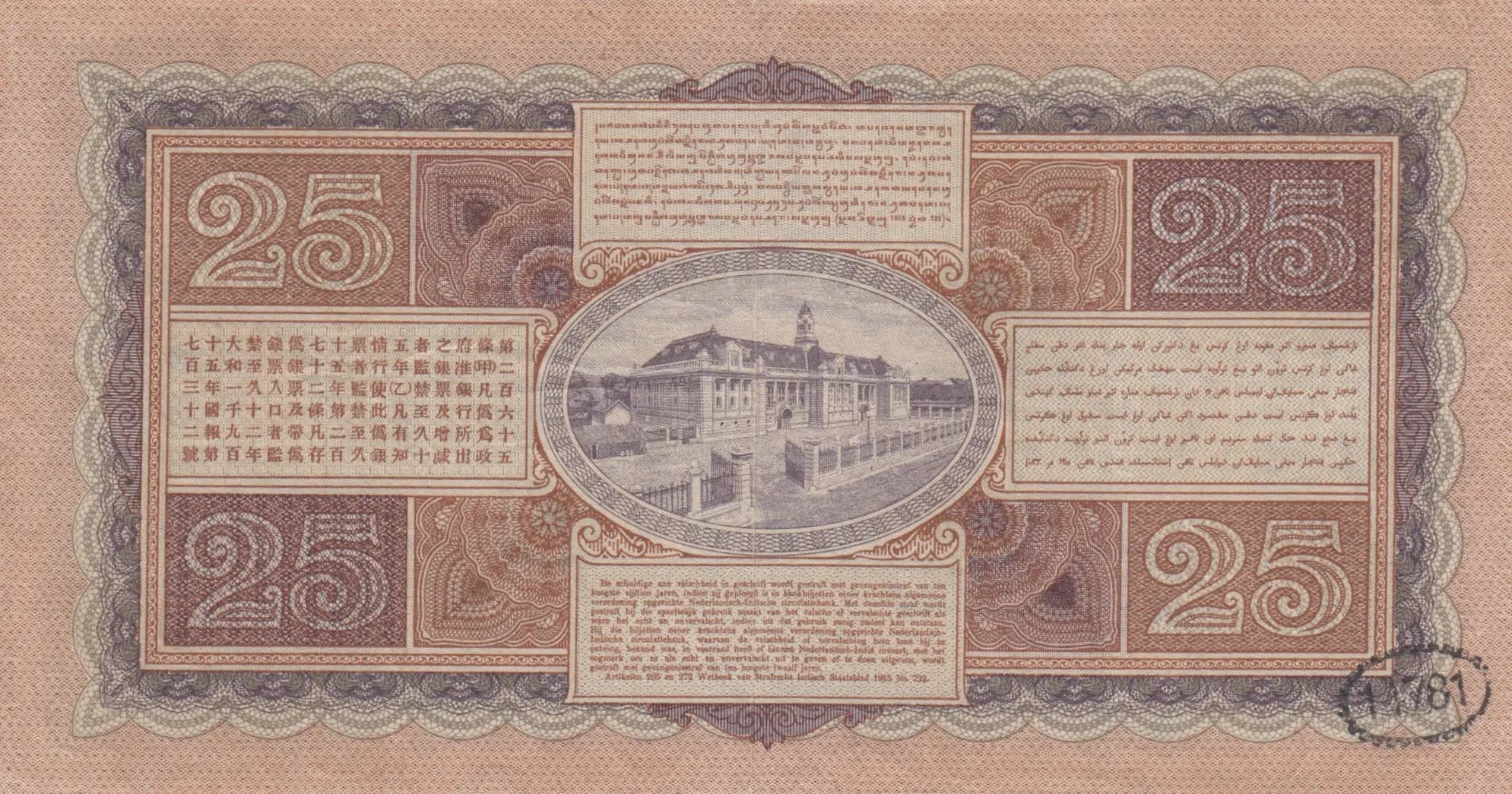
A handsome example of the 25 gulden banknote issued by De Javasche Bank on 24 January 1929, displaying the characteristic brown/sepia color scheme and ornate engraved borders typical of colonial-era East Indies currency. The note exhibits a VF condition grade with age-appropriate toning and foxing, showing minimal handling wear despite its 95-year age. The detailed portrait on the obverse and the striking colonial institutional building vignette on the reverse make this a visually compelling specimen of pre-World War II Netherlands Indies numismatic heritage.
Common. The 25 gulden denomination from De Javasche Bank's 1929 series was produced in substantial quantities for regular circulation throughout the Dutch East Indies. No specific information suggests restricted print runs, early recalls, or significant scarcity for this Pick number. VF condition examples remain readily available in the numismatic market at modest prices, typically ranging $15-40 USD depending on serial number and exact condition. The note's age and the relatively small collector base for Indies currency keeps values moderate rather than premium.
This note was issued during the final decades of the Dutch East Indies colonial period by De Javasche Bank (The Java Bank), the principal currency authority for the region before Indonesian independence. The colonial-era institutional building depicted on the reverse, shown with its distinctive cupola within fortified walls, represents the administrative infrastructure of Dutch colonial governance in Java. The multilingual text panels in Chinese and Arabic on the reverse reflect the cosmopolitan commercial environment of the Indies, acknowledging the significant Chinese and Arab merchant communities that facilitated regional trade.
The obverse features a distinguished portrait of a bearded man in historical dress with an ornate ruffled collar, positioned within an elegant oval decorative frame on the right side of the note. The man's identity, consistent with banknotes of this era and issuer, likely represents a significant figure in the bank's or colonial administration's history. The reverse showcases a central oval vignette depicting a substantial colonial-era institutional building—likely a government or administrative building—characterized by its prominent cupola and dome, surrounded by protective walls and formal fencing. This architectural imagery symbolized Dutch colonial authority and permanence in the East Indies. Both sides are enriched with intricate scrollwork, filigree ornamentation, and geometric border patterns in the classical style favored by the Bank of England-trained printers of the era.
FRONT: 'DE JAVASCHE BANK' (The Java Bank) | 'BETAALT AAN TOONDER' (Payable to Bearer) | 'VIJF EN TWINTIG GULDEN' (Twenty-five Guilders) | '25' (denomination numerals in top left and bottom right) | 'BATAVIA' (place of issue) | '24 JANUARI 1929' (24 January 1929) | 'De Secretaris' (The Secretary) | 'De President' (The President) | Serial number: 'TS 04826' | BACK: '25' (in all four corners) | 'Artikel 308 en 773 Wetboek van Koophandel Inzake Strafwet 1918 No. 338' (Article 308 and 773 Commercial Code Regarding Criminal Law 1918 No. 338) | Chinese text panel (left side, content unclear from image quality) | Arabic text panel (right side, content unclear from image quality) | Dutch text panel (bottom, content unclear from image quality)
Steel engraving with intaglio printing, executed with exceptional technical precision typical of Thomas de la Rue's security printing standards. The fine-line engraving is evident throughout the design, particularly in the complex decorative borders, the background filigree work, and the detailed portraiture. The multiple language text panels demonstrate sophisticated typographic integration. This note exemplifies the highest standards of security banknote production from the period, with intricate cross-hatching, scrollwork, and vignette work designed to prevent counterfeiting. The printer, while not explicitly stated on this note, follows the design and technical characteristics consistent with De Javasche Bank's standard production practices of the 1920s-1930s period.
This specific example carries serial number TS 04826 with the 'TS' prefix, representing one of the standard serial number series for this issue. The note is dated 24 January 1929 and bears signatures identified as 'De President' and 'De Secretaris' of De Javasche Bank. Minor varieties may exist in serial number prefixes and signature variations across the print run, but the 1929 25 gulden Pick 71b does not have widely documented major varieties comparable to other issues. The absence of overprints or special markings on this example indicates it represents a standard circulation issue from the primary production run.