25 gulden 1926
About This Note
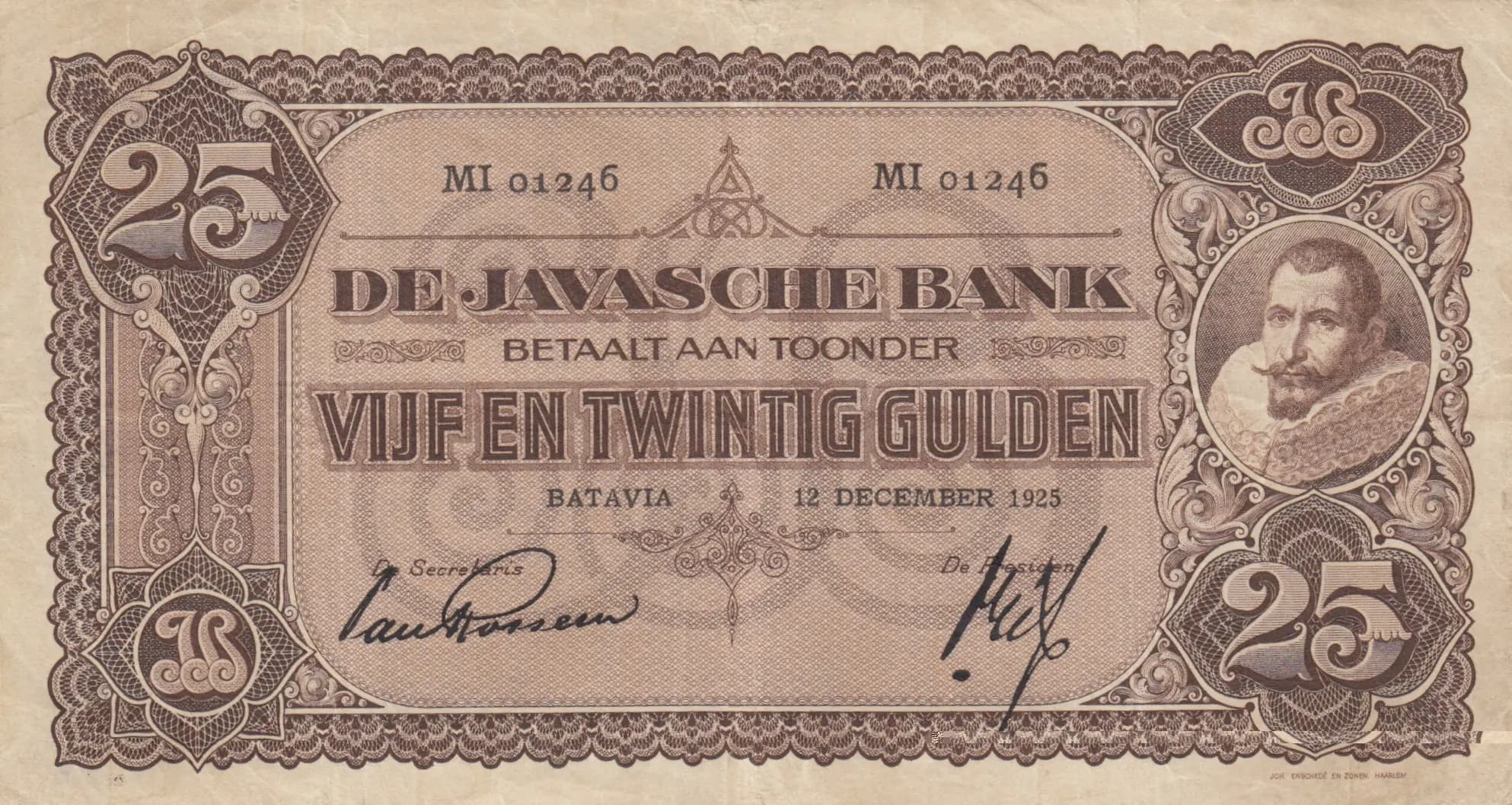
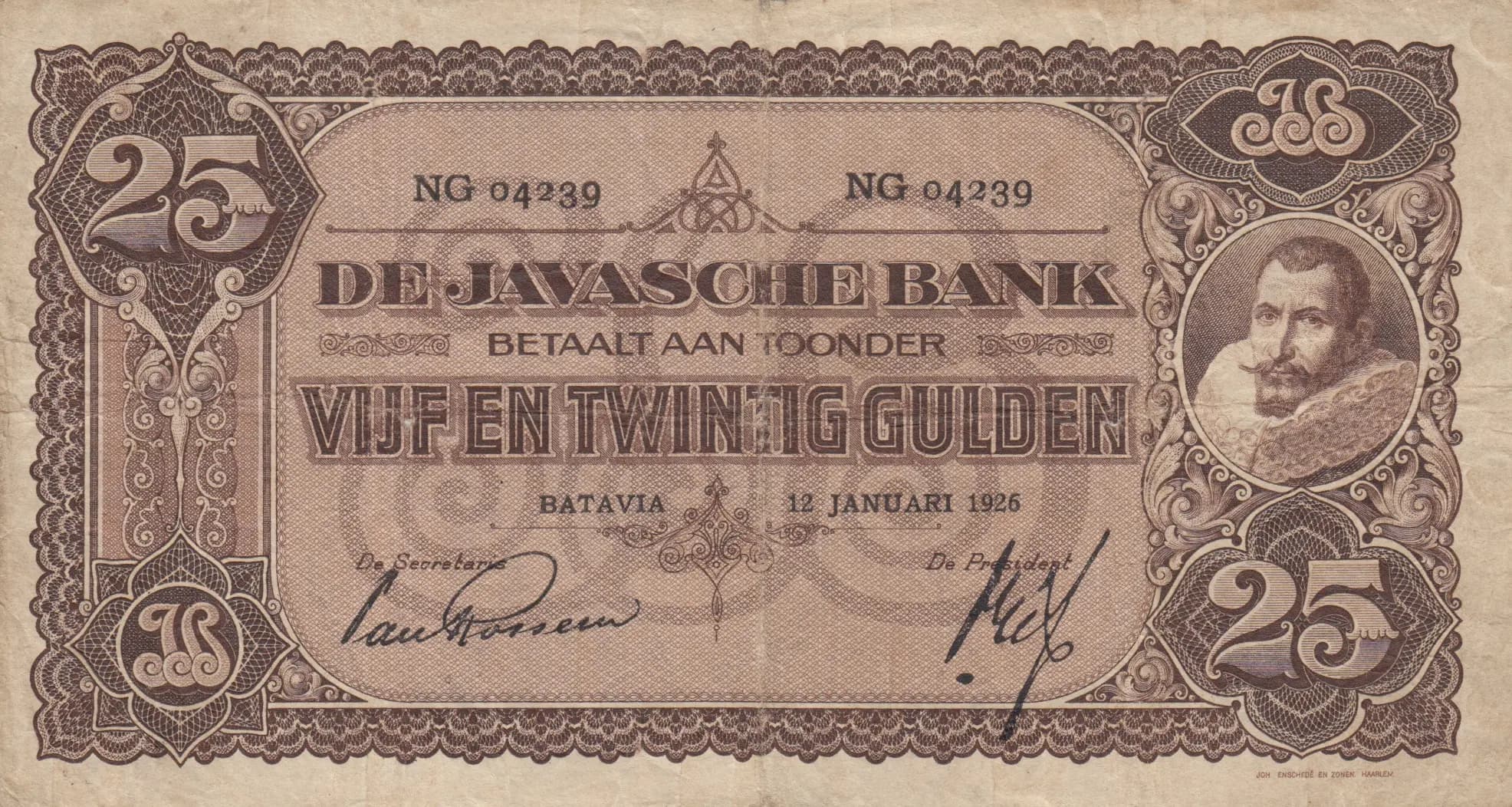
This is a 25 Gulden note issued by Javasche Bank on 12 January 1926, representing an important example of Netherlands Indies currency from the colonial period. The note exhibits significant age-related patination with brown and sepia toning throughout, consistent with its nearly 100-year age, and displays the fine engraved craftsmanship characteristic of early 20th-century banknote production. The Fair condition grade reflects visible creasing, foxing, and wear, yet the intricate ornamental borders and portrait engraving remain well-defined, making this a collectible piece of colonial Indonesian financial history.
Common. The 25 Gulden denomination from the 1926 Javasche Bank issue represents a standard circulation note from a substantial print run. While individual notes of this age show significant wear due to decades of handling and storage, the issue itself was not limited or recalled. Fair condition examples are routinely available in the collector market at modest prices, indicating strong supply relative to collector demand.
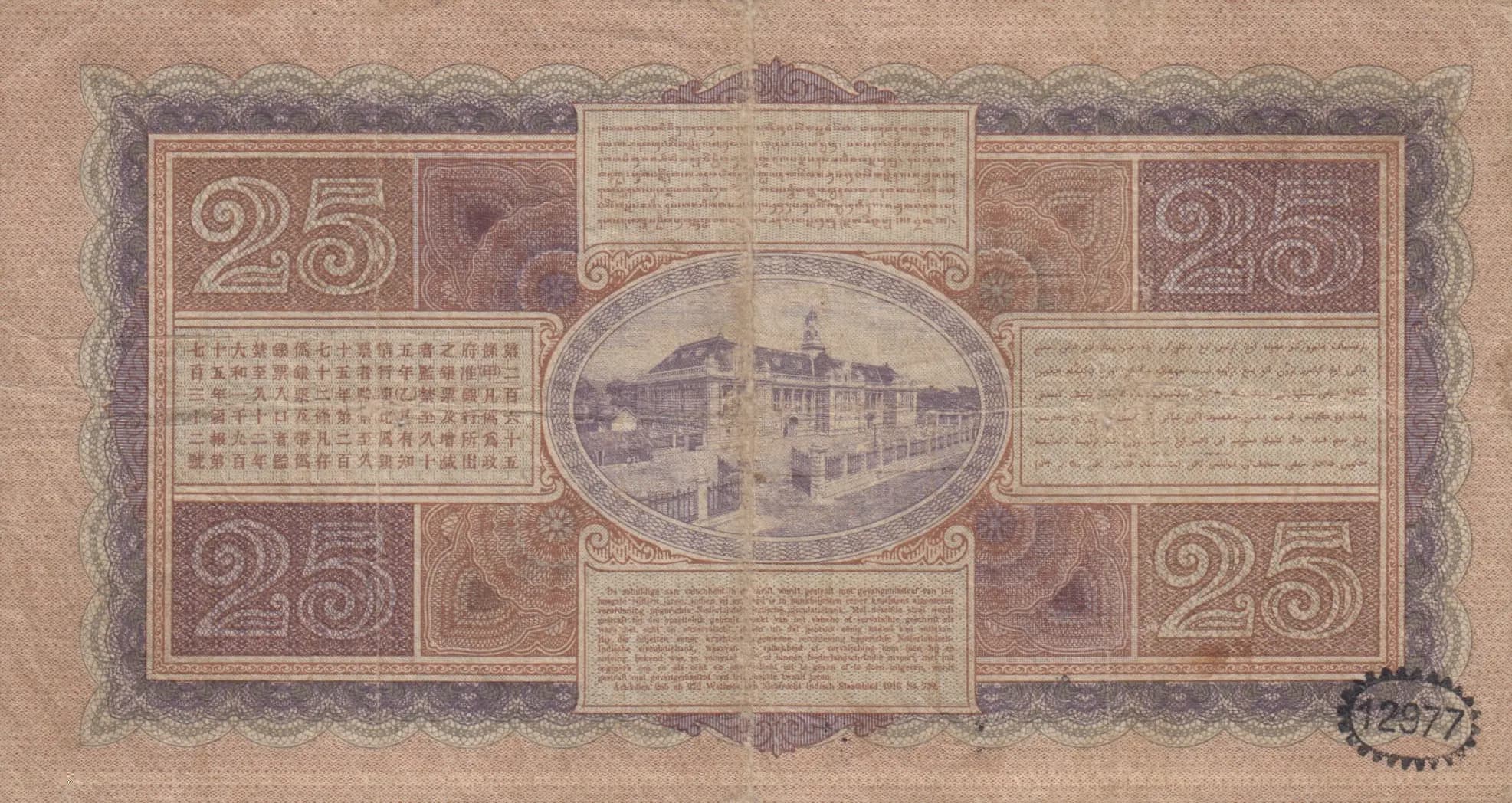
Issued during the height of Dutch colonial rule in the Netherlands Indies, this 1926 note reflects the administrative and economic structure of the Dutch East Indies under the Javasche Bank, which served as a key financial institution in Batavia (modern Jakarta). The architectural vignette on the reverse depicts a prominent colonial-era government building, symbolizing European administrative presence in the archipelago. The parallel use of Dutch language inscriptions with what appears to be Chinese characters reflects the multicultural commercial environment of early 20th-century Java, where Chinese merchants played a significant role in regional trade and finance.
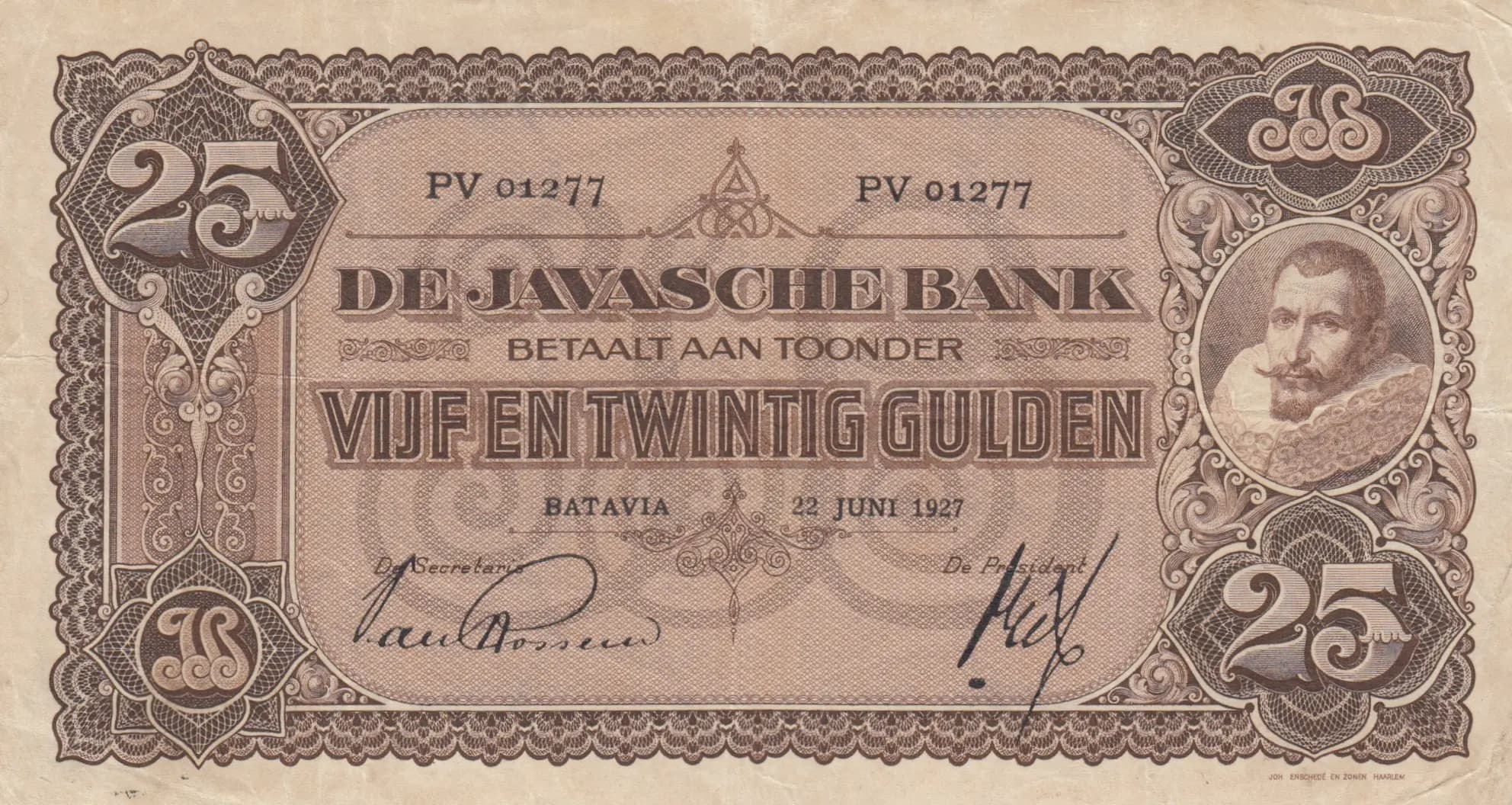
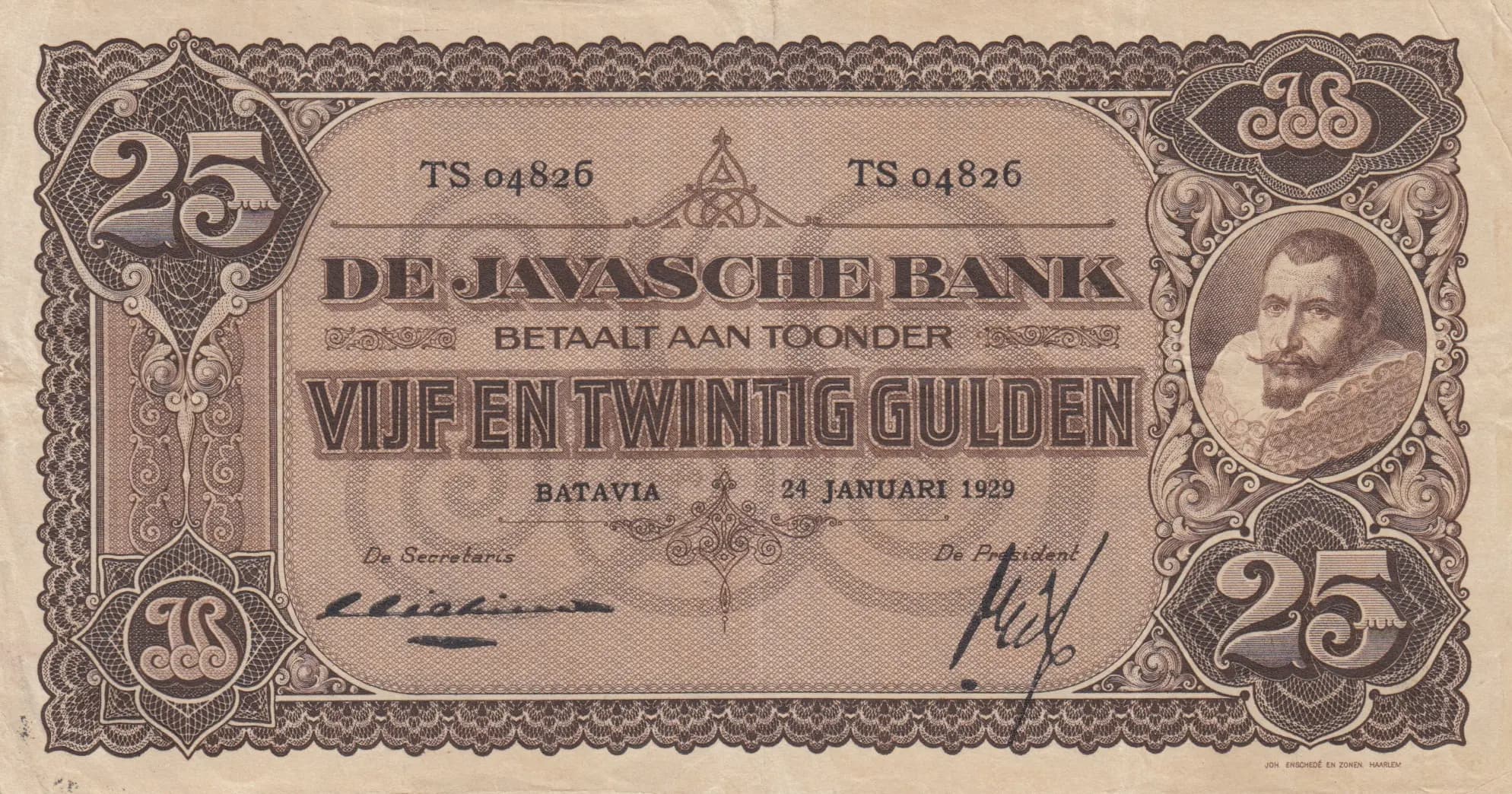
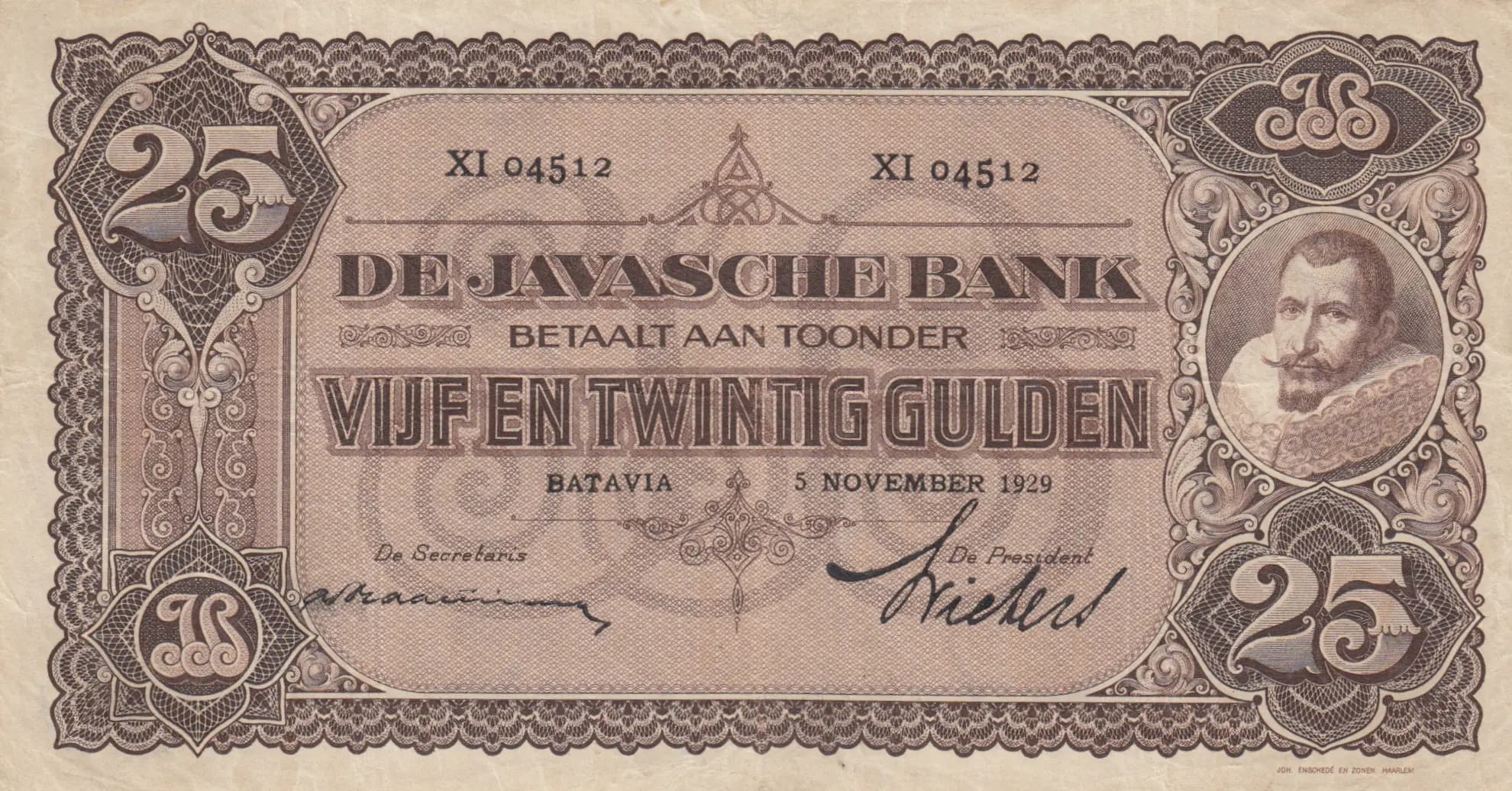
The front features an ornate design typical of Javasche Bank notes, with the denomination 25 prominently displayed in the upper left and right corners within decorative circular emblems. A bearded male portrait in historical dress with curled hair occupies the right side, framed in an oval cartouche, likely representing a historical figure of significance to the Netherlands Indies. The center contains a triangular symbol with curved elements at the top and extensive ornamental scrollwork throughout, characteristic of the fine-line engraving technique. The back displays a large oval vignette at center depicting a colonial-era administrative building with distinctive multi-story architecture and classical proportions, flanked by text blocks and ornamental corner designs. The overall design employs an elaborate lace-like border scheme with filigree patterns on both sides, typical of high-security banknote design of the era.
FRONT SIDE: 'DE JAVASCHE BANK' (The Java Bank) - issuing institution; 'BETAALT AAN TOONDER' (Pays to bearer) - standard bearer note clause; 'VIJF EN TWINTIG GULDEN' (Twenty-five gulden) - denomination in words; 'BATAVIA' - place of issue; '12 JANUARI 1926' (12 January 1926) - date of issue; 'De Secretaris' (The Secretary) and 'De President' (The President) - signature lines; Serial number 'NG 04239'. BACK SIDE: Denomination '25' repeated in corners; Chinese characters visible in upper left text block (specific content not fully legible in image); additional text blocks in upper right and lower portions in Dutch or Indonesian (content not fully legible in provided images).
Intaglio (engraved line printing), the standard security printing method for banknotes of this period. The fine detail visible in the portrait engraving, ornamental scrollwork, and architectural vignette are characteristic of intaglio production. The note was produced by Thomas de la Rue, London, one of the world's premier banknote security printers during this era, as evidenced by the typical design sophistication and printing quality of Javasche Bank notes from this period.
This note is identified as Pick 71a, the standard 1926 issue dated 12 January 1926 with signatures of De President and De Secretaris. The serial number prefix 'NG' visible on this example (NG 04239) represents one of the standard serial number series used for this printing. No major varieties (such as overprints, color variants, or signature variations) are evident from the visual analysis of this specimen.