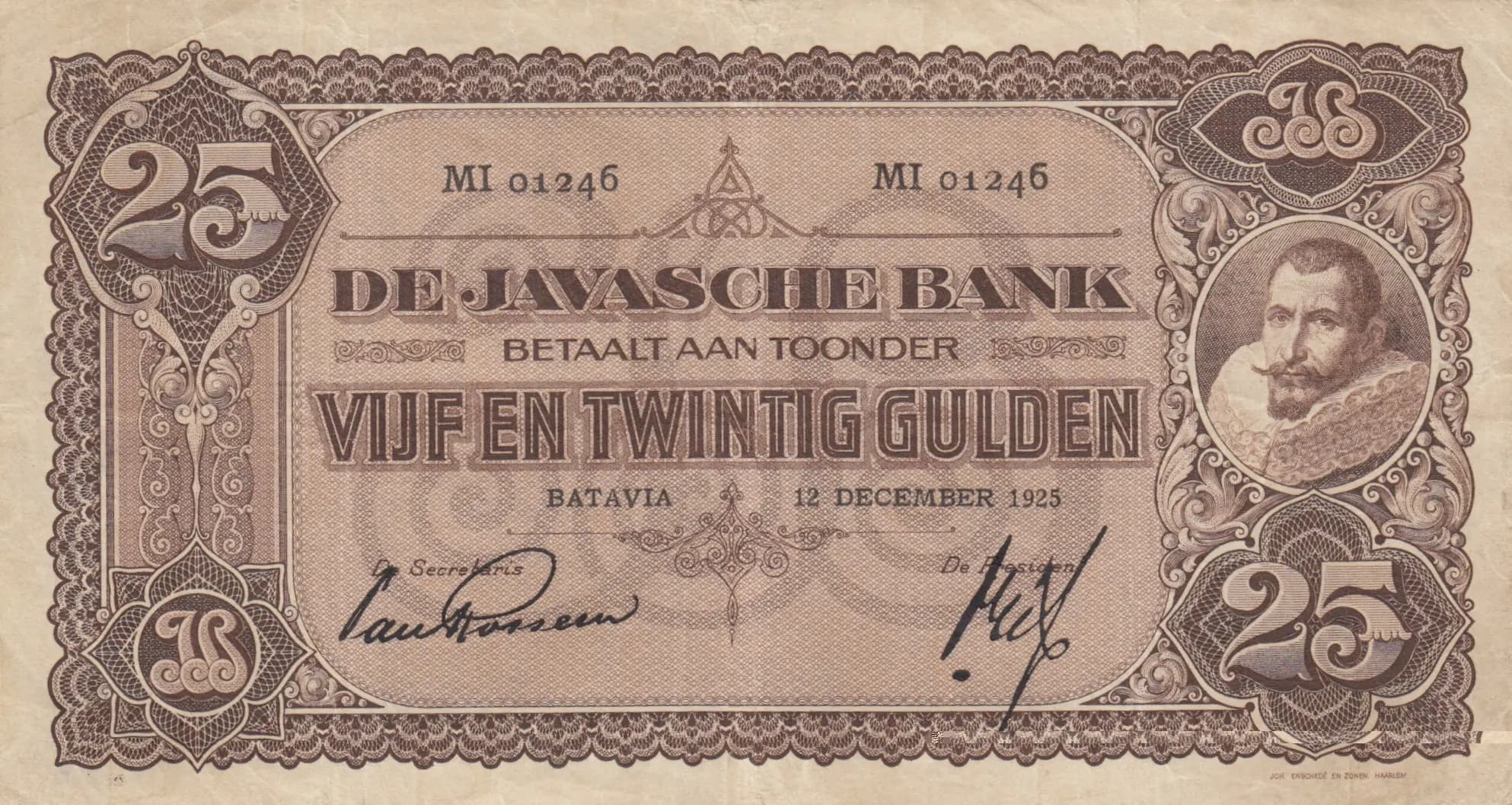
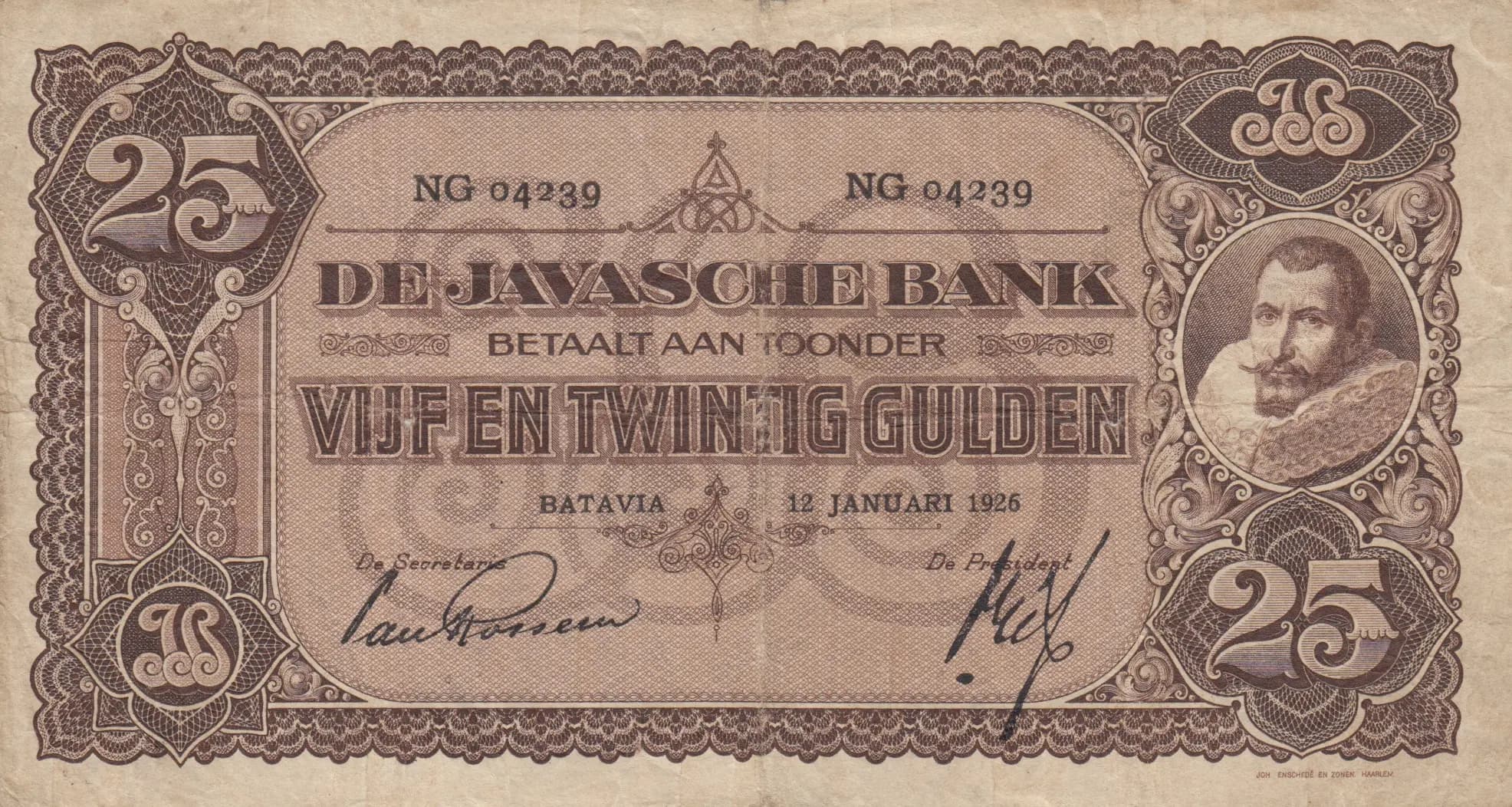
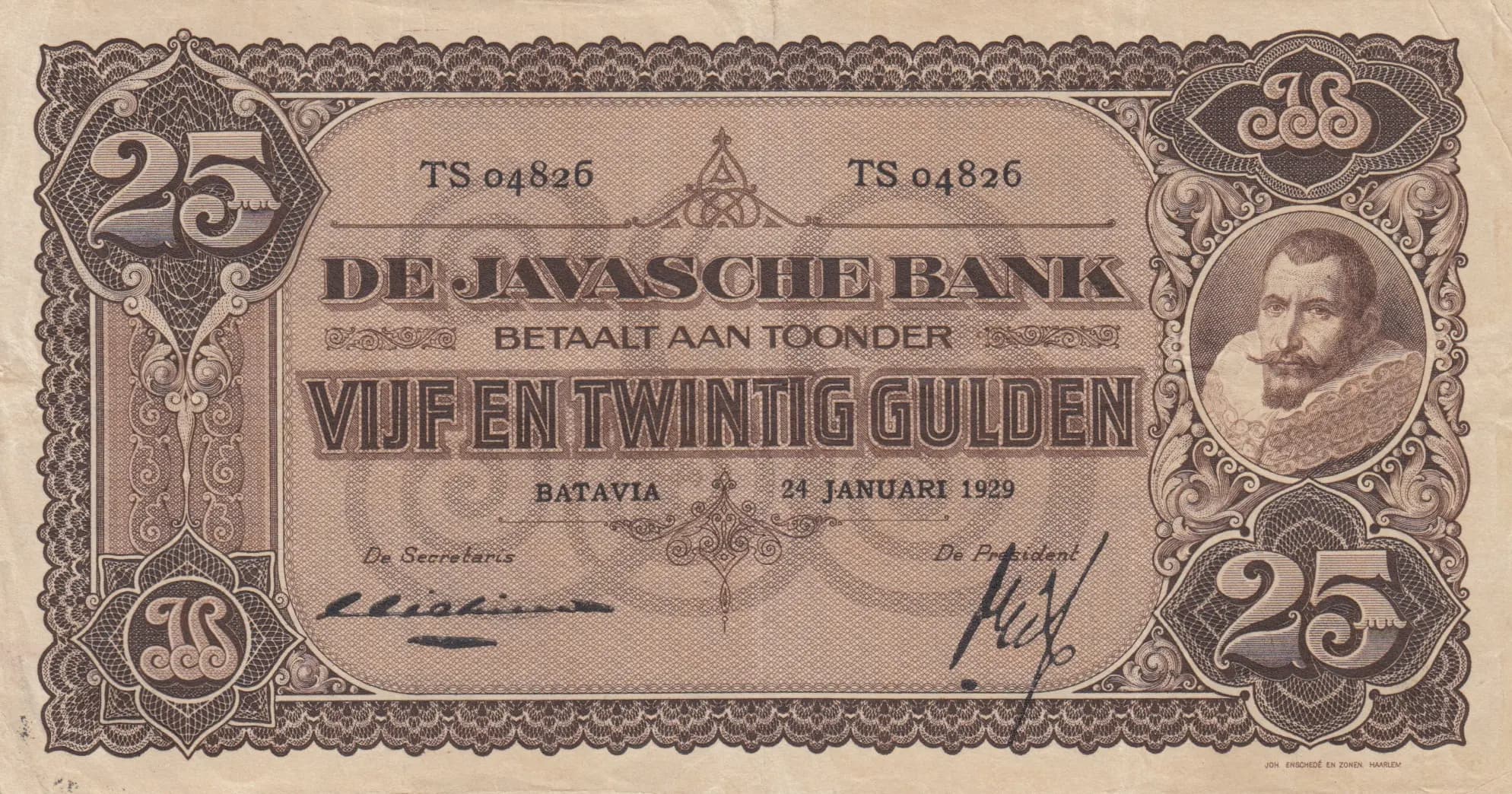
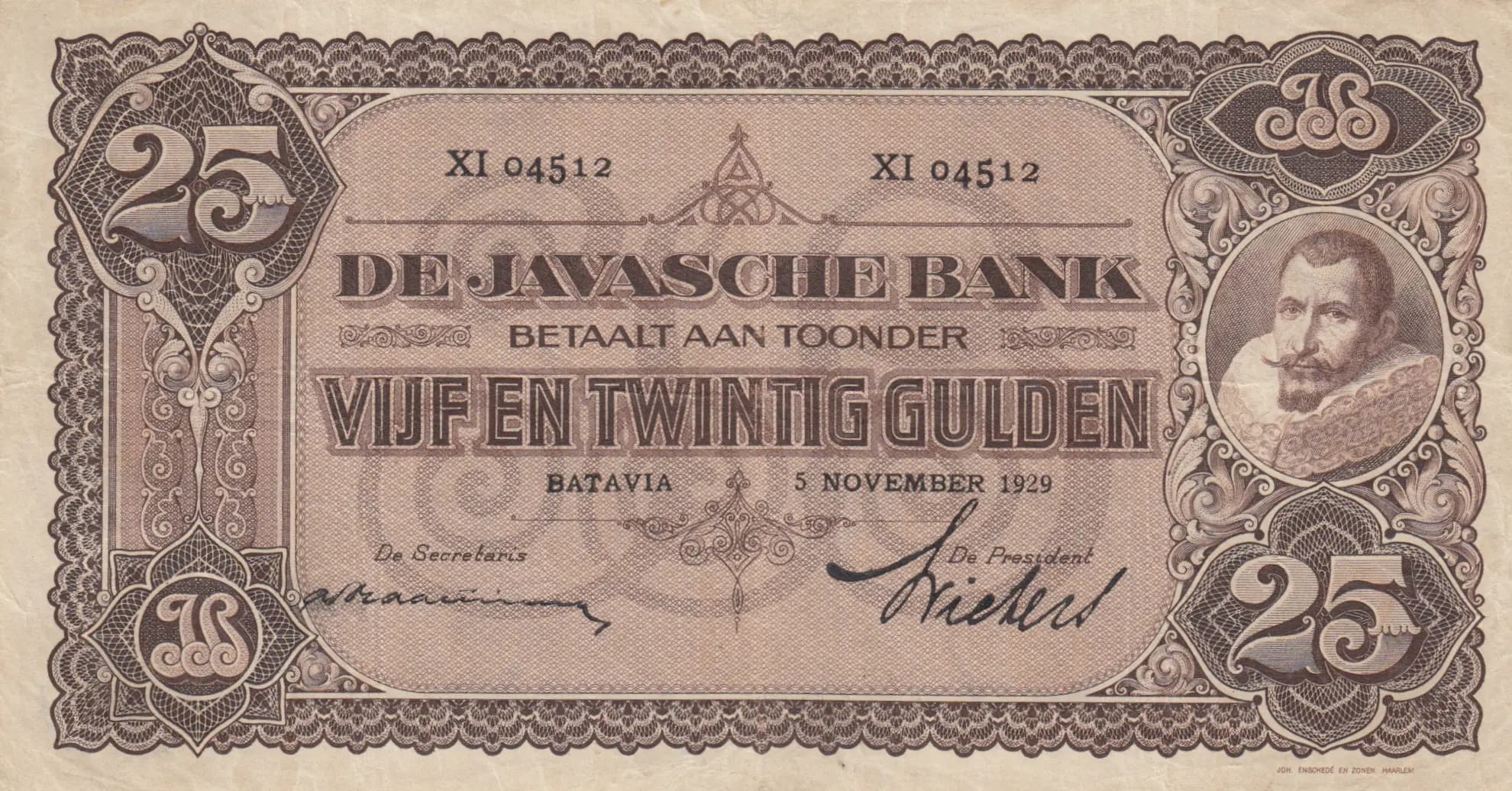
25 gulden 1927
About This Note
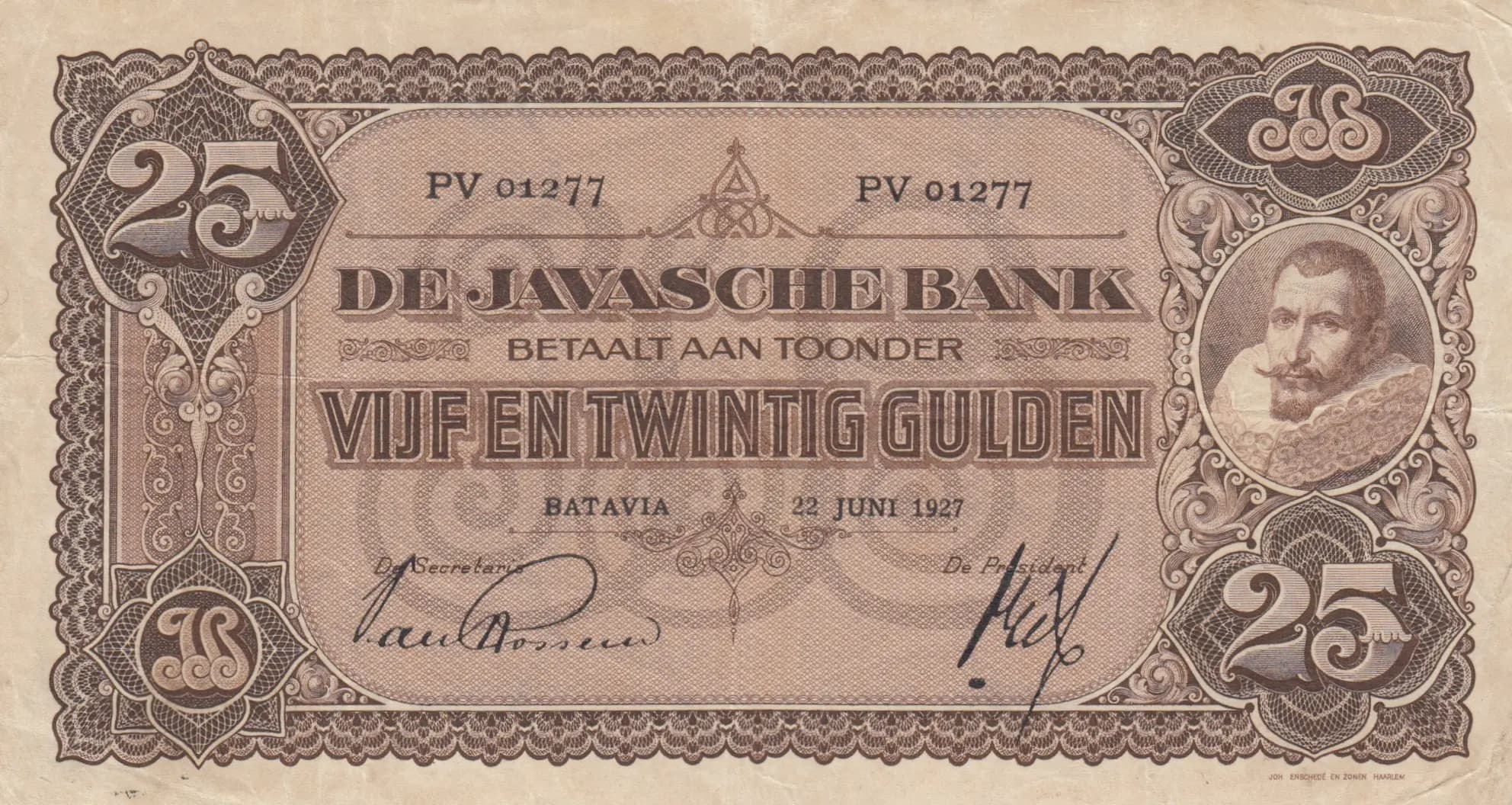
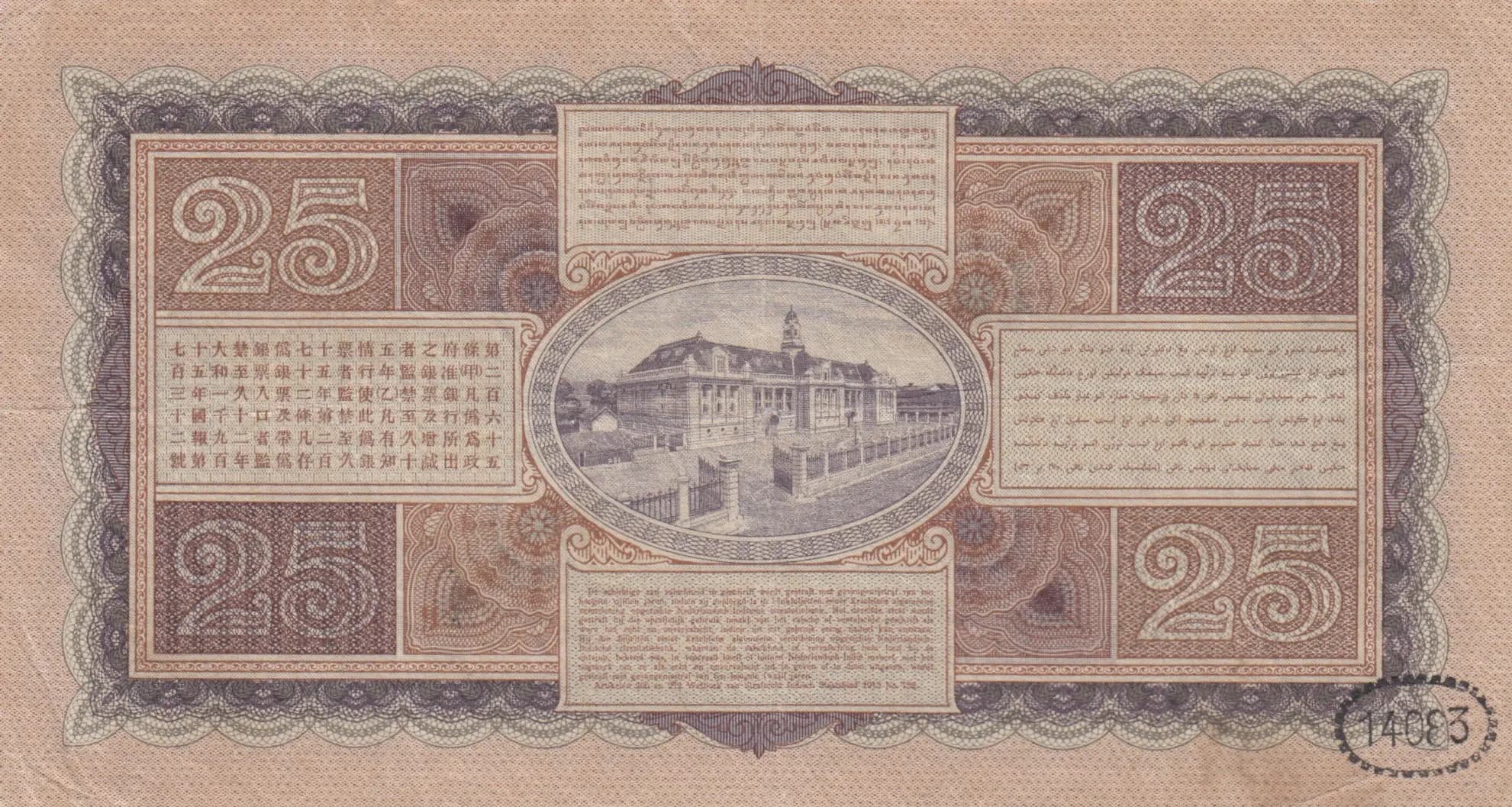
This is a 25 Gulden banknote from De Javasche Bank dated 22 June 1927, representing an attractive example of Dutch East Indies currency from the pre-World War II colonial period. The note exhibits excellent condition with crisp, uncirculated appearance, featuring ornate Art Nouveau-style decorative borders and fine engraving throughout. The combination of the colonial-era building vignette on the reverse and the historical portraiture makes this an interesting artifact of Netherlands Indies financial history.
Common. The 25 Gulden 1927 from De Javasche Bank (Pick 71a) was issued in substantial quantities to support commerce in the Dutch East Indies and remains readily available in the collector market. While the condition observed here is exceptional, the denomination and date are not restricted issues, and examples continue to appear with reasonable frequency at auctions and through dealers specializing in colonial currency.
Issued by De Javasche Bank (Java Bank) during the height of Dutch colonial administration in the East Indies, this 1927 note reflects the economic prominence of Batavia (modern-day Jakarta) as a colonial financial center. The ornate design with its blend of European artistic tradition and the inclusion of Chinese characters on the reverse acknowledges the significant Chinese merchant community in the Dutch East Indies, illustrating the multicultural commercial networks of early 20th-century colonial commerce.
The front features an ornate portrait of a bearded historical figure in period dress positioned within an elaborate oval frame on the right side, surrounded by intricate floral and geometric scrollwork typical of late 19th/early 20th-century European bank note design. The reverse displays a colonial-era administrative building with a prominent central tower or cupola, rendered in photographic or finely engraved style within an oval vignette, set within elaborate decorative corner cartouches and ornamental borders. The denomination '25' appears in ornamental frames at all four corners of both sides. The consistent use of brown, tan, and beige tones throughout creates a unified, sophisticated aesthetic reflective of the bank's prestige.
Front side: 'DE JAVASCHE BANK' (The Java Bank), 'BETAALT AAN TOONDER' (Pays to Bearer), 'VIJF EN TWINTIG GULDEN' (Twenty-Five Guilders), 'BATAVIA' (Batavia), '22 JUNI 1927' (22 June 1927), 'VIJF EN TWINTIG' (Twenty-Five), serial number 'PV 01277', and signatures including 'Secretaris' (Secretary) and 'De P.' Back side: Denomination '25' appearing in top corners, Chinese character text in left panel (administrative/legal text), and additional Latin script text in right panel and lower sections (Dutch legal/administrative text). The exact transcription of Chinese characters and partial Latin text is not fully legible but appears to be standard legal disclaimers and terms common to colonial banknotes.
The note employs traditional steel-plate intaglio engraving, evident from the fine line work, intricate border patterns, and multiple layers of detailed ornamentation observed throughout both sides. The photographic quality of the building vignette suggests the use of photogravure or a combined intaglio process capable of reproducing photographic images. The security features—including the elaborate engraved patterns, fine line work in borders, and the combination of ornamental and photographic elements—are characteristic of high-security bank note production typical of colonial-era issues from established European security printers.
This specimen displays the serial number 'PV 01277,' which falls within the standard serial number range for this issue. The signature block visible includes 'Secretaris' (Secretary) and 'De P.' designations. No obvious overprints, date variations, or printed alterations are apparent. The visual quality and printing characteristics are consistent with the primary 1927 issue from the Javasche Bank, classified as Pick 71a in the standard catalog.