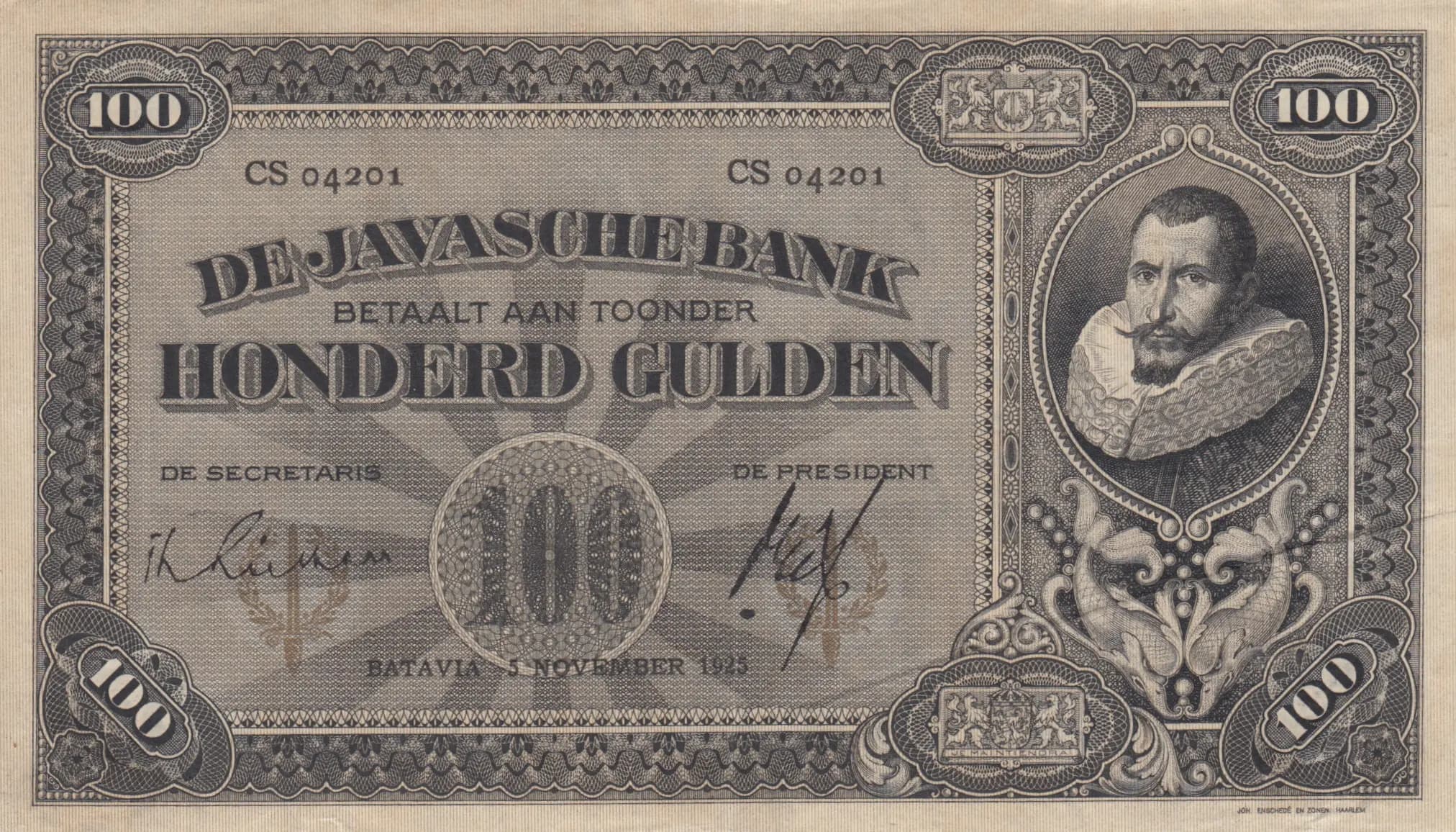
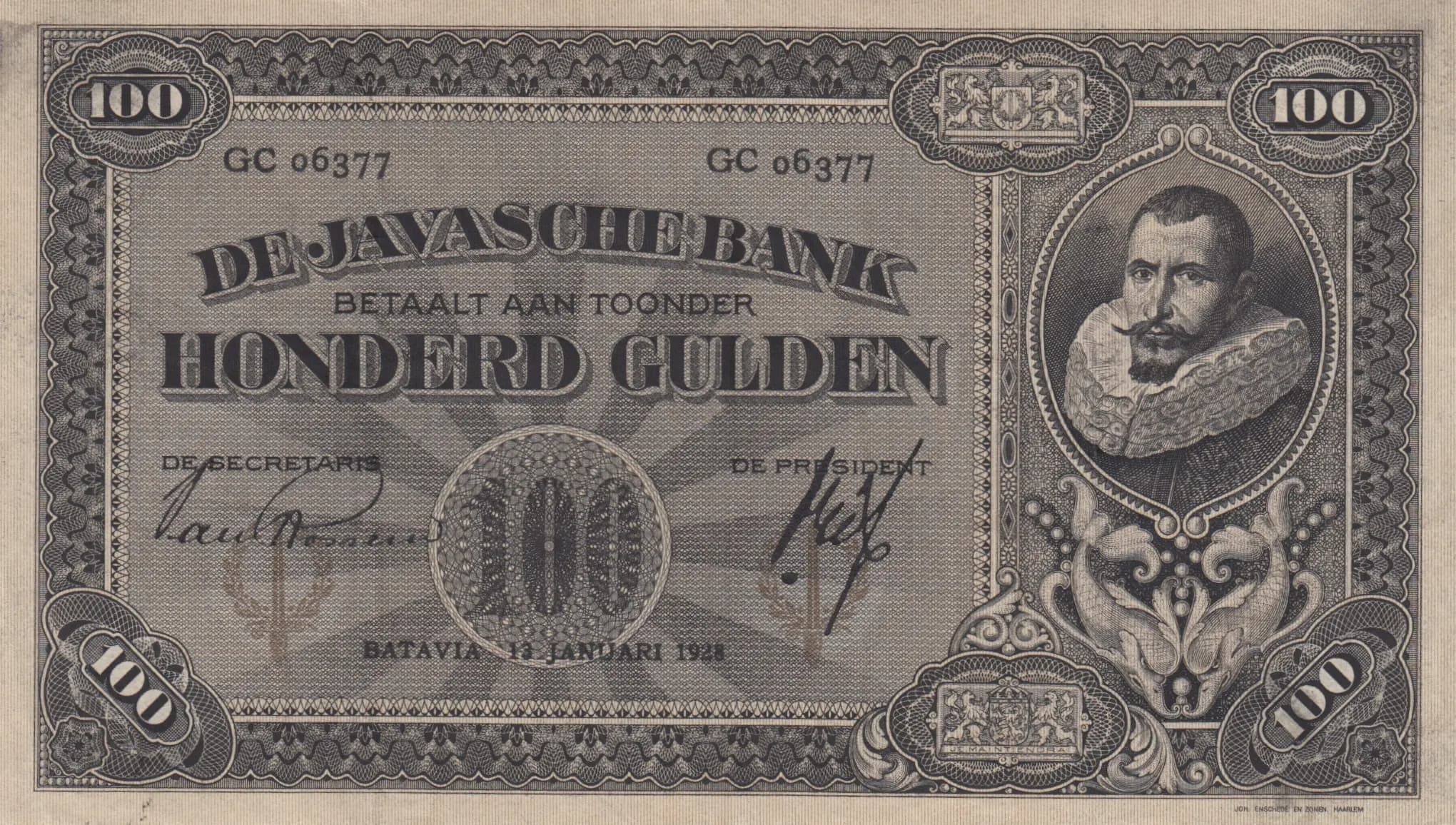
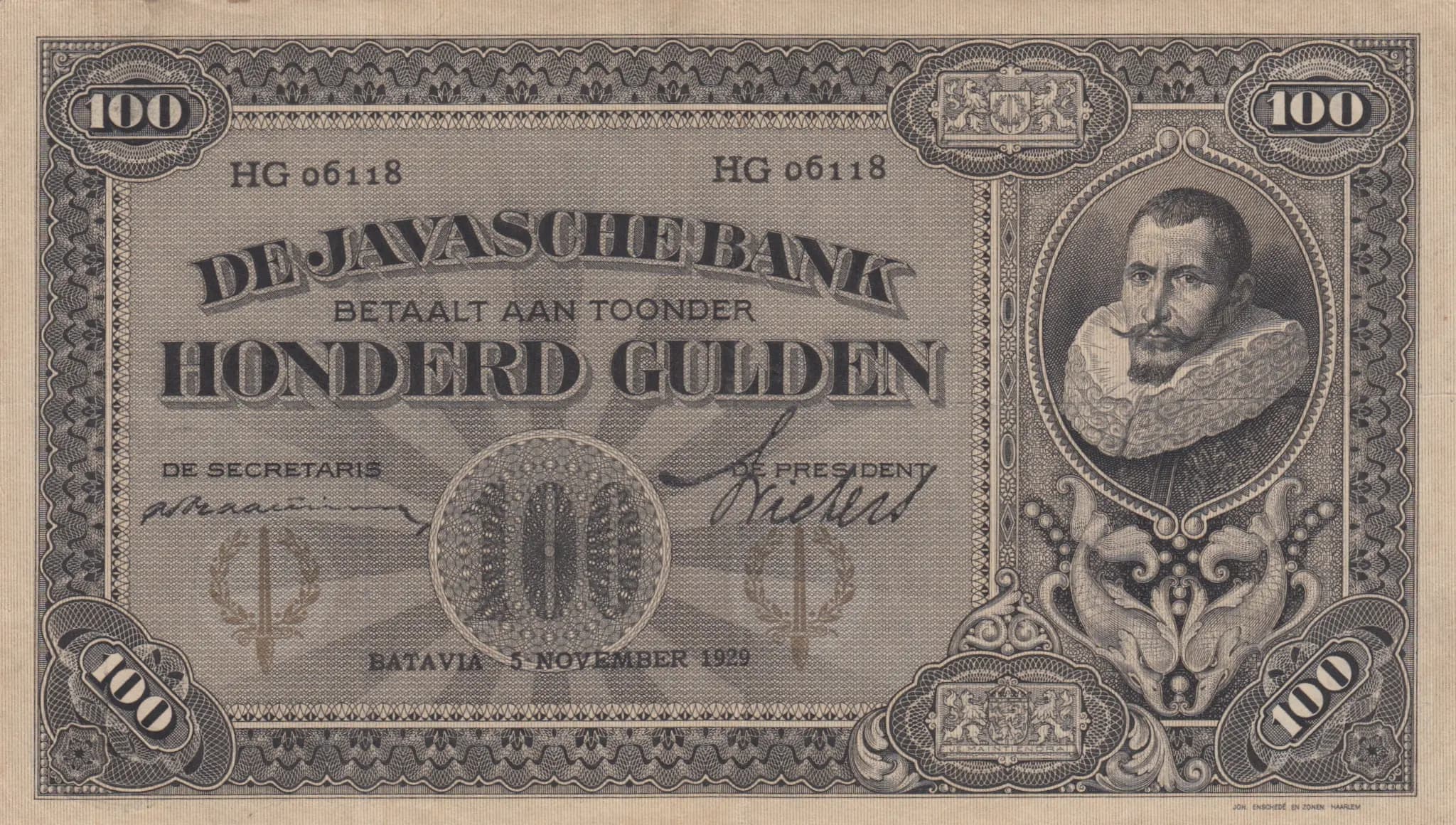
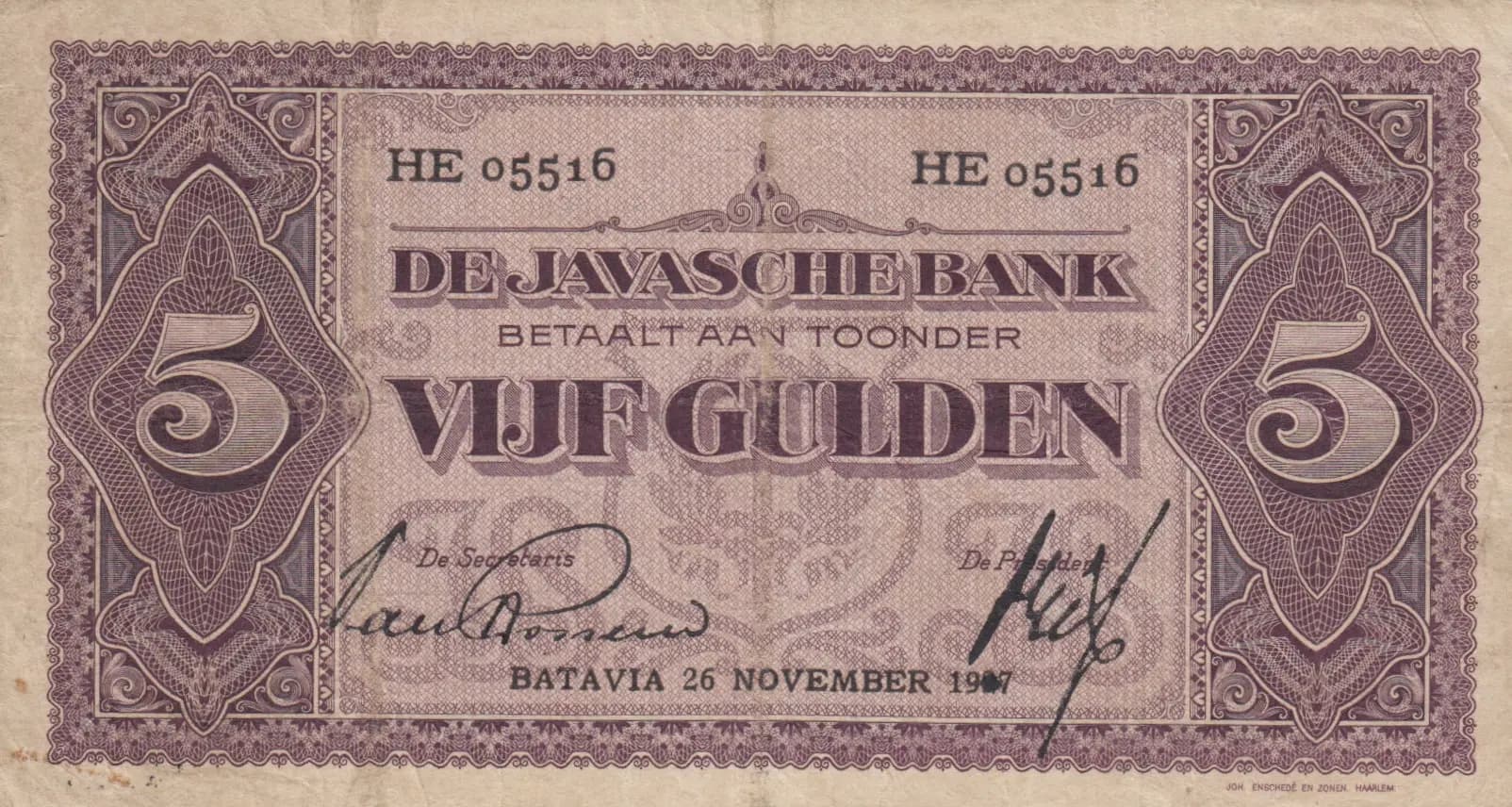
100 gulden 1930
About This Note
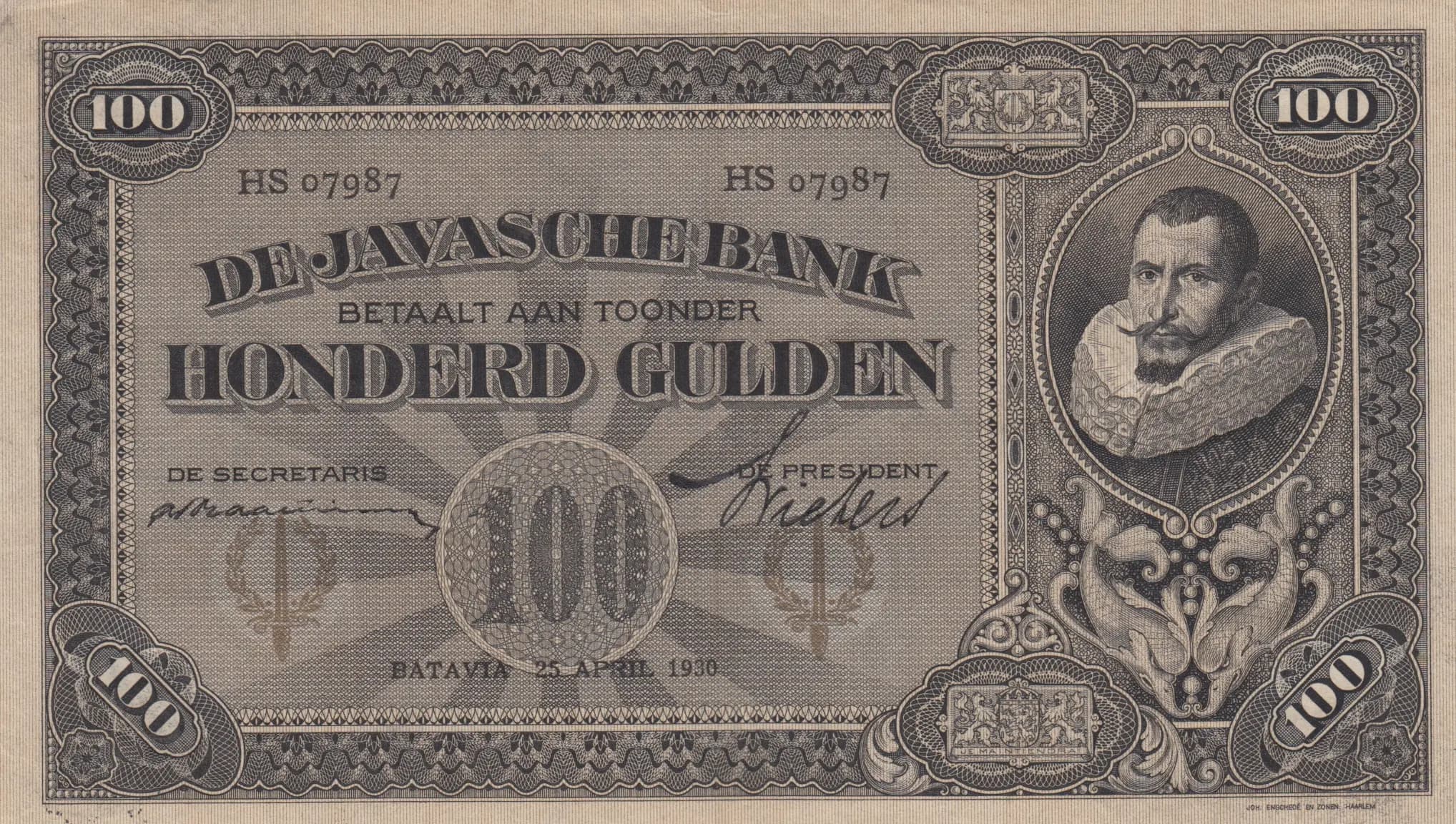
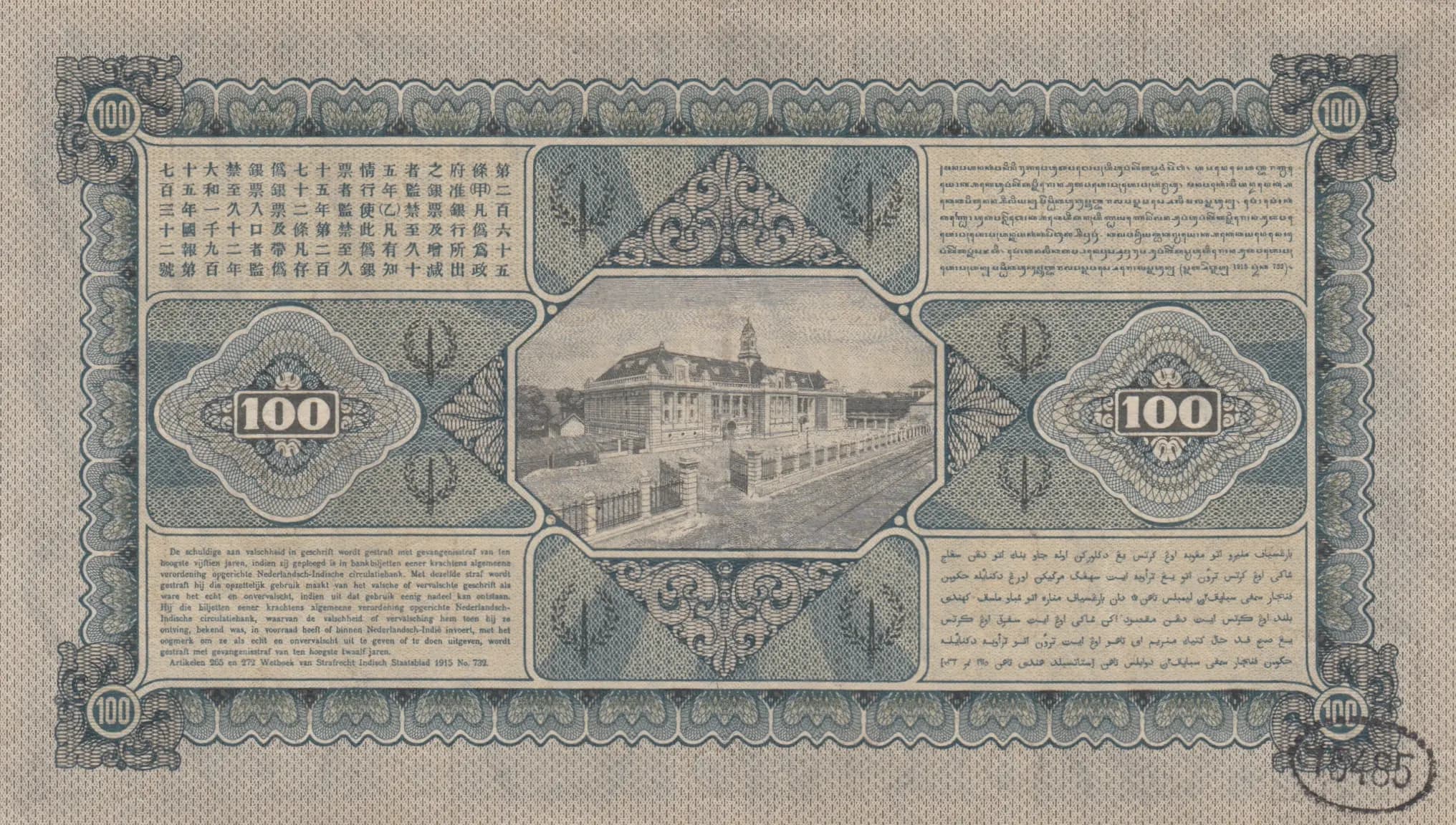
This is a well-preserved example of the De Javasche Bank 100 Gulden note from April 1930 (Pick P-73c), graded VF, featuring the bank's characteristic ornate design with period engraving. The note displays a bearded historical figure in 16th-17th century dress on the obverse and a prominent institutional building on the reverse, with multilingual inscriptions reflecting the colonial Netherlands Indies context. The sharp printing quality and minimal wear suggest careful handling since issue, making this a solid collector specimen of this pre-war Dutch East Indies denomination.
Common. The De Javasche Bank 100 Gulden notes from 1930 were issued in significant quantities as a standard denomination for the colonial economy. Pick P-73c represents the standard issue of this denomination from this period, and no indication of limited print runs, early recalls, or rarity markers is apparent from catalog data or the specimen observed. While pre-war Dutch East Indies notes have collector interest, the 100 Gulden denomination in VF condition is a frequently encountered variety in the collector market, consistent with typical availability for major denominations from stable, well-funded colonial banking institutions.
This banknote was issued by De Javasche Bank (The Java Bank), the primary note-issuing authority for the Netherlands Indies during the colonial period, and reflects the economic prominence of Java as the commercial heart of the Dutch East Indies. The April 1930 date places this note during the interwar period, just before the global financial crisis would impact colonial economies. The multilingual inscriptions (Dutch, Arabic, and Asian scripts visible on the reverse) demonstrate the multicultural nature of the colonial administration and the diverse population it served.
The obverse features a formal portrait of a bearded gentleman in 16th or 17th-century European dress, depicted in three-quarter view within an ornate oval frame with decorative heraldic elements. This historical figure likely represents a founder or prominent historical figure associated with the Java Bank or Dutch colonial enterprise, though not definitively identified from the visual analysis alone. The reverse showcases a detailed engraving of a substantial classical institutional building—almost certainly the De Javasche Bank's headquarters in Batavia—featuring a prominent central dome, symmetrical wings, and formal architectural elements characteristic of late 19th/early 20th-century colonial administration buildings. The design incorporates extensive guilloche patterns, floral rosettes, and decorative borders throughout, with the denomination '100' displayed in ornate oval cartouches at all four corners. The multilingual text blocks (Dutch, Arabic, and Asian scripts) on the reverse underscore the note's utility across the diverse populations of the Netherlands Indies.
FRONT SIDE: 'DE JAVASCHE BANK' (The Java Bank) / 'BETAALT AAN TOONDER' (Payable to Bearer) / 'HONDERD GULDEN' (One Hundred Guilders) / 'PRESIDENT' and 'DE SECRETARIS' (President and The Secretary - signature lines) / 'BATAVIA' (Batavia, the colonial capital, now Jakarta) / 'APRIL 1930' (Issue date) / Serial number: 'HS 07987'. BACK SIDE: '100' (denomination in ornate frames) / Text blocks in Dutch containing legal conditions and terms of the banknote / Text in Arabic script (likely containing similar legal/informational content for Arabic-reading populations) / Historical or commemorative text in Chinese/Japanese characters (specific translation uncertain due to historical script complexity, but likely relating to the bank's operations or currency regulations in the multicultural colony).
This note was produced using steel engraving and intaglio printing, evidenced by the fine line work, detailed guilloche patterns, and crisp definition visible throughout the design. The catalog identifies Johan Enschede as the printer, a renowned Dutch security printing house specializing in high-quality banknote production. The sharp registration between colors (black and colored elements), the precision of the ornamental borders, and the quality of the photographic reproduction of the building on the reverse all demonstrate the advanced printing technology available to premium security printers of the 1930s era.
This specimen carries the serial number 'HS 07987' with the 'HS' prefix, indicating a specific production batch from De Javasche Bank's 1930 issue. The note is dated April 1930 and bears signatures typical of the bank's senior officials from that period ('PRESIDENT' and 'DE SECRETARIS'). The Pick catalog designation P-73c suggests this is the third identified variety of the 100 Gulden 1930 note; potential varieties within this issue may relate to signature variants, serial number prefix variations, or minor design differences. The specific variety designation 'c' may indicate signature variations or subtle design state differences relative to earlier printings (P-73a or P-73b), though detailed variety information would require consultation of specialized Dutch East Indies catalogs.