100 gulden 1943
About This Note
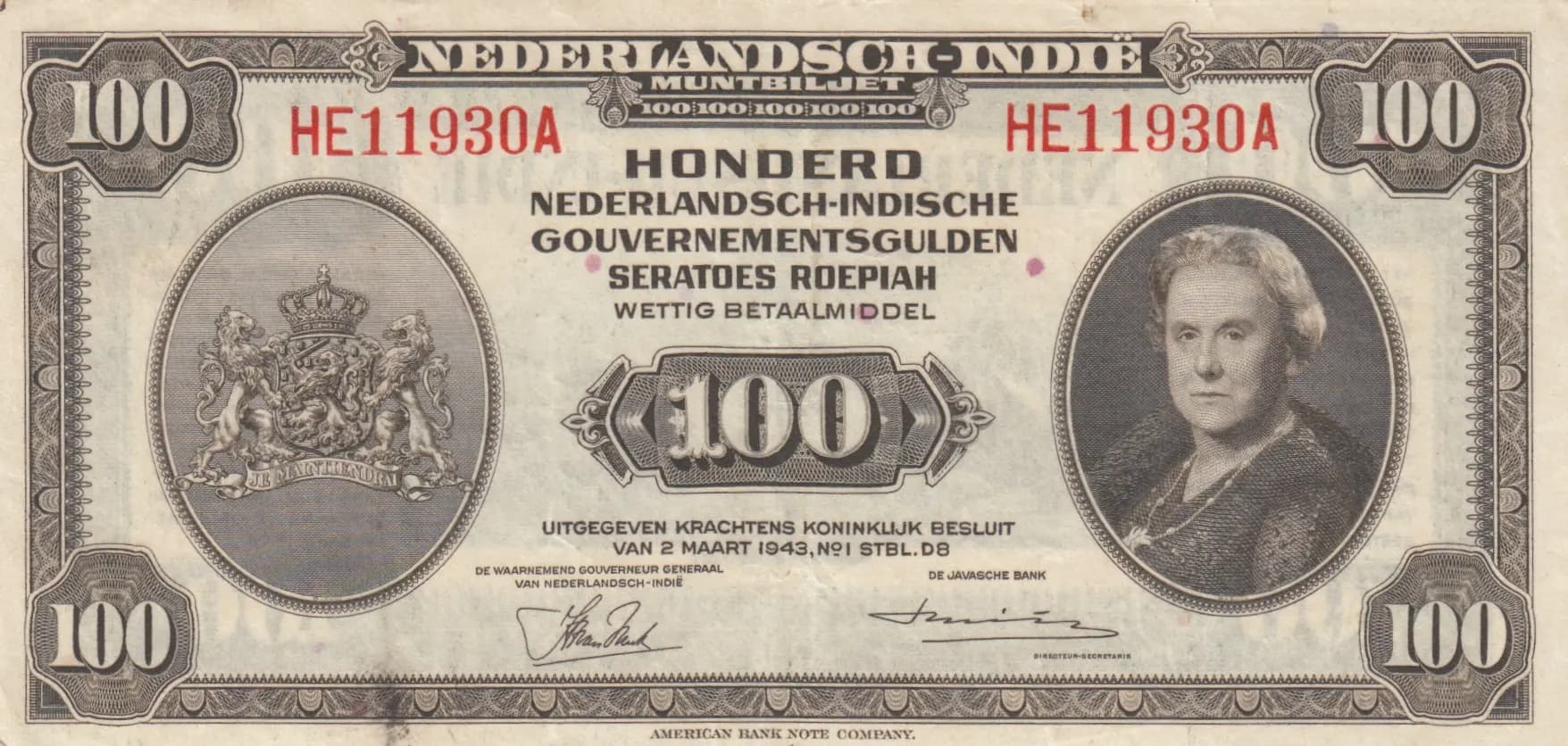
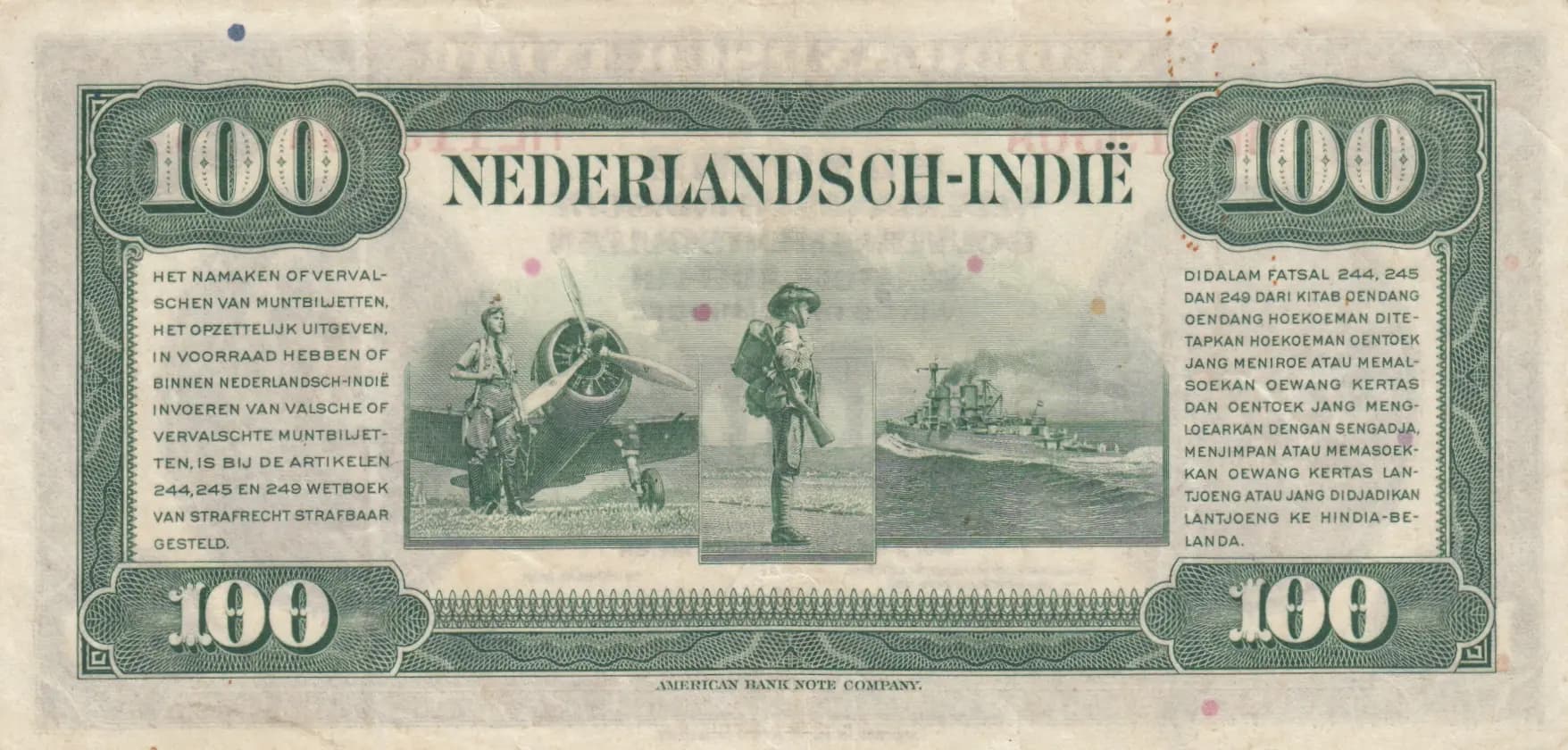
This is a 100 Gulden banknote from the Netherlands Indies, issued March 2, 1943, in Very Fine condition. The note displays excellent preservation with only minor age-related toning and foxing, showing crisp engraving and vibrant green coloring on the reverse. Both sides feature formal classical design elements including ornate borders, decorative denomination boxes, and significant bilateral text in Dutch and Indonesian/Malay, reflecting the colonial administration's dual-language approach during this pivotal period.
common. The 100 Gulden denomination from this 1943 issue was produced in substantial quantities to meet the financial needs of the occupied Netherlands Indies. Pick P-117 notes appear regularly in the collector market at moderate prices, typically ranging from $15-40 depending on condition and serial number variety. No evidence of limited print runs, early recall, or significant scarcity exists for this denomination. The VF condition grade observed here is relatively common for surviving examples, as the note's relatively recent vintage (1943) and adequate production quantities have allowed many examples to survive.
Issued under Royal Decree during the Japanese occupation of the Netherlands Indies (1942-1945), this Muntbiljet represents emergency currency produced by the Dutch colonial government in exile's arrangements. The reverse vignettes depicting military and naval personnel reflect the wartime context and the Indies' strategic military importance. The American Bank Note Company's involvement indicates how the note was produced outside the occupied territory, likely in the United States, making it a significant artifact of World War II colonial finance.
The obverse features a formal classical layout with prominent ornate borders and four corner denomination boxes displaying '100'. The left oval frame contains the Dutch royal coat of arms featuring two supporting lions, a crown, and heraldic insignia representing Dutch sovereignty. The right oval frame contains a portrait of a high-ranking Netherlands Indies government official or dignitary in formal attire. The note's header clearly identifies it as Netherlands Indies government currency in both Dutch and Indonesian/Malay. The reverse displays three central vignettes in green/teal tones depicting scenes of colonial military and administrative presence: an aviation or military officer on the left, another uniformed military figure in the center, and a naval vessel on the right, symbolizing the Indies' defense capabilities during wartime. All four corners on the reverse contain decorative denomination boxes with '100'. Extensive text in both languages flanks the central vignettes, including the formal counterfeiting warning required by law.
{"frontSide":{"headerText":"NEDERLANDSCH-INDIË (Netherlands Indies) / MUNTBILJET (Currency Note)","denominationText":"HONDERD (Hundred) / NEDERLANDSCH-INDISCHE GOUVERNEMENTSGULDEN (Netherlands Indies Government Gulden) / SERATOE ROEPIAH (One Hundred Rupiah)","legalDesignation":"WETTIG BETAALMIDDEL (Legal Payment Means)","issuanceText":"UITGEGEVEN KRACHTENS KONINKLIJK BESLUIT VAN 2 MAART 1943, NR 1 STBL. D8 (Issued by Royal Decree of March 2, 1943, Nr 1 STBL. D8)","authorityText":"DE WAARNEMEND GOUVERNEUR GENERAAL VAN NEDERLANDS-INDIË (The Acting Governor General of Netherlands Indies) / DE JAVASCHE BANK (The Javanese Bank)","printer":"AMERICAN BANK NOTE COMPANY","serialNumber":"HE11930A"},"backSide":{"denominationBoxes":"100","headerText":"NEDERLANDSCH-INDIË (Netherlands Indies)","counterfeItWarning":"HET NAMAKEN OF VERVALSCFHEN VAN MUNTBILJETTEN, HET OPZETTELIJK UITGEVEN, IN VOORRAAD HEBBEN OF BINNEN NEDERLANDS-INDIË INVOEREN VAN VALSCHE OF VERVALSCHTE MUNTBILJETTEN, IS BIJ DE ARTIKELEN 244, 245 EN 249 WETBOEK VAN STRAFRECHT STRAFBAAR GESTELD. (The counterfeiting or alteration of banknotes, the intentional issuance, keeping in stock or import into Netherlands Indies of false or altered banknotes, is punishable according to articles 244, 245 and 249 of the Penal Code.)","counterfeItWarningMalay":"DIDALAM FATSAL 244, 245 DAN 249 DARI KITAB DENDANG OENDANG HOEKOEMAN DITE-TAPKAN HOEKOEMAN OENTOEK JANG MENIROE ATAU MEMAL-SOEKAN OEWANG KERTAS DAN OENTOEK JANG MENG-LOEARKAN DENGAN SENGAJA, MENJIMPAN ATAU MEMASOEKAN OEWANG KERTAS LAIQ TOENG ATAU JANG DIDJADIKAN LANTJOENG KE HINDIA-BELANDA. (According to articles 244, 245 and 249 of the Criminal Code, punishment is provided for those who counterfeit or falsify banknotes and for those who intentionally issue, keep or import falsified banknotes into Dutch Indies.)","printer":"AMERICAN BANK NOTE COMPANY"}}
The note was produced using fine line steel engraving, the standard security printing method of the era. The American Bank Note Company, a premier security printer established in 1858 and renowned for producing high-security banknotes, handled the production. The detailed line work visible throughout both sides, the complex ornamental borders, the precise vignette illustrations, and the sharp registration between design elements are all characteristic of quality engraved banknote production. The dual-color printing (black/cream on obverse; green/teal on reverse) was achieved through multiple passes using separate engraved plates.
The serial number HE11930A indicates this is from a standard production run. Known varieties for P-117 include different prefix letters on the serial numbers, with HE being one of the standard prefixes. Some examples may bear different signatures or slight printing variations due to the American Bank Note Company's production methods, but these do not significantly affect the note's catalog value or classification. No major overprints or special issues are recorded for this denomination in the 1943 issue.