10 gulden 1943
About This Note
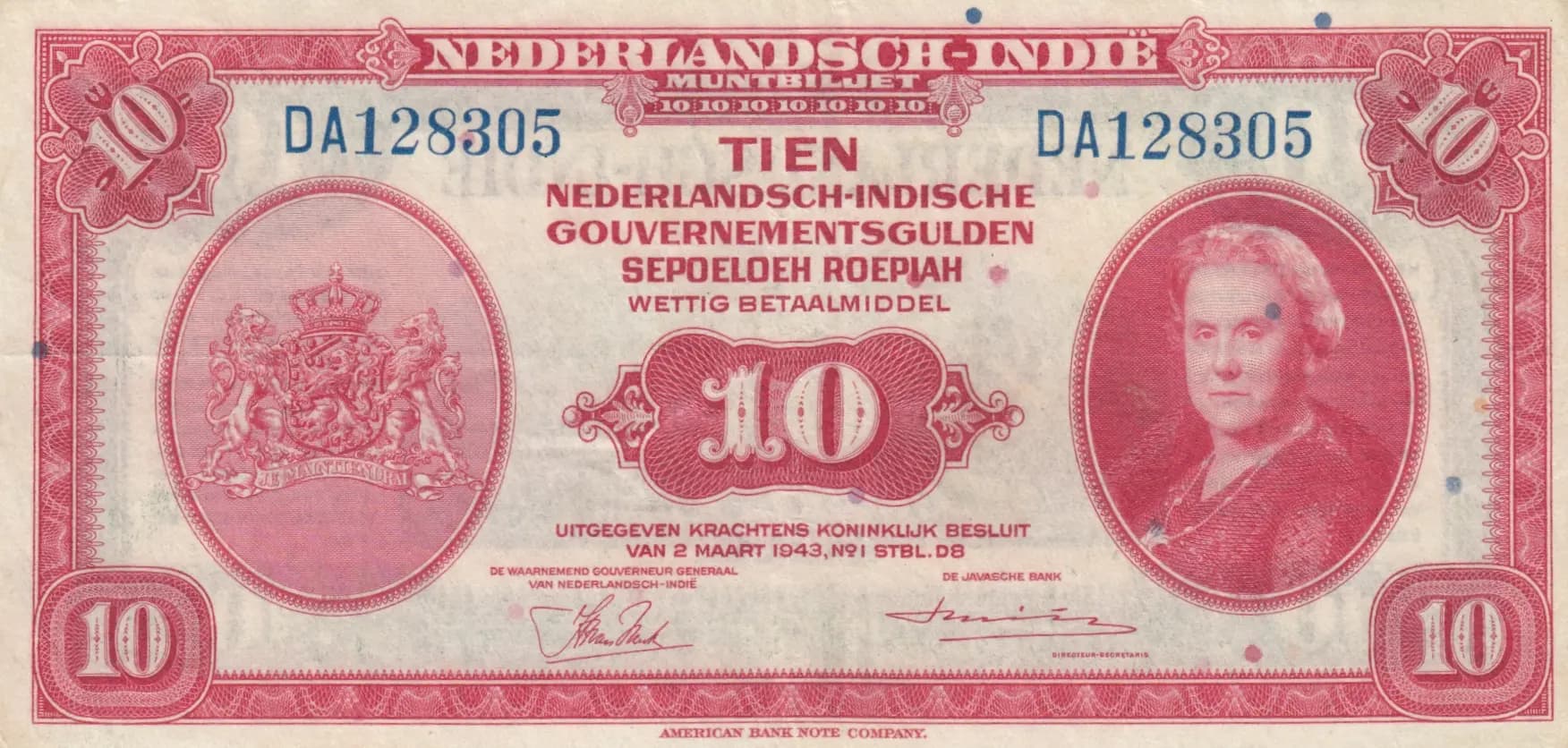
This 1943 Netherlands Indies 10 gulden banknote (Pick P-114) presents in Very Fine condition with the characteristic pink/red obverse and green/teal reverse typical of Muntbillet emergency currency. The note displays the expected aging consistent with 1940s circulation, including visible creasing, minor foxing spots, and paper yellowing, yet retains strong color saturation and clear detail in both the ornate intaglio borders and central vignettes. The presence of bilingual Dutch-Indonesian inscriptions and American Bank Note Company printing reflects the wartime emergency nature of this issue, making it an important example of Netherlands Indies monetary history during the Japanese occupation period.
Common. The 1943 Netherlands Indies 10 gulden Muntbillet (Pick P-114) was produced in substantial quantities as emergency wartime currency during the Japanese occupation period. While these notes are now historically significant, they remain readily available in the collector market at modest prices, typically in the $5-25 USD range depending on condition. No evidence suggests limited print runs, recalls, or scarcity; the note's availability across multiple condition grades and with various serial numbers confirms wide circulation and survival in collector hands.
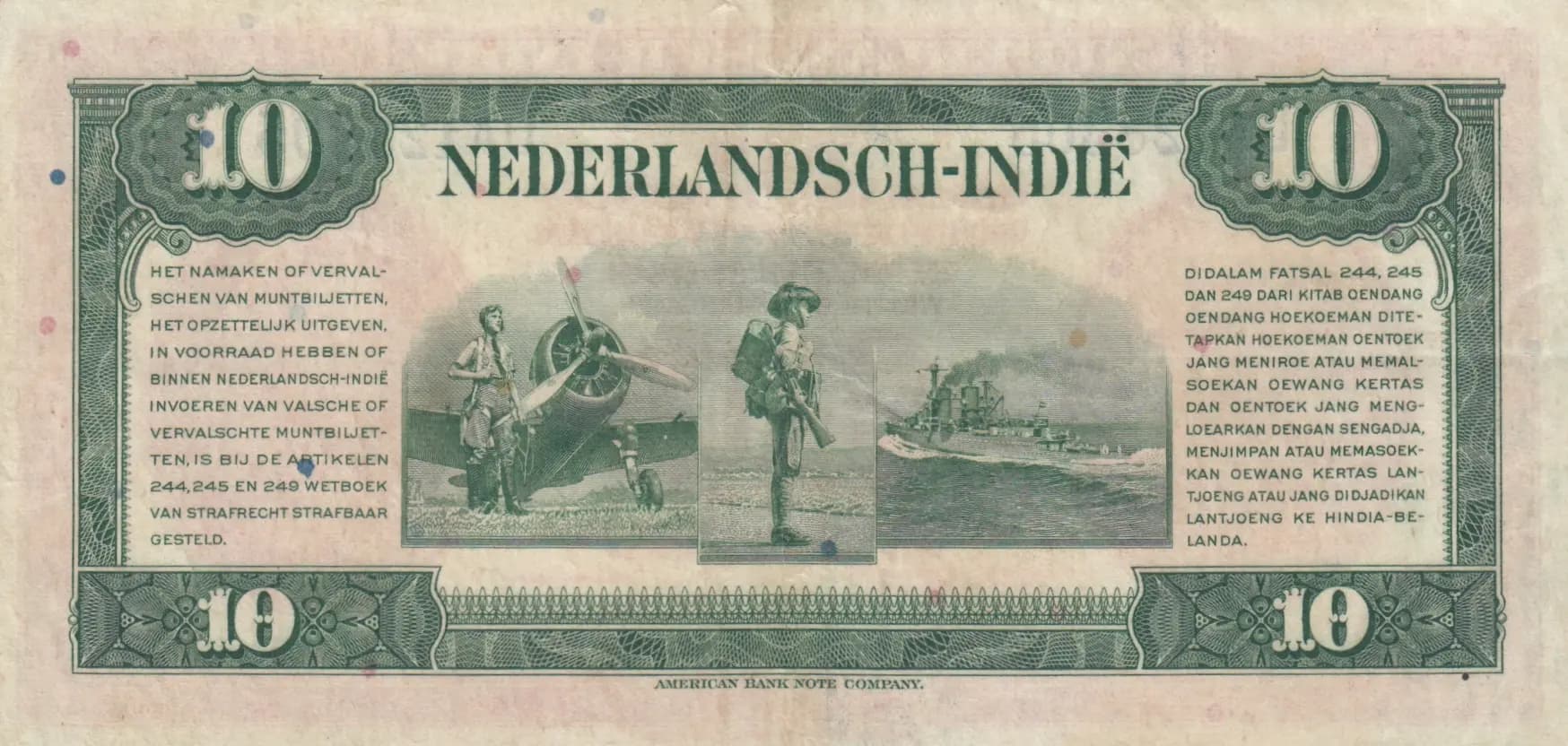
Issued by Royal Decree on March 2, 1943, during Japan's occupation of the Netherlands Indies, this note represents the Dutch colonial administration's attempt to maintain monetary authority despite wartime circumstances. The reverse vignettes depicting military and naval scenes—a soldier in tropical setting, combat imagery, and a warship—commemorate Dutch colonial military heritage and the defense efforts during the transition to wartime governance. The bilingual inscriptions in Dutch and Indonesian reflect the colonial administration's dual linguistic framework during a period of significant political and military upheaval in the region.
This emergency Muntbillet note features a formal dual-portrait format with a crowned lion coat of arms (representing Dutch sovereignty) in an oval medallion on the obverse left, paired with a three-quarter profile portrait of a woman (likely representing the Dutch monarchy or colonial authority) on the right side in a matching oval frame. The obverse employs an elaborate pink and red color scheme with dense ornamental borders featuring floral and geometric intaglio patterns, with the denomination '10' prominently displayed in elaborate cartouches at all four corners. The reverse shifts to a green/teal palette and presents three historical vignettes: a colonial soldier in tropical military dress (left), a military combat or naval engagement scene (center), and a detailed warship (right), all rendered in fine intaglio work. The denomination appears again in corner ornaments. The overall design emphasizes security through complexity, with multiple interlocking decorative elements and fine line work throughout.
FRONT SIDE: 'NEDERLANDSCHE GULDEN' (Netherlands Gulden); 'MUNTBILLET' (Banknote); 'TIEN' (Ten); 'NEDERLANDSCH-INDISCHE GOUVERNEMENTSGULDEN' (Netherlands-Indian Government Gulden); 'SEPOELDEH ROEPIAH' (Ten Rupiah in Javanese/Indonesian); 'WETTIG BETAALMIDDEL' (Legal Tender); 'UITGEGEVEN KRACHTENS KONINKLIJK BESLUIT VAN 2 MAART 1943, N°1 STBL. D8' (Issued by Royal Decree of March 2, 1943, No. 1 of the State Gazette); 'DE WAARNEMEND GOUVERNEUR GENERAAL VAN NEDERLANDSCH-INDIË' (The Acting Governor General of the Netherlands Indies); 'DE JAVASCHE BANK' (The Javanese Bank); 'AMERICAN BANK NOTE COMPANY' (printer attribution). BACK SIDE: 'NEDERLANDSCH-INDIË' (Netherlands Indies); Warning text in Dutch: 'The counterfeiting or forgery of banknotes, the intentional issuance, possession for supply or importing into the Netherlands Indies of forged or counterfeit banknotes is punishable under articles 244, 245 and 249 of the Penal Code'; Equivalent warning in Indonesian/Javanese regarding counterfeiting penalties under sections 244, 245 and 249 of the Criminal Code Law; 'AMERICAN BANK NOTE COMPANY' (printer attribution).
Intaglio engraving executed by American Bank Note Company, one of the world's premier security printers. The visual analysis confirms characteristic intaglio features including fine, precisely executed line work in all decorative borders, multiple color layers applied through separate printing passes, and the distinctive depth and detail visible in the historical vignettes and portraiture. The technique employed both line engraving and possibly steel engraving for the security elements, with the multiple colors (pink/red on obverse, green/teal on reverse) suggesting multi-plate color separation typical of high-security banknote production.
This example bears serial number DA128305, which follows the standard serial numbering format for this issue. Varieties of this Pick number may include different serial number prefixes (indicating different printing batches or authorization blocks), though the cataloged Pick P-114 does not distinguish major varieties by prefix in standard references. The bilingual format (Dutch/Indonesian) is consistent across all examples of this emergency issue. No overprints or significant design variants are known for this denomination and year in the Muntbillet series.