1 gulden 1948
About This Note
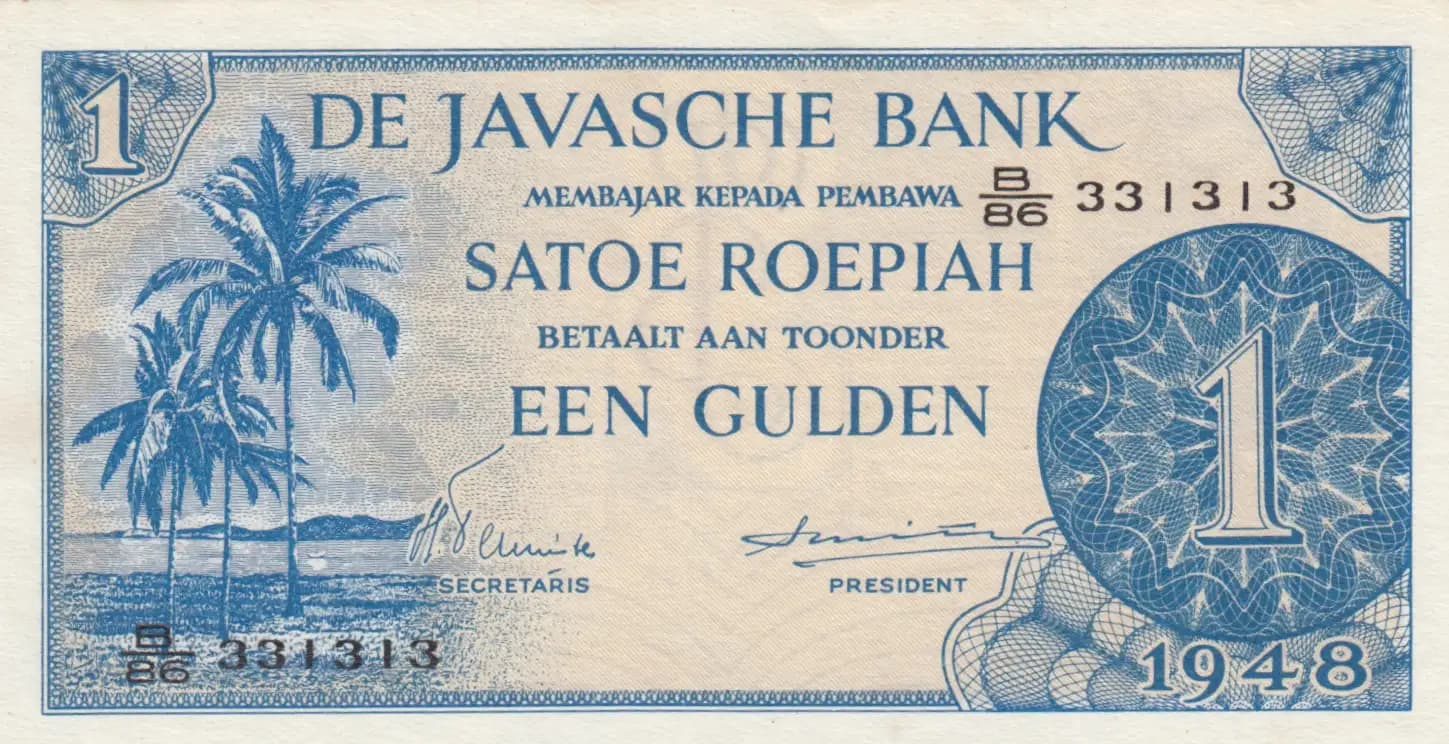
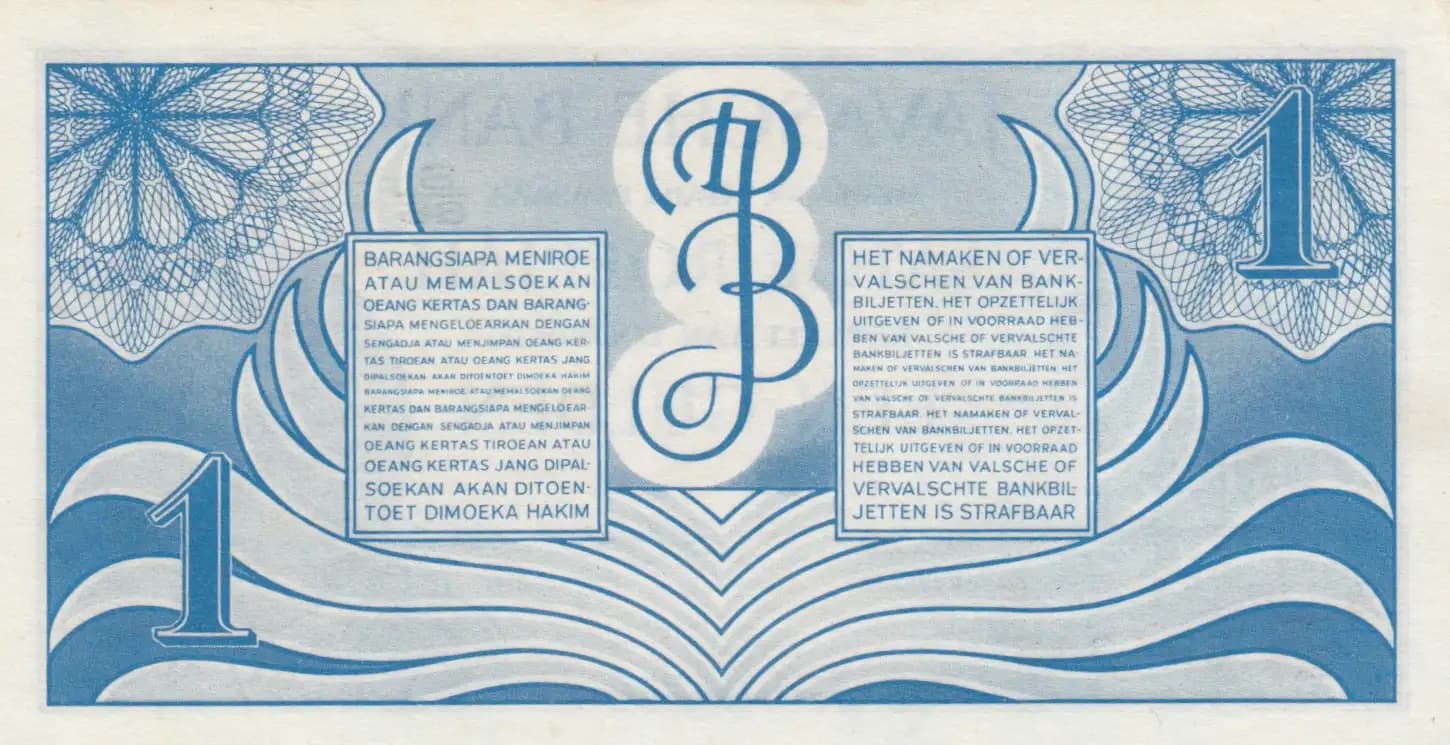
A pristine example of the 1 Gulden note issued by De Javasche Bank in 1948, graded UNC. The note displays the characteristic bilingual Dutch-Indonesian design reflecting the post-WWII transition period in the Dutch East Indies, with striking blue ink on cream background and intricate engraved security features including dual numeral '1' designs and ornate circular motifs. The tropical palm tree landscape and caduceus symbolism are well-preserved with no visible wear, making this an excellent specimen of this important transitional currency.
Common. The 1948 1 Gulden note from De Javasche Bank (Pick #98) was part of the regular circulation series during a transitional period when denominations were high-volume issues. No specific information indicates a limited print run, early recall, or short production period. While the issuer was colonial and the note is from an early post-war period, the Dutch East Indies maintained functional banking systems with standard circulation levels. UNC examples are more desirable than circulated specimens, but this denomination and issue date remain readily available in the numismatic market.
Issued in 1948, this note represents a critical moment in Dutch East Indies history during the final stages of Dutch colonial rule and the transition toward Indonesian independence (achieved in 1949). De Javasche Bank's bilingual inscriptions in Dutch and Indonesian—including 'MEMBAJAR KEPADA PEMBAWA' and 'SATOE ROEPIAH'—reflect the political and linguistic complexities of the era, while the palm tree landscape evokes the tropical colonial imagery typical of the period. The caduceus symbol on the reverse, traditionally associated with commerce and negotiation, underscores the monetary function during this transitional administration.
The front of this note centers on a formal monetary design with large ornamental numerals '1' positioned in the top left and bottom right corners within elaborate circular frames featuring intricate cross-hatching and geometric filigree. The left side depicts a stylized tropical palm tree landscape in blue, evoking the colonial geography of the Dutch East Indies. The bank name 'DE JAVASCHE BANK' appears prominently in the center band with bilingual text arranged symmetrically. The back features a central caduceus (the classical symbol of Hermes/Mercury, consisting of a winged staff entwined with two serpents), a motif widely adopted on commercial and monetary instruments to represent commerce, negotiation, and economic authority. This caduceus is flanked by elaborate wave patterns and ornamental filigree work, all rendered in fine engraved lines. The symmetrical design and dual-language legal text emphasize both Dutch authority and Indonesian administrative participation during this final colonial period.
FRONT: 'DE JAVASCHE BANK' (The Javanese Bank) appears as the primary issuing authority. 'EEN GULDEN' (One Gulden) and 'SATOE ROEPIAH' (One Rupiah) indicate dual denominations. 'BETAALT AAN TOONDER' (Dutch: Payable to Bearer) and 'MEMBAJAR KEPADA PEMBAWA' (Indonesian: Pay to Bearer) are printed on both sides reflecting the bilingual administration. 'PRESIDENT' and 'SECRETARIS' (Secretary) denote signature lines. The date '1948' and serial number 'B 331313' complete the front. BACK: Two lengthy counterfeiting warnings appear in both languages. The Dutch text warns: 'HET NAMAKEN OF VER-FALSCHEN VAN BANK-BILJETTEN IS VOLGENS WETTELICUE BEPALINGEN STRAFBAAR' (The counterfeiting or falsification of banknotes is punishable by law) and continues with details about penalties for circulation and possession of counterfeit notes. The Indonesian text conveys the same legal warning: 'BARANGSIAPA MENIROE ATAU MEMALSOEKAN OEANG KERTAS...AKAN DITOENTOET DIMOEKA HAKIM' (Anyone who counterfeits or falsifies paper money shall be prosecuted before a court of law).
Intaglio engraving (line engraving/copperplate printing), evidenced by the fine, precise line work, complex cross-hatching, and deep filigree details visible throughout both sides. The consistent depth of impression, the clarity of the ornate circular designs, and the intricate wave patterns on the caduceus are characteristic signatures of high-quality intaglio work. The printer for this series is not definitively documented in the Pick catalog data provided, but De Javasche Bank notes of this era were typically produced by established Dutch security printers.
The observed serial number 'B 331313' with matching secondary serial '331313' is consistent with standard De Javasche Bank 1948 issuance. Varieties for Pick #98 would be documented by signature combinations (President and Secretary positions), printing batch prefixes, and watermark variations if present. Without additional comparative specimens or specialized catalogs covering all signature varieties, the primary identifier remains the serial number prefix letter. No major recognized varieties (overprints, color variants, or special issues) are evident from this specimen.