1 gulden 1942
About This Note
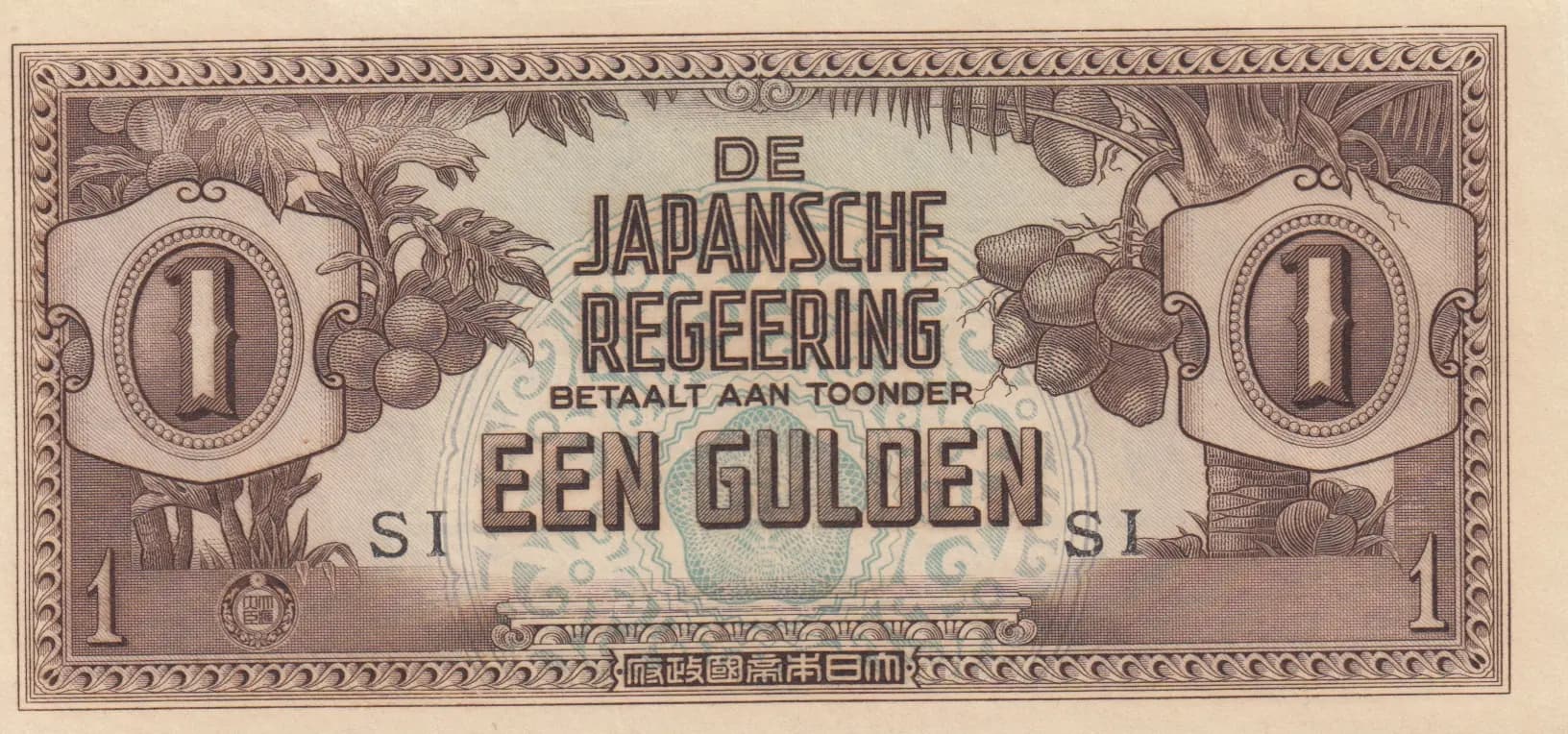
An exceptional example of a 1 gulden banknote issued by De Japansche Regeering (the Japanese Government) in 1942 during the occupation of the Netherlands Indies. This UNC specimen displays pristine condition with no visible wear, creases, or stains, featuring elaborate brown/sepia intaglio engraving with ornate scrollwork, grape vine imagery, and dual-language inscriptions in Dutch and Japanese characters. The symmetrical design and fine line work throughout exemplify the high-quality security printing standards of Japanese occupation currency.
Common. This is a standard-issue occupation currency note from a large-scale printing campaign during the Japanese administration of the Netherlands Indies (1942-1945). Millions of these notes were produced for circulation across the occupied territory. UNC examples, while always more desirable than circulated specimens, remain readily available in the collector market. The note's subsequent historical significance has ensured its preservation by collectors, meaning UNC examples are not difficult to locate.
This note represents the Japanese military occupation currency issued during World War II in the Netherlands Indies (present-day Indonesia), following Japan's conquest in 1942. The bilingual inscriptions—'DE JAPANSCHE REGEERING' (The Japanese Government) in Dutch alongside '日本帝國政府' (Japanese Imperial Government) in kanji—reflect the colonial administrative structure under Japanese control. The use of traditional Dutch guilder denominations and bearer-note language maintained the appearance of currency continuity while establishing Japanese governmental authority over the occupied territory.
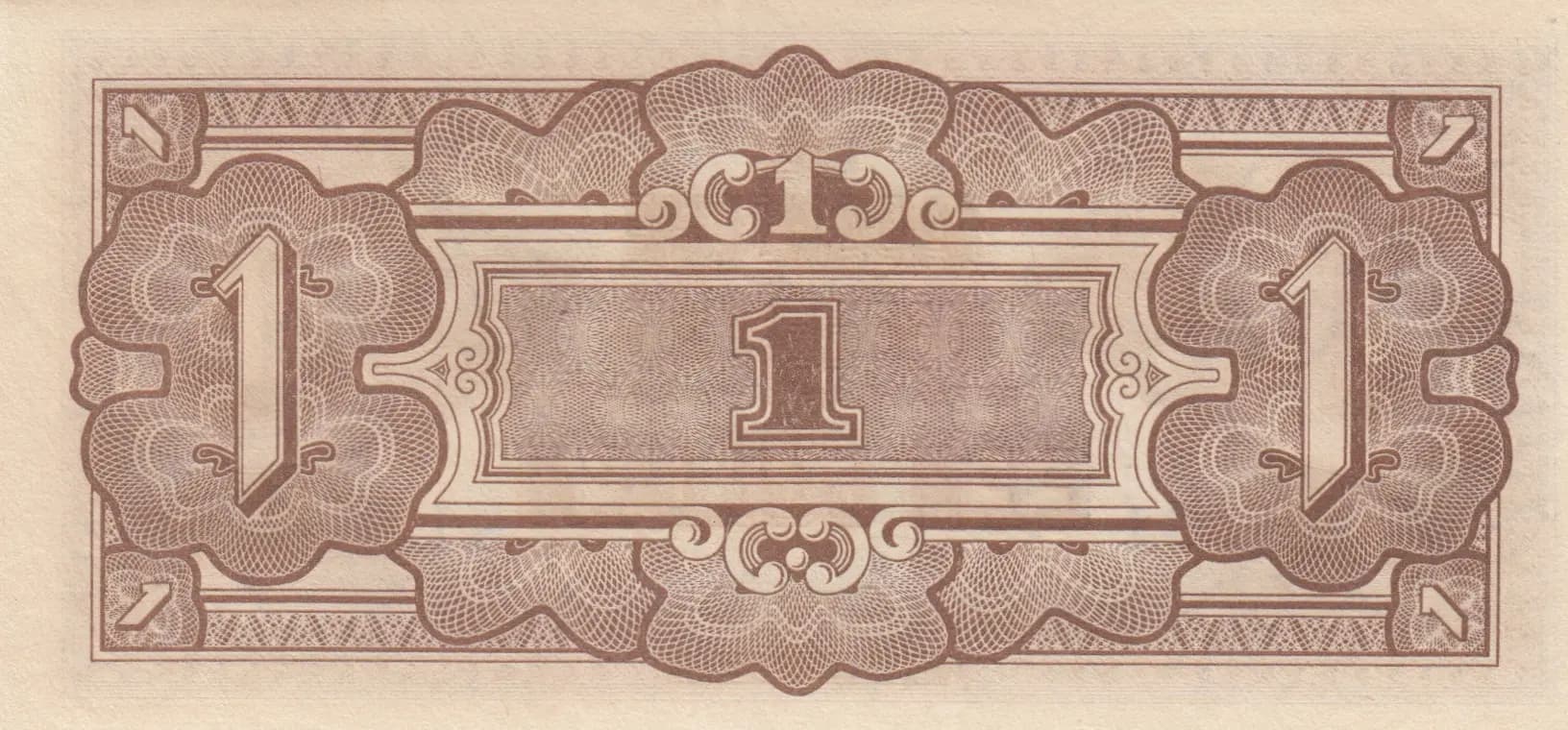
The obverse features a formal, highly ornamental design centered on the dual-language issuing authority text, with the denomination presented as 'EEN GULDEN' (One Guilder) prominently displayed. Large numerals '1' appear in circular medallions positioned in the upper left and right corners, following classical banknote design conventions. Grape vine imagery with naturalistic grape bunches decorates both lateral borders, serving both aesthetic and symbolic purposes. The reverse maintains strict symmetry with a large numeral '1' enclosed within an ornamental rectangular frame, surrounded by scalloped floral motifs and intricate geometric patterns. The design employs no portraits or specific landmarks, instead relying entirely on abstract decorative elements and intaglio security features typical of Japanese occupation currency.
Front side: 'DE JAPANSCHE REGEERING' (The Japanese Government), 'BETAALT AAN TOONDER' (Pays to Bearer), 'EEN GULDEN' (One Guilder), 'SI' (appears on left and right sides as an abbreviation or mark), and '日本帝國政府' (Japanese Imperial Government) in Japanese characters. Back side: No prominent text inscriptions; design is purely ornamental.
Intaglio engraving (recess printing), evidenced by the fine line work, ornate scrollwork, detailed floral patterns, and complex geometric borders visible throughout both sides. The precise nature of the engraving and the depth of detail suggest professional security printer production. Japanese occupation currency of this period was typically produced by the Imperial Japanese Government Printing Bureau (Teikoku Insatsu-kyoku) or contracted security printers, though specific printer attribution for Pick 123c would require additional documentation.
Pick 123c designation indicates this is the third identified variety of the 1 gulden 1942 issue. Potential variety distinctions for this issue may include: differences in Japanese Government printing bureau marks, variations in serial number formatting or prefix letters, plate varieties affecting the ornamental designs, or watermark differences if present. The visual analysis does not reveal obvious overprints, date variations, or signature varieties. Specific variety identification would require comparison with Pick catalog detailed specifications and examination of serial numbers and printing signatures not fully detailed in this analysis.