1 gulden 1943
About This Note
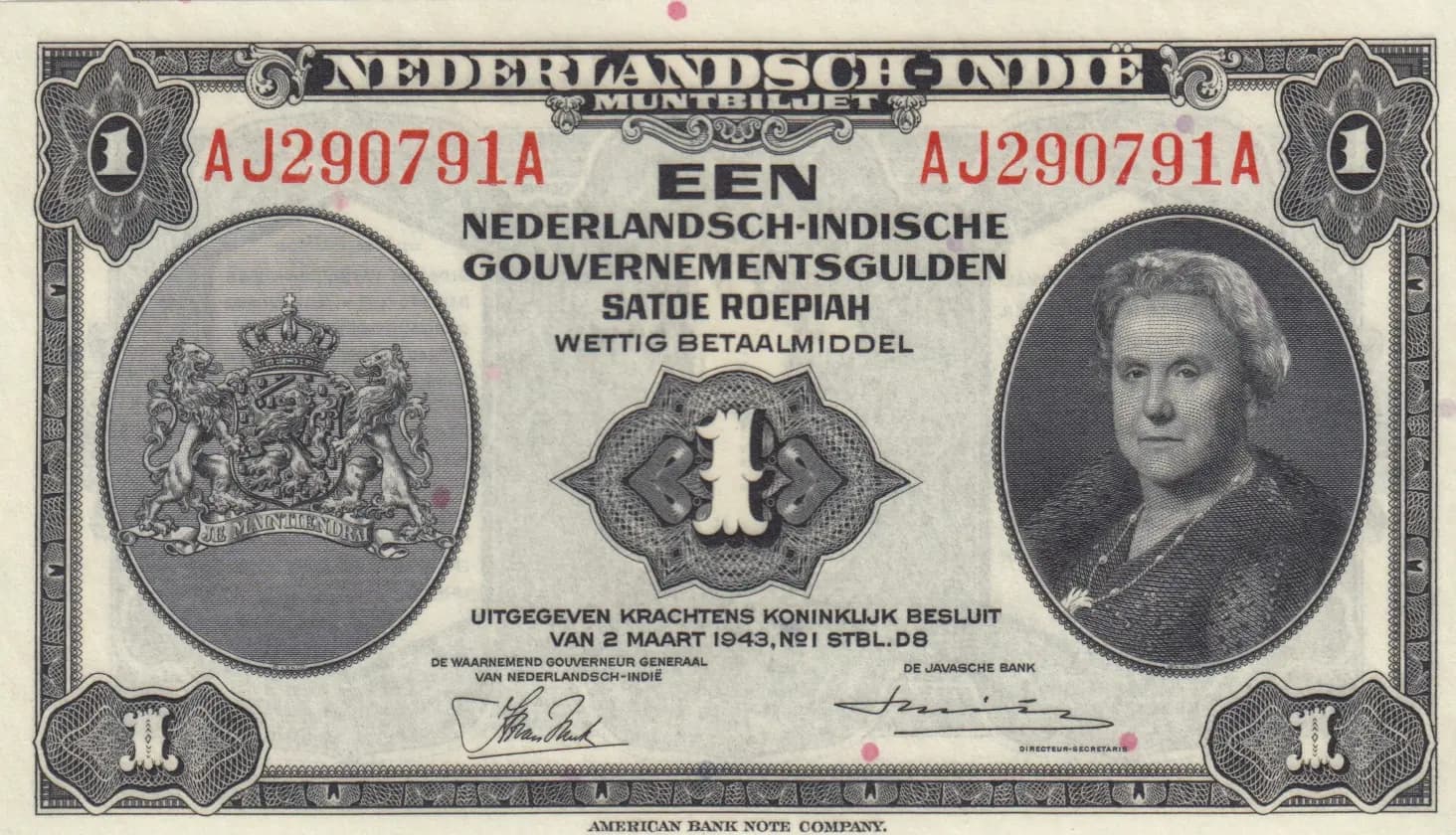
A stunning uncirculated 1943 Netherlands Indies 1 Gulden banknote (Pick P-111) issued under emergency wartime conditions by Muntbiljet. The note exhibits pristine condition with crisp black printing on the obverse, vibrant red serial numbers, and elegant green reverse design featuring intricate ornamental and scrollwork elements. This historically significant emergency currency represents the Japanese occupation period's complex monetary administration and is notable for its bilingual Dutch-Indonesian inscriptions and American Bank Note Company engraving.
Common. This note was part of a substantial wartime emergency issuance by the Netherlands Indies colonial administration during Japanese occupation. Multiple varieties exist with different serial number prefixes and signatures. While historically significant, these emergency notes were produced in quantities sufficient to make uncirculated examples relatively available to collectors today. The Pick P-111 series remains affordable and accessible in the numismatic market.
This 1943 banknote was issued by Royal Decree during the Japanese occupation of the Dutch East Indies (March 2, 1943), a critical moment when traditional Dutch colonial monetary systems were being reorganized under occupation authority. The note's dual-language presentation (Dutch and Indonesian) reflects the transitional political landscape of the period, while The Javaanse Bank's continued nominal issuance authority masked the underlying Japanese military occupation. The emergency 'Muntbiljet' designation indicates these notes were produced under extraordinary wartime circumstances, representing a unique intersection of Dutch colonial administration and Japanese occupation policy.
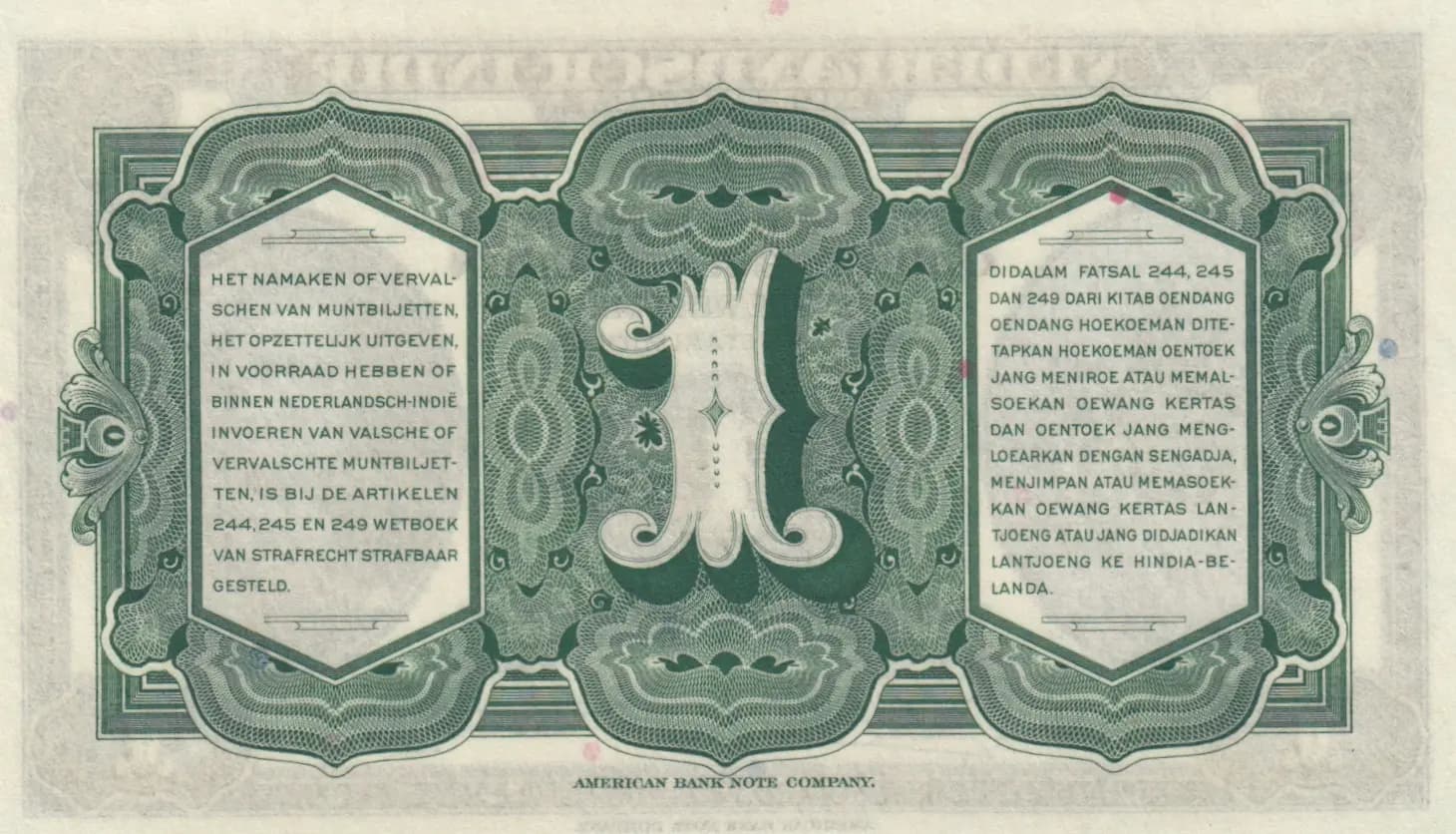
The obverse displays a symmetrical composition with an ornate coat of arms featuring lions and a crown positioned on the left side, representing Dutch colonial authority. A formal male portrait in profile facing left occupies the right portion of the note, representing a colonial administrator or dignitary from the period. The central design features elaborate scrollwork and a decorative emblem. Ornamental floral medallions occupy all four corners with fine-line geometric borders framing the entire composition. The reverse presents a dominant central ornamental emblem with complex scrollwork flourishes, surrounded by rectangular text panels containing legal warnings and administrative information in Dutch and Indonesian. The border design on the reverse employs intricate geometric and floral patterns executed in green ink, reflecting the Art Deco influences common in 1940s currency design. The bilingual presentation emphasizes the transitional administrative status during occupation.
FRONT SIDE: 'NEDERLANDSCH-INDIË' (Dutch East Indies); 'MUNTBILJET' (Banknote); 'EEN' (One); 'NEDERLANDSCH-INDISCHE GOUVERNEMENTSGILDEN' (Dutch East Indies Government Guilders); 'SATOE ROEPIAH' (One Rupiah in Indonesian); 'WETTIG BETAALMIDDEL' (Legal Tender); 'UITGEGEVEN KRACHTENS KONINKLIJK BESLUIT VAN 2 MAART 1943, N°1 STBL. D°' (Issued by Royal Decree of March 2, 1943, No. 1 State Gazette); 'DE WAARNEMEND GOUVERNEUR GENERAAL VAN NEDERLANDS-INDIË' (The Acting Governor General of the Dutch East Indies); 'DE JAVASCHE BANK' (The Javanese Bank); 'DIRECTEUR-SECRETARIS' (Director-Secretary); Serial number 'AJ290791A'; 'AMERICAN BANK NOTE COMPANY.' BACK SIDE: 'HET NAMAKEN OF VERVALSCHAN VAN MUNTBILJETTEN...' [counterfeiting warning in Dutch listing Criminal Code Articles 244, 245, 249]; Indonesian translation of counterfeiting warning: 'DIDALAM FATSAL 244, 245 DAN 249 DARI KITAB OENDANG OENDANG HOEKOEMAN...' [corresponding penalty provisions]; 'AMERICAN BANK NOTE COMPANY.'
Intaglio engraving (line engraving) executed by the American Bank Note Company, as evidenced by the fine-line detail work, precise geometric patterns, and complex ornamental elements visible throughout both sides. The crisp impression of serial numbers in red ink, the intricate scrollwork definition, and the uniform density of the black and green inks are all characteristic of high-quality intaglio production. The ornate border designs and security-oriented fine-line patterns were intentionally designed to resist counterfeiting through the complexity of the engraved plates.
This specimen is identified as variety with serial number prefix 'AJ' and specific serial number AJ290791A. Varieties of the 1943 1 Gulden (P-111) are known to exist with different serial number prefixes reflecting multiple printing runs. The 'Muntbiljet' designation appears consistent with the standard 1943 issue. Signature varieties may exist depending on the acting Director-Secretary who authorized the note during different production periods in 1943.