50 gulden 1941
Market Prices
24 salesAbout This Note
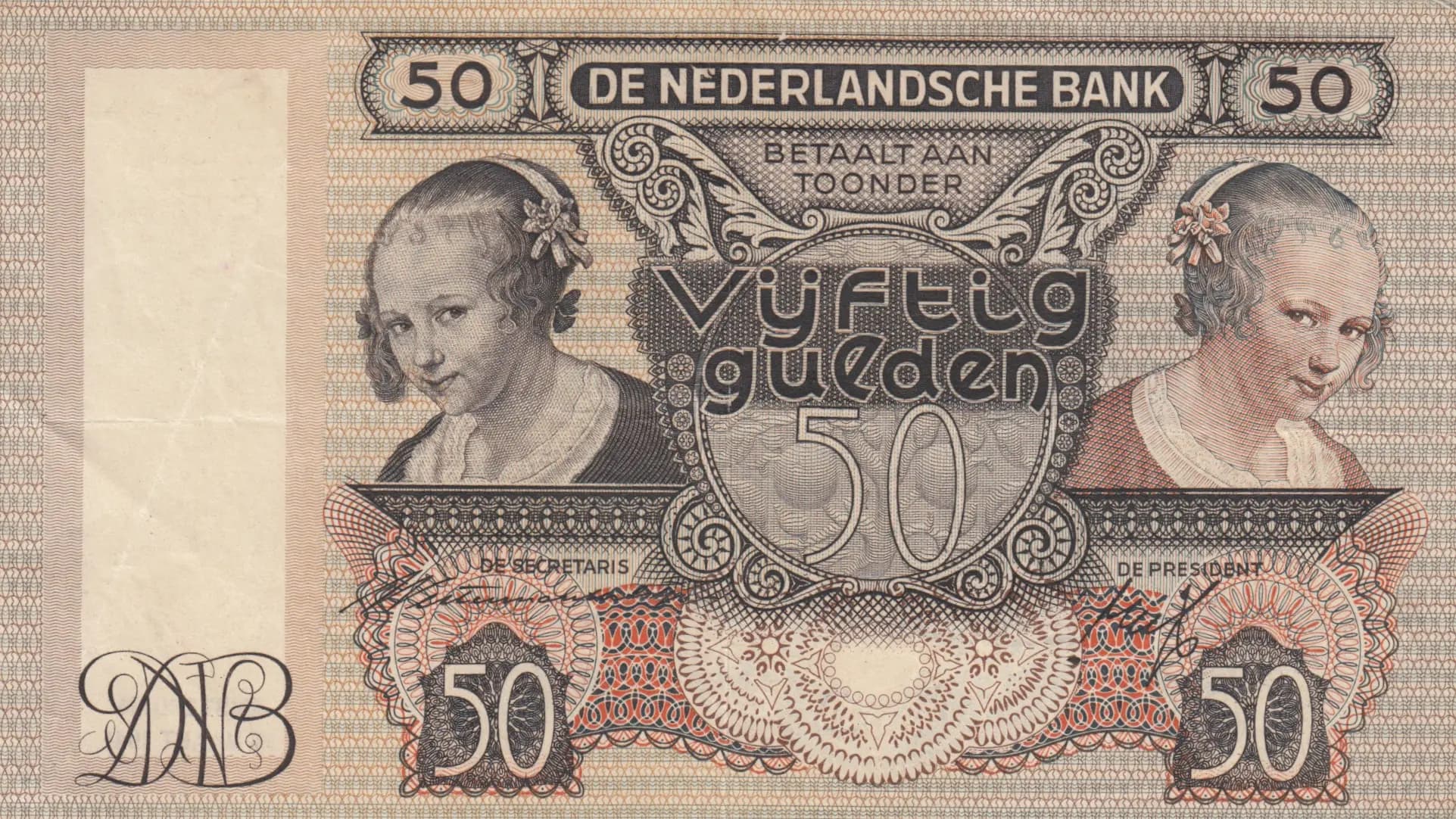
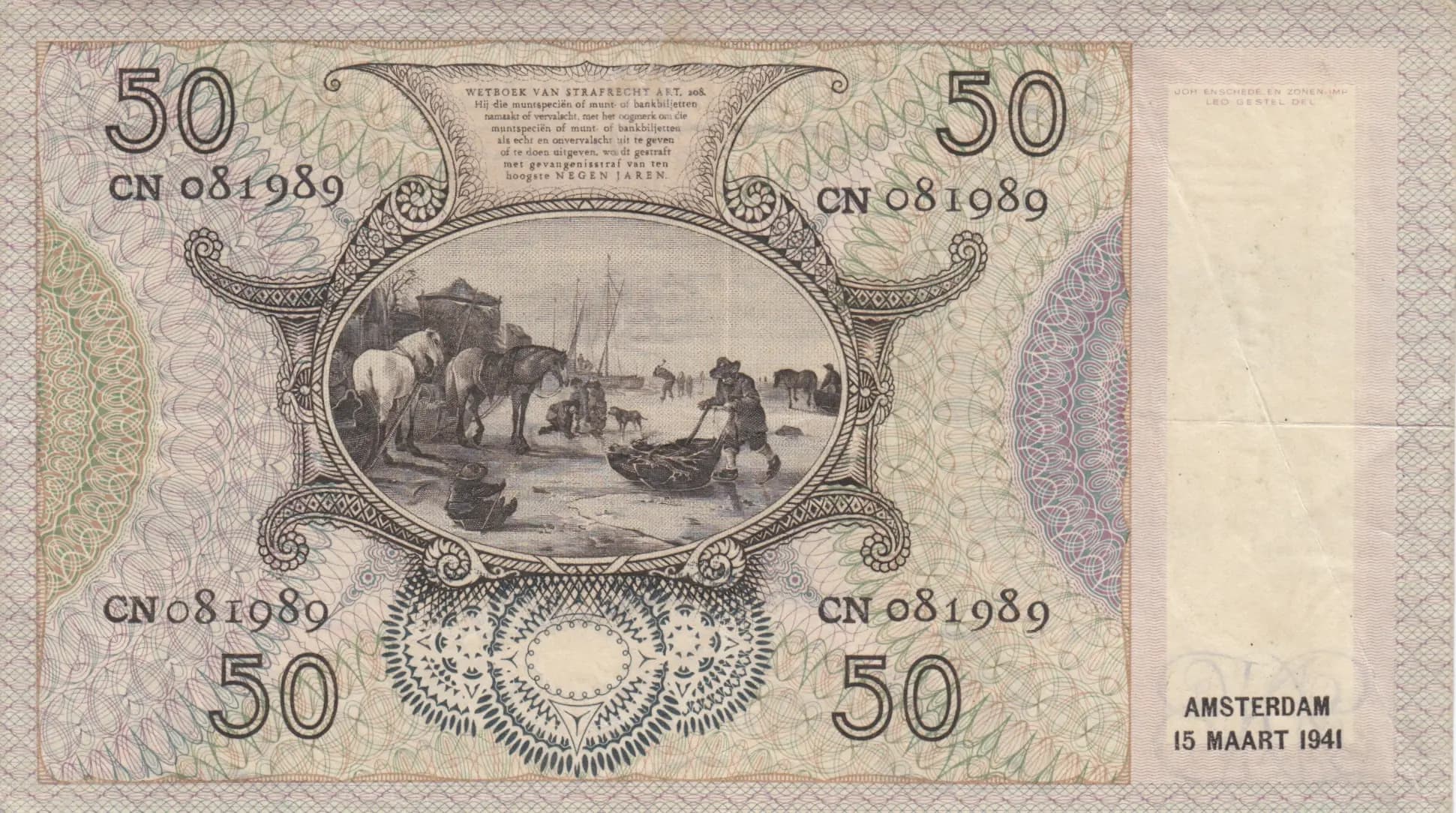
A well-preserved 1941 Netherlands 50 gulden note from De Nederlandsche Bank, printed by Joh. Enschede. The note displays the characteristic ornate design of the period with dual female portrait busts on the obverse and a detailed winter landscape scene on the reverse, rendered in warm tan and brown tones with fine engraved detail work. The visual condition appears exceptionally crisp with sharp detail throughout, consistent with an uncirculated or near-uncirculated specimen despite the catalog grade of VF.
Common. Despite the wartime context, this note was issued in substantial quantities across a two-year period (January 1941 to February 1943) and circulated widely. eBay sales data shows consistent availability across multiple condition grades, with VF specimens selling regularly between $31–$77 over the past decade. The 2016 catalog value for EF grade was $50, and current market prices for VF examples remain in the $50–$70 range, consistent with common circulation issues. No indication exists of a short print run, early recall, or scarcity.
This note was issued during March 1941, in the midst of German occupation of the Netherlands during World War II, as evidenced by the dated inscription on the reverse (15 MAART 1941). The artistic selections—featuring Jan Steen's 'The Oystereaters' on the obverse and Isack van Ostade's 'Winter Landscape' on the reverse—reflect the Dutch Golden Age artistic heritage, a deliberate cultural statement during occupation. The note's continued use of formal denominations and classical artistic imagery represented monetary stability and national continuity during this turbulent period.
The obverse features two allegorical female busts representing virtues or prosperity, positioned symmetrically on the left and right sides of the note, framed within ornate baroque-style scrollwork and geometric borders. The large central denomination '50' dominates the center with elaborate calligraphic styling and decorative flourishes. The reverse showcases a meticulously engraved oval vignette depicting 'Winter Landscape' by Isack van Ostade, a Dutch Golden Age master, showing a frozen waterscape with multiple human figures engaged in winter activities, horses, boats, sailing vessels, and architectural elements rendered in atmospheric detail. Both sides employ lace-like border patterns, decorative corner elements, and the DNB monogram, with the overall composition reflecting high-quality engraved banknote design characteristic of Joh. Enschede's production standards.
FRONT SIDE: '50' (Fifty, denomination), 'DE NEDERLANDSCHE BANK' (The Netherlands Bank, issuer), 'BETAALT AAN TOONDER' (Payable to Bearer, promise clause), 'Vijftig gulden' (Fifty guilders, full denomination in words), 'DE SECRETARIS' (The Secretary, signing authority), 'DE PRESIDENT' (The President, signing authority). BACK SIDE: '50' (Fifty, denomination appearing in corners), 'CN 081989' (Serial number), 'WETBOEK VAN STRAFRECHT ART. 208' (Penal Code Article 208, counterfeiting warning), 'AMSTERDAM' (Printing/issuing location), '15 MAART 1941' (15 March 1941, official issue date).
Intaglio engraving (line engraving and steel plate printing), printed by Joh. Enschede of the Netherlands. The visual characteristics—fine cross-hatching, intricate line work, detailed portraiture, complex ornamental borders, and the depth visible in the landscape vignette—are all hallmarks of steel plate intaglio printing. The security features relied on the difficulty of reproducing the fine detail work, subtle tonal gradations, and complex scenic imagery rather than on modern security threads or watermarks.
The observed serial number 'CN 081989' indicates a note from the standard production run with the CN prefix. Varieties for this Pick-58 issue may exist based on signature combinations of the President and Secretary, as well as minor date variations within the stated issue window of 07.01.1941–06.02.1943, but the single specimen observed does not provide sufficient information to classify beyond the standard issue type. No overprints, emergency markings, or unusual production anomalies are evident in the visual analysis.