10 gulden 1929
Market Prices
28 salesAbout This Note
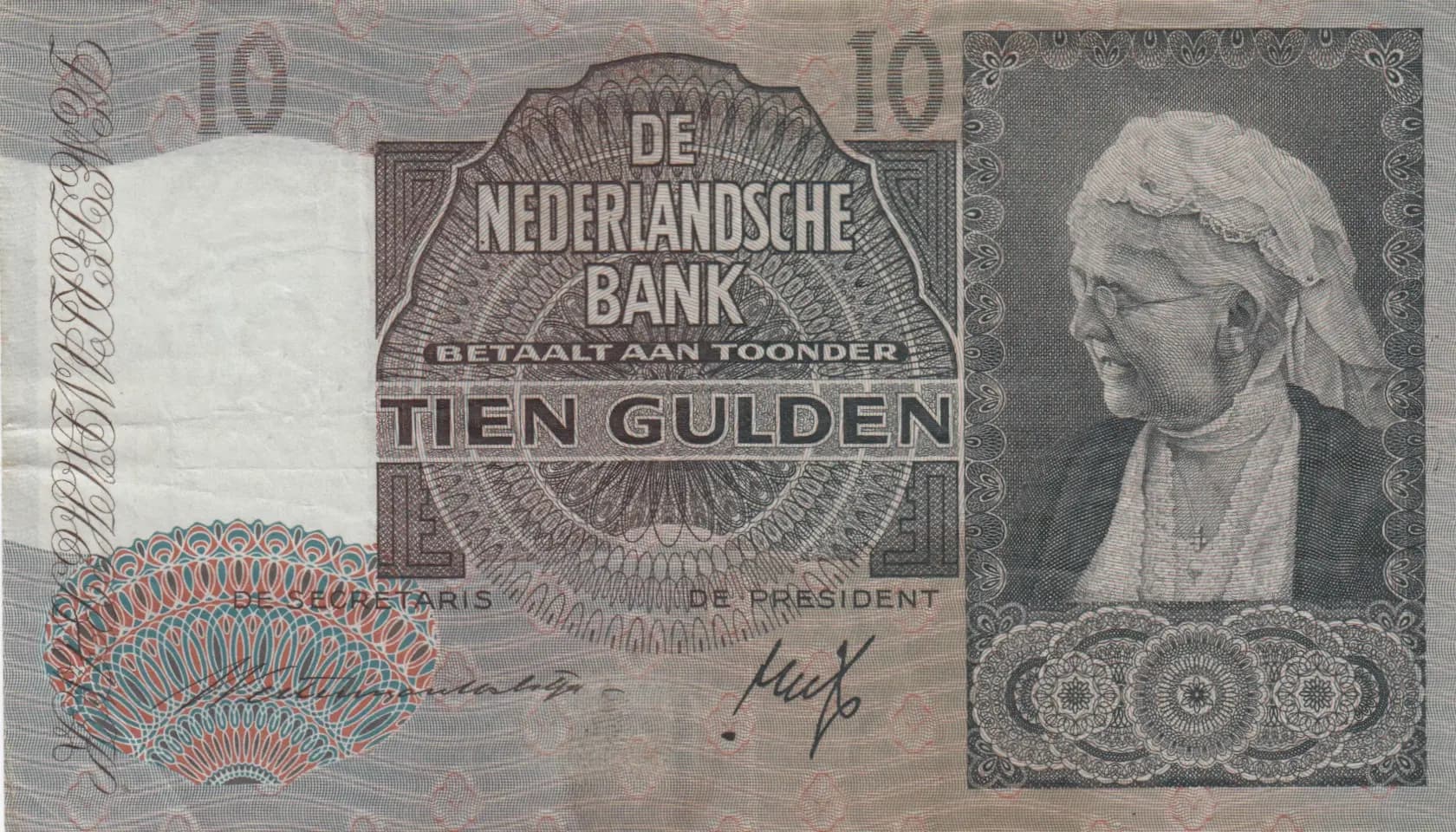
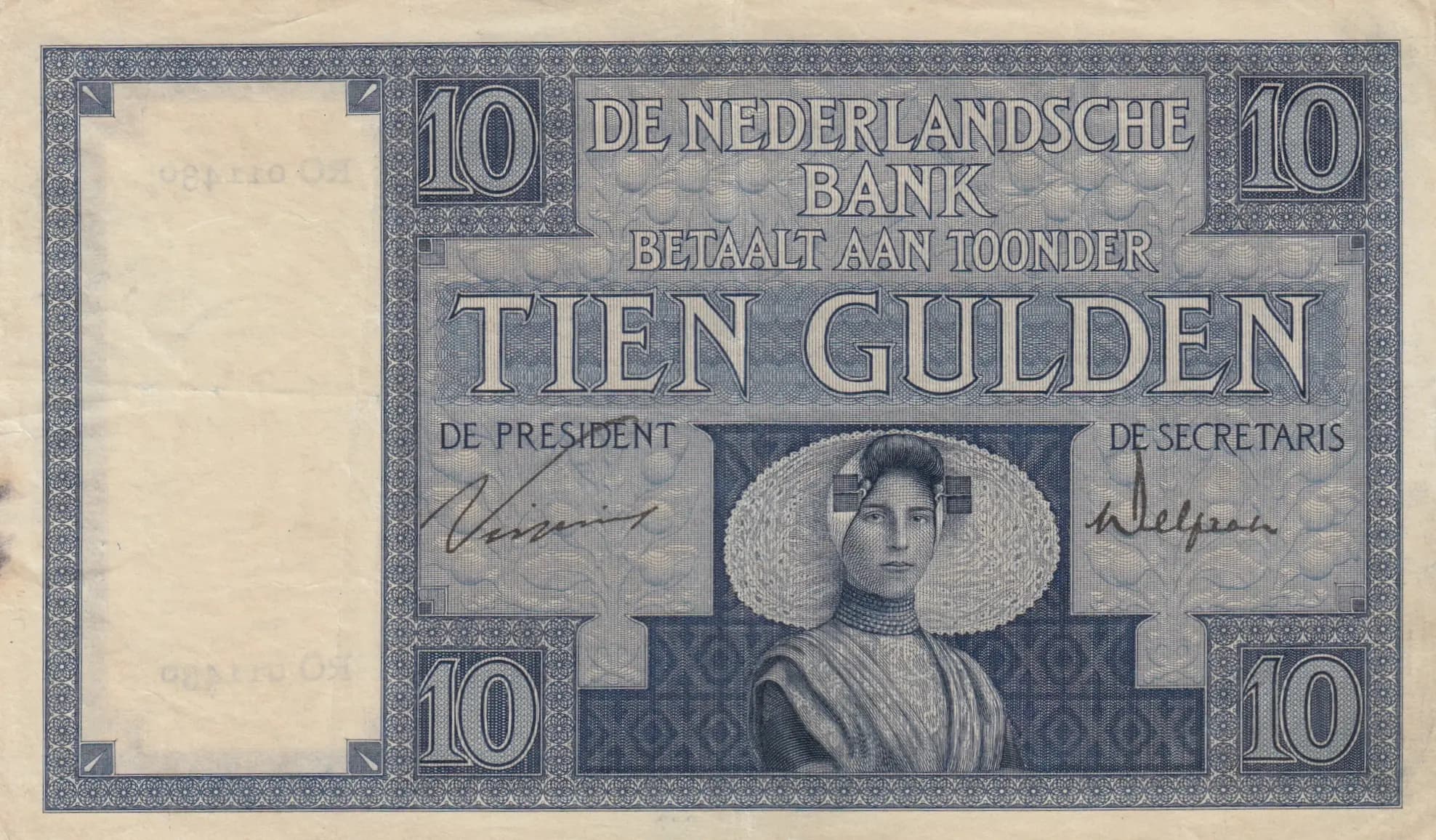
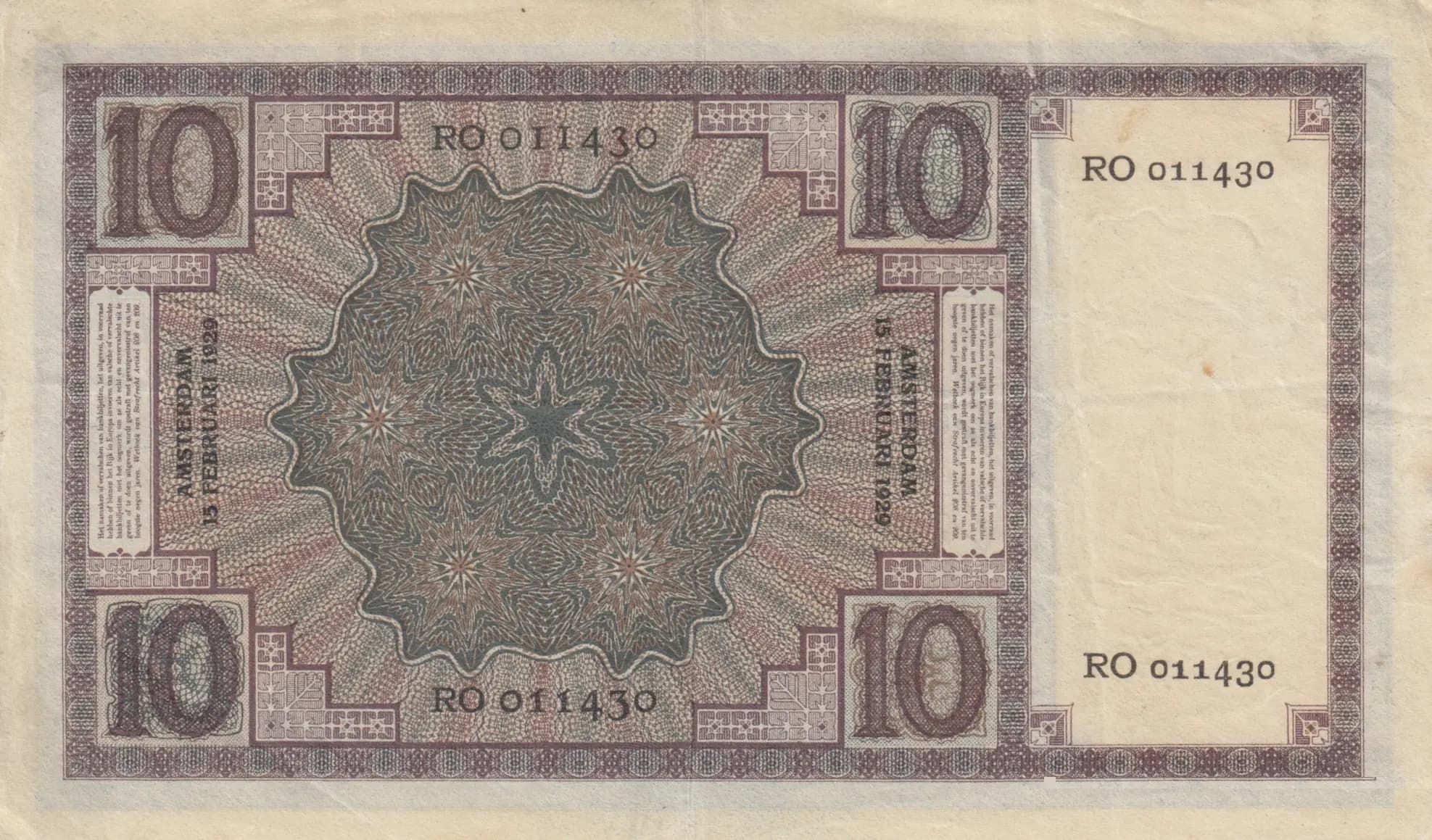
This 10 Gulden note from De Nederlandsche Bank (1924-1930 issue, Pick P-43b) features a striking portrait of a Zeeland farmer's wife wearing an elaborate decorative wide-brimmed hat, rendered in classical engraving style on the obverse. The reverse displays an ornate mandala-like geometric and floral pattern in brown and green tones. In VF condition, the note exhibits the cream/beige patina and foxing characteristic of well-preserved 1920s currency, with visible period signatures and reference numbers (RO 011430) that add to its historical authenticity.
Common. eBay market data shows consistent sales in the $20-$100 range across multiple condition grades over the past decade, with VF specimens regularly selling for $28-$92. The 2016 catalogue value for F-grade is $12 and EF-grade $45, indicating moderate collector demand but substantial surviving circulation. This was a standard-issue denomination from a major European bank during a 6-year issuance period (1924-1930), ensuring large print runs and adequate survival.
Issued during the mid-to-late 1920s by De Nederlandsche Bank, this note commemorates rural Dutch cultural identity through its depiction of a Zeeland farmer's wife—a region famous for distinctive traditional dress and agricultural heritage. The imagery reflects the Netherlands' agrarian economy during the interwar period, before the economic disruptions of the Great Depression. The 'Pays to Bearer' (Betaalt aan Toonder) inscription confirms this as a bearer note from the gold standard era, when currency was theoretically exchangeable for precious metals.
The obverse features a dignified portrait of a Zeeland farmer's wife positioned in the center-right, shown in left-facing profile wearing a characteristic ornate wide-brimmed hat with decorative elements—an iconic symbol of Zeeland folk tradition. The background is light cream with blue-gray decorative borders and fine line work. The denomination '10' appears in all corners. Two signature lines below 'DE PRESIDENT' and 'DE SECRETARIS' labels represent the dual authorization required for currency issuance. The reverse showcases an elaborate symmetrical mandala or star-burst pattern in brown, maroon, and green, occupying the central field with decorative borders. Serial number prefix 'RO' appears on the reverse, indicating one of two catalogued varieties (P-43b notes had prefix letter variants).
FRONT: '10' (denomination numeral), 'DE NEDERLANDSCHE BANK' (The Dutch Bank / The Netherlands Bank), 'BETAALT AAN TOONDER' (Pays to Bearer), 'TIEN GULDEN' (Ten Guilders), 'DE PRESIDENT' (The President), 'DE SECRETARIS' (The Secretary). BACK: '10' (denomination numerals in corners), 'RO 011430' (serial/reference number with prefix letter 'RO').
Intaglio engraving (copperplate printing), evidenced by the fine line work, intricate decorative borders, and the precise detail visible in the portrait and geometric patterns. This was the standard security printing method for Nederlandsche Bank notes during this period. The multi-color printing (blue-gray on obverse; brown, maroon, green on reverse) suggests separate printing passes for each color using engraved plates.
This note is catalogued as Pick P-43b, which specifically denotes the variety with prefix letter before serial number on the reverse (observed as 'RO' in this example). According to the REALBANKNOTES reference, there are 2 types within the 1924-1930 series, differentiated by serial number prefix placement. The visual analysis confirms the 'RO 011430' reference number visible on the reverse, consistent with the P-43b designation. Signature combinations may vary, as both 'DE PRESIDENT' and 'DE SECRETARIS' lines are signed (signatures not fully legible in the image but present as stated in catalog data).