2.50 gulden 1920
Market Prices
1 saleAbout This Note
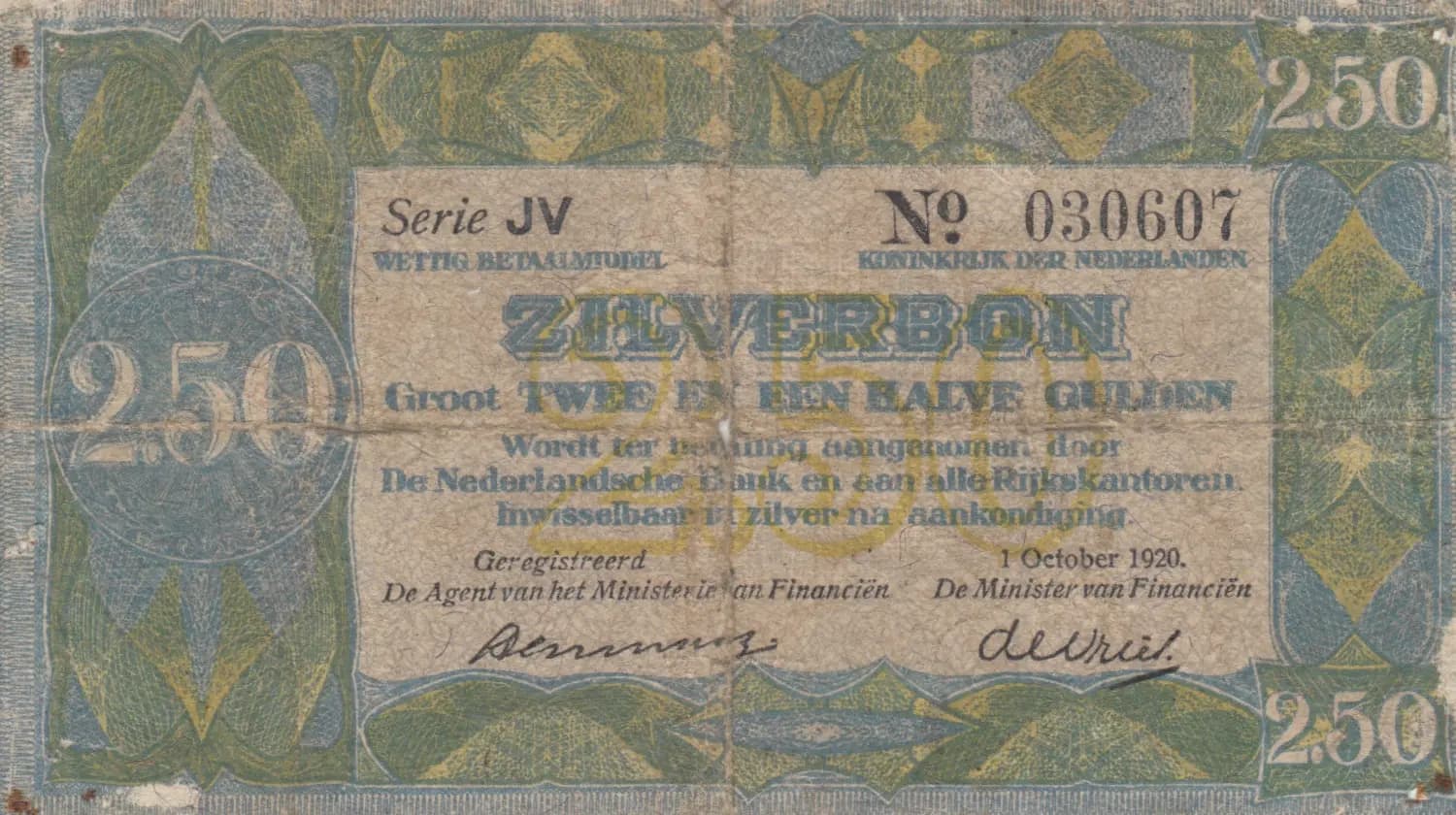
This is a Dutch 2.50 gulden silver certificate from 1920 (Pick P-16), issued by the Ministry of Finance during a period of post-WWI economic transition. The note displays characteristic Art Deco ornamental design with green and gold geometric patterns, and features the denomination prominently in all corners. In Grade G condition, this example shows significant age-appropriate wear including multiple creases, a prominent center fold, and patina consistent with historical circulation, making it a genuine period artifact rather than a preserved specimen.
Common. The catalog values provided (G: $5, F: $30, EF: $125) and the market data showing comparable F-grade examples selling for $44.08 indicate healthy circulation and availability of this denomination. The 1920 2.50 gulden was a standard regular-issue note with substantial print runs to support commerce in the interwar Dutch economy. No evidence of limited production, early withdrawal, or scarcity is apparent. This Pick P-16 remains widely available to collectors in various conditions at affordable price points.
This 2.50 gulden silver certificate was issued on October 1, 1920, representing the Kingdom of the Netherlands' monetary system during the early interwar period. The note's designation as a 'ZILVERBON' (silver certificate) reflects the gold standard monetary framework still in place immediately following World War I, with the inscribed promise of redemption in silver at state offices and De Nederlandsche Bank. The ornamental geometric design with Dutch institutional text and ministerial signatures exemplifies the formal, security-conscious banknote design aesthetic of the 1920s Dutch financial system.
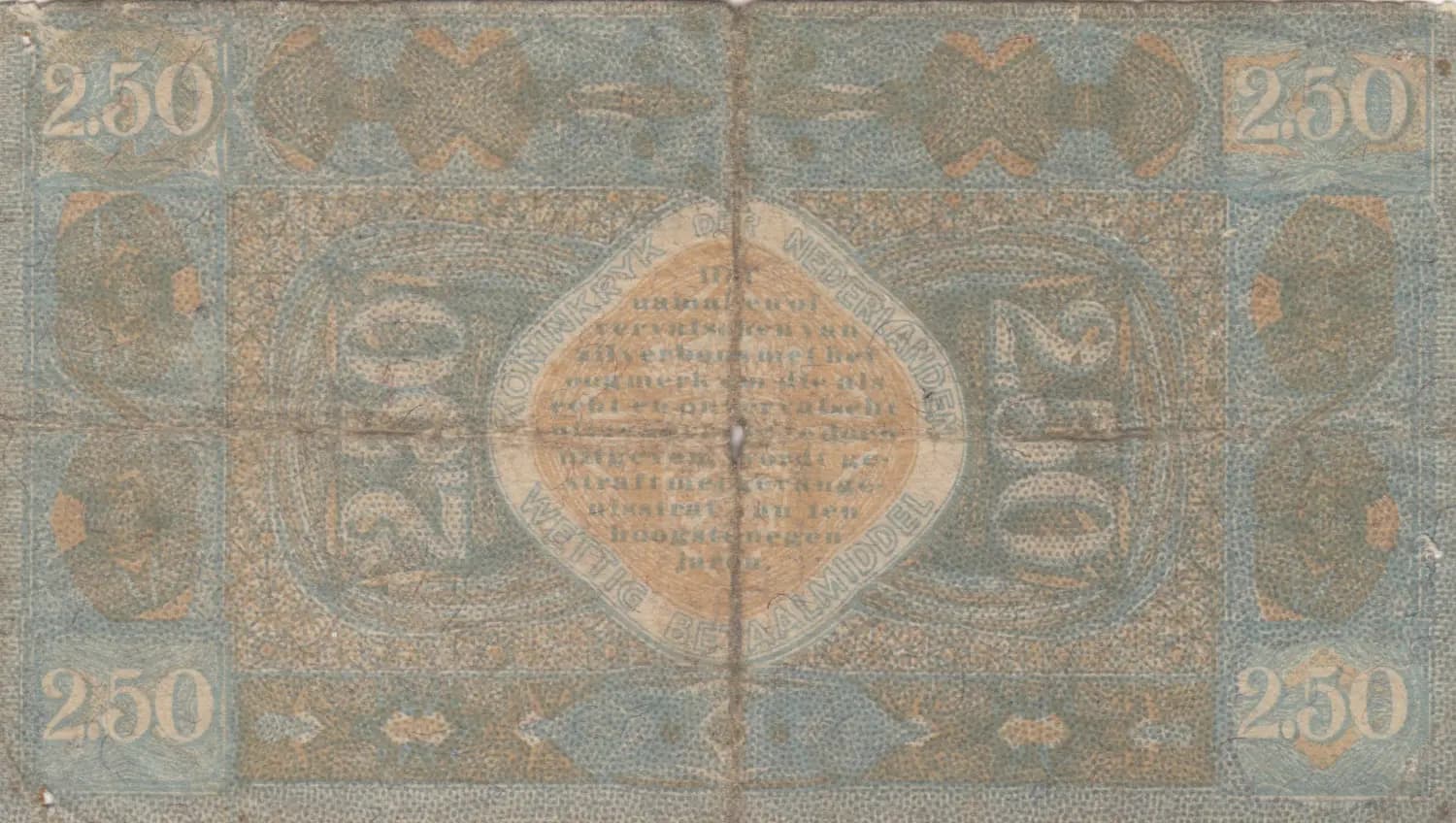
The 2.50 gulden silver certificate features a purely ornamental design characteristic of early 20th-century Dutch security printing, with no portraits or specific landmarks depicted. The front displays a formal institutional layout with a central rectangular panel containing regulatory text, redemption terms, and ministerial/agent signatures (de Vries and Menning). Both sides are framed by elaborate decorative borders incorporating repeating diamond and leaf motifs in green, gold, and blue-grey tones. The back features a prominent circular seal or coat of arms at center, likely representing the Dutch royal arms or national emblem, surrounded by additional geometric and floral ornamental patterns. The denomination '2.50' appears in large numerals at both top corners and both bottom corners on both sides, facilitating rapid visual identification. The color palette—green, gold/yellow, blue-grey, and cream/tan—was standard for Dutch banknote production of this era and provides visual distinction from lower and higher denominations.
FRONT SIDE: '250' (denomination), 'Serie JV' (Series JV), 'WETTIG BETAALMIDDEL' (Legal Tender), 'N° 030607' (Serial Number 030607), 'KONINKRIJK DER NEDERLANDEN' (Kingdom of the Netherlands), 'ZILVERBON' (Silver Certificate), 'Groot TWEE EN HALVE GULDEN' (Large Two and a Half Guilders), 'Wordt ter bestelling aangenomen door De Nederlandsche Bank en aan alle rijkskaantooren inwisselbaar in zilver na aankondiging' (Will be exchanged upon request by The Dutch Bank and at all state offices, redeemable in silver after notification), 'Geregistreerd' (Registered), 'De Agent van het Ministerie van Financiën' (The Agent of the Ministry of Finance), 'De Minister van Financiën' (The Minister of Finance), '1 October 1920' (date), signatures 'Menning' and 'de Vries'. BACK SIDE: '2.50' (denomination in all four corners), 'KONINKLIJK DER NEDERLANDEN' (Kingdom of the Netherlands), 'WETTIG BETAALMIDDEL' (Legal Tender).
This note was produced using multi-color letterpress and intaglio printing techniques, typical for high-security banknote production in the 1920s. The precise ornamental borders, fine line work in the geometric patterns, and clear registration of multiple colors indicate professional security printing by a specialized banknote printer. The Dutch government's banknote production during this period was typically handled by De Nederlandsche Bank's printing operations or contracted to established security printers such as Enschedé (Dutch Banknote Printing Company), though attribution from visual analysis alone cannot be definitive without archival documentation.
Series JV is noted on the observed specimen (serial number 030607). This note represents the standard 1920 issue dated October 1, 1920, signed by the Agent of the Ministry of Finance (de Vries) and the Minister of Finance (Menning). Serial number varieties exist as part of the sequential printing run. No major overprints, color varieties, or significant production variants are documented for this Pick number. The combination of Series JV and the specific signatures represents the standard variety for this regular-issue silver certificate.