25 gulden 1941
Market Prices
65 salesAbout This Note
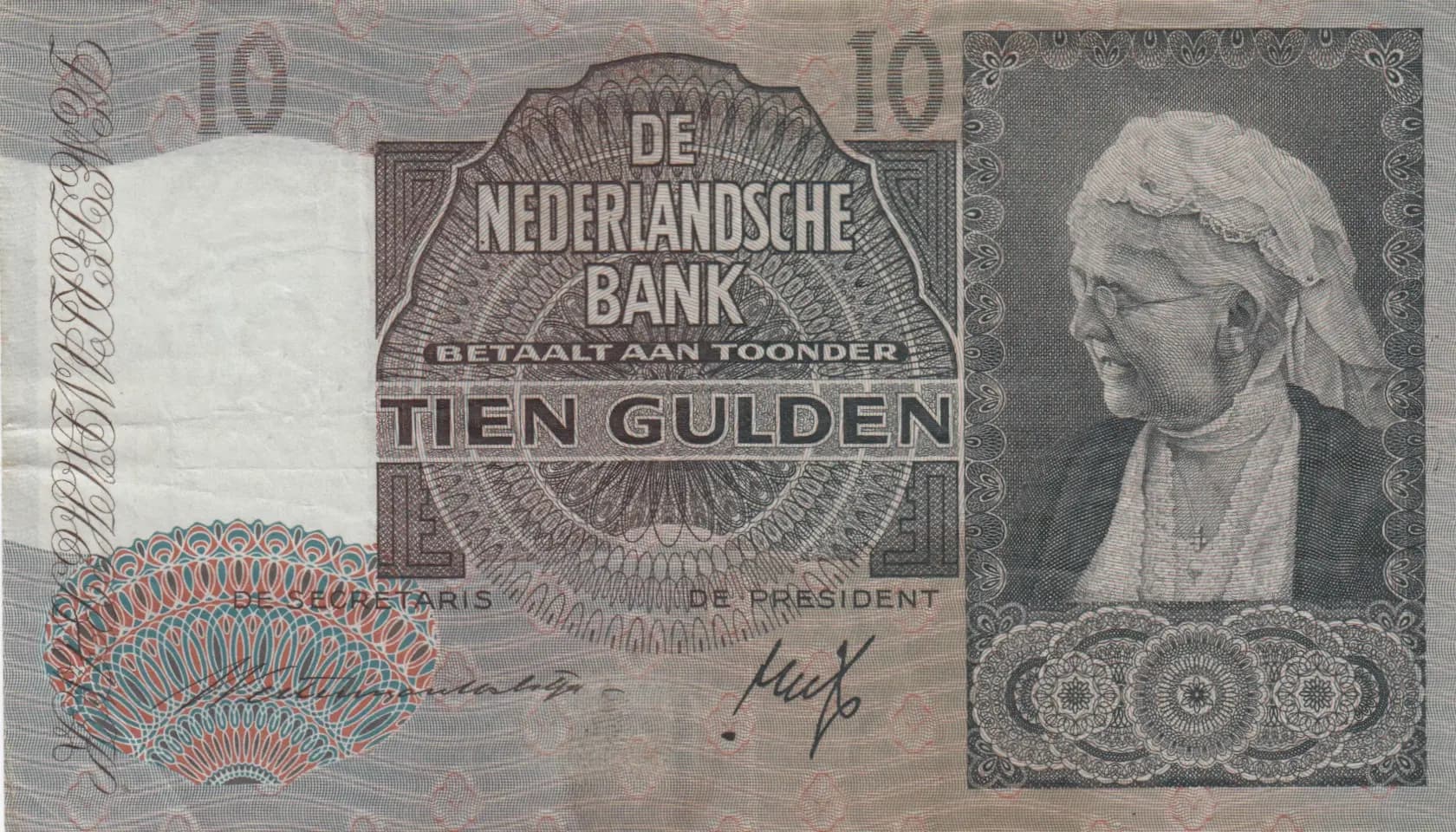
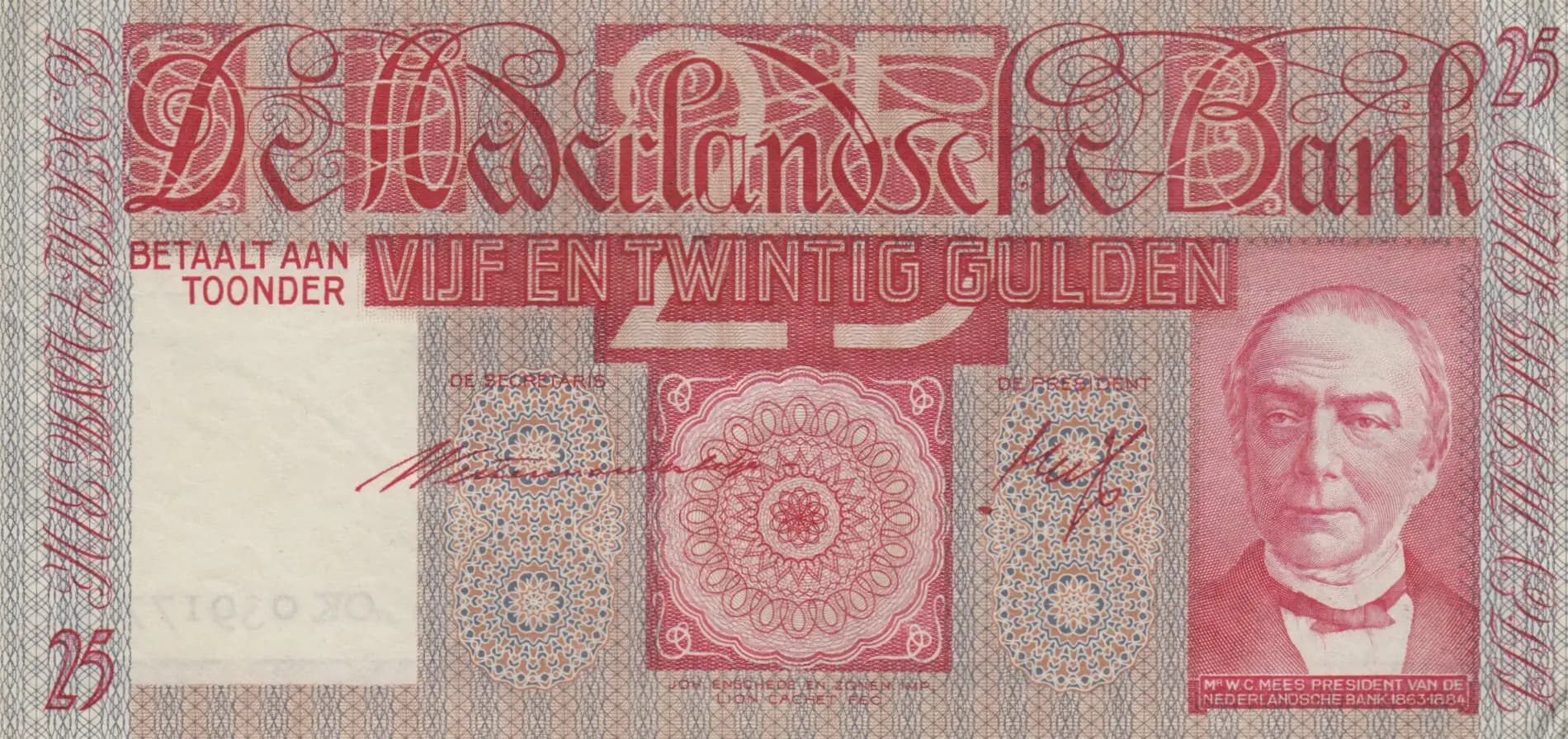
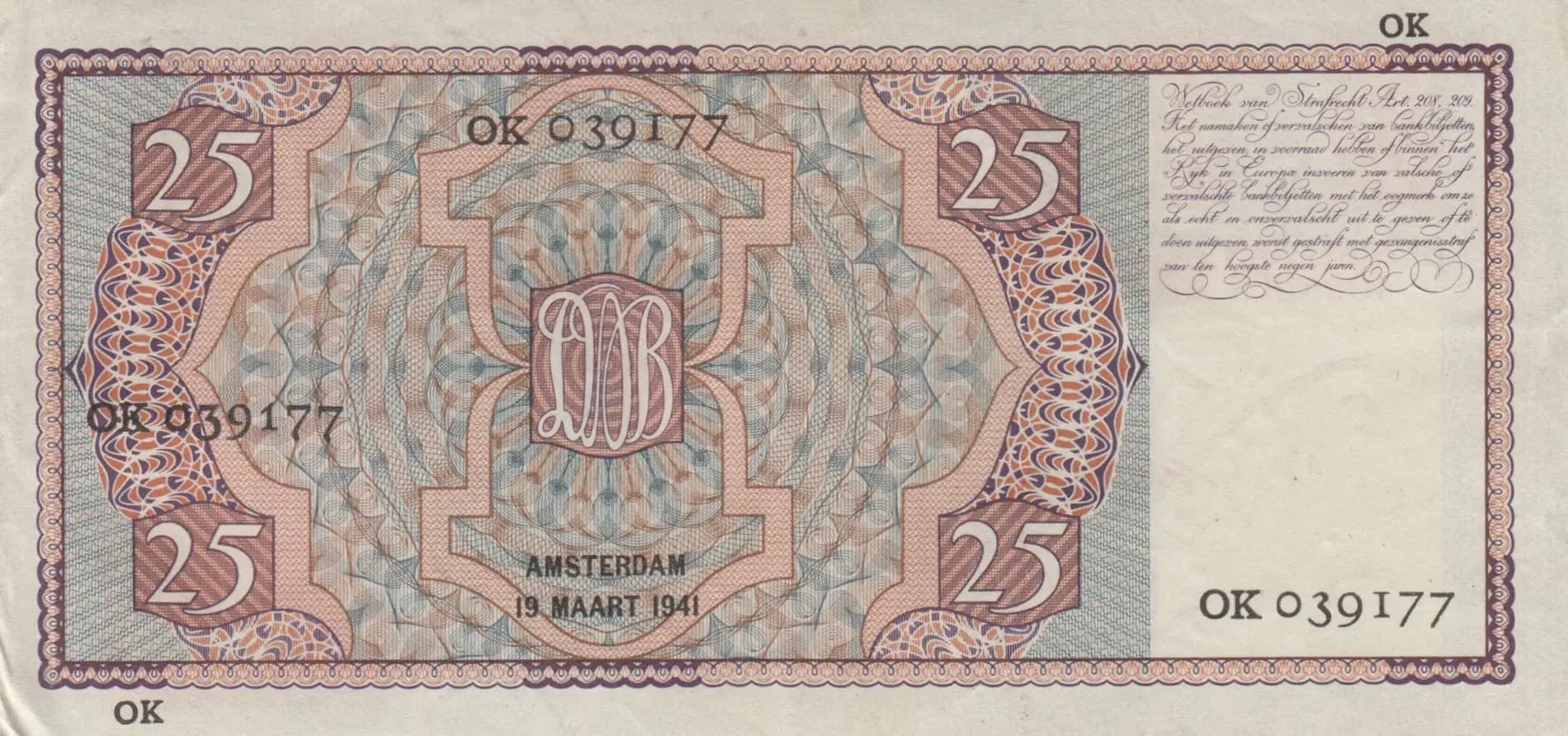
This 1941 Netherlands 25 gulden banknote (Pick P-50) displays the characteristic red and multicolor design of the later Nederlandsche Bank issue, featuring an elegant portrait of W.C. Mees in formal dress on the right side of the obverse. The note is presented in EF condition with light creasing visible but no major defects, showing good color retention and clear impressions of the ornate guilloche patterns. The handwritten notation on the reverse dated 19 March 1941 and reference to emergency legislation adds historical interest, placing this note squarely within the World War II occupation period of the Netherlands.
Common. This is a regular issue 25 gulden note from the standard 1931-1941 series with substantial production numbers. eBay transaction data provided shows consistent sales activity across decades with EF-graded examples selling in the $15-43 range as late as 2020-2021, indicating ready market availability. Catalog values for 2016 assessed EF examples at $40, and the note lacks characteristics of scarce wartime issues (no special overprints, emergency-only design, or limited denomination). The presence of two known signature varieties further indicates substantial circulation quantities. This specimen represents a common collectible with modest value driven primarily by condition and historical interest rather than scarcity.
This 25 gulden note was issued during the Nederlandsche Bank's final years of independent operation before German occupation intensified in 1941. The portrait of Willem Cornelis Mees, bank president from 1863-1910, honors a significant figure in Dutch banking history and appears on notes issued from 1931-1941. The handwritten notation 'Uitbetaald aan Standrecht Art. 208, 209' (Paid under Emergency Articles) on the reverse reflects the extraordinary monetary measures adopted by Dutch authorities during the Nazi occupation, making this a historically significant document of the wartime period.
The obverse features an ornate Art Deco design centered on a portrait of Willem Cornelis Mees positioned in profile facing left, depicted as a distinguished gentleman in formal dress with bow tie. The composition employs elaborate guilloche patterns and geometric rosette designs in red, pink, beige, and cream tones, with decorative floral and ornamental borders framing the composition. The reverse displays the DB monogram (Nederlandsche Bank) prominently within an ornamental shield design, surrounded by complementary purple, blue, and brown decorative elements. Serial numbers appear in multiple locations, and the handwritten notation indicates official authorization for emergency circulation. The overall design reflects the refined aesthetic standards of early 20th-century European banknote production.
FRONT SIDE: 'DE NEDERLANDSCHE BANK' (The Netherlands Bank); 'BETAALT AAN TOONDER' (Pays to Bearer); 'VIJF EN TWINTIG GULDEN' (Twenty-five Guilders); 'DE SECRETARIS' (The Secretary); 'DE PRESIDENT' (The President); 'M. W.C. MEES PRESIDENT VAN DE NEDERLANDSCHE BANK 1863-1910' (M. W.C. Mees President of the Netherlands Bank 1863-1910). BACK SIDE: Serial numbers 'OK O39177' and 'SB203917'; 'AMSTERDAM' (printing location); '19 MAART 1941' (19 March 1941); 'Uitbetaald aan Standrecht Art. 208, 209...' (Paid out according to Emergency Articles 208, 209...).
The note was produced by Joh. Enschede of the Netherlands using intaglio printing combined with color lithography. The fine line work evident in the guilloche patterns, microprint-style detailed geometric designs, and sharp portrait rendering are characteristic of intaglio engraving, while the multicolor palette (red, pink, beige, purple, blue, brown) indicates the use of color lithography or multi-plate printing techniques. The high resolution and clarity of the ornamental designs throughout demonstrate the precision capabilities of early-to-mid 20th-century European security printing.
This specimen exhibits the '19 March 1941' issue date variant and bears the serial number prefix 'OK' with secondary number sequence 'SB203917,' consistent with later-period printing blocks of the 1931-1941 series. The note is one of two known signature varieties for this Pick number. The handwritten authorization notation with reference to emergency legislation (Standrecht Art. 208, 209) suggests this may have been part of special emergency circulation measures during March 1941, though such notations appear to have been applied to various examples and do not constitute a distinct catalogued variety. No major overprint varieties or limited-issue characteristics are apparent.