5 gulden 1973
“star”
Market Prices
169 salesAbout This Note
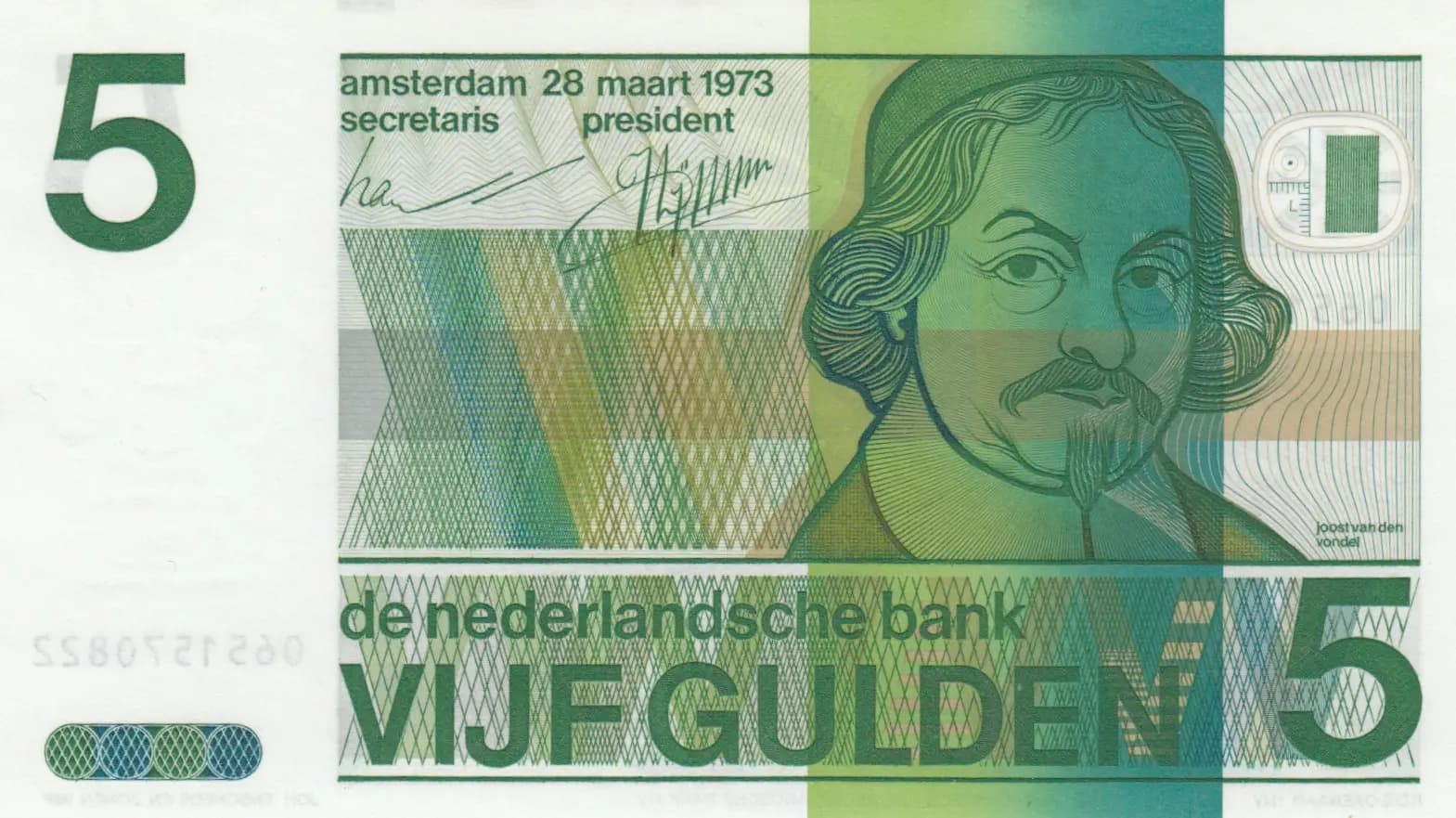
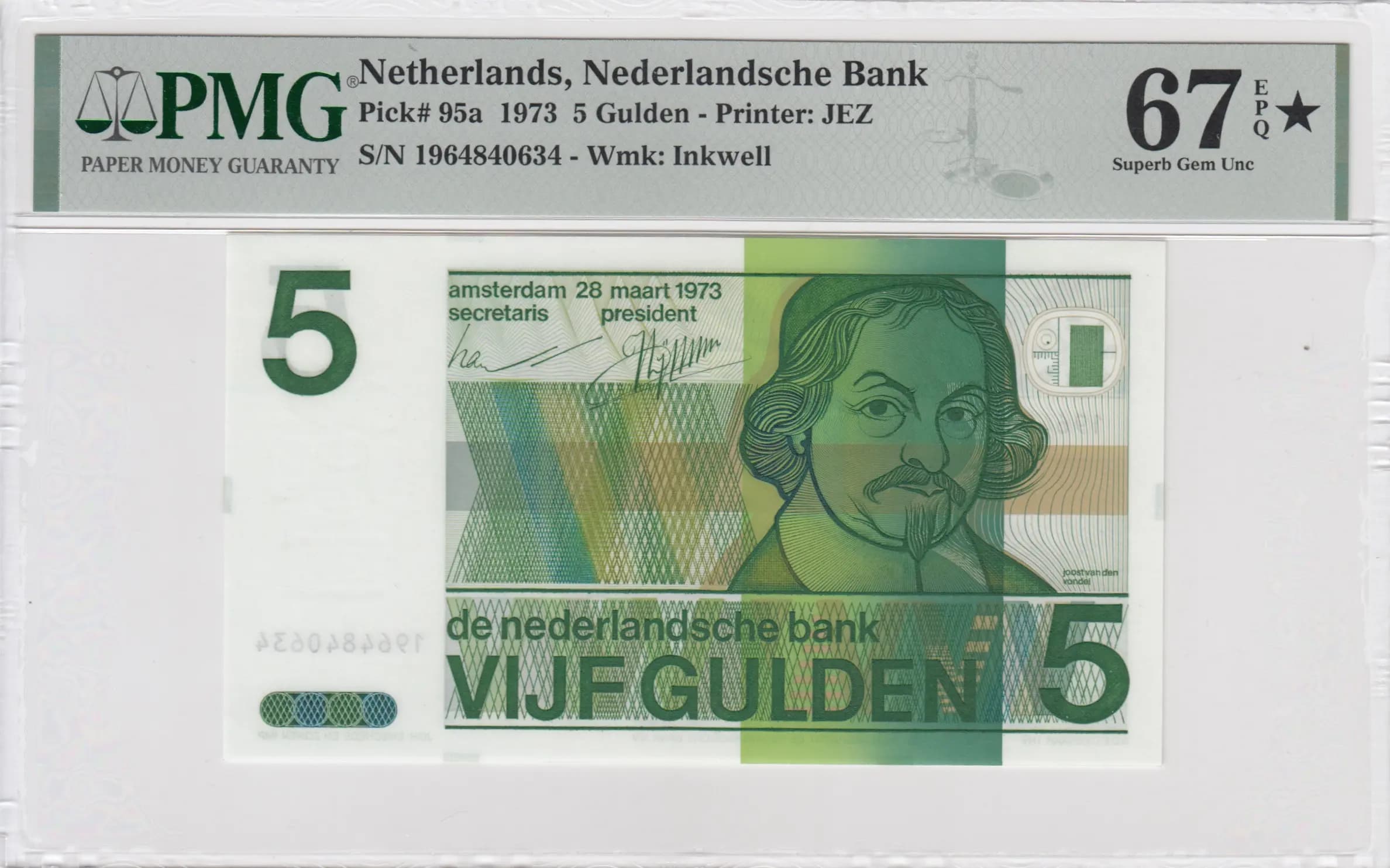
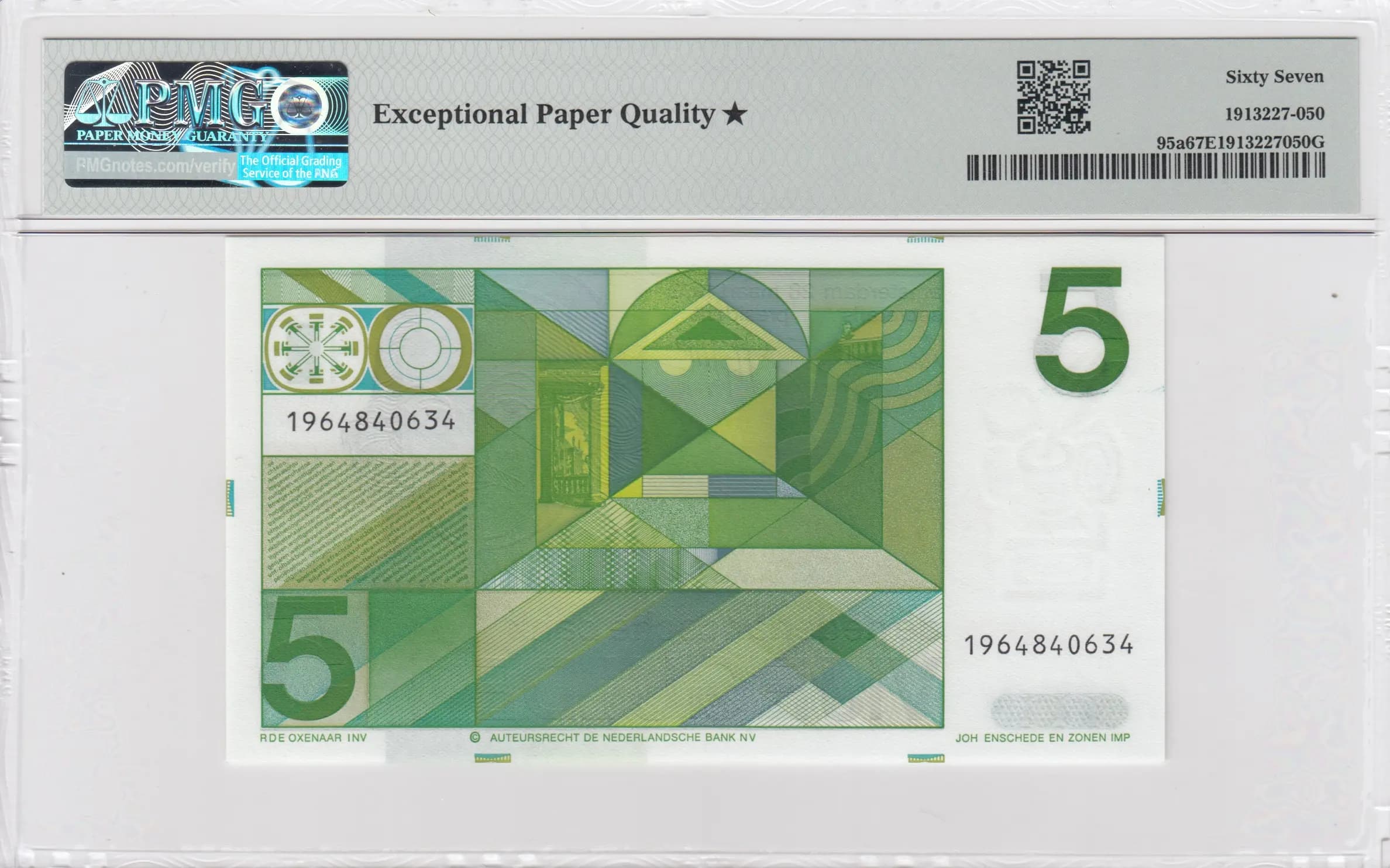
This is an exceptional example of the Netherlands' 1973 5 Gulden banknote, graded PMG 67 EPQ with a rare star notation. The note displays the vibrant green and multicolor design characteristic of this series, featuring a portrait of Joost van den Vondel on the obverse and an intricate geometric design on the reverse. The paper quality is pristine with sharp, crisp printing throughout, and the note shows no signs of circulation or wear, making it a desirable specimen for collectors of Dutch currency and mid-20th century European banknotes.
Common. While this specific note in PMG 67 EPQ with star notation represents an excellent specimen, the base Pick 95 (1973 5 Gulden) was issued in substantial quantities and remains readily available in the modern numismatic market. eBay price history shows consistent availability across multiple condition grades, with PMG 67 examples regularly trading in the $25-55 range across various sales from 2012-2025. The catalogue value for UNC specimens was documented at $20 in 2019, and average realized prices for PMG 67 grades remain modest, indicating a common issue despite its aesthetic appeal.
Issued on March 28, 1973, by the Nederlandsche Bank (De Nederlandsche Bank N.V.), this note reflects the Dutch monetary system during the final decades before the adoption of the Euro. The obverse features Joost van den Vondel, a celebrated 17th-century Dutch Golden Age poet and playwright, reflecting the Netherlands' cultural heritage and intellectual traditions. The reverse's sophisticated geometric design by R.D.E. Oxenaar represents the modern security printing standards of the early 1970s, produced by the renowned firm Johan Enschedé en Zonen.
The obverse features a portrait of Joost van den Vondel, the celebrated Dutch poet and dramatist of the Golden Age, rendered in fine green intaglio line work and shown in profile facing left. His bearded visage is complemented by ornate security patterns and geometric background designs in green, yellow, and tan gradients. The reverse showcases an elaborate abstract composition of interlocking geometric forms—diamonds, circles, and grid patterns—in a complex color-separated design that serves as both an aesthetic element and a security measure against counterfeiting. The denomination '5' appears prominently on both sides, and the watermark (not visible in printed form but documented) consists of an inkwell, quill pen, and scroll, reinforcing the literary significance of the featured portrait.
Front side: 'Amsterdam 28 maart 1973' (Amsterdam 28 March 1973); 'Secretaris' (Secretary); 'President' (President); 'De Nederlandsche Bank' (The Dutch Bank); 'VIJFGULDEN' (Five Gulden); Large denomination numeral '5'. Back side: Serial number '1964840634'; Denomination '5'; 'R.D.E. Oxenaar INV' (Designer: R.D.E. Oxenaar); 'AUTEURSRECHT DE NEDERLANDSCHE BANK NV' (Copyright The Dutch Bank N.V.); 'JOH ENSCHEDE EN ZONEN IMP' (Printed by Joh. Enschedé and Sons).
Intaglio engraving (fine line engraving and geometric pattern work), produced by Johan Enschedé en Zonen of the Netherlands. The note demonstrates the high security standards of 1970s Dutch currency printing, with multiple overlapping color-separated intaglio plates creating the complex geometric patterns on the reverse and the detailed portraiture on the obverse. The fine line work, intricate background patterns, and color gradient transitions are characteristic of professional security printing of this era.
This example corresponds to Pick catalog number P-95 (1973 issue). The PMG population report indicates one documented variant (P-95a) with printer designation JEZ (Johan Enschedé en Zonen), which matches the imprint visible on the reverse of this note. The specific serial number '1964840634' is individual to this specimen. The star notation on the PMG holder indicates this note was selected for exceptional eye appeal within its grade, a subjective quality designation indicating superior aesthetic presentation compared to typical examples of the same numerical grade.