5 gulden 1973
Market Prices
169 salesAbout This Note
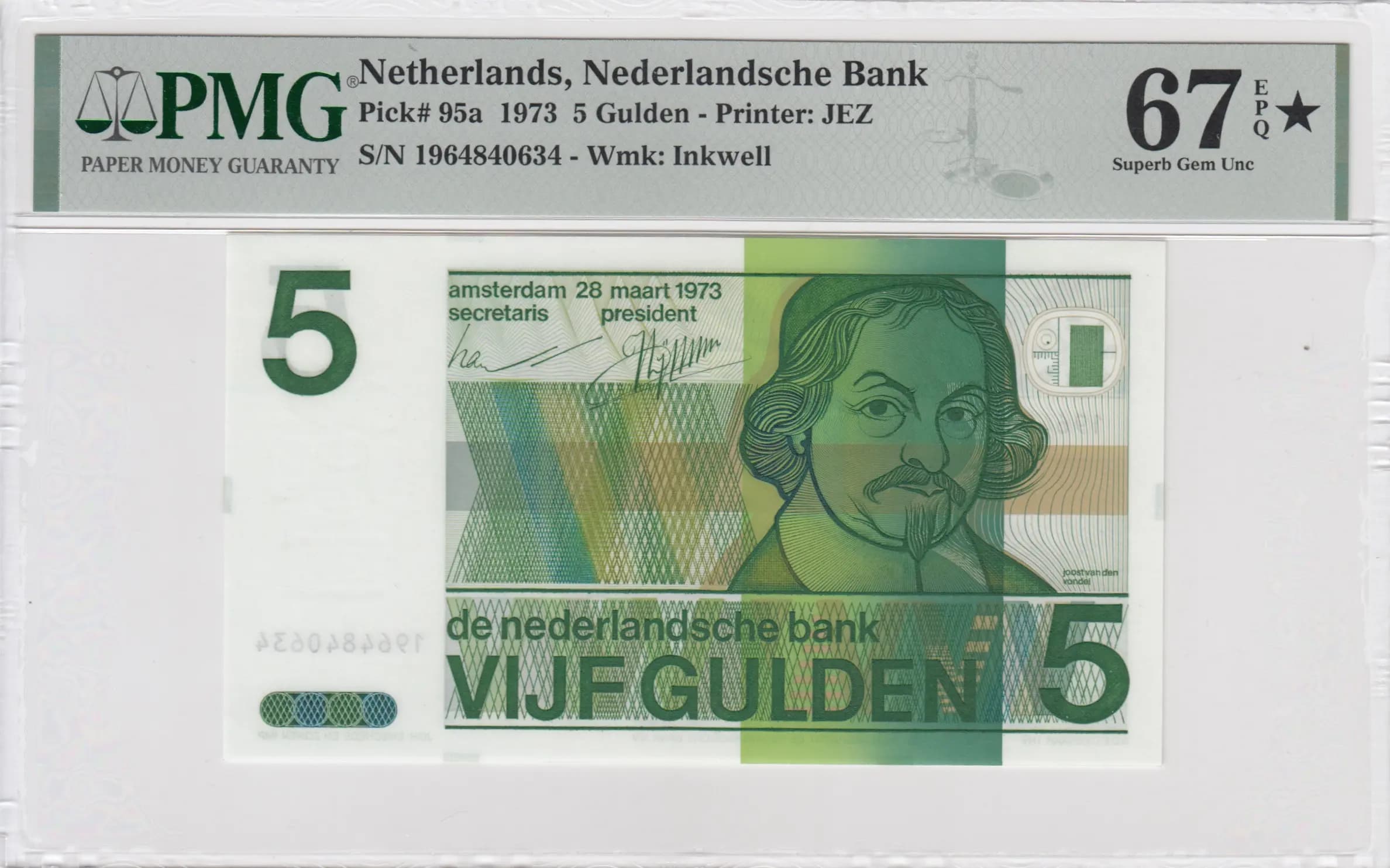
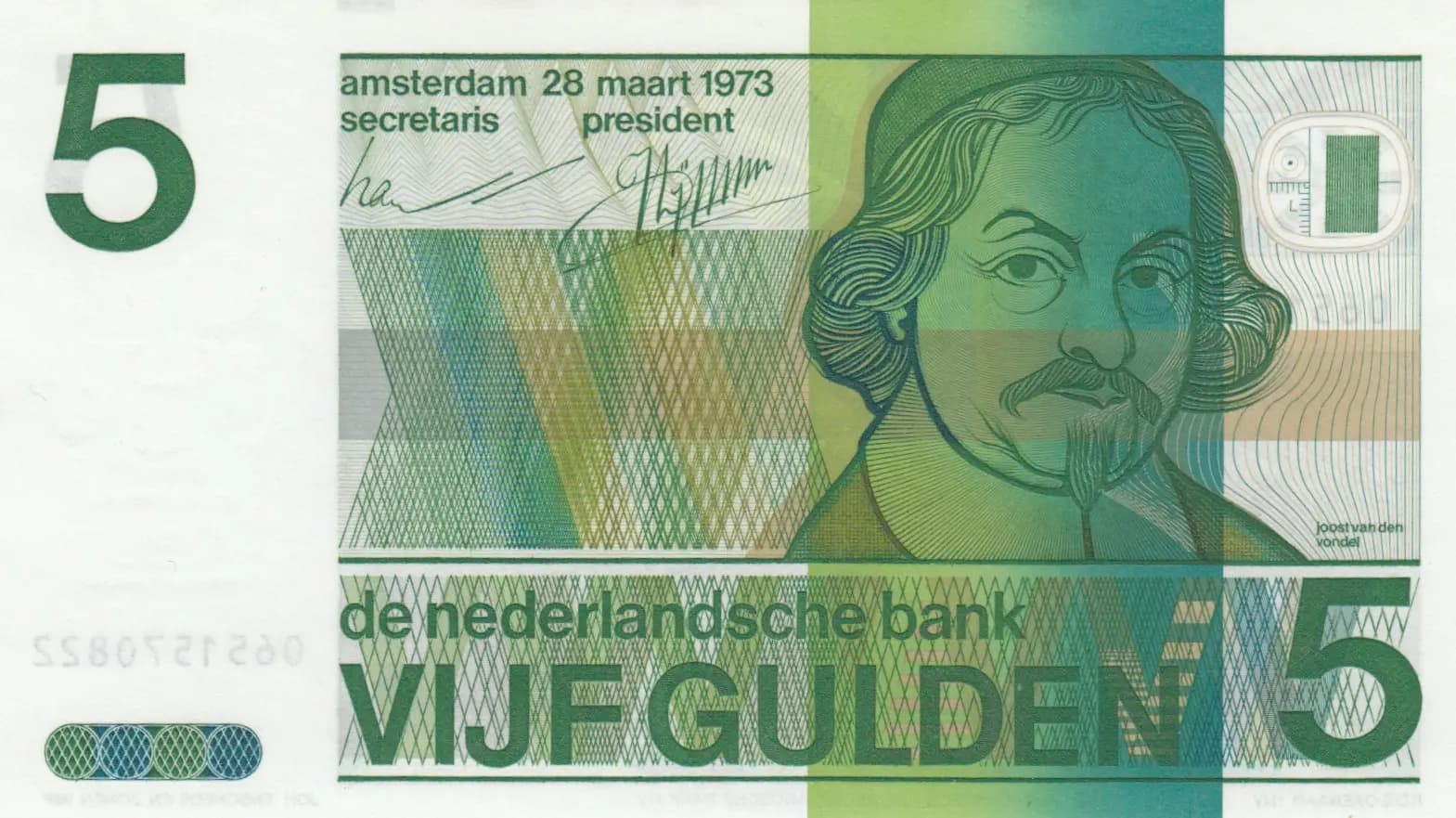
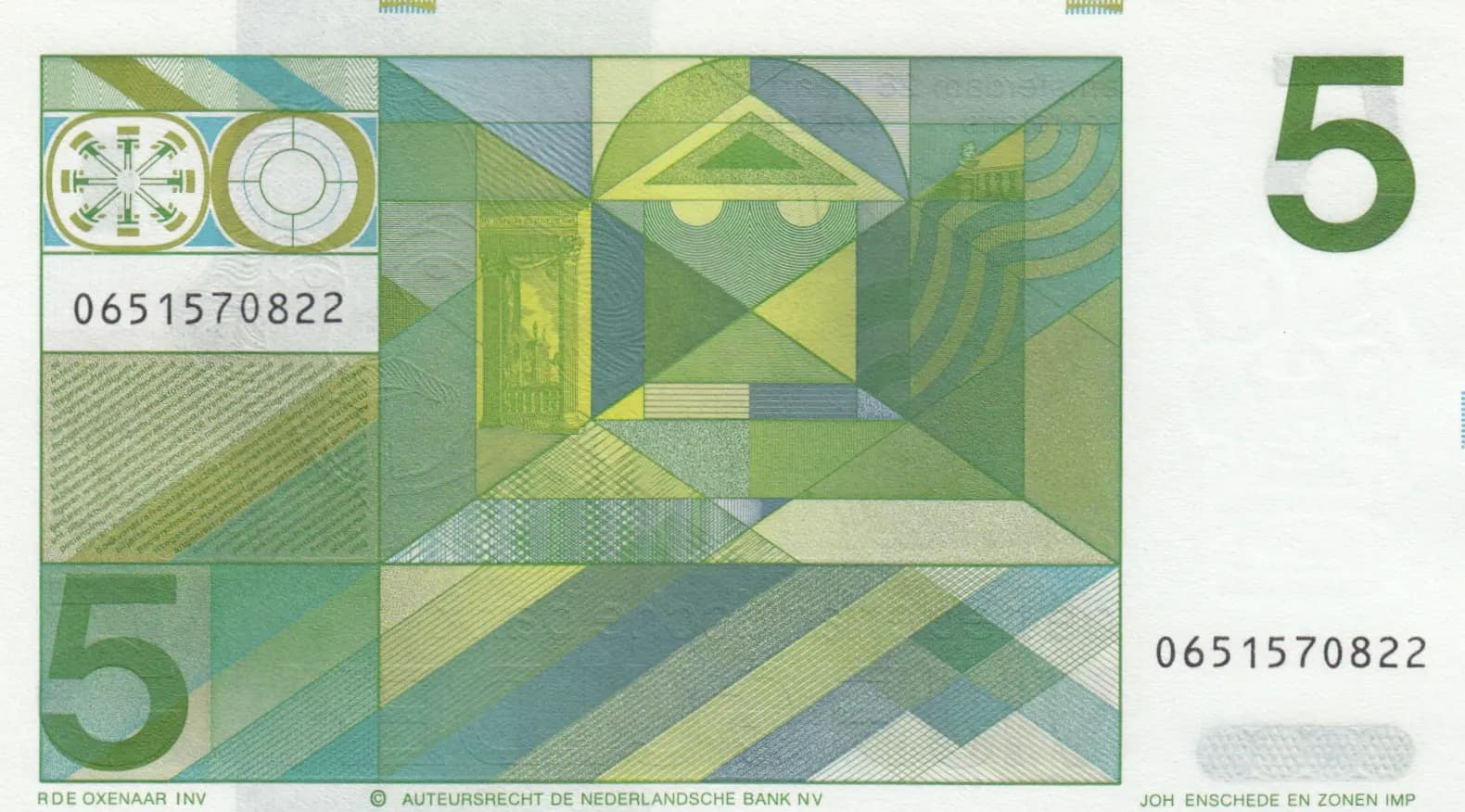
This is a splendid uncirculated example of the Netherlands 5 Gulden from 1973 (Pick P-95), featuring the portrait of renowned Dutch poet and playwright Joost van den Vondel rendered in elegant green and teal engraving on the obverse. The reverse showcases an innovative geometric abstract design composed of tessellated rectangles in multiple colors—a striking departure from traditional banknote aesthetics that reflects 1970s modernist design sensibilities. The note exhibits pristine condition with sharp printing, crisp paper, and no signs of circulation, making it an excellent specimen for Dutch currency collectors.
Common. The eBay sales data provided shows consistent, frequent transactions across all condition grades from 2012 to 2025, with UNC examples routinely selling in the $5–$16 range and occasionally higher ($26–$52) with significant auction activity. This indicates robust supply and regular collector demand rather than scarcity. The 1973 issue was a standard production run of the Nederlandsche Bank with no known recall or short circulation period. Print run data is not available, but the frequency of sales and modest market prices are strong indicators of commonality.
This 1973 issue marks the Nederlandsche Bank's continued production of the 5 Gulden denomination during the final decades before the Netherlands' transition to the Euro in 2002. The selection of Joost van den Vondel (1587–1679), one of the Dutch Golden Age's most celebrated literary figures, reflects the Dutch cultural pride of the post-war era. The modernist geometric design on the reverse, created by R.D.E. Oxenaar, represents a significant shift in European banknote design philosophy toward contemporary abstract aesthetics rather than historical or allegorical imagery.
The obverse features a refined engraved portrait of Joost van den Vondel in left-facing profile, depicted as a bearded mature man with curled hair characteristic of 17th-century Dutch portraiture. The background employs sophisticated fine-line engraving with geometric cross-hatching patterns and a decorative rectangular frame element with curved ornamentation, typical of high-security banknote design. The reverse represents an avant-garde departure from traditional banknote imagery, consisting of an intricate tessellation of overlapping rectangles in coordinated green, teal, yellow, and blue-gray tones with varying line patterns and shading. Two circular medallion designs appear in the upper left corner featuring cross and concentric circle patterns. This modernist geometric composition served both aesthetic and security purposes, being characteristic of Dutch banknote design innovations of the 1960s-1970s period.
Front side: 'Amsterdam 28 maart 1973' (Amsterdam 28 March 1973); 'VIJFGULDEN' (Five Gulden); 'denederlandschebank' (The Dutch Bank); 'secretaris' (Secretary); 'president' (President); denomination numeral '5' appears in two locations. Back side: 'RDE OXENAAR INV' (R.D.E. Oxenaar inventor/designer); 'AUTEURSRECHT DE NEDERLANDSCHE BANK NV' (Copyright The Dutch Bank NV); 'JOH ENSCHEDE EN ZONEN IMP' (Joh. Enschedé and Sons printed/impressed); Serial number '0651570822' appears in two locations; denomination numeral '5'.
Intaglio engraving (copperplate), as evidenced by the fine line work, precise geometric patterns, and the characteristic crisp impression visible throughout both sides. The note was printed by Johan Enschedé en Zonen (Joh. Enschede and Sons), the prestigious Dutch security printer, as noted in the reverse inscription. Multiple color printing techniques were employed to achieve the multicolor palette while maintaining the security features of fine-line engraving.
The PMG Population Report indicates one catalogued variant: P-95a (Printer: JEZ—Johann Enschedé en Zonen). The note under examination appears to be the standard P-95a variety based on the 'JOH ENSCHEDE EN ZONEN IMP' imprint visible on the reverse. Serial number observed: 0651570822. No significant overprints, date variations, or signature variants are noted in this UNC specimen. The straightforward design and single-printer production for this denomination suggest minimal variety production compared to some other Dutch notes of the period.