20 gulden 1941
Market Prices
61 salesAbout This Note
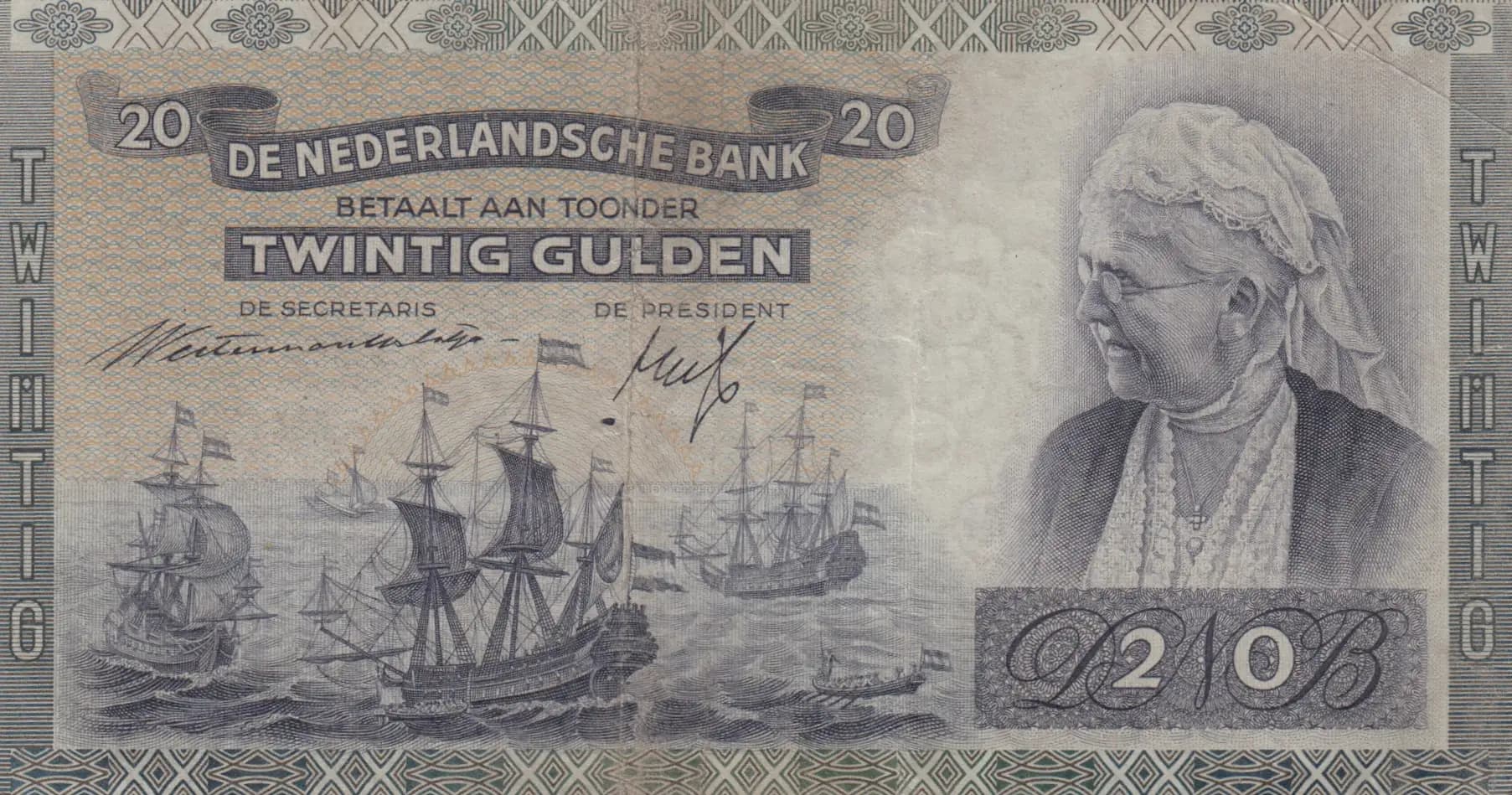
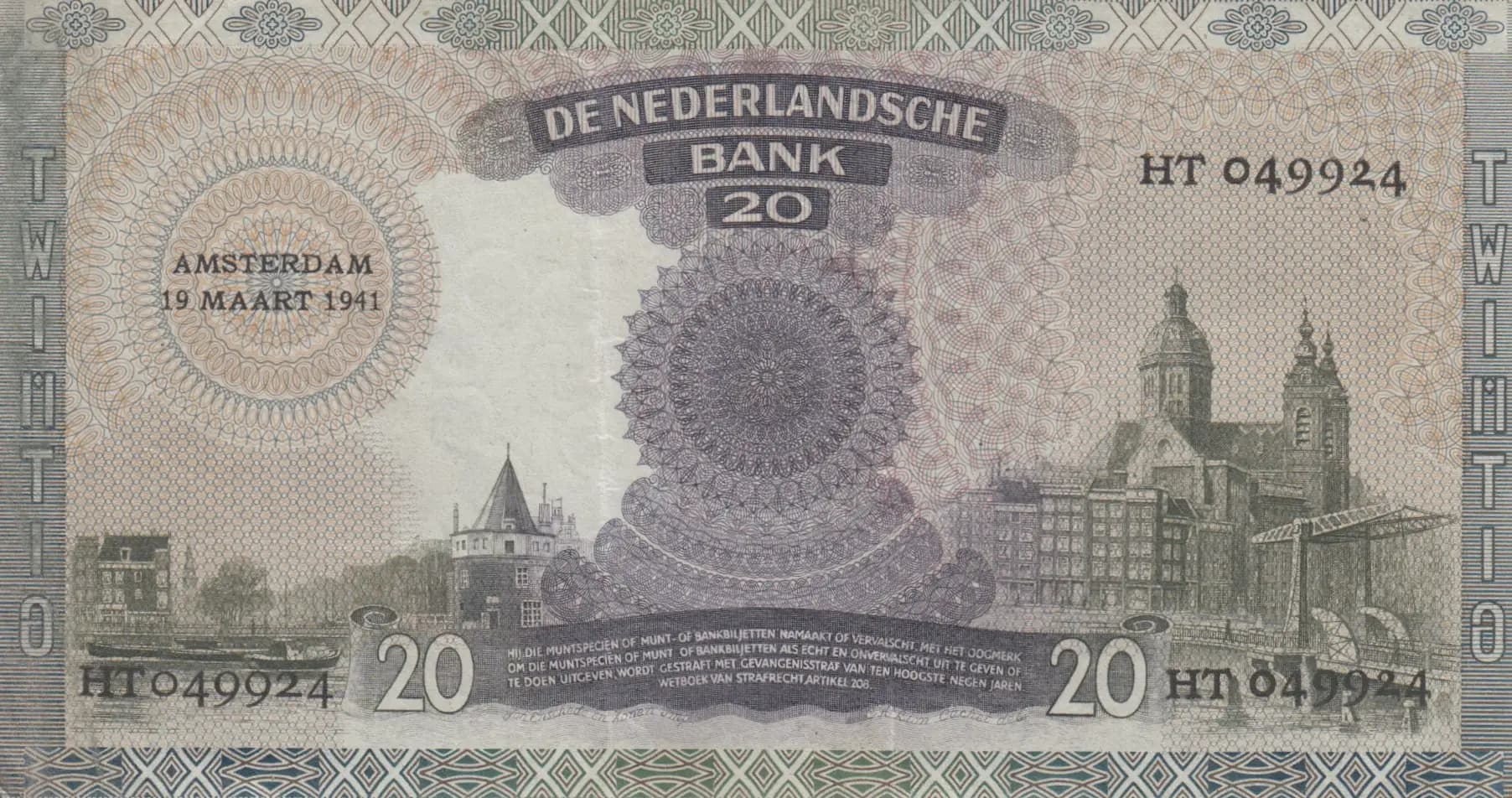
This Netherlands 20 Gulden banknote from 1941 presents a museum-quality example of Dutch Golden Age iconography combined with 20th-century banking design. The note features an engraved naval scene depicting Admiral de Ruyter's fleet on the obverse and architectural landmarks of Amsterdam (Schreierstoren and Sint Nicolaaskerk) on the reverse, with clear handwritten signatures of two bank officials. In VF condition, the note shows expected aging with visible creasing, foxing, and cream-tan patination, consistent with 80+ years of potential circulation or storage.
Common. The extensive eBay sales data provided demonstrates consistent market availability across all condition grades from VF to UNC, with VF specimens routinely selling for $13–$38 USD over the past decade. The steady volume of comparable sales, the availability of PMG-graded examples (including professional grading for this variant), and the catalog value estimates (2016: $10 for Fine grade) all confirm this as a regularly traded, non-scarce note. Dutch 20 Gulden notes from 1939–1941 were issued in substantial quantities by the Nederlandsche Bank, and survival rates remain good. The 1941 overprint date does not confer rarity premium; rather, the note's common status reflects predictable wartime production volumes.
Issued during the Nazi occupation of the Netherlands (1941), this banknote represents the Nederlandsche Bank's continued operation under German control during World War II. The imagery deliberately evokes Dutch maritime glory and national pride through the depiction of Admiral Michiel de Ruyter, the 17th-century naval hero, and Amsterdam's iconic churches and towers—symbolic references to Dutch independence and cultural identity during a period of foreign domination. The overprint date of 19 March 1941 marks this as a wartime currency issue when the occupying authorities allowed limited continued operation of the Dutch central bank.
The obverse features a historically significant engraved naval battle scene at left, depicting Admiral Michiel de Ruyter's fleet of 17th-century men-o-war (warships), referencing his victory at the Roads of Algiers and representing the Dutch Golden Age of maritime dominance. The right side displays a portrait of an elderly man with long white hair in period costume with cravat—identified from catalog sources as Queen Emma, though the facial features and styling appear masculine in presentation, likely representing a historical Dutch figure from the maritime era. The reverse showcases two iconic Amsterdam landmarks: the Schreierstoren (Weepers' Tower) on the left and the Sint Nicolaaskerk (St. Nicholas Church) on the right, both rendered in fine engraved detail. Ornamental borders frame both sides with geometric and floral patterns. The denomination '20' and text 'TWINTIG GULDEN' appear prominently in corners. Handwritten signatures of two bank officials (President and Secretary) appear on the obverse. Serial number HT 049924 is printed on the reverse.
FRONT: 'DE NEDERLANDSCHE BANK' (The Dutch Bank), 'BETAALT AAN TOONDER' (Payable to Bearer), 'TWINTIG GULDEN' (Twenty Guilders), 'DE SECRETARIS' (The Secretary), 'DE PRESIDENT' (The President), '920B' (reference/batch code). BACK: 'DE NEDERLANDSCHE BANK' (The Dutch Bank), '20' (denomination), 'AMSTERDAM' (city of issue), '19 MAART 1941' (19 March 1941 — overprint date), 'HT 049924' (serial number), and extended legal text: 'WILHE MUNTSPECIE OF BANKBILJETTEN NAAMAKT OF VERVALSCHNG VAN HET DOCUMENT OF DE MUNT SPECIE OF BANKBIJETTEN ALS ECHT EN ONVERVALSCHT UIT TE GEVEN WORDT GESTRAFT MET GEVANGENISSTRAF VAN EEN MAAND TOT TIEN JAREN EN MET GELDBOETE VAN STRAFRECHT ARTIKEL 208' (Counterfeiting currency, banknotes, or presenting counterfeit documents or coins as authentic is punishable by imprisonment from one month to ten years and a fine under Penal Code Article 208).
Intaglio engraving (line engraving), executed by Joh. Enschede, the renowned Dutch security printer. The security features visible in the visual analysis—including intricate geometric border patterns, complex fine-line work in the naval and architectural scenes, dense pattern fills, and watermarking in the paper substrate—are characteristic of high-quality intaglio production. The dual-color printing (predominant grey-brown with green-tinted areas noted on the reverse) suggests multi-pass intaglio printing with careful registration of color layers, a technique standard for Enschede's banknote production during this period.
This note represents Pick-54 variant with the 19 March 1941 overprint date. The catalog reference (banknote.ws) specifically notes that a similar note with the overprint date '19.03.1941' and the old date obliterated with a bar corresponds to Pick-55 (a related variety). Serial number HT 049924 places this within the HT prefix range. The presence of handwritten signatures by two officials (President and Secretary) is standard for this issue. No unusual markings, re-entries, or printing anomalies are evident in the visual analysis. This represents a standard, issued example of the 1941 dated currency rather than a rare overprint variant.