2,50 gulden 1938
Market Prices
65 salesAbout This Note
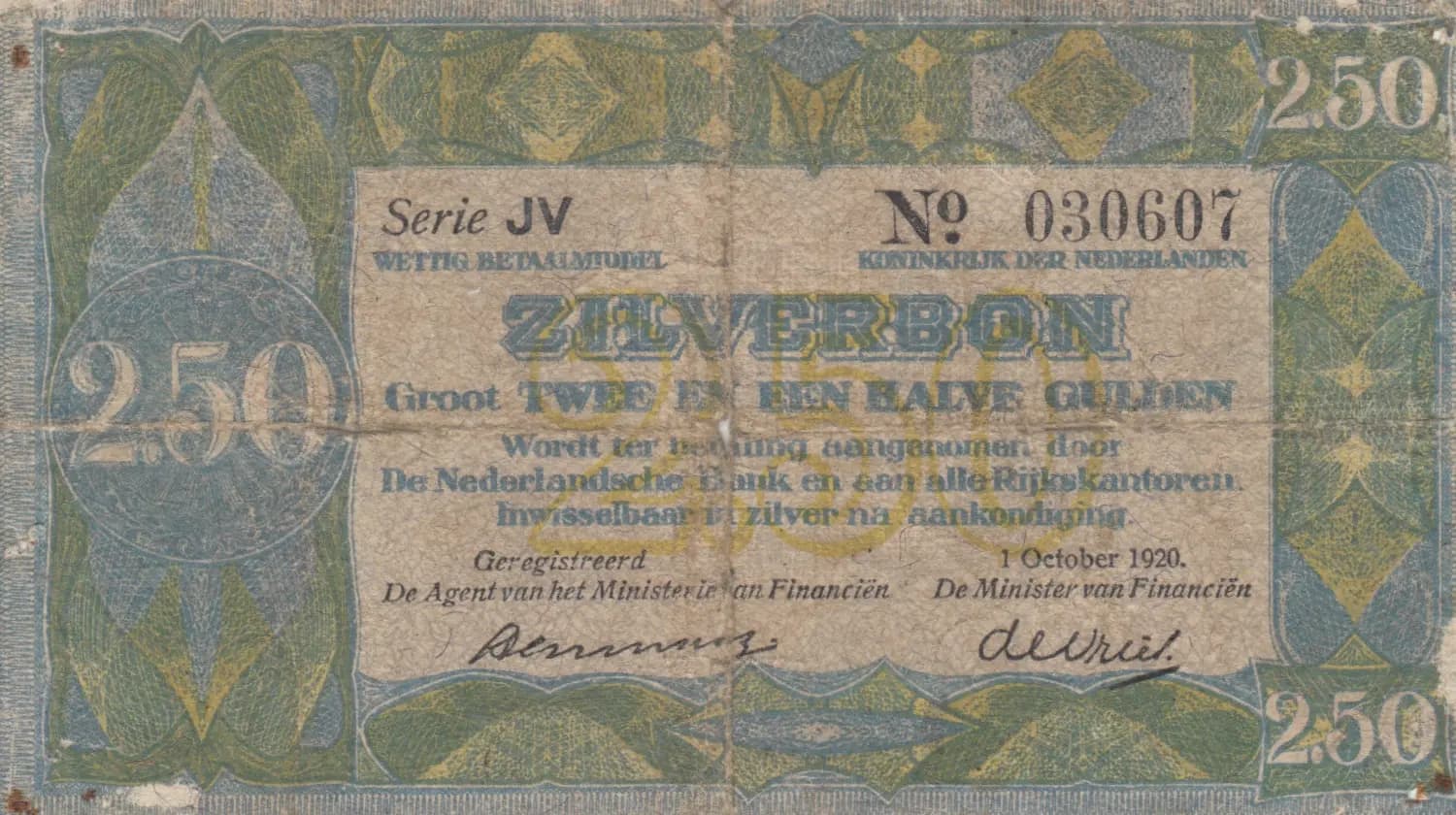
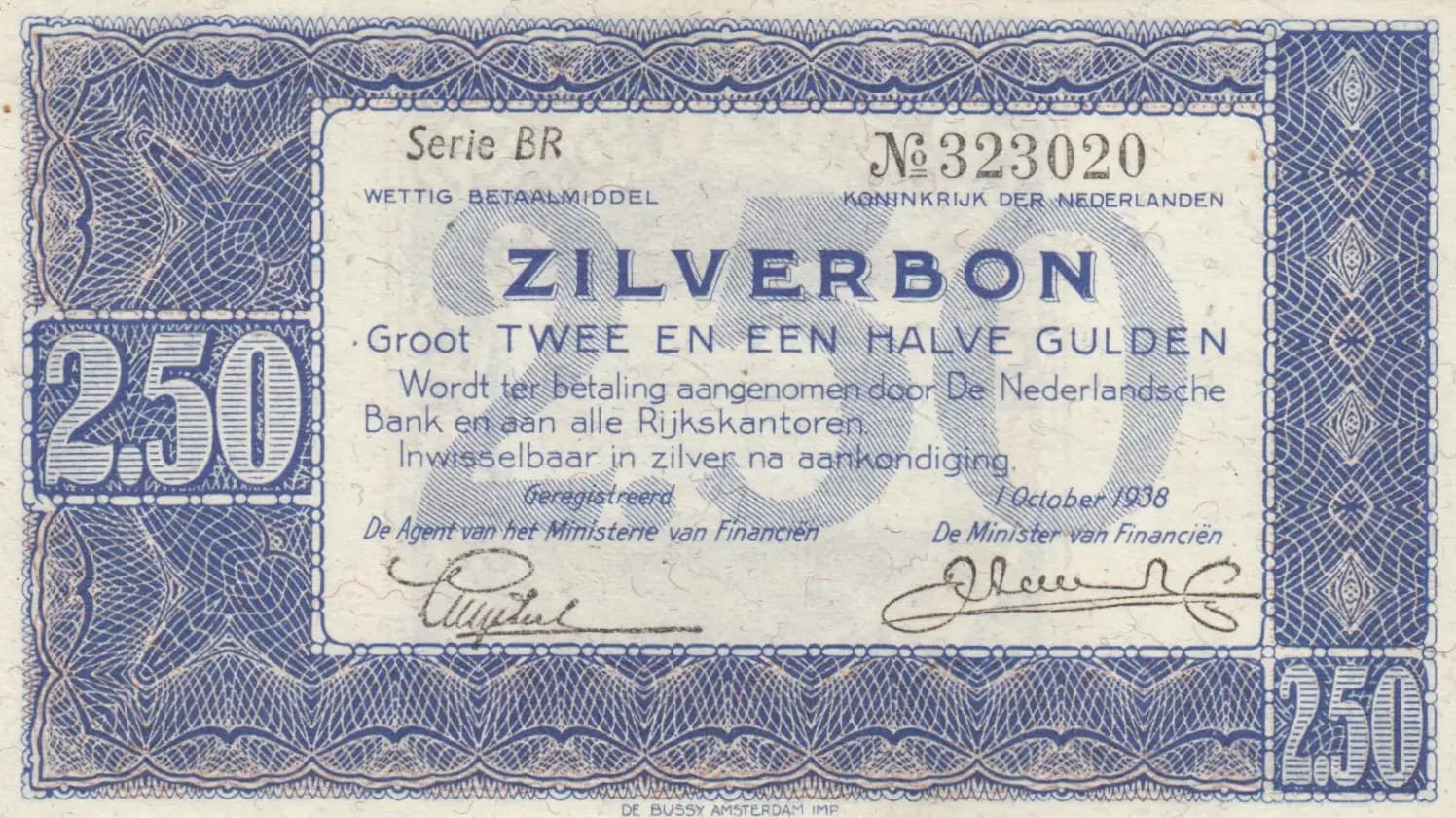
This Netherlands 2.50 gulden silver bond (zilverbon) from October 1938 represents a distinctive monetary instrument issued during the pre-war period. The note exhibits characteristics consistent with its UNC grade, featuring crisp ornate engraved borders and clear inscriptions, though light foxing and age-related discoloration are visible throughout, which is typical for notes of this era and denomination. The dual-signature requirement and official Ministry of Finance seals underscore its formal legal tender status as a registered silver certificate.
Common. The eBay sales history demonstrates regular market availability with consistent pricing ranging from under $1 to approximately $113 for premium graded examples, with the majority of UNC examples selling between $8-$20. Print run for this denomination appears substantial given the frequency of sales and serial number evidence (Series BR noted). The denomination's modest face value and status as a registered security bond rather than a high-value note contributed to wider distribution. UNC examples are readily obtainable, supporting a common classification.
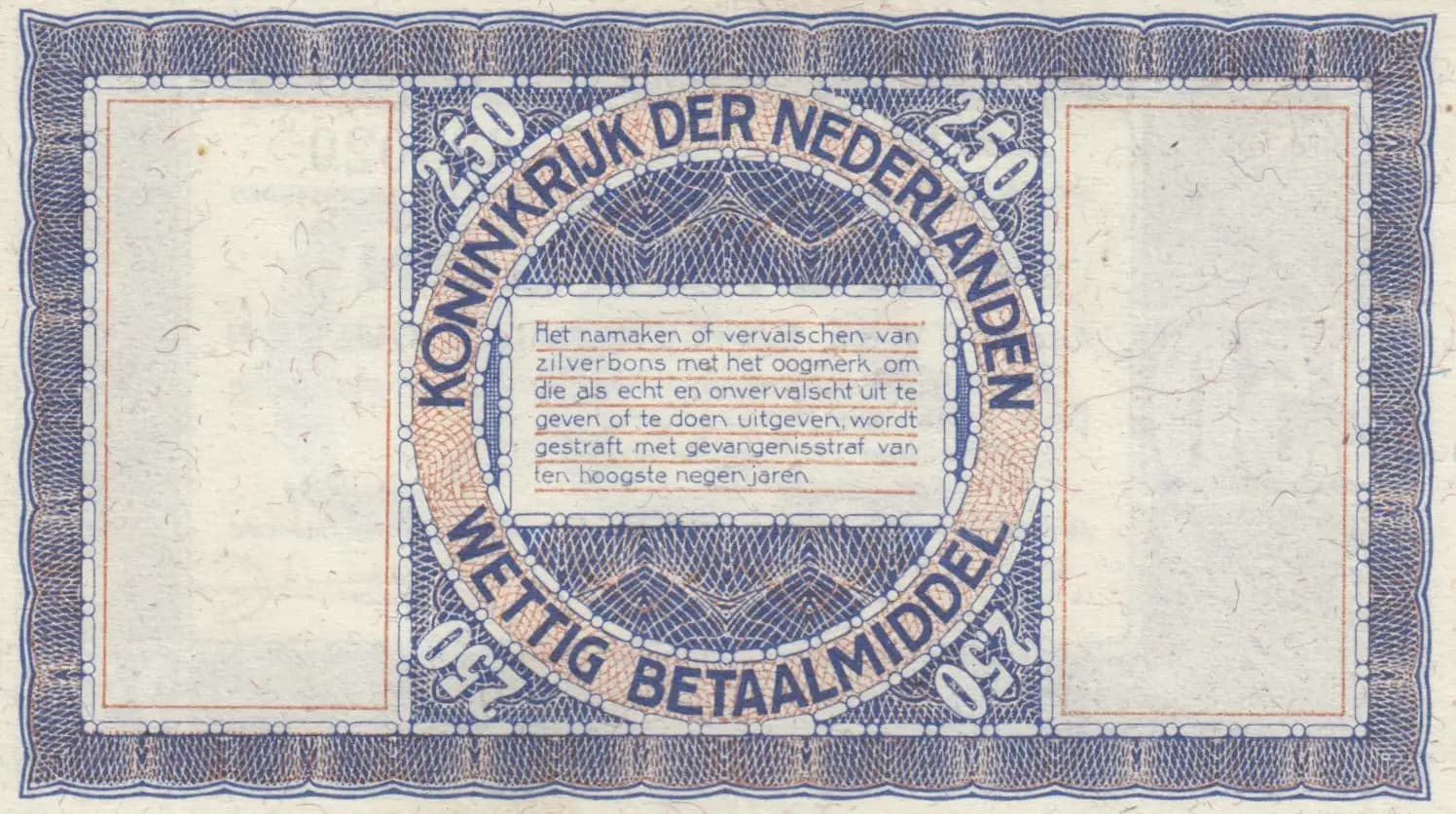
Issued in October 1938 by the Kingdom of the Netherlands Ministry of Finance, this silver bond reflects the economic conditions of late 1930s Europe as nations grappled with post-Depression monetary policy. The zilverbon served as a redemption certificate backed by silver reserves, accepted by De Nederlandsche Bank and state offices—a practical measure to stabilize currency during uncertain times just prior to World War II. The specific counterfeit penalties noted on the reverse (up to nine years imprisonment) underscore the government's serious approach to protecting its monetary instruments during this period.
This silver bond features a symmetrical, formal design characteristic of official Dutch financial documents. The front displays an ornate blue engraved border with geometric and floral security patterns framing the denomination and issuing information. The central text identifies it as a wettig betaalmiddel (legal tender) redeemable in silver through the Dutch Bank. Signature lines at the bottom are designated for 'De Agent van het Ministerie van Financiën' (left) and 'De Minister van Financiën' (right), with an official stamp area accompanying each. The reverse features a prominent circular medallion with concentric rings and ornamental borders, surrounded by the same geometric patterns. Blank rectangular spaces flank the medallion, presumably for registration stamps or seals. The denomination '250' appears on both sides. No portraits or geographical landmarks are depicted; instead, the design emphasizes security printing and official governmental authority through elaborate engraved ornamentation.
FRONT SIDE: 'Serie BR' (Series BR); 'No. 3232020' (Serial number); 'WETTIG BETAALMIDDEL' (Legal tender); 'KONINKRIJK DER NEDERLANDEN' (Kingdom of the Netherlands); 'ZILVERBON' (Silver bond); 'Groot TWEE EN EEN HALVE GULDEN' (Worth two and one half guilders); 'Wordt ter betaling aangenomen door De Nederlandsche Bank en aan alle Rijkskantoren Inwisselbaar in zilver na aankondiging.' (Is accepted as payment by the Dutch Bank and all State offices. Exchangeable in silver after announcement.); 'De Agent van het Ministerie van Financiën' (The Agent of the Ministry of Finance); 'De Minister van Financiën' (The Minister of Finance); 'October 1938'; '250'. BACK SIDE: 'KONINKRIJK DER NEDERLANDEN' (Kingdom of the Netherlands); 'WETTIG BETAALMIDDEL' (Legal tender); 'Het namaken of vervalschen van zilverbons met het oogmerk om die als echt en onvervalscht uit te geven of te doen uitgeven, wordt gestraft met gevangenisstraf van ten hoogste negen jaren.' (The counterfeiting or forgery of silver bonds with the intent to pass them off as genuine and unforged, or to have them passed off, is punishable by imprisonment of up to nine years.); '250'.
Intaglio (engraving) printing, identified by the fine line work, ornate geometric and floral patterns, and precise detail visible throughout both sides. The printer De Bussy, Amsterdam (noted in external reference as 'De Bussy, Amsterdam') was a renowned Dutch security printer specializing in high-quality engraved banknotes and official documents. The depth and clarity of the ornamental borders, security patterns, and medallion design are consistent with steel plate intaglio production, the standard security printing method for Dutch currency and certificates of this period.
Series BR is recorded in the observed example (serial No. 3232020). Primary varieties for the 1938 2.50 gulden issue are distinguished by series letters. October 1938 represents the standard issue date; no overprints or significant variations are evident in this specimen. The blank rectangular stamp areas on the reverse may indicate this particular note was not fully processed through official registration channels, though this does not constitute a catalogued variety.