2 1/2 gulden 1943
Market Prices
36 salesAbout This Note
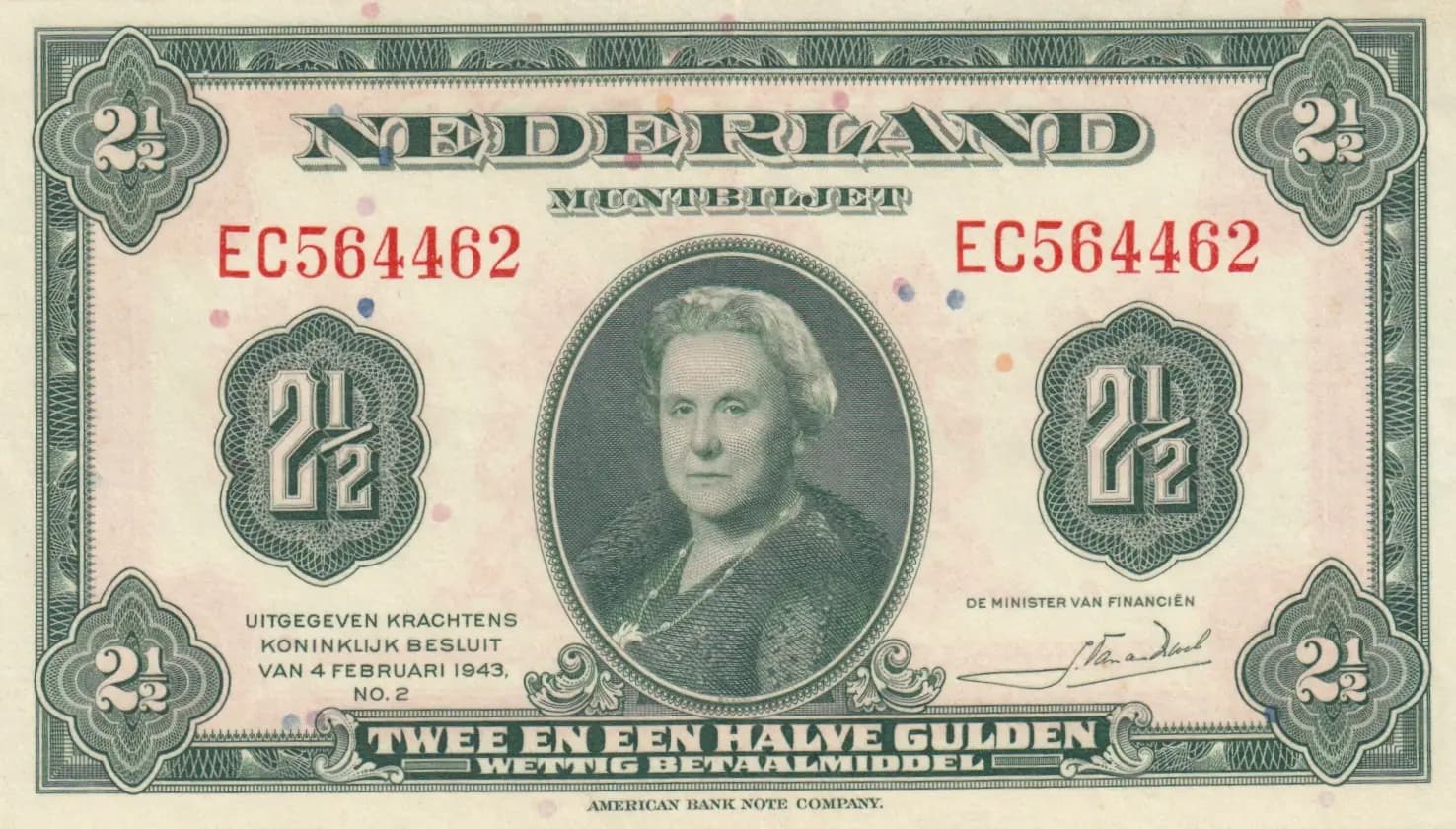
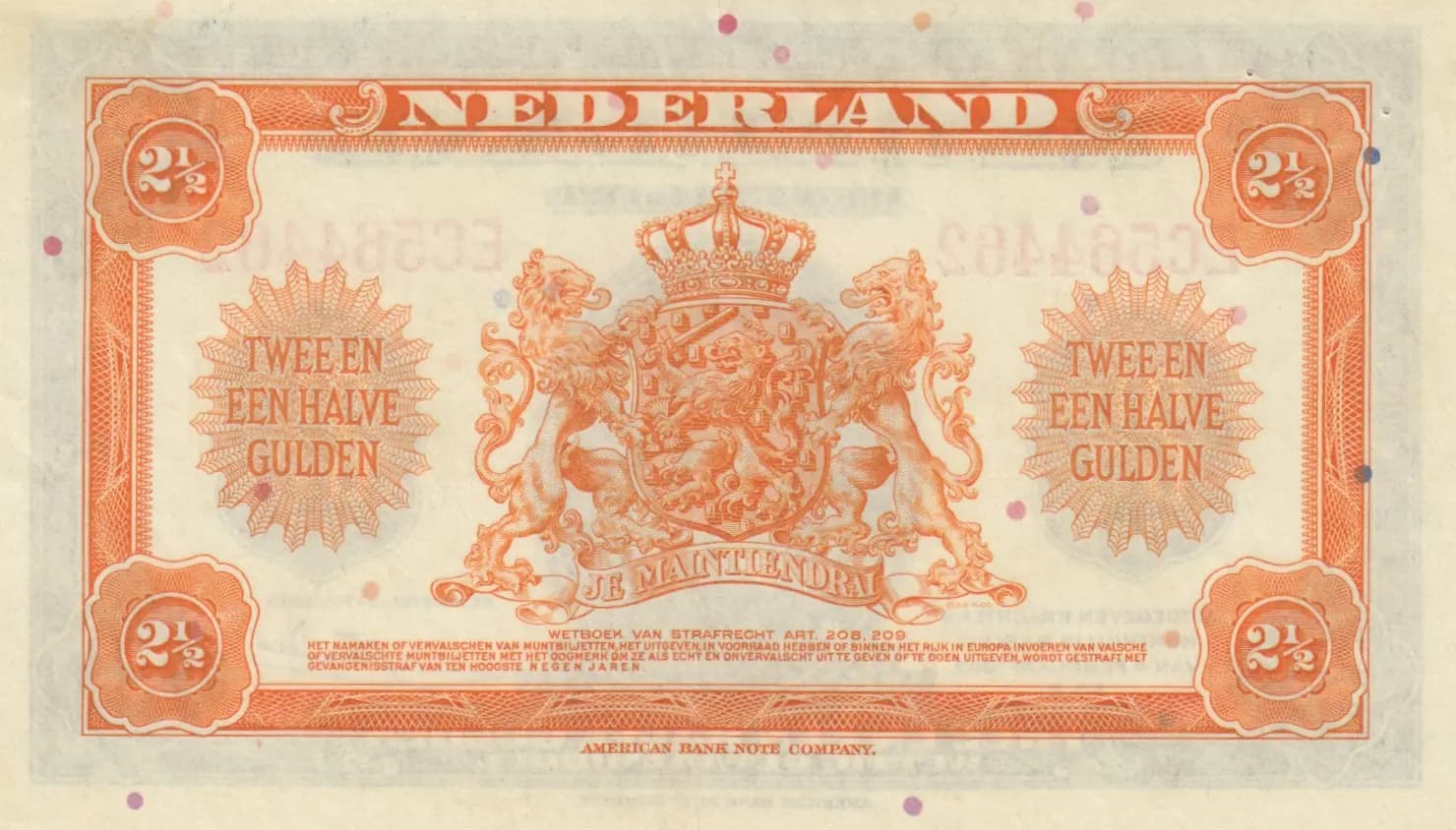
This is a 2½ gulden banknote issued by the Dutch Ministry of Finance on February 4, 1943, featuring an elegant portrait of Queen Wilhelmina on the obverse and the Dutch coat of arms on the reverse. The note displays exceptional condition consistent with EF grading, with crisp green and orange printing, intact margins, and no visible folds or tears, though scattered foxing spots in various colors indicate age-related aging typical of 1940s paper currency.
Common. The eBay price tracking data shows consistent sales ranging from $2.24 to $37 over a 12-year period, with most examples grading VF or lower selling in the $7-20 range. EF examples have sold for $22.50-$37, which is modest for higher grades. The 2016 catalogue value of $30 for UNC confirms this is a readily available note in most conditions. This was a regular issue produced in substantial quantities by ABNC, and no historical evidence suggests limited print runs or recall status.
Issued during World War II under a Royal Decree of February 4, 1943, this banknote represents the Netherlands' currency production during the German occupation. The prominent portrait of Queen Wilhelmina served as a symbol of Dutch national identity and sovereignty during this period, while the Dutch coat of arms with supporting lions and the national motto 'Je Maintiendrai' reinforced national continuity and legitimacy of the Dutch government-in-exile's financial authority.
The obverse features a formal portrait of Queen Wilhelmina positioned centrally within an elaborate oval frame, rendered with fine engraving lines characteristic of 1940s currency design. The Queen is depicted from the shoulders up in formal dress with what appears to be fur collar or shawl, styled in the fashion of the period. The design incorporates ornate decorative corner medallions displaying the '2½' denomination in all four corners within square frames, surrounded by intricate geometric and floral patterns. The reverse presents the Dutch coat of arms as the central design element, featuring a shield with lions and a royal crown positioned above, flanked by two supporting lions. The denomination appears in decorative sunburst frames on both sides. Serial number 'EC564462' is printed in red on the obverse. The color scheme uses green ink on the obverse and orange/rust tones on the reverse, with cream or off-white paper stock throughout.
FRONT SIDE: 'NEDERLAND' (Netherlands), 'MUNTBILJET' (Banknote), 'TWEE EN EEN HALVE GULDEN' (Two and a half guilders), '2½' (denomination), 'UITGEGEVEN KRACHTENS KONINKLIJK BESLUIT VAN 4 FEBRUARI 1943, NO-Z' (Issued under Royal Decree of February 4, 1943, No-Z), 'DE MINISTER VAN FINANCIËN' (The Minister of Finance), 'WETTIG BETAALMIDDEL' (Legal tender), 'AMERICAN BANK NOTE COMPANY' (printer identification). REVERSE SIDE: 'NEDERLAND' (Netherlands), 'TWEE EN EEN HALVE GULDEN' (Two and a half guilders), '2½' (denomination), 'JE MAINTIENDRAI' (I will maintain - Dutch national motto), 'WETBOEK VAN STRAFRECHT ART. 208, 209' (Penal Code Articles 208, 209), legal text warning against counterfeiting and illegal circulation of currency with associated penalties, 'AMERICAN BANK NET COMPANY' (printer identification).
Intaglio engraving (line engraving and guilloché patterns) combined with multi-color letterpress or offset printing. The American Bank Note Company (ABNC), noted in the inscriptions, was a master security printer specializing in intaglio techniques for currency production. The fine line engraving visible throughout, intricate geometric patterns in borders, decorative guilloché work, and multi-color application (green and red on obverse; orange on reverse) are hallmarks of ABNC's security printing methodology of the period.
This specific example shows serial number 'EC564462' printed in red on the obverse. The prefix 'EC' may indicate a particular printing series or batch designation. The note was issued under Royal Decree designation 'NO-Z' as noted in the front inscription. Varieties for P-65 typically relate to serial number prefixes and printing dates within the February 4, 1943 authorization period; further documentation would be needed to confirm if this particular series (EC-prefix) represents a known identified variety.