10 gulden 1945
Market Prices
10 salesAbout This Note
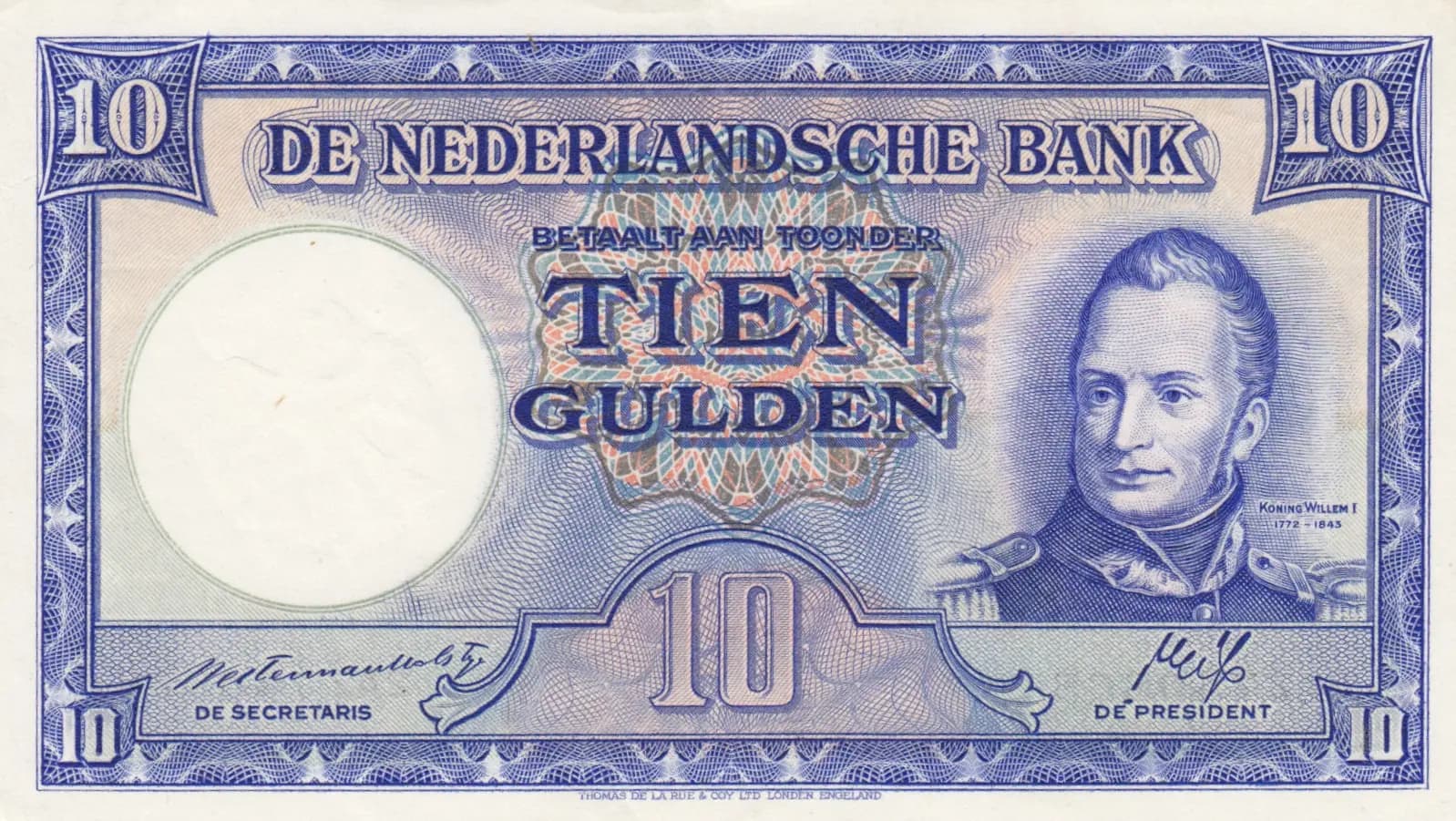
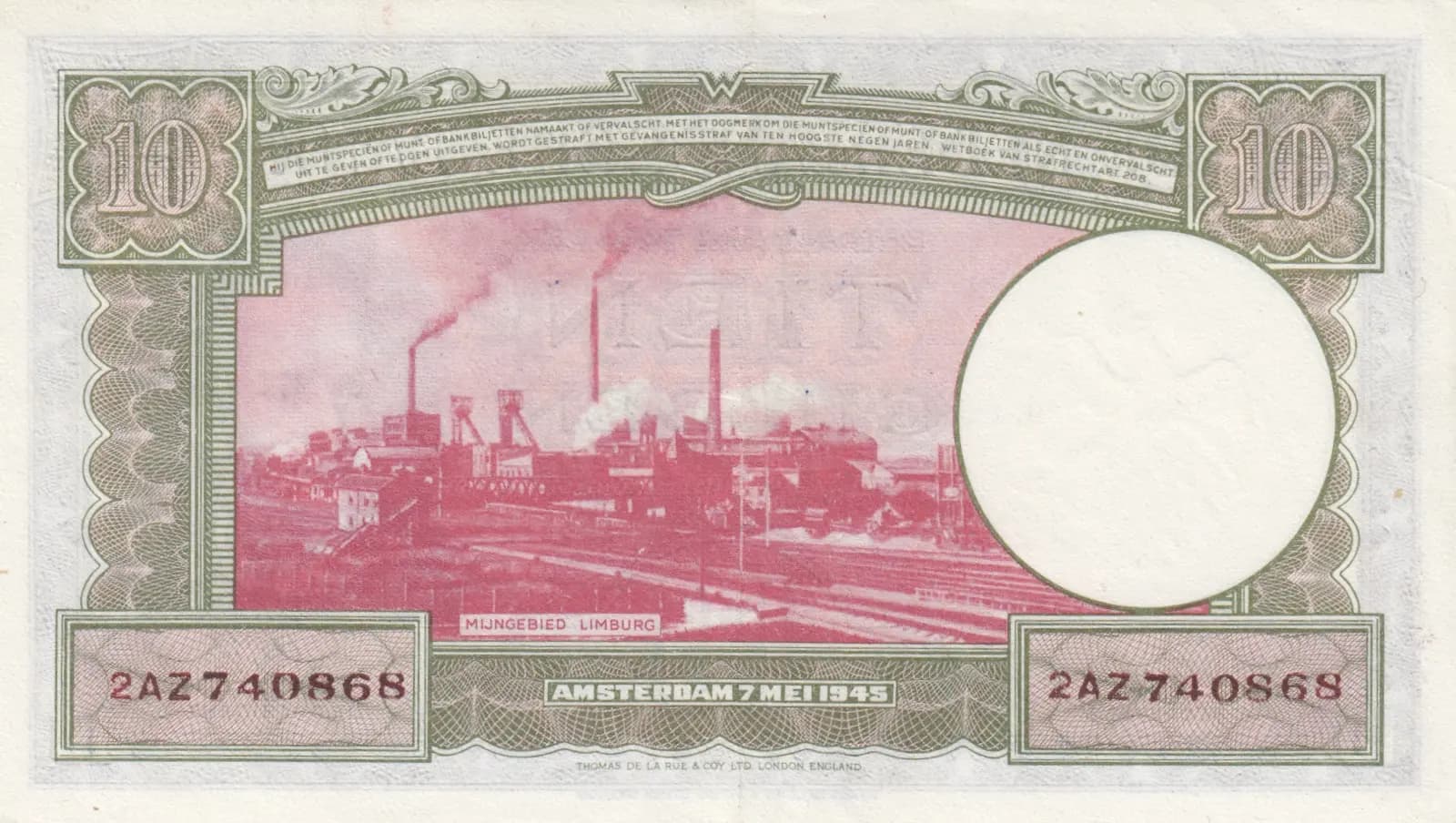
This is a Netherlands 10 Gulden note from 1945, issued by Nederlandsche Bank and printed by Thomas de la Rue in London. The note displays excellent condition with vibrant blue coloring on the obverse featuring a portrait of King Willem I, and a richly detailed reverse depicting the Limburg mining region with industrial smokestacks and railway infrastructure rendered in red and olive tones. The visual preservation is remarkable for a note now approaching 80 years old, with no visible creasing, tears, or significant wear.
Common. eBay market data shows VF specimens consistently selling in the $20-50 range over multiple years, with a 2016 catalog value of $20 for VF grade. Multiple sales records exist across different grades and time periods, indicating steady collector availability. The note was issued in substantial quantities for post-war circulation and remains readily obtainable in the numismatic market.
Issued on May 7, 1945, just days after the Netherlands' liberation from Nazi occupation, this banknote commemorates the nation's industrial heritage through its reverse design showcasing the Limburg mining region's steelworks and collieries. The portrait of King Willem I (1772-1843), the founder of the modern Dutch state, reinforced national identity and continuity during this critical post-war period of reconstruction and renewal.
The obverse features a formal portrait of King Willem I in military dress positioned at the right side, with his name and life dates (1772-1843) inscribed below. The left side contains a prominent circular white space (watermark area) surrounded by intricate blue ornamental borders featuring geometric patterns and repeating decorative motifs. Corner elements display ornamental designs with denomination markers. The reverse depicts the Limburg mining region's industrial landscape—featuring factories with multiple tall smokestacks, railway tracks, and industrial development—rendered in a pink/mauve central composition framed by green and olive ornamental borders. A large circular white space appears on the right side of the reverse. Serial numbers are printed in red in the lower corners. Both sides showcase fine engraved line work characteristic of Thomas de la Rue's security printing standards.
Front: 'DE NEDERLANDSCHE BANK' (The Netherlands Bank), 'BETAALT AAN TOONDER' (Pays to Bearer), 'TIEN GULDEN' (Ten Guilders), 'Koning Willem I' (King William I), '1772-1843' (dates of Willem I's life), 'DE SECRETARIS' (The Secretary), 'DE PRESIDENT' (The President), '10' (denomination), 'THOMAS DE LA RUE & COY LTD LONDON ENGLAND' (printer identification). Back: 'MIJNGEBIED LIMBURG' (Limburg Mining Region), 'AMSTERDAM 2 MELLE STRAAT' (Amsterdam address), '10' (denomination), serial number '2AZ740868' (appears twice), 'THOMAS DE LA RUE & COY LTD LONDON ENGLAND' (printer identification), and regulatory text in Dutch at top (partially legible fine print regarding banknote terms).
Intaglio engraving (line engraving) executed by Thomas de la Rue & Co. Ltd., London. The note demonstrates the hallmark characteristics of high-security banknote engraving: fine line work throughout, intricate border patterns, detailed portrait rendering, and precisely engraved landscape elements. The multi-color printing on the reverse (red and olive on pink/mauve underprint) was achieved through multiple pass intaglio printing, a premium security technique. Evidence of watermark paper preparation is visible in the circular white spaces on both sides.
This specimen is catalogued as Pick P-75b, with Pick catalog notation indicating 2 serial number varieties exist for this issue. The observed serial number prefix '2AZ' represents one of these documented varieties. PMG population reports indicate P-75a variant exists, suggesting this note (P-75b) represents a distinct serial number series variant. The visual analysis confirms the standard Thomas de la Rue printing for this issue with no apparent overprints or unusual markings that would indicate a special variety or emergency issue.