2 maloti 1981
Market Prices
28 salesAbout This Note
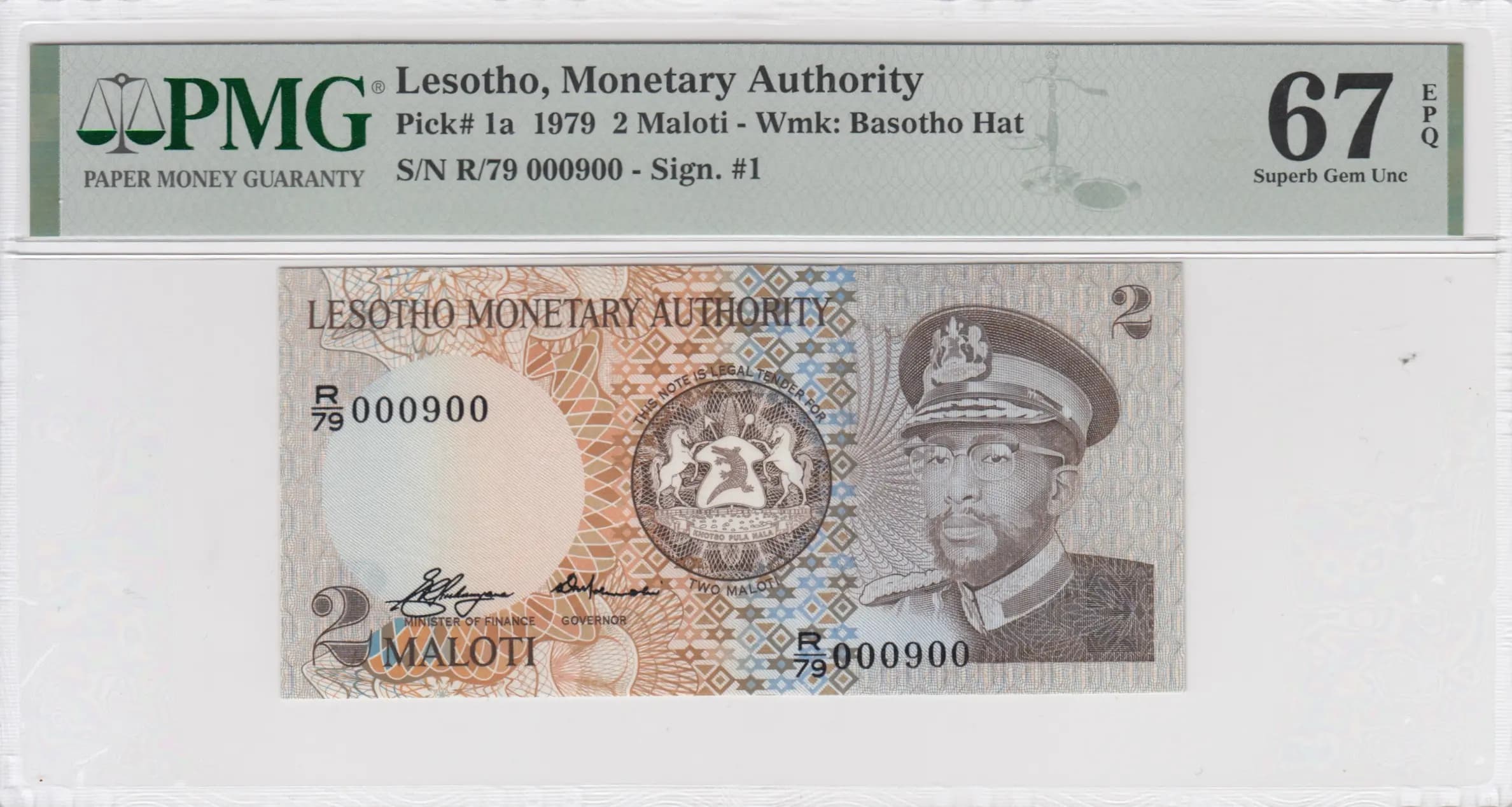
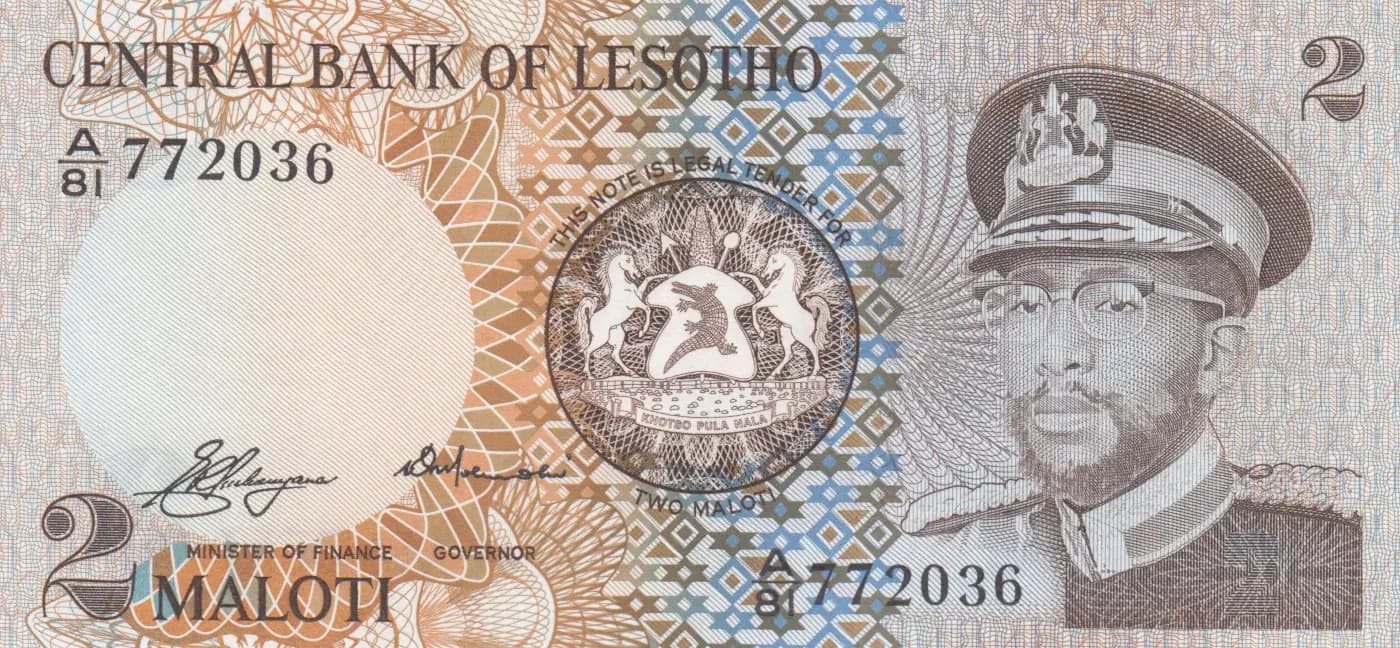
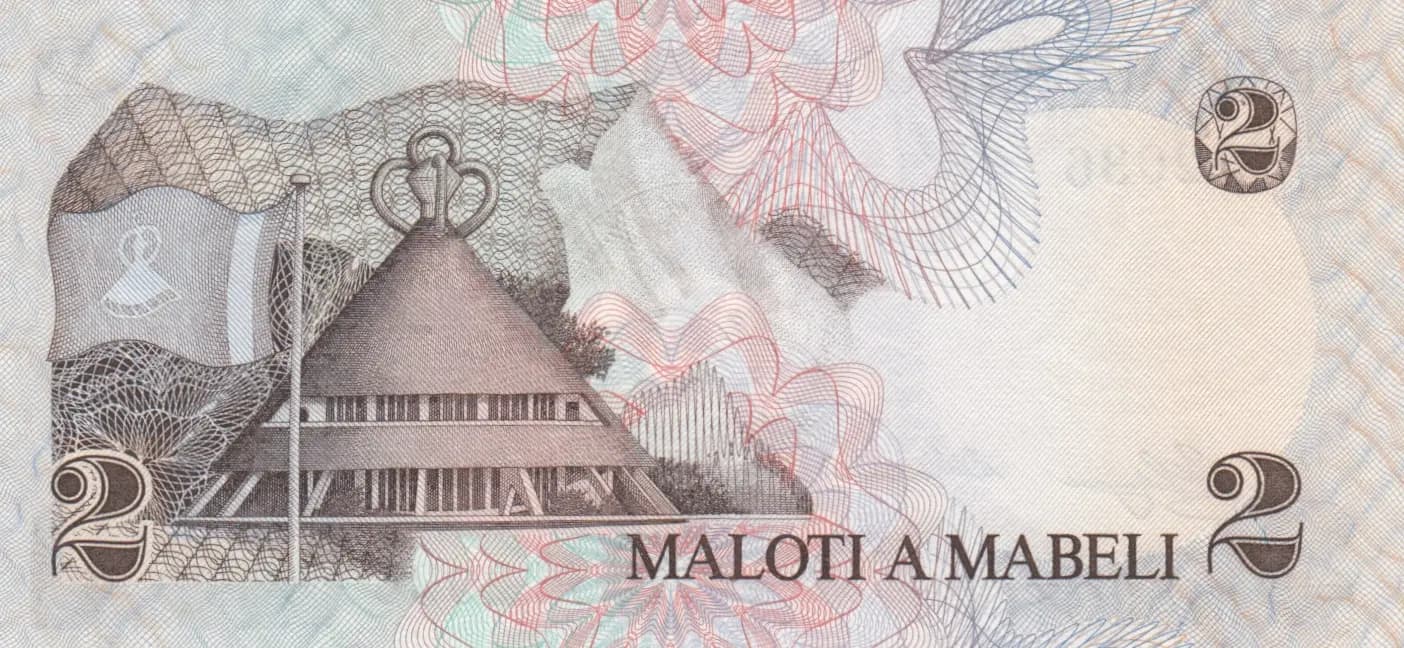
This is a pristine, uncirculated 1981 Central Bank of Lesotho 2 maloti note (Pick P-4a) featuring an ornate multicolored design with King Moshoeshoe II in military dress on the obverse. The reverse displays a traditional Basotho building with thatched roof and decorative wave patterns in red, blue, and green. The note exhibits sharp printing, vibrant colors, and no signs of wear, with intricate security features including fine-line engraving and detailed microprint patterns throughout.
Common. The 1981 2 maloti note remains widely available in the collector market, with consistent eBay sales data showing UNC examples regularly selling in the $5–$9 range across a 12-year period (2010–2022), with occasional outliers to $11.50. The 2019 catalog valuation of $15 for UNC examples and $4 for VF indicates healthy availability without scarcity premium. Print runs for this denomination and period were standard, and no evidence of recalls or short-lived issue exists. The multiple PMG variants (P-4a, P-4b, P-4br, P-4s1) further confirm sustained production.
This 1981 issue commemorates King Moshoeshoe II's reign during Lesotho's early independence period following the 1966 separation from South Africa. The military portrait reflects the nation's political climate in the early 1980s, while the traditional Basotho rondavel building on the reverse emphasizes cultural heritage and national identity. The circular coat of arms featuring the two antelope (likely springbok) represents Lesotho's sovereignty and national symbols during this formative period.
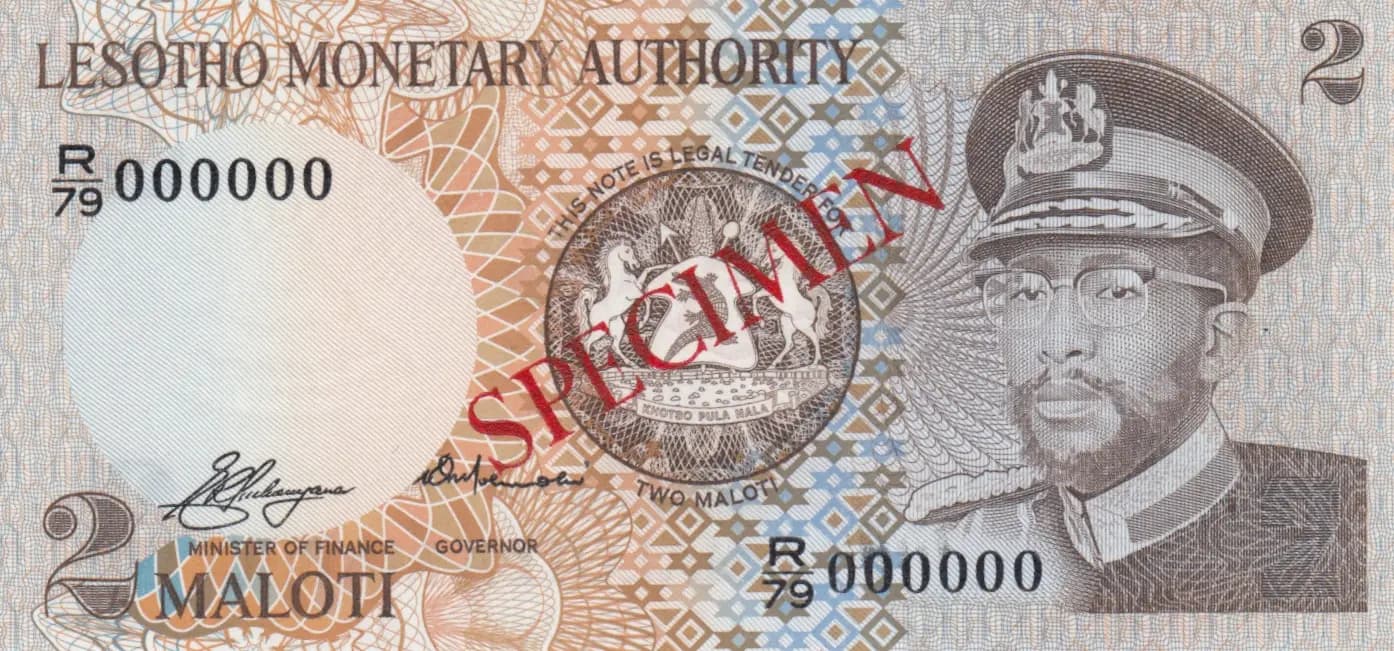
The obverse features a formal military portrait of King Moshoeshoe II in profile facing left, positioned on the right side of the note wearing ceremonial military uniform and cap. The central design element is an ornate circular seal containing the national coat of arms with two antelope (springbok) flanking a heraldic shield topped with a crown, surrounded by the text 'THIS NOTE IS LEGAL TENDER.' The reverse depicts a traditional Basotho rondavel (circular dwelling) with distinctive peaked thatched roof and a cross or finial mounted on the apex, a fundamental element of Lesotho's vernacular architecture. Background decorative elements include geometric patterns in orange, brown, blue, and red with wave motifs and fine-line guilloche work.
Front side: 'CENTRAL BANK OF LESOTHO' (issuing authority), 'TWO MALOTI' (denomination in English), 'MALOTI' (currency name), 'MINISTER OF FINANCE' and 'GOVERNOR' (authorization signatures), 'THIS NOTE IS LEGAL TENDER' (arc text around seal). Serial number 'A 8I 772036' appears twice. Back side: '2' (denomination markers in multiple corners), 'MALOTI A AMABELI' (Two Maloti in Sesotho language). All inscriptions are rendered in English and Sesotho, reflecting Lesotho's bilingual official status.
Intaglio printing (engraved) combined with multicolor lithography. The note exhibits characteristics typical of security banknote production from this era including fine-line engraving, detailed microprint patterns visible in geometric background designs, and precise color registration across multiple color passes. The complexity of the design and security features suggests production by a specialized banknote security printer, likely an international security printing house contracted by the Central Bank of Lesotho.
This note is identified as Pick P-4a, the primary 1981 variety with Basotho hat watermark. The serial number format visible in the images ('A 8I 772036') demonstrates the characteristic prefix system where the denominator fraction of the serial number prefix contains the last two digits of the issue year (81 for 1981). PMG records indicate four cataloged varieties for this base Pick number (P-4a, P-4b, P-4br, P-4s1), with differences likely relating to signature variants or minor design revisions. The 1981 date is confirmed by the serial number structure and matches the catalog designation year.