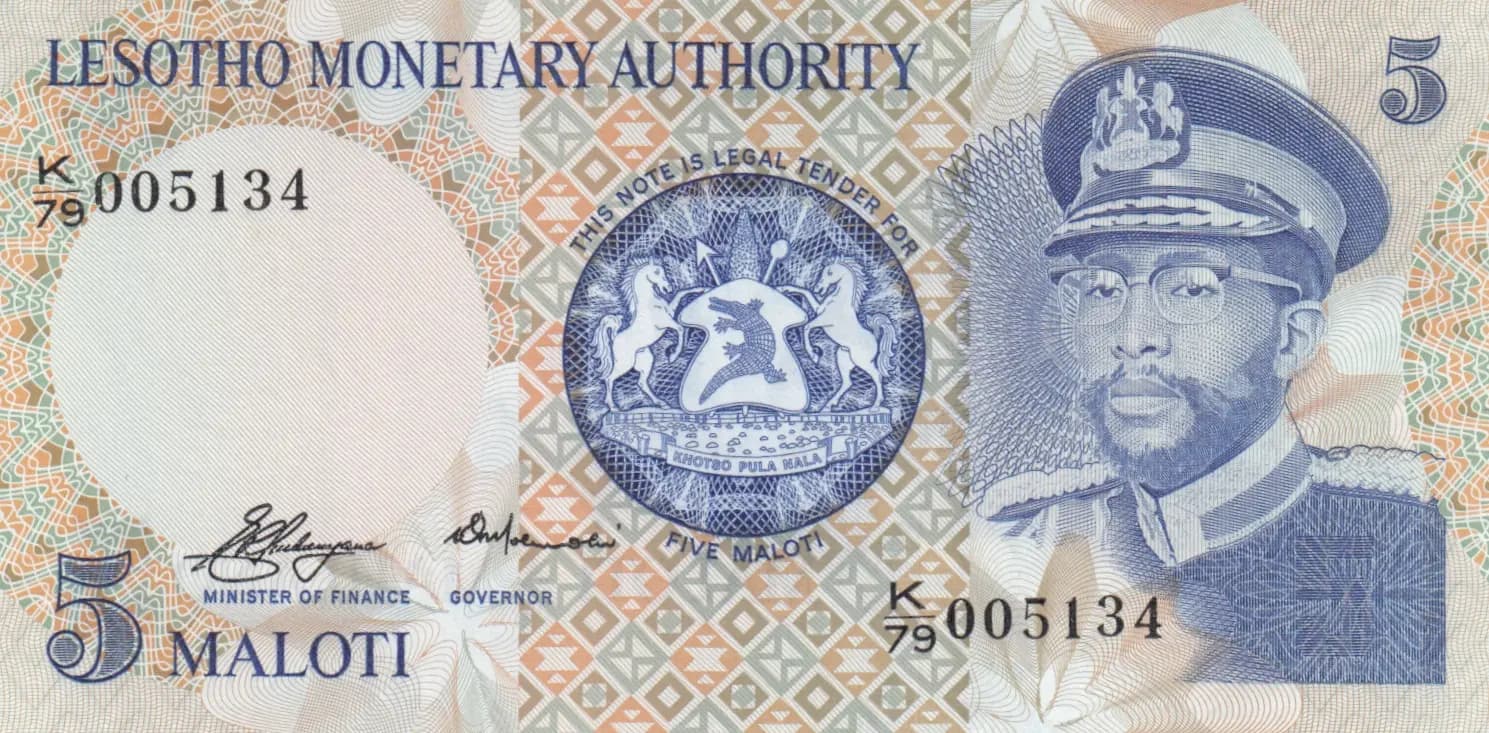
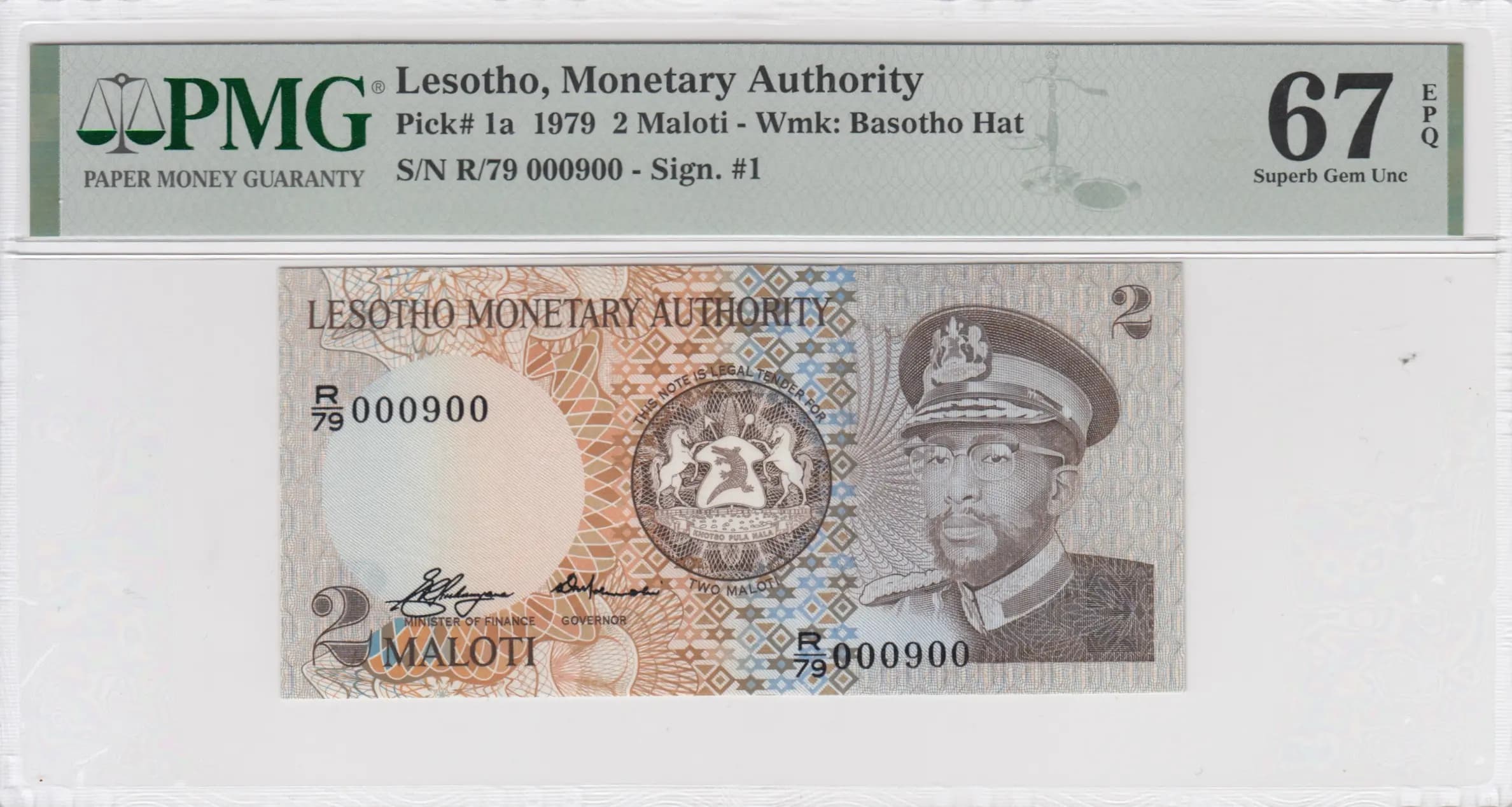
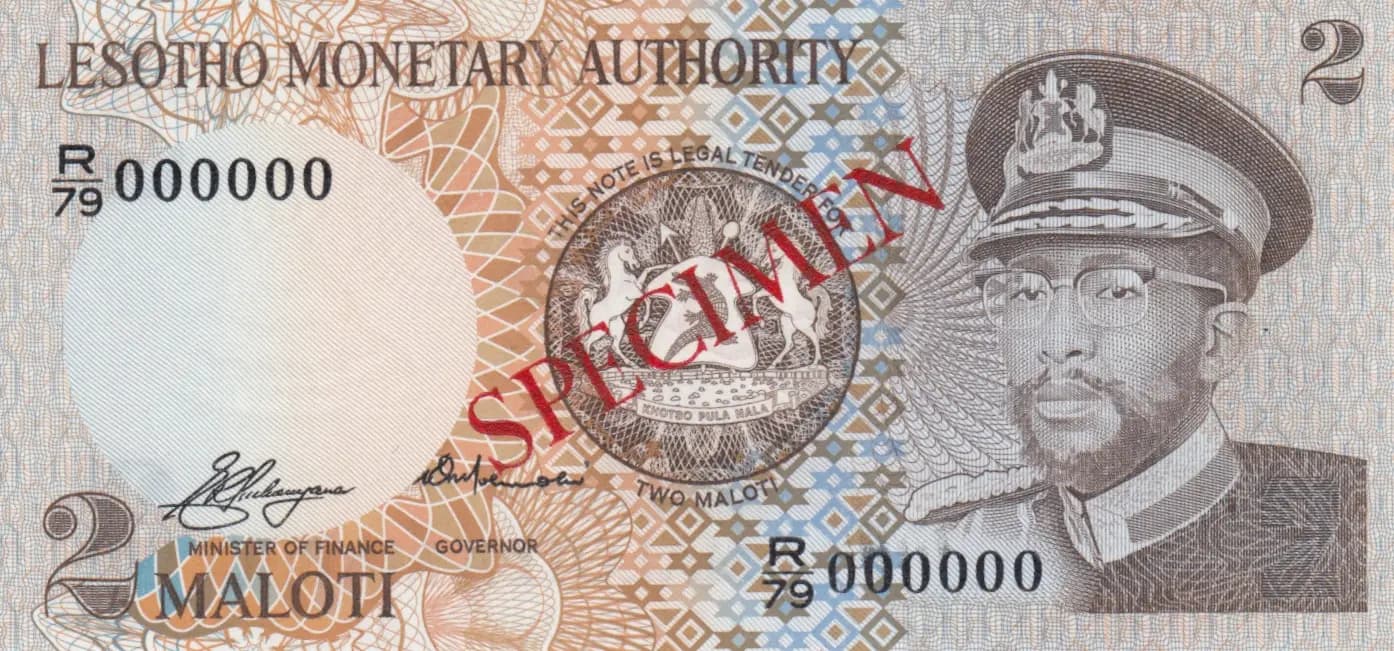
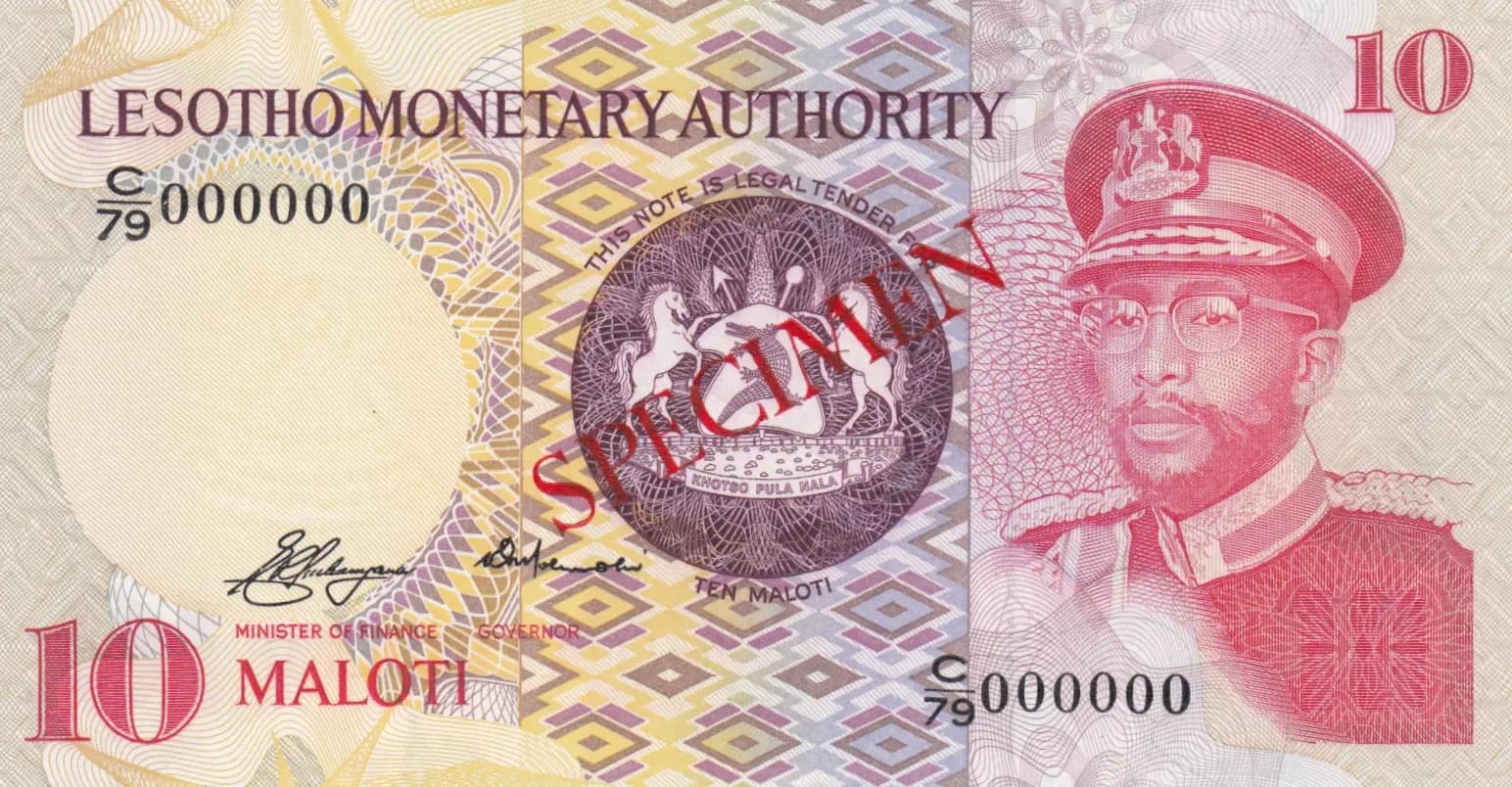
5 maloti 1979 specimen
Market Prices
1 saleAbout This Note
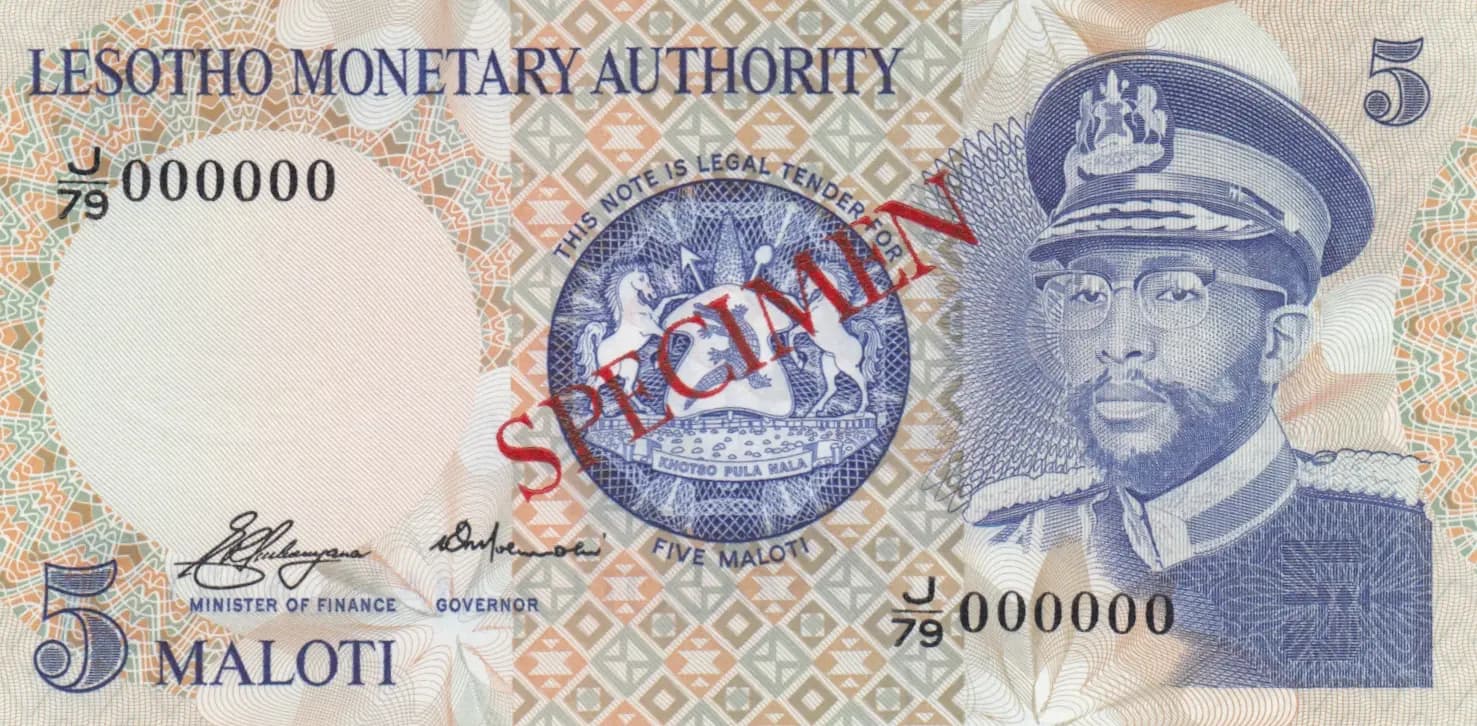
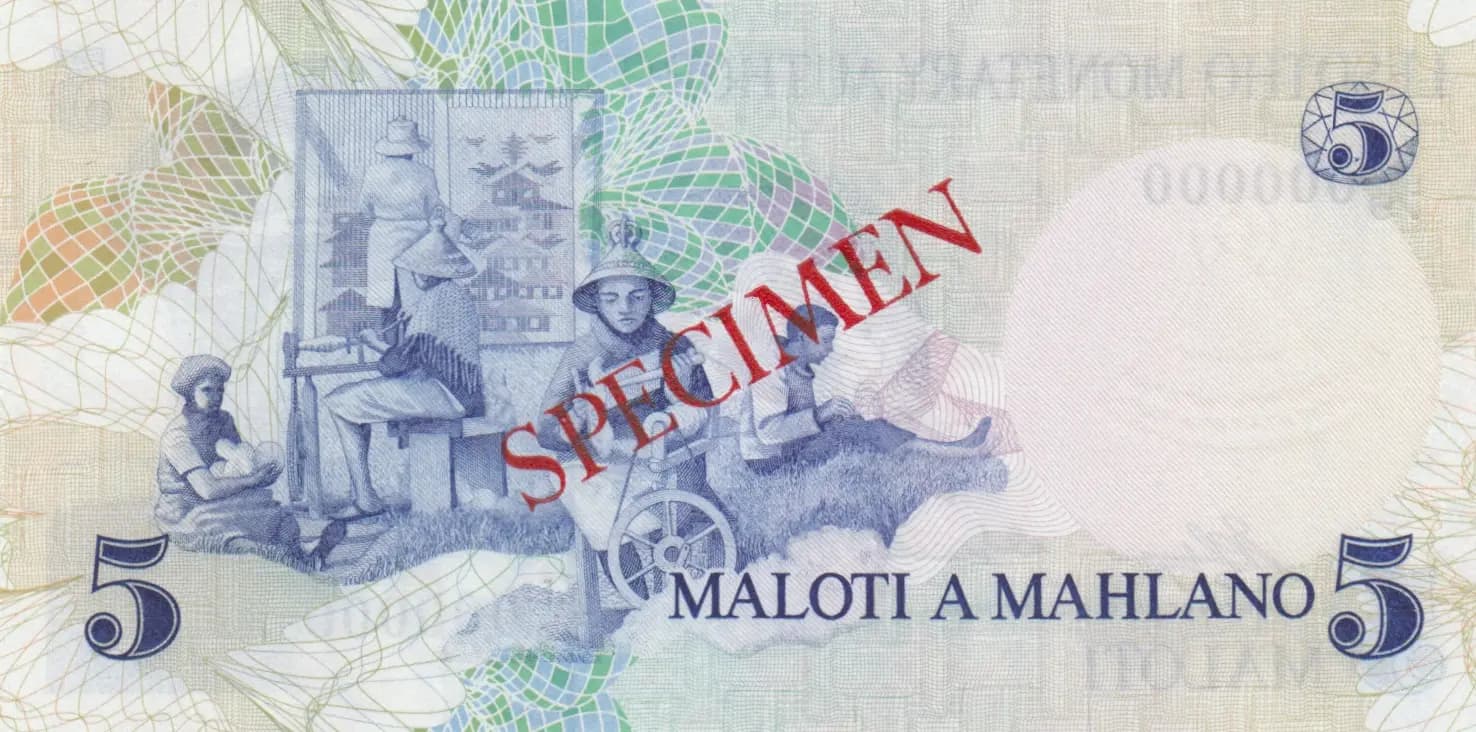
This is a 1979 Lesotho Monetary Authority 5 Maloti specimen note (Pick P-2s) in uncirculated condition, notable for its red diagonal 'SPECIMEN' overprint marking it as a non-circulating presentation piece. The obverse features a striking military portrait of King Moshoeshoe II set against an intricate geometric pattern in beige, orange, and navy blue, while the reverse depicts traditional Basotho craftsmanship with weavers and pastoral scenes rendered in detailed engraving. As a specimen note from the early years of Lesotho's monetary independence, this represents an important piece of the nation's numismatic heritage.
Common. As a specimen note, this piece was produced in relatively limited quantities for official and archival distribution rather than circulation, which typically makes specimens more scarce than regular-issue notes. However, specimen notes from major early African currency issues like Lesotho's 1979 series are generally well-represented in the numismatic market. The observed eBay market price of $39 for UNC examples (compared to a 2019 catalogue value of $135) suggests good availability. Specimen designations and the note's modest denomination further indicate this is a commonly encountered variety among serious collectors, rather than a scarce issue.
Issued in 1979 by the newly established Lesotho Monetary Authority, this note commemorates the early currency years of the Kingdom of Lesotho following its independence. The imagery deliberately showcases both national leadership (King Moshoeshoe II) and traditional Basotho cultural practices (weaving and pastoralism), reflecting the nation's effort to establish a modern identity while honoring its heritage. The specimen designation indicates this was produced for official presentation and archival purposes rather than circulation, making it a key document in the country's monetary development.
The obverse presents King Moshoeshoe II in formal military dress uniform with peaked cap, positioned prominently on the right side of the note. This portrait reflects the monarch's role as head of state and the nation's symbol of stability during the early independence period. At center-left, the Lesotho national coat of arms (circular seal) displays the heraldic lion and shield with legal tender inscription, serving as the principal security symbol and governmental authority marker. The background features sophisticated geometric guilloche patterns in warm tones (beige and orange) providing both aesthetic appeal and anti-counterfeiting security. The reverse depicts scenes of traditional Basotho labor: on the left, a weaver works at a loom, representing the nation's textile heritage; on the right, a figure is shown with pastoral/agricultural elements including cattle, symbolizing the pastoral economy central to Basotho culture. Decorative vine and leaf motifs in green and yellow frame these scenes, connecting the imagery to the natural landscape and traditional craftsmanship.
OBVERSE: 'LESOTHO MONETARY AUTHORITY' (English) — issuing institution; 'THIS NOTE IS LEGAL TENDER FOR FIVE MALOTI' (English) — legal tender declaration; 'FIVE MALOTI' / 'MALOTI' (English) — denomination; 'MINISTER OF FINANCE' and 'GOVERNOR' (English) — official signatories; Serial number 'J 79 000000' (mixed alphanumeric) — identification, where '79' indicates 1979 issuance; 'SPECIMEN' (English, red overprint) — non-circulating status. REVERSE: 'MALOTI A MAHLANO' (Sotho) — Five Maloti in the Sotho language; Denomination '5' (numeric, in decorative frames); 'SPECIMEN' (English, red overprint) — non-circulating status.
Intaglio engraving, the standard security printing method for banknotes of this era. The fine line work, detailed portraiture, subtle shading, and intricate guilloche patterns visible throughout both obverse and reverse are characteristic of traditional steel plate engraving. The geometric patterns and security features demonstrate professional security printing standards typical of De La Rue (TDLR), the likely printer for Lesotho's early banknote series, evidenced by the sophisticated design and technical execution. The multi-color printing with careful registration of the overprinted red 'SPECIMEN' designation further demonstrates advanced printing capabilities.
This note is identified as Pick P-2s (the 's' suffix denoting specimen status), with serial number prefix 'J/79' where the '79' corresponds to the year of issue (1979). The red diagonal 'SPECIMEN' overprint is the defining characteristic distinguishing this from the circulating P-2a variety. The serial number format with letter prefix and year designation follows the standard convention for this Lesotho series. No other noted varieties for the 5 Maloti denomination are recorded in the PMG population data, indicating this specimen variant represents the sole catalogued variety of this specific denomination in specimen form.