10 maloti 1981
Market Prices
2 salesAbout This Note
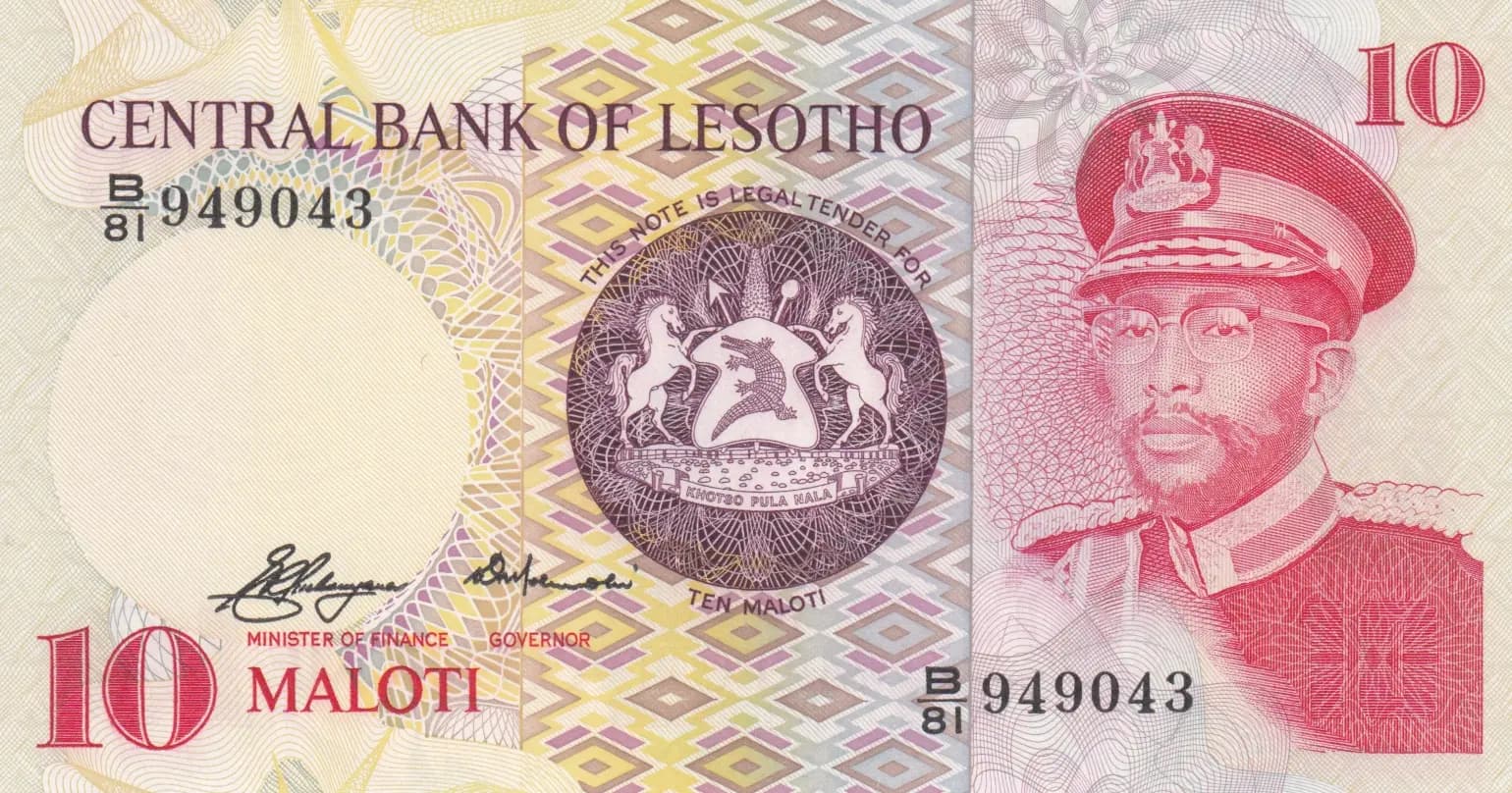
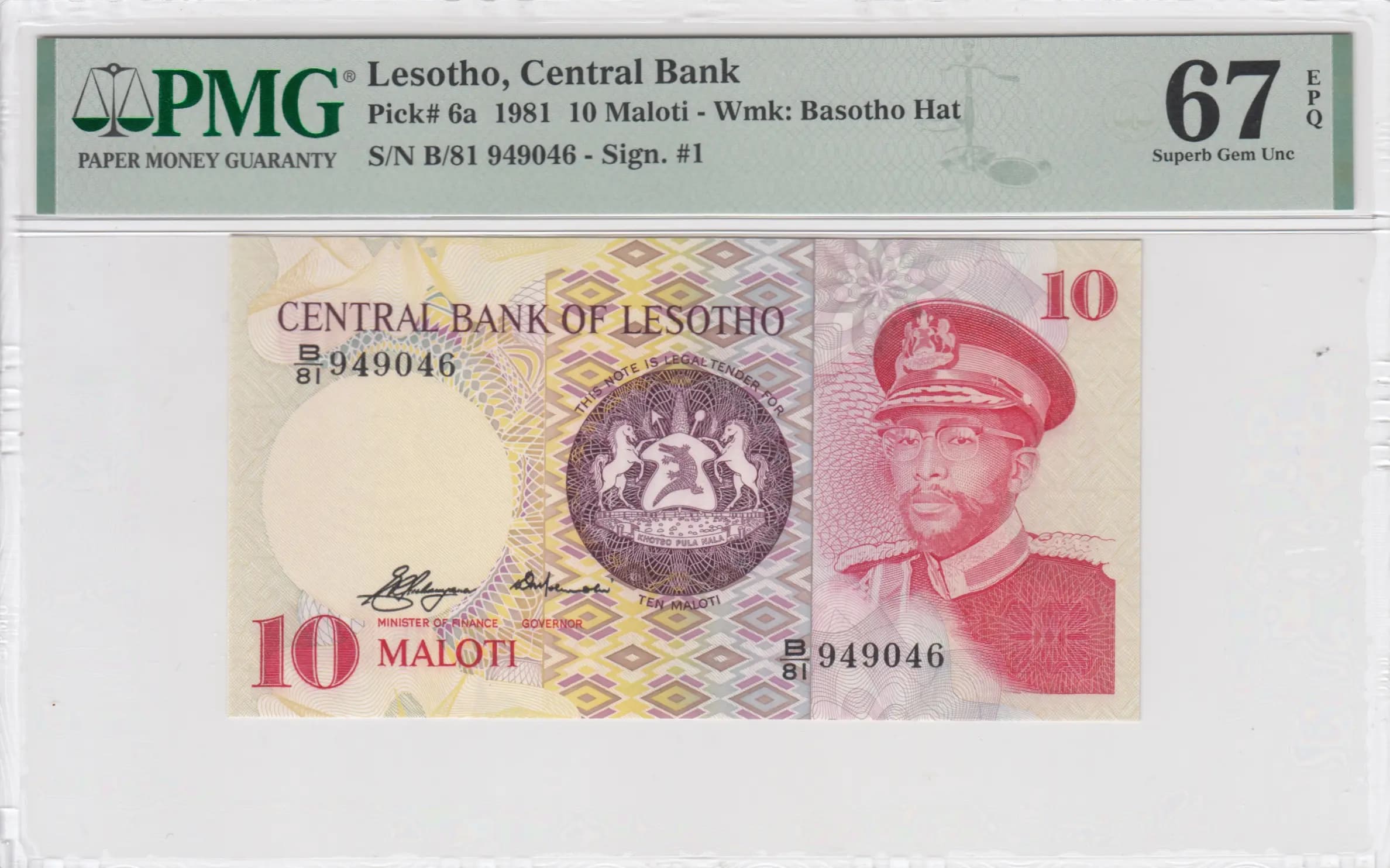
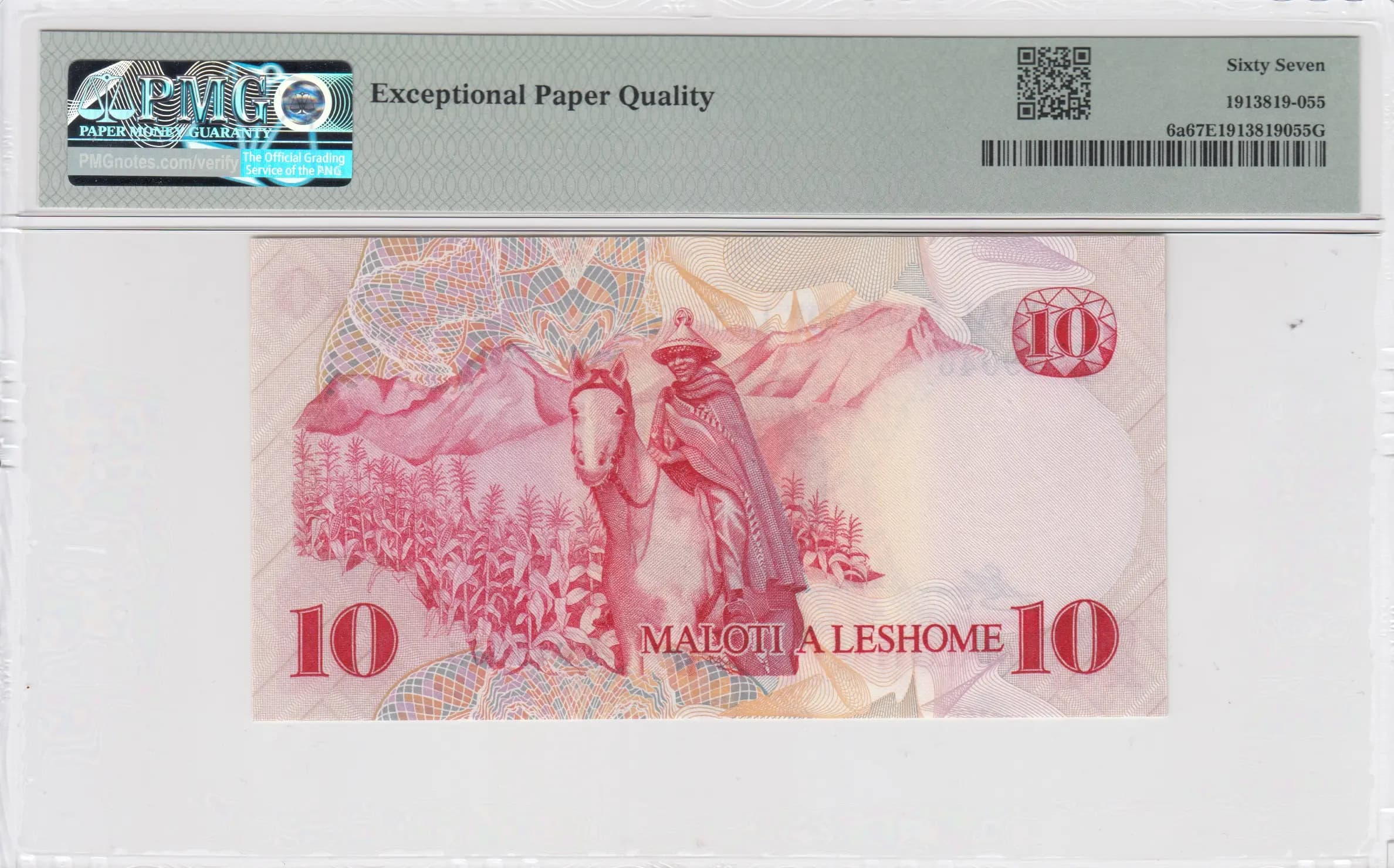
This PMG 67 EPQ graded 10 Maloti note from Lesotho's 1981 issue represents an exceptional example of early Central Bank of Lesotho currency in near-perfect condition. The note displays the characteristic deep blue-toned obverse featuring King Moshoeshoe II in military dress alongside the national coat of arms, with a striking multicolored reverse depicting a woman in traditional Basotho attire on camel-back against a mountainous landscape. The pristine condition with no visible wear, creases, or printing defects, combined with excellent centering and bright paper quality, makes this an attractive specimen for collectors of Southern African currency.
Common. Despite the PMG 67 EPQ grade representing exceptional condition, the 10 Maloti 1981 (Pick P-6a) is a regular issue note with presumably substantial print runs. Market data from realbanknotes.com indicates PMG 67 examples sold for approximately $67 in 2019, while uncirculated examples trade in the $33–$55 range, consistent with common-grade modern banknotes. The note's accessibility and relatively recent issue date place it firmly in the common category, though high-grade examples command modest premiums.
Issued in 1981, during the reign of King Moshoeshoe II, this banknote reflects Lesotho's post-independence monetary sovereignty under the Central Bank of Lesotho. The obverse portrait of the military-uniformed monarch emphasizes the nation's stability and leadership during this period, while the reverse's depiction of traditional Basotho pastoral life—represented by the woman in traditional dress and the iconic Basotho hat watermark—celebrates the country's cultural heritage and agricultural traditions. The bilingual inscription 'MALOTI A LESHOME' acknowledges both English and Sesotho, the official languages of the nation.
The obverse features King Moshoeshoe II positioned at right in full military uniform with a distinctive red/pink military cap, representing the nation's leadership and stability. The left side displays the national coat of arms of Lesotho, featuring a shield flanked by two antelope (crocodile) supporters, symbolizing national pride and sovereignty. The center contains geometric diamond guilloche patterns in purple and yellow against a cream background. The reverse depicts a woman wearing traditional Basotho clothing, including the characteristic conical Basotho hat (mokorotlo), mounted on a camel with mountainous terrain and cultivated fields visible in the background—imagery celebrating Lesotho's pastoral heritage and cultural identity. The watermark, visible as a pale circular impression, features the Basotho hat, a symbol of national identity.
FRONT: 'CENTRAL BANK OF LESOTHO' (issuing authority); '10' and 'MALOTI' (denomination); 'TEN MALOTI' (written form of denomination); 'MINISTER OF FINANCE - GOVERNOR' (signatories); Serial number 'B/81 949046' (where '81' indicates 1981 issue year in the serial prefix fraction). BACK: '10' (denomination in red); 'MALOTI A LESHOME' (Sesotho/English: 'Maloti of Lesotho'); Octagonal security feature displaying '10'.
Intaglio printing (engraved) with multicolor offset. The intricate geometric guilloche patterns, fine line work, stippling, and background security features visible throughout both sides are characteristic of professional security printing. The note exhibits the hallmarks of bank note-quality currency production typical of 1980s Central Bank issues, with precise registration and depth of impression. The printer for this issue is likely Thomas De La Rue or a comparable international security printer contracted by the Central Bank of Lesotho.
This note is cataloged as Pick P-6a, identified by the Basotho hat watermark. The PMG population report indicates five variants for the 10 Maloti 1981 base Pick number (P-6a, P-6b, P-6r, P-6s1, P-6s2), with differentiation primarily by watermark and printing characteristics. The serial number format 'B/81 949046' indicates the standard 1981 issue variety, with '81' appearing in the denominator of the serial prefix fraction as per catalog convention for this series. No overprints or exceptional signatures are evident in the visual analysis, indicating this is a standard production variety.