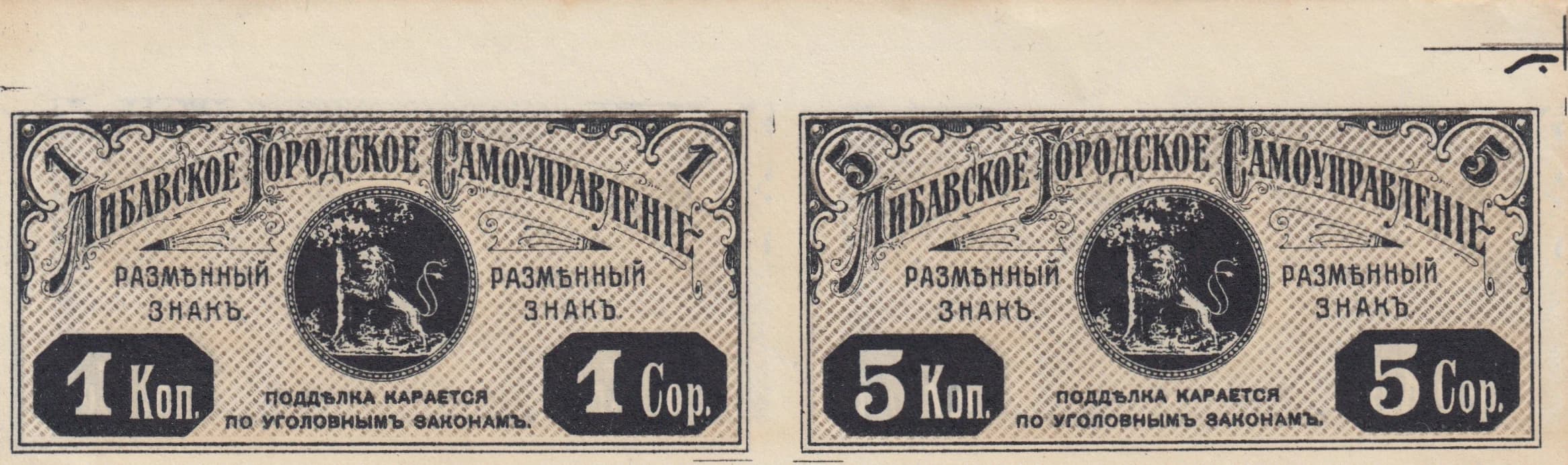
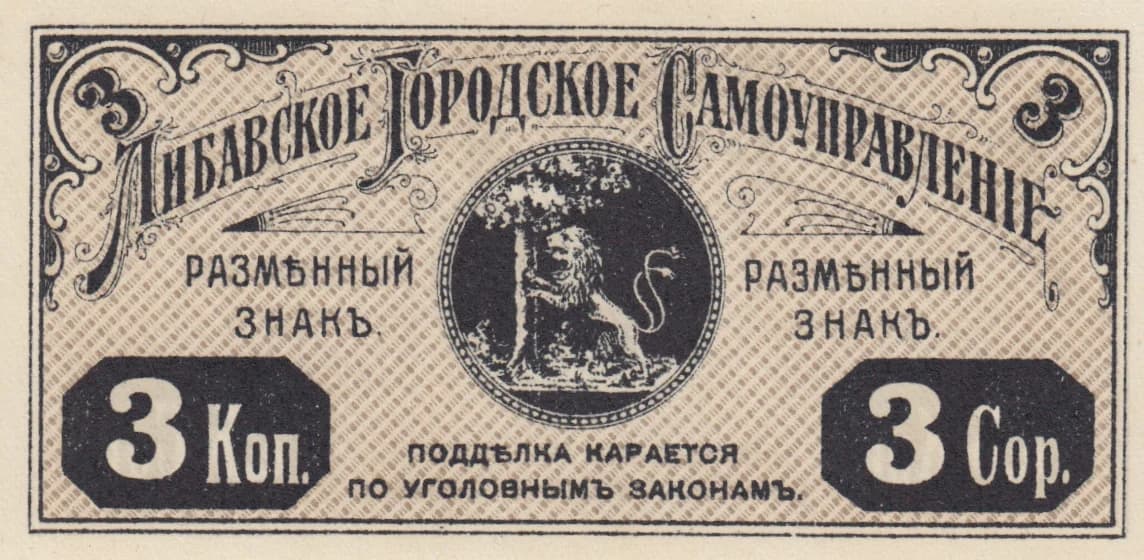
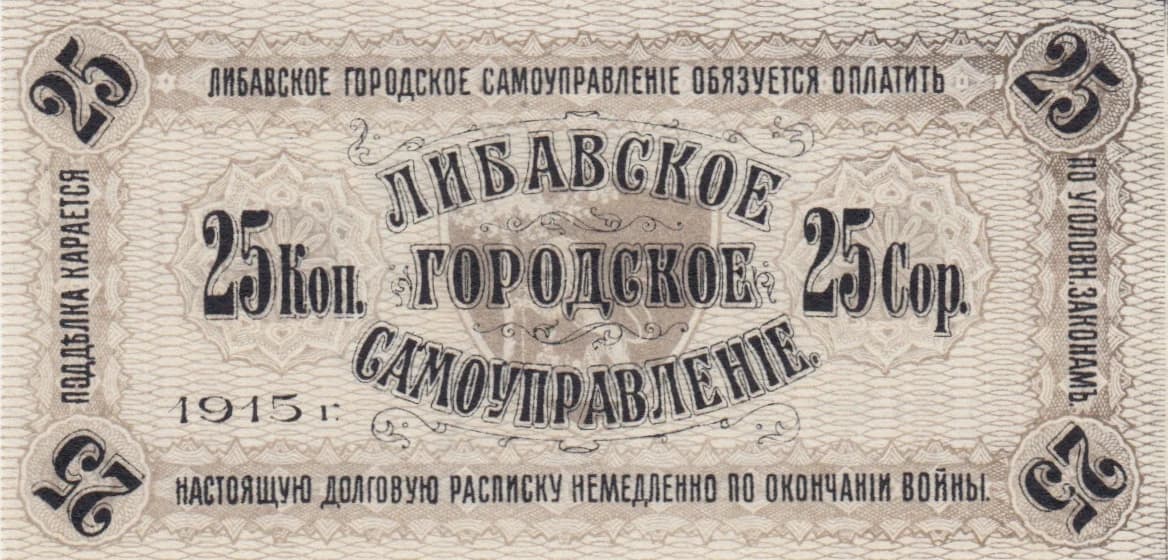
Riga 3 rubel 1919
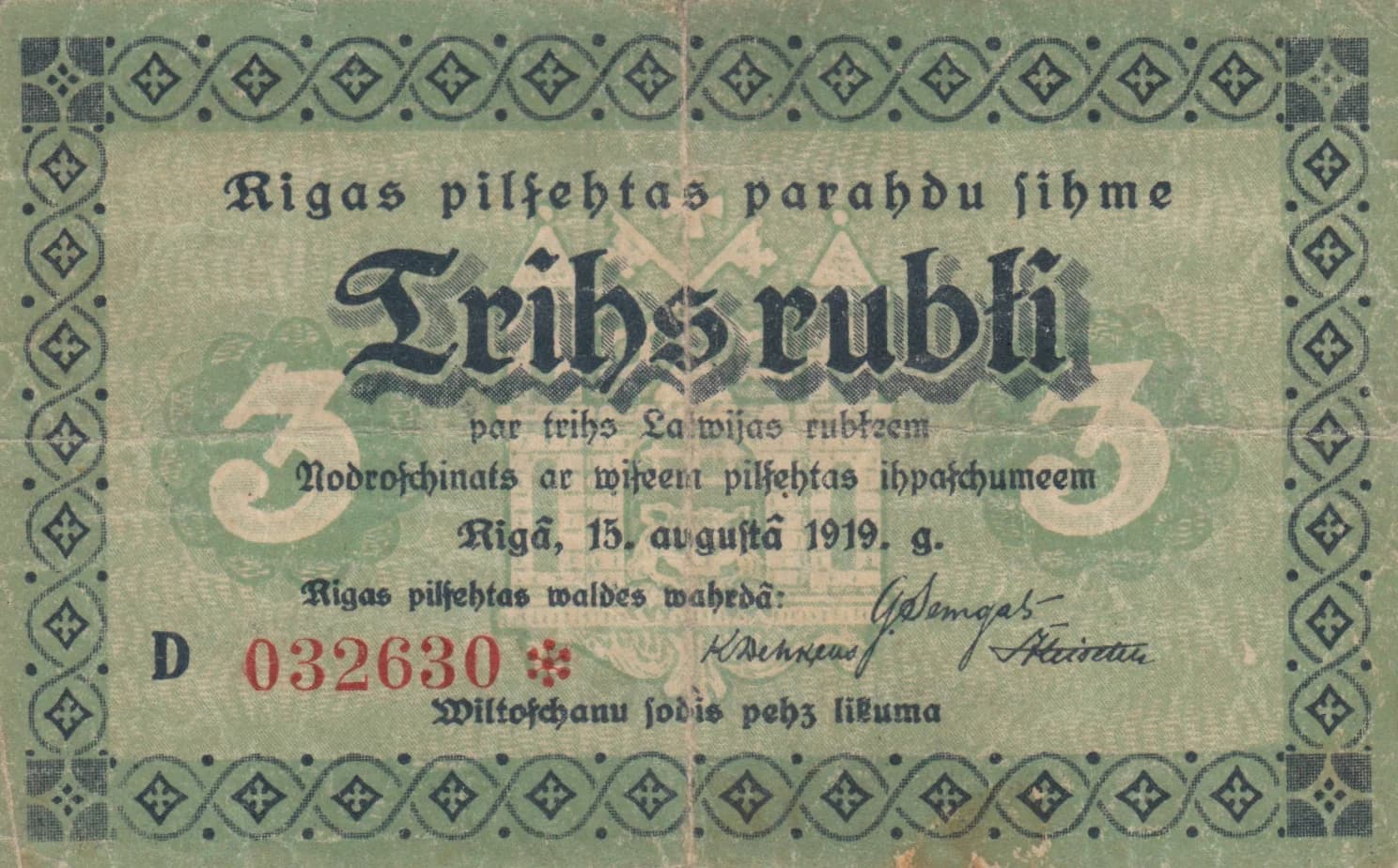
“serie D”
About This Note
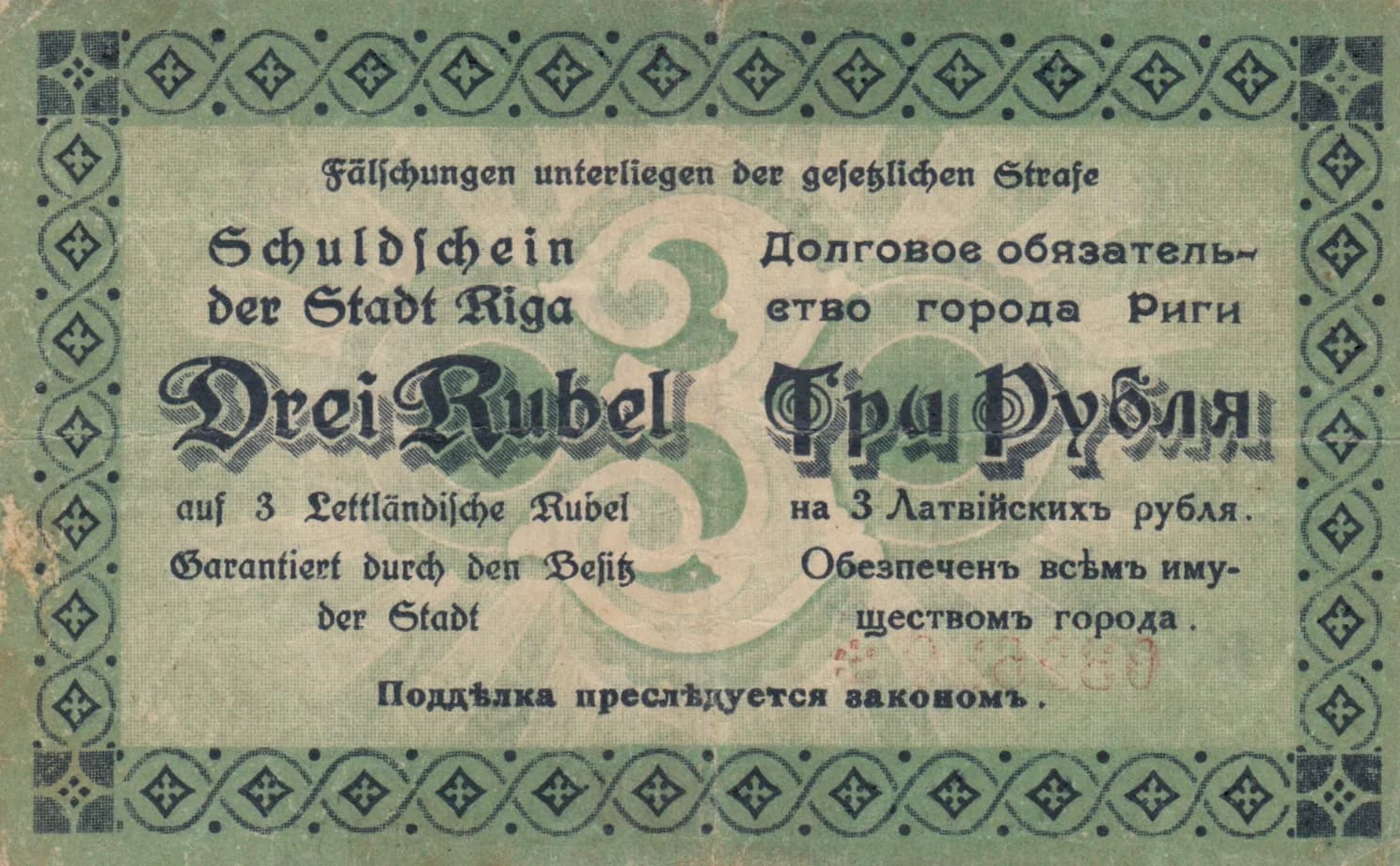
A fascinating example of emergency currency issued by Riga's municipal government during Latvia's turbulent transition to independence. This VF-graded 3 Rubel note from August 15, 1919, features an elegant green and cream color scheme with ornamental geometric borders and a prominent decorative '3' on the reverse. The multilingual inscriptions (Latvian, German, and Russian) reflect Riga's complex cultural and political context during the post-WWI period, making this series D specimen a compelling historical artifact of early 20th-century Baltic numismatics.
Common. Riga municipal bonds from 1919 were issued in substantial quantities to meet local currency demands during the transition period. The series D designation and serial number D 032630 indicate this was part of a large production run. While historically significant and no longer in circulation, these notes were not recalled or destroyed in large numbers, and examples appear regularly in Baltic and European numismatic markets. The VF condition grade is typical for surviving examples, as the sturdy paper stock and careful production have allowed many specimens to preserve relatively well over a century.
This municipal bond was issued by Riga's city government as emergency currency during the chaotic period following World War I and the Russian Revolution, when Latvia was establishing its independence. The trilingual text—combining Latvian as the dominant language with German and Russian—illustrates Riga's position as a cosmopolitan Baltic port city caught between empires. The guarantee 'secured by all property of the city' reflects the municipal government's attempt to provide confidence in local currency when traditional banking systems had collapsed.
A classically restrained design befitting municipal emergency currency of the post-WWI era. The note employs symmetrical ornamental borders composed of repeating diamond and circular geometric motifs characteristic of Art Nouveau and early 20th-century commercial printing. Decorative corner flourishes frame all sides. The obverse emphasizes textual authority through its carefully arranged multilingual declarations of civic backing and legal status. The reverse centers on a large decorative numeral '3' as the primary visual focal point, surrounded by parallel columns of text in three languages (German, Latvian, and Russian) presenting equivalent information in each. No portraits, national symbols, or landmarks appear—the design's authority derives entirely from institutional legitimacy and legal language rather than iconography. The green base color with beige/cream highlights and dark blue-black text creates a professional, conservative aesthetic appropriate to financial instruments.
FRONT SIDE: 'Rigas pilsehtas parahdu jihme' (Riga city treasury bond); 'Zeih5 rubli' (Three rubles); 'par feihs Latwijas rubtzem' (for three Latvia rubles); 'Modrofchinats ar wijseem pilsehtas ibhpatcbumeem' (Endorsed by city authority); 'Rigā, 15. augustā 1919. g.' (Riga, August 15, 1919); 'Rigas pilsehtas waldes wahrdā:' (Under the care of Riga city council); Serial number 'D 032630'; 'Wiltoschanu jodis pebz likeuma' (Legal tender). REVERSE SIDE: German: 'Schuldschein der Stadt Riga' (Bond of the City of Riga); 'Drei Rubel' (Three Rubles); 'auf 3 Lettländische Rubel' (for 3 Latvian rubles); 'Garantiert durch den Besitz der Stadt' (Guaranteed by the property of the city); 'gaischungen unterliegen der gesetzlichen Strafe' (Counterfeiting is subject to legal penalty). Russian: 'Долговое обязательство города Риги' (Bond obligation of the city of Riga); 'Фра Рубля' (Three Rubles); 'на 3 Латвийских рубля' (for 3 Latvian rubles); 'Обеспечен всемь имуществом города' (Secured by all property of the city); 'Подчилка преследуется законом' (Counterfeiting is prosecuted by law).
Letterpress printing, the standard method for municipal bonds and emergency currency of this period. The precision of the ornamental borders, the consistency of text alignment, and the crisp impression of the decorative elements are typical of high-quality letterpress work from established Baltic or Central European security printers. The red serial number was likely applied in a separate pass, as was standard practice. The uniform color application and clean edges suggest professional commercial printing rather than emergency improvisation, indicating this note received treatment from an experienced printer despite its municipal origin.
Series D specimen, serial number D 032630. Known varieties for Riga municipal 3 Rubel notes from 1919 include different series designations (A, B, C, D, etc.). This example belongs to series D, which appears to represent a later printing or portion of the emission. The serial numbering format and series letter provide the primary means of cataloging varieties for this issue, as signature variations and date changes do not apply to this municipal bond type.