Riga 1 rubel 1919
“serie K”
About This Note
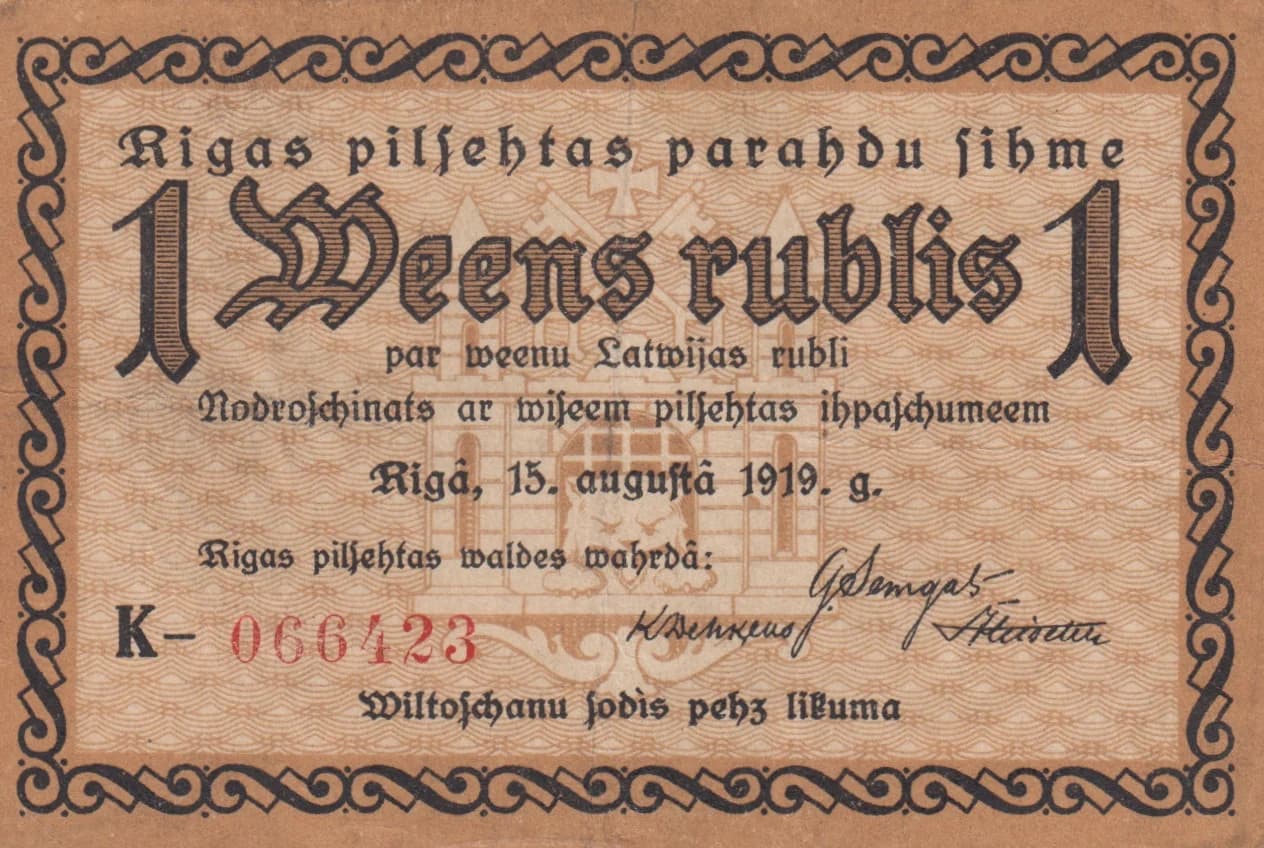
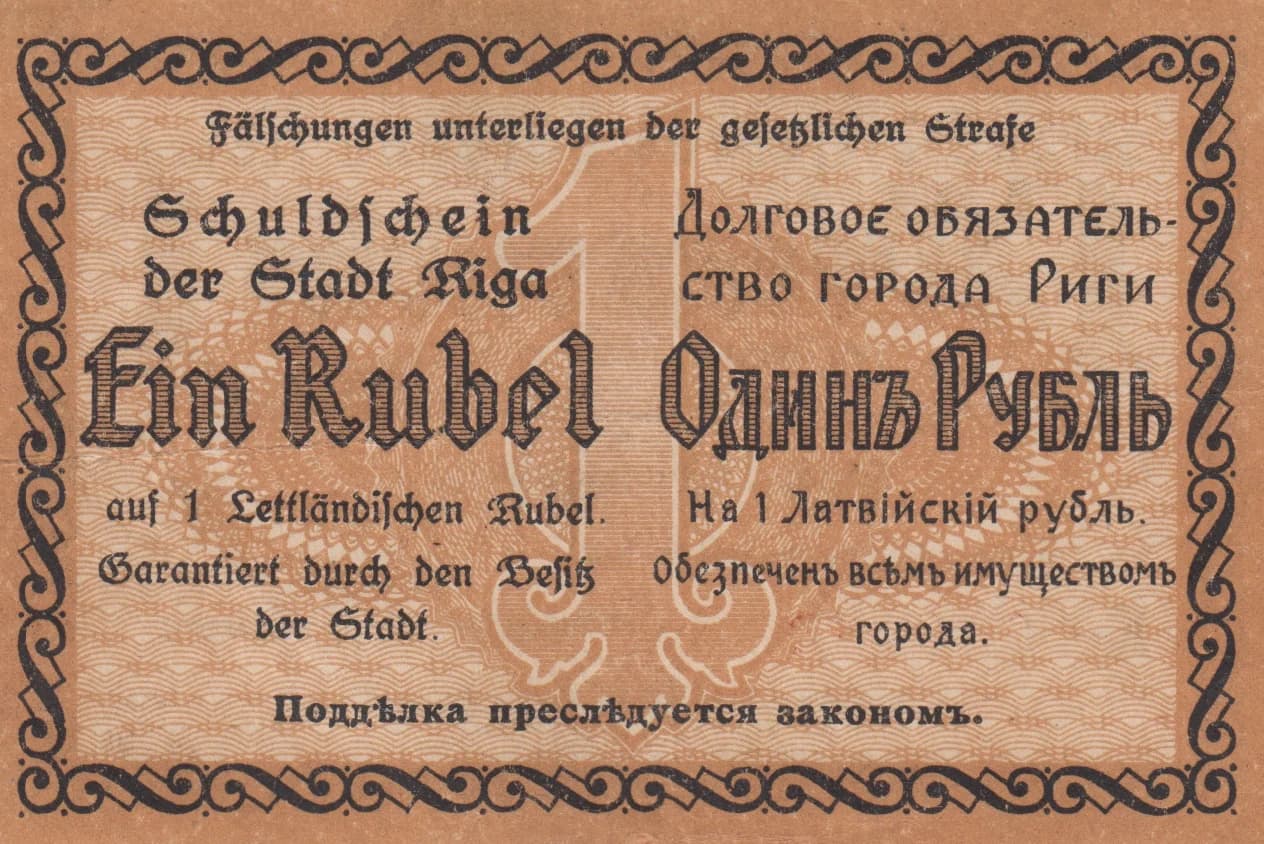
This is a Riga City Municipality 1 ruble note from August 15, 1919, issued during Latvia's early independence period. The note displays excellent condition for its age, with clear impressions, visible watermark featuring a heraldic shield, and well-preserved ornate spiral-pattern borders. The multilingual design (Latvian, German, and Russian) reflects Riga's cosmopolitan character and the transitional period following World War I and the Russian Revolution.
Common. Riga municipal notes from 1919 are readily available to collectors of Baltic currency and municipal scrip. While these notes have historical significance as artifacts of Latvia's independence period, they were issued in substantial quantities to serve the city's monetary needs and have survived in reasonable numbers. The VF condition grade and identifiable serial number (K-0664223) do not indicate scarcity; notes of this type and condition typically appear on the market at modest valuations consistent with common emergency currency issues.
Issued by Riga's municipal government in August 1919, this note represents a critical moment when the city needed to assert financial independence following Latvia's declaration of independence in November 1918. The trilingual inscriptions—Latvian, German, and Russian—document Riga's status as a Baltic trading hub with significant German and Russian-speaking populations. The note's designation as a 'debt certificate' (Schuldschein/парахду) rather than currency reflects the chaotic monetary conditions of post-war Eastern Europe, when municipalities and institutions issued their own credit instruments due to currency shortages.
The note features a symmetric, elegant design with ornate decorative borders composed of repeating spiral patterns that frame both sides. The primary security feature is a watermarked heraldic shield or coat of arms positioned in the center background of the front side, representing Riga's municipal authority. The design employs a beige/tan paper base with black text and decorative elements, creating high contrast for readability. No portraits or specific landmarks are depicted; instead, the design emphasizes textual authority and institutional legitimacy through repeated legal language affirming the city's backing of the obligation. The denomination appears prominently in multiple languages to serve the diverse populations within Riga's jurisdiction. This minimalist approach—focusing on ornamental borders and multilingual legal text rather than figurative artwork—was typical of municipal credit instruments of this period.
FRONT SIDE: 'Rigas pilsehtas parahdu jihme' (Riga's city debt certificate) / '1 Weens rublis' (1 ruble) / 'par weenu Latvijas rubli' (for one Latvian ruble) / 'Apdreichinaes ar wijeem pilsehtas ibpalchuneem' (Secured by all city property) / 'Rigd, 15. auguste 1919. g.' (Riga, 15 August 1919) / 'Rigas pilsehtas waldes wahrdā' (Under the authority of Riga's city government) / Serial number: 'K- 0664223' / 'wiltoschoanu jodis pebz libuma' (according to law passed). BACK SIDE: 'Schuldschein der Stadt Riga' (Debt certificate of the City of Riga) / 'Ein Rubel Одинъ Рубль' (One ruble in German and Russian) / 'auf 1 Settländischen Rubel' (for 1 Lettlandian ruble) / 'На 1 Латвийский рубль' (For 1 Latvian ruble) / 'Garantiert durch den Besitz der Stadt' (Guaranteed by the property of the city) / 'обезпечен всѣм имуществом города' (Secured by all property of the city) / 'Fällschungen unterliegen der gesetzlichen Strafe' (Counterfeiting is subject to legal penalties) / 'Подделка преследуется законом' (Counterfeiting is punishable by law) / 'ДОЛГОВОЕ ОБЯЗАТЕЛЬСТВО ГОРОДА РИГИ' (Debt obligation of the City of Riga).
The note was produced using letterpress printing, evidenced by the crisp, even impression of the ornate borders and text visible in the visual analysis. The consistent ink coverage and sharp definition of the decorative spiral patterns indicate professional lithographic or engraved plate work. The watermark visible in the background demonstrates the use of specialized security paper manufactured with embedded heraldic imagery. No specific printer attribution is documented for this municipal issue, but the quality of execution suggests work by an established Baltic or Central European security printer active in 1919.
Series K, serial number 0664223. The series prefix 'K' identifies this note within Riga's sequential numbering system for the 1919 municipal issue. The specific serial number falls within the documented range for this emission. No known major varieties (such as signature variants, date variations, or overprints) are evident from the visual analysis. Standard variety considerations for this issue would include different series letters and serial number ranges, though all represent the single dated issue of August 15, 1919.