Riga 1 rubel 1919
“serie C”
About This Note
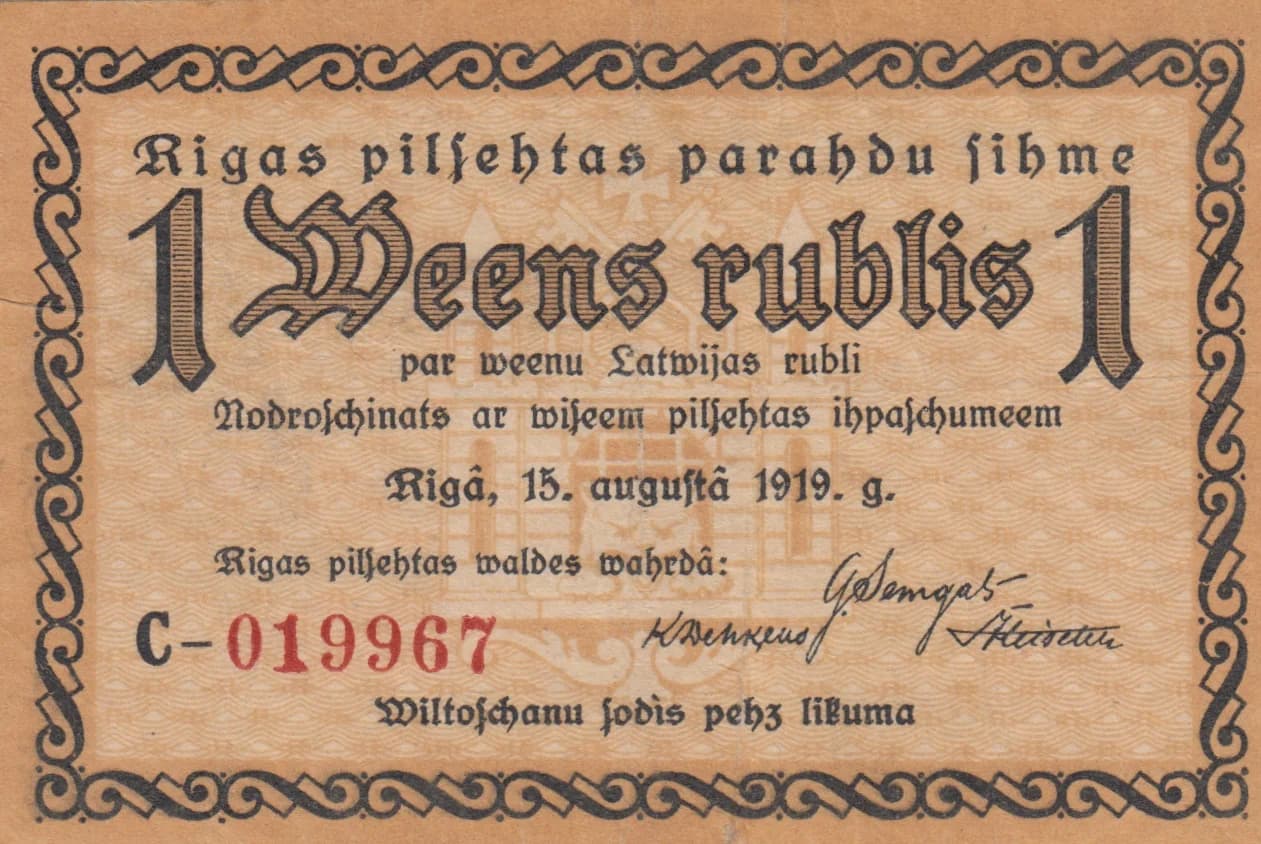
This is a 1919 Riga City Municipality 1 Ruble note in VF condition, featuring an elegant ornamental wave/spiral border in black on tan/beige paper. The note displays bilingual and trilingual text (Latvian, German, and Russian/Cyrillic), reflecting Riga's complex linguistic landscape during the transitional post-WWI period. The serial number C-019967 and two handwritten signatures authenticate this emergency municipal currency issue, which represents an interesting chapter in early Latvian monetary history.
common
Issued on August 15, 1919, just after Latvia's declaration of independence from Russia (November 1918), this municipal note represents Riga's temporary solution to currency shortages during the chaotic transition period. The trilingual inscriptions (Latvian, German, and Russian) reflect Riga's diverse population and the competing cultural influences of the recently departed Russian Empire and Germanic Baltic nobility. These municipal obligation notes were guaranteed by city property and served as provisional currency until Latvia could establish its own national banking system.
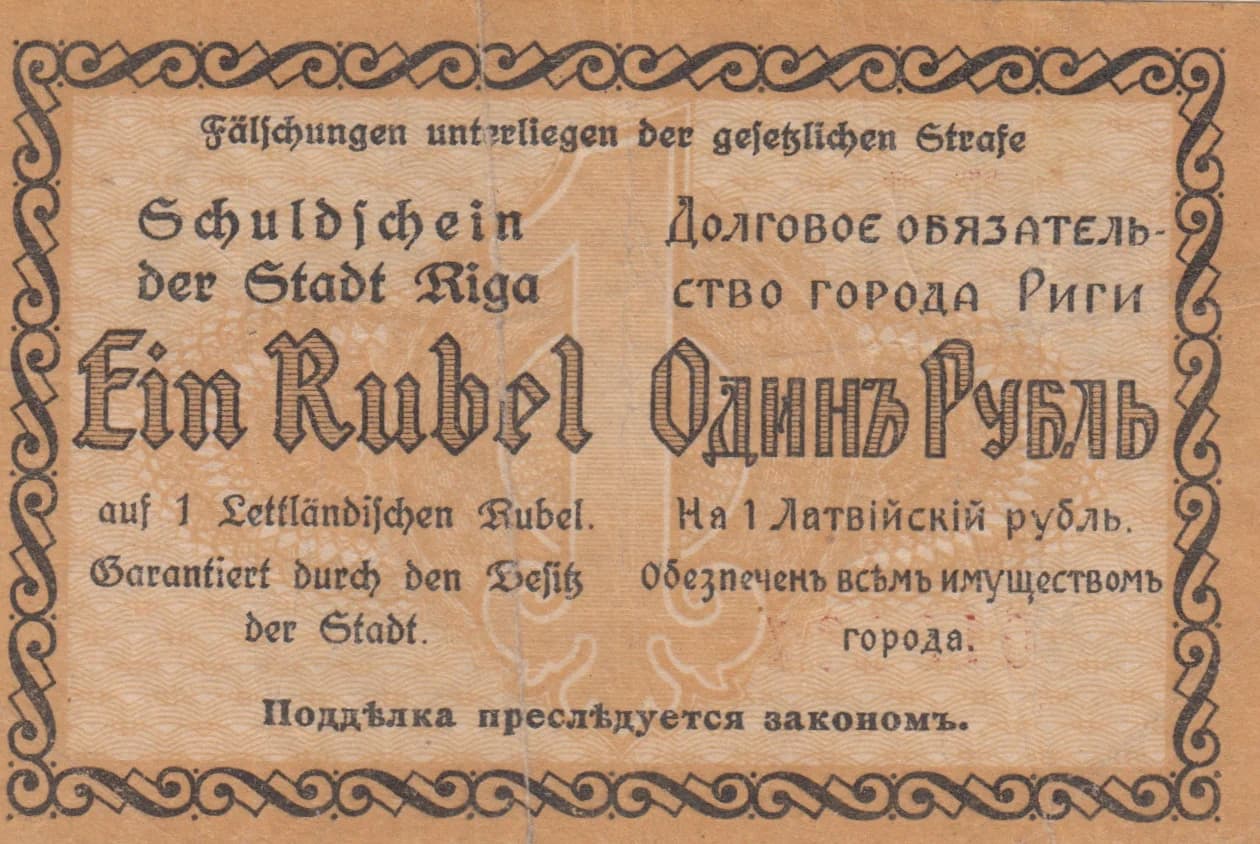
This municipal obligation note features a symmetrical design with a repeating wave or spiral ornamental border framing all edges in black ink. The front displays the denomination '1' prominently positioned on both left and right sides with 'Weens rublis' (One Ruble) in large, stylized text at center. The design eschews portraiture and landmarks, instead emphasizing official governmental text and legal language that establishes the note's status as a guaranteed debt obligation of Riga's municipal authority. Two handwritten signatures appear in black ink below the main text block, providing individual authorization. The back repeats the identical ornamental border and provides parallel text in three languages (German, Russian, and Latvian) to ensure clarity across the city's multilingual population, with emphasis on counterfeiting penalties and the security of the obligation.
FRONT SIDE: 'Rigas pilsehtas parahdu jihme' (Riga city authority obligation) / '1 Weens rublis 1' (1 One ruble 1) / 'par weenu Latwijas rubli' (for one Latvian ruble) / 'Nodrojchinatg ar wijeem pilsehtas ihpajchumeem' (Guaranteed by the city authority property) / 'Riga, 15. augusta 1919. g.' (Riga, 15th August 1919) / 'Rigas pilsehtas waldes wahrdā' (In care of Riga city government) / 'Willojchanu jodis pebz likuma' (According to law) / Serial: C-019967. BACK SIDE: 'Fälschungen unterliegen der gesetzlichen Strafe' (Counterfeiting is subject to legal penalty) / 'Schuldschein der Stadt Riga' (Debt certificate of the City of Riga) / 'Договое обязательство города Риги' (Debt obligation of the city of Riga) / 'Ein Rubel Одинь Рубль' (One Ruble in German and Russian) / 'auf 1 Lettländischen Rubel' (for 1 Lettish ruble) / 'На 1 латвийской рубль' (for 1 Latvian ruble) / 'Garantiert durch den Besitz der Stadt' (Guaranteed by the property of the city) / 'Обезпечен всем имуществом города' (Secured by all property of the city) / 'Подъялка преследуется законом' (Counterfeiting is prosecuted by law).
Letterpress printing on tan/beige paper stock, executed in black ink only. The ornamental border patterns and text demonstrate the characteristic crisp detail of letterpress production typical of 1919. No security printing features beyond the serial number are evident. The handwritten signatures were added post-printing. The printer's identity for this Riga municipal issue is not definitively established in standard catalogues, though it was likely produced by a local or regional Baltic printing house capable of multilingual composition.
Series C, serial number C-019967. The series letter 'C' indicates this is from the third printing run of this issue. Individual varieties may exist based on signature combinations and serial number ranges (prefixes A, B, C, etc.), though specific documented varieties are not well-catalogued in standard references. The date of August 15, 1919 appears consistent across known examples, suggesting a single-date issue rather than multiple dated varieties. Condition, serial number prefix, and signature combinations may distinguish collector examples, but these distinctions are not formally recognized in major catalogues.