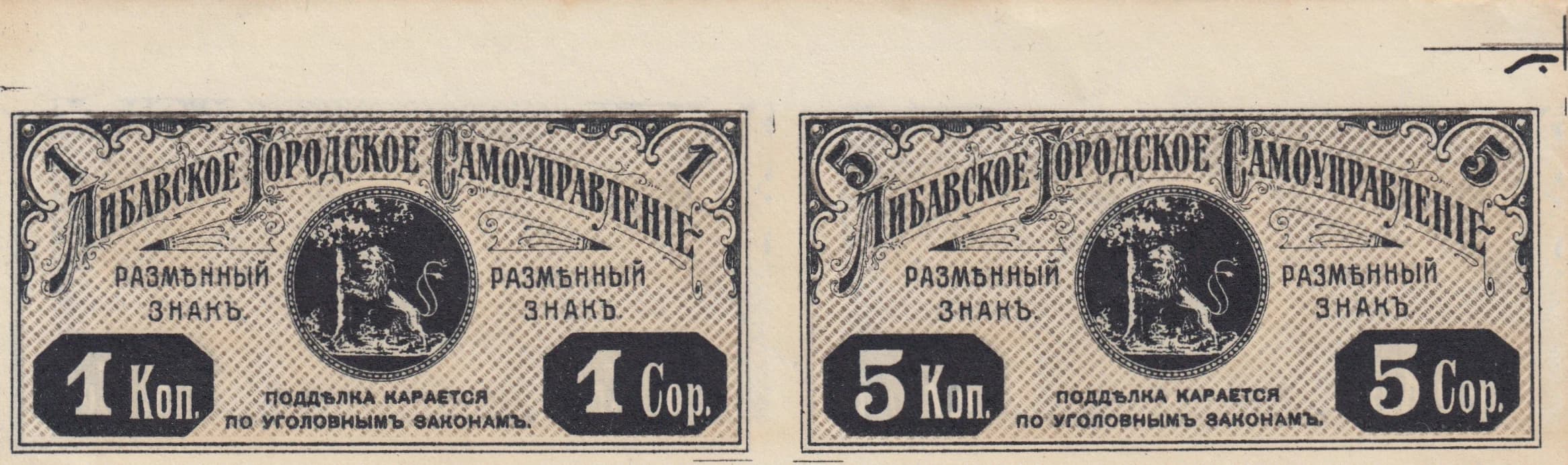
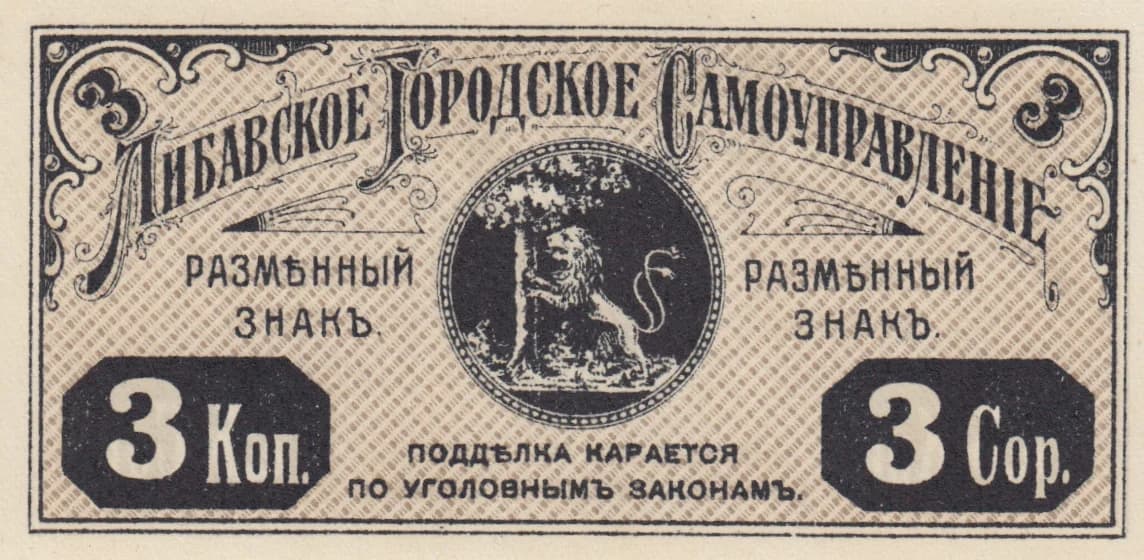
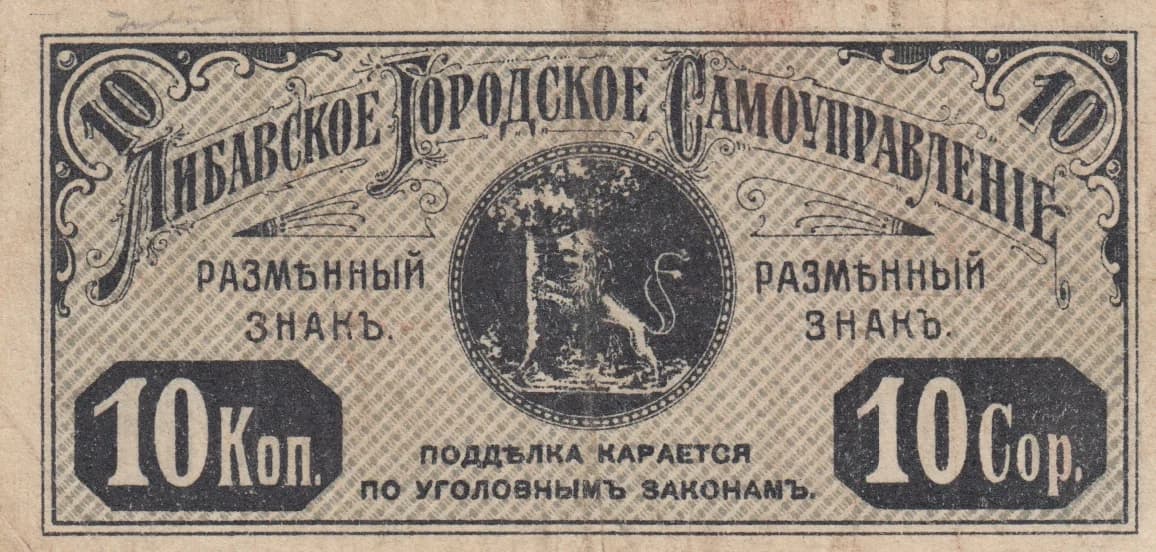
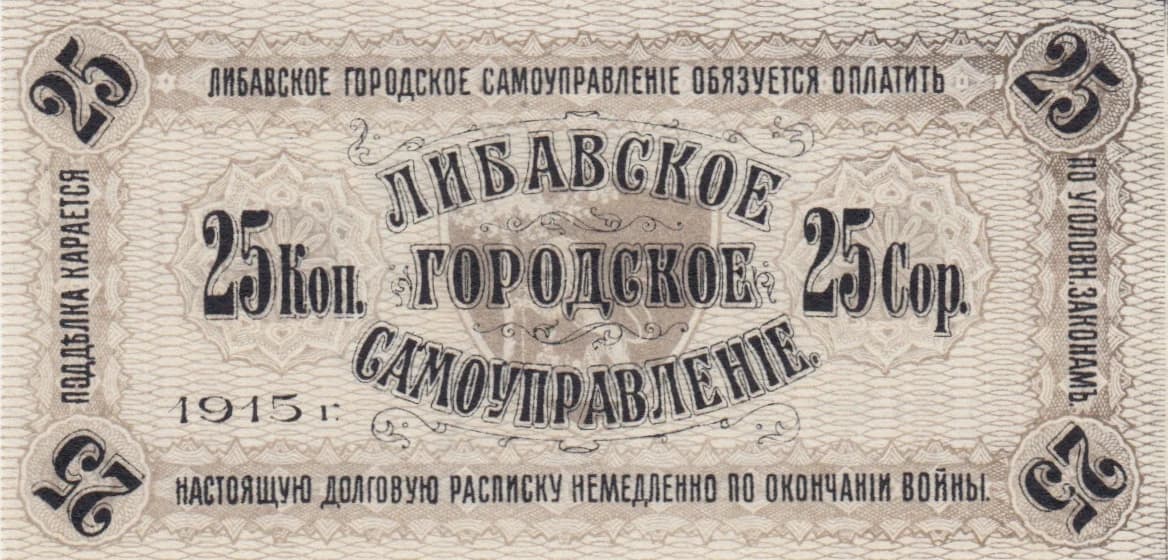
Libau 50 kopeek 1915
About This Note
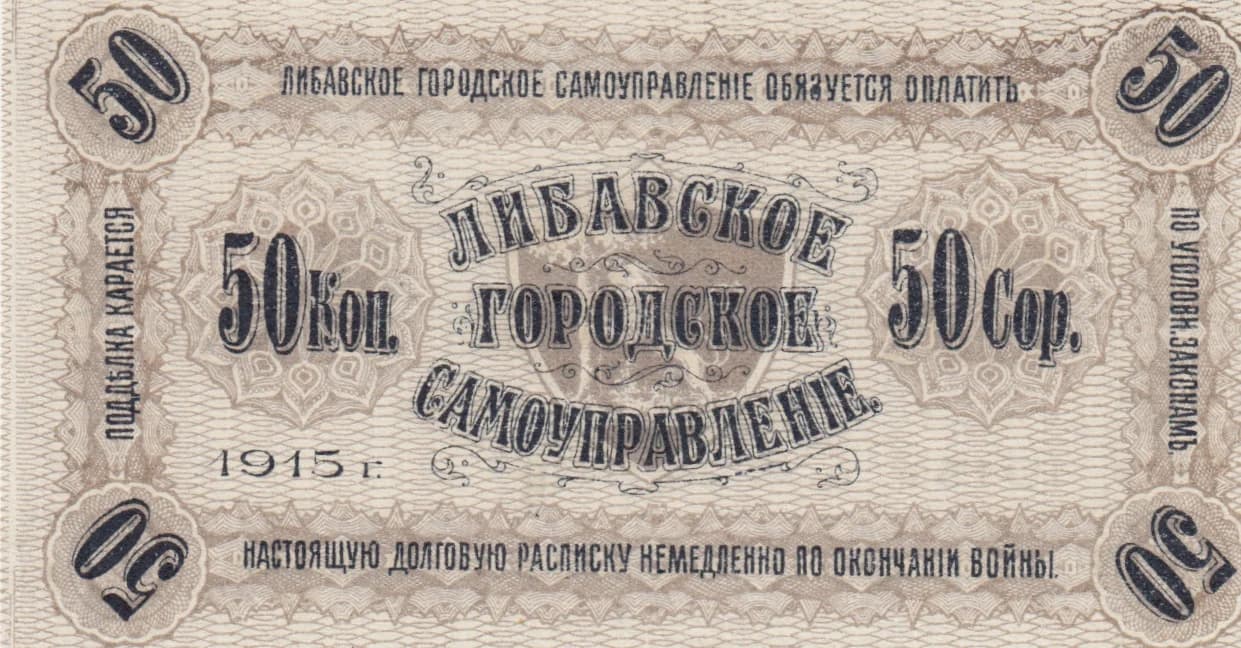
This is an exceptional UNC example of a 1915 Libau City Municipality 50 kopeck emergency banknote, featuring a beautifully preserved beige/tan paper stock with crisp dark blue and black printing throughout. The note displays the characteristic ornate decorative borders and corner medallions typical of WWI-era Russian municipal emergency currency, with all text remaining clearly legible despite its 109-year age. This particular specimen represents an important artifact from Latvia's brief period under Russian imperial administration during the First World War, when local authorities issued such notes to address wartime liquidity crises.
common. While all emergency municipal currency from the Russian Empire's Baltic territories possesses historical significance, Libau 50 kopeck notes from 1915 were issued in substantial quantities to meet local monetary needs during the wartime crisis. No evidence of exceptionally limited print runs, mass destruction, or severe scarcity exists in numismatic literature. The note's survival in UNC condition is noteworthy but does not override the baseline assessment that the original issue quantities were sufficient to make this denomination relatively common compared to other Russian emergency issues.
Libau (modern-day Liepāja, Latvia) issued this emergency currency during 1915 under the temporary regulations established by the Russian Empire's military administration, as indicated by the explicit reference to 'Libau Garrison' and 'Temporary Regulation' on the note. During World War I, many Baltic municipal governments under Russian control were forced to issue promissory notes and emergency currency to maintain local commerce and pay obligations, as reflected in the note's promise to redeem 'immediately upon the end of the war.' This note exemplifies the financial disruption and local monetary improvisation that characterized the Eastern Front during the Great War.
The note features a classical symmetrical layout characteristic of Imperial Russian municipal emergency currency. Large denomination numerals '50' are positioned in all four corners within ornamental circular medallions. The central field is dominated by hierarchically arranged Russian Cyrillic text describing the issuing authority and redemption promise. Elaborate decorative borders frame the entire note with fine geometric and floral pattern work, creating a security-enhancing visual complexity. The beige/cream paper color and dark blue/black printing create high contrast for legibility while the intricate background patterns serve both aesthetic and anti-counterfeiting purposes. No portraits or specific landmarks are depicted; instead, the design relies entirely on ornamental elements and administrative text to convey authority and authenticity.
FRONT SIDE: Primary inscription: 'ЛИБАВСКОЕ ГОРОДСКОЕ САМОУПРАВЛЕНИЕ ОБЯЗУЕТСЯ ОПЛАТИТЬ' (Libau City Municipal Government undertakes to pay). Denomination: '50 Коп.' (50 Kopeck), repeated in corners. Additional text includes: 'ЛИБАВСКОЕ ГОРОДСКОЕ САМОУПРАВЛЕНИЕ' (Libau City Municipal Government), '1915 г.' (1915), 'ЛИБАВСКИЙ КАРАЦИОН' (Libau Garrison), 'ВРЕМЕННОГО ПОЛОЖЕНИЯ' (Temporary Regulation/Under Temporary Regulations), and 'НАСТОЯЩУЮ ДОЛГОВУЮ РАСПИСКУ НЕМЕДЛЕННО ПО ОКОНЧАНИИ ВОЙНЫ' (This promissory note [shall be redeemed] immediately upon the end of the war). All inscriptions are in Russian Cyrillic script, reflecting Libau's status as part of the Russian Empire at the time of issuance.
This note was produced using letterpress/relief printing, the standard technique for Russian municipal emergency currency of the WWI period. The fine line work visible in the borders, the crisp impression of the ornamental patterns, and the consistent ink density throughout are characteristic of professional letterpress printing. The specific printer for Libau municipal notes of this period has not been definitively documented in standard catalogs, though such notes were typically produced by established Imperial Russian printing facilities or licensed municipal printers operating under military administration oversight.
This particular specimen appears to represent the standard 1915 issue without observable overprints, date variations, or signature varieties that would constitute a distinct cataloged variety. The uniform printing, consistent paper tone, and lack of any hand-applied modifications suggest this is the primary variety of the Libau 50 kopeck note. No distinguishing serial numbers, control marks, or printer's imprints are clearly visible in the visual analysis that would indicate a sub-variety. Further examination of the reverse side would be needed to identify any verso markings, control numbers, or secondary variety characteristics.