50 latu 1934
Market Prices
53 salesAbout This Note
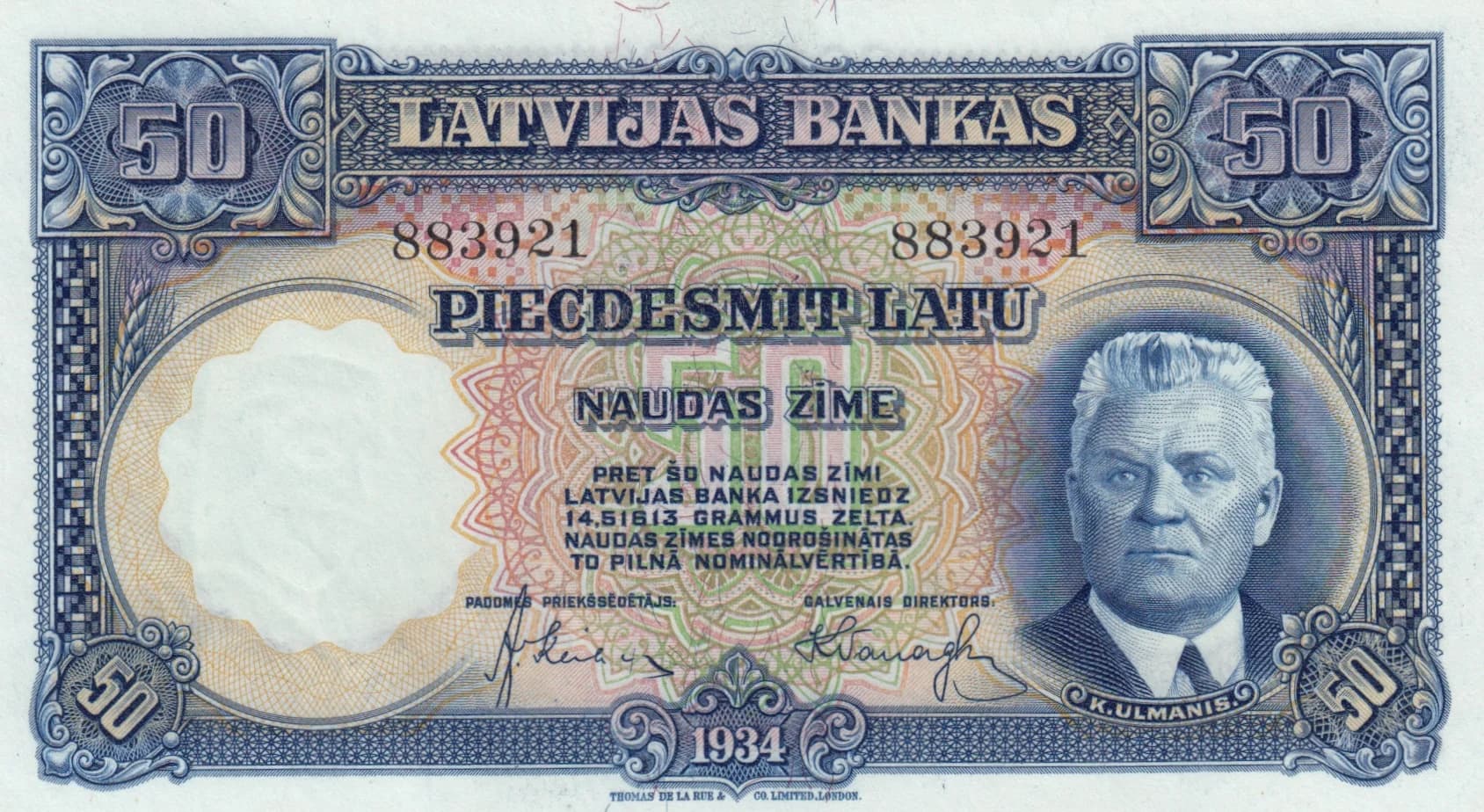
This is a 1934 50 Latu banknote from Latvia issued by Latvijas Banka, printed by the prestigious Thomas de la Rue company. The note displays the characteristic ornate baroque-inspired design typical of interwar Latvian currency, featuring a formal portrait on the front and the national coat of arms on the back. While the visual analysis indicates the note has been circulated with visible age-related discoloration and minor foxing, the printing remains clear and legible, making it a representative example of this important historical currency from Latvia's independent period.
Common. This note is a regular issue from Latvia's stable interwar period with no indication of limited print runs or recall. The extensive eBay sales data provided shows this note consistently trading in modest price ranges, with most examples in circulated grades selling for $5-$30 USD and even high-grade specimens (PMG 66) typically realizing $100-$200. The 2016 catalogue value of $100 for UNC examples confirms standard collector-grade pricing. While historically and artistically significant, this is a commonly encountered note in the numismatic market.
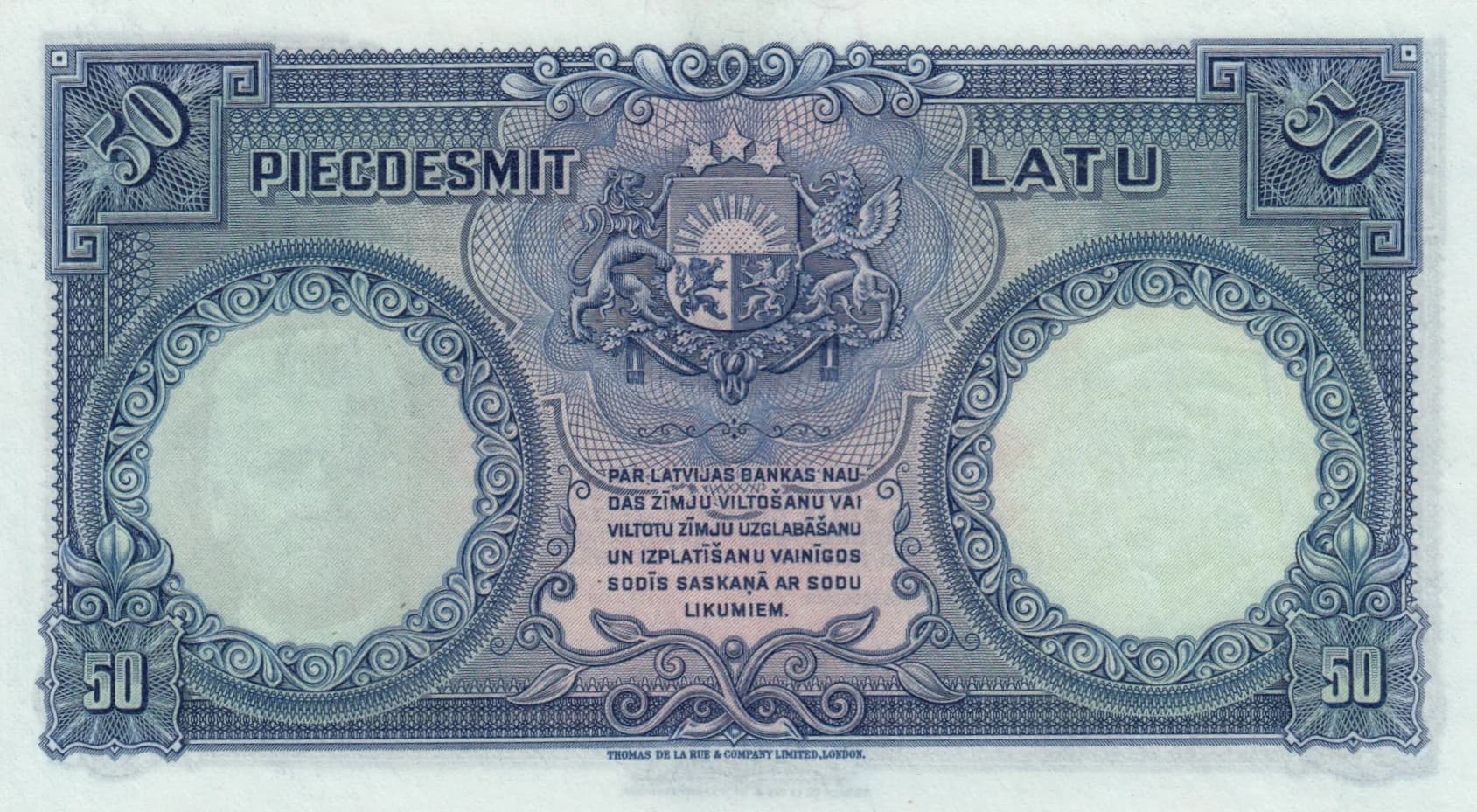
This 1934 note was issued during Latvia's interwar independence period (1918-1940), a formative era for the newly sovereign nation. The Latvian coat of arms prominently featured on the reverse—depicting the lion and sun motif—served as a powerful symbol of national identity and sovereignty. The note's text explicitly guarantees convertibility to gold (14.51813 grams per note), reflecting the gold standard monetary system that underpinned European currencies during the 1930s and the Bank of Latvia's commitment to currency stability during the Great Depression.
The front of this note features a formal three-quarter profile portrait of Kārlis Ulmanis, Latvia's prominent political figure and Prime Minister during the interwar period, positioned on the right side of the note facing left. The portrait is rendered in dignified formal attire with suit and tie, characteristic of Ulmanis's public persona. The reverse displays the Latvian national coat of arms—a shield featuring a lion (representing strength and sovereignty) topped with rays or a crown symbolizing the nation's aspirations. The entire design is framed by elaborate baroque-inspired decorative scrollwork, floral motifs, and geometric lattice patterns in a sophisticated color palette of dark blue, light blue, green, pink, and cream. Two large arched rectangular frames on the back are left blank, serving as watermark areas. The denomination '50' appears in all four corners of the note, and detailed intaglio work throughout creates fine line patterns that serve both aesthetic and security purposes.
FRONT: 'LATVIJAS BANKAS' (Bank of Latvia) / 'PIECDESMIT LATU' (Fifty Lats) / 'NAUDAS ZĪME' (Currency note) / 'PRET ŠO NAUDAS ZĪMI LATVIJAS BANKA IZSNIEDZ 14.51813 GRAMMUS ZELTA. NAUDAS ZĪMES NODOROSINĀTAS TŪ PILNĀ NOMINĀLVERTĪBĀ' (Against this currency note, the Bank of Latvia issues 14.51813 grams of gold. The currency note is guaranteed at its full nominal value) / 'PADOMIES PRIEKŠSĒDĒTĀJS' (Chairman) / 'GALVENAIS DIREKTORS' (Chief Director) / '1934' (Year) / Serial number: 883921 / 'THOMAS DE LA RUE & CO LIMITED, LONDON' (printer identification). BACK: 'PIECDESMIT LATU' (Fifty Lats) / 'PAR LATVIJAS BANKAS NAUDAS ZĪMJU VILTOŠANU VAI VILTOTU ZĪMJU UZGLABĀŠANU UN IZPLATĪŠANU VAINĪGOS SODUS SAŠĶANA AR SODU LIKUMIEM' (For counterfeiting Bank of Latvia currency notes or possessing and distributing counterfeit notes, those guilty face penalties in accordance with penalty laws) / 'THOMAS DE LA RUE & COMPANY LIMITED, LONDON' (printer).
This note was produced using intaglio printing (also called engraving or recess printing), the primary security printing method employed by Thomas de la Rue & Co Limited of London, the world's leading banknote printer at the time. The intaglio technique is evidenced by the crisp, detailed line work visible throughout the design, the fine-line decorative patterns, and the tactile quality of the printed elements. The use of multiple color printing (dark blue, light blue, green, pink, and red inks for serial numbers) required multiple passes through the press. The ornate decorative elements and baroque flourishes served dual purposes: aesthetic appeal and anti-counterfeiting security features that were difficult to replicate with contemporary printing technology.
This note corresponds to Pick catalogue number P-20, with Thomas de la Rue as the identified printer. The PMG population data indicates two catalogued varieties: P-20a and P-20s2 (both printed by TDLR). The observed serial number 883921 suggests this is a P-20a variety. The specific signature varieties and potential overprint variations would require comparison with the PMG population database to determine exact variety classification, but the standard printed signatures for 'PADOMIES PRIEKŠSĒDĒTĀJS' (Chairman) and 'GALVENAIS DIREKTORS' (Chief Director) are consistent with the base P-20 type.