50 kapeikas 1920
Market Prices
13 salesAbout This Note
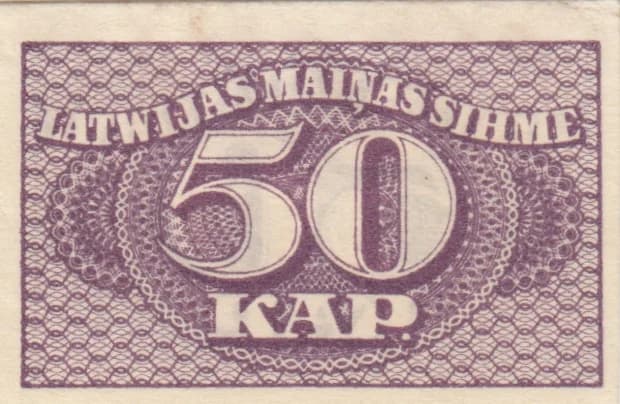
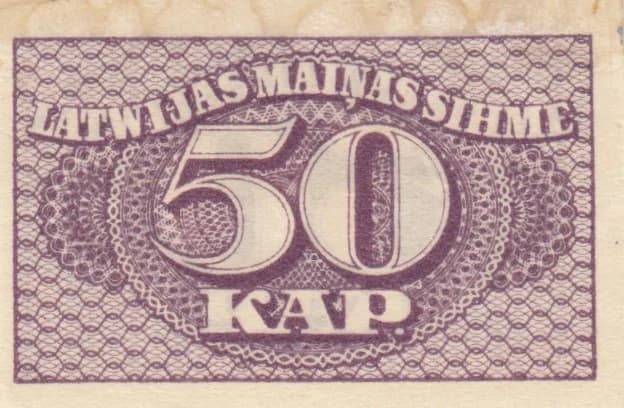
This 1920 Latvian 50 Kapeikas banknote (Pick P-12) displays an elegant purple and mauve color scheme with symmetrical geometric patterning throughout. The note exhibits the aged patina consistent with genuine 1920s-era currency, with visible creasing and yellowing of the paper stock characteristic of its AU condition grade. The intricate ornamental border design and central denomination marking showcase the refined aesthetic of early Latvian currency, making this a notable example of the newly independent nation's monetary design.
Common. eBay market data shows consistent sales ranging from $2 to $24, with most graded examples (VF-UNC) selling between $6-$15. The 2016 catalogue valuation of $30 for UNC specimens further confirms this is a readily available note. The printing run for this 1920 issue was substantial enough to ensure continued availability in the modern collector market, with no evidence of being a short-run or recalled issue.
This banknote was issued in 1920, during the formative period of the Latvian Democratic Republic following independence from the Russian Empire. The inscription 'LATVIJAS MAINAISSIHME' (Bank of Latvia) reflects the establishment of national monetary authority separate from the Russian ruble system. The geometric Art Deco-influenced design patterns were typical of interwar Eastern European currency design, symbolizing modernity and national pride during Latvia's brief period of independence (1920-1940).
The 50 Kapeikas features a classically symmetrical design centered around large '50' numerals in the middle of the note. The background consists of an intricate interlocking geometric pattern rendered in purple and mauve tones against a cream or off-white paper base. The design incorporates decorative border elements with ornamental flourishes at the edges. The text is arranged in a curved arch formation at the top of the note, enhancing the formal, official appearance. No portraits or specific landmarks are depicted; instead, the design relies on abstract geometric ornamentation typical of early 20th-century security printing practices. The symmetrical composition and geometric emphasis reflect Art Deco influences prevalent in interwar European currency design.
Front/Obverse: 'LATVIJAS MAINAISSIHME' — Bank of Latvia (official issuing institution); '50' — denomination numerals; 'KAUP' — Kapeikas (plural monetary unit designation). The inscriptions appear in Latvian language, consistent with the newly independent nation's emphasis on national language standardization in official documents.
This note was produced using letterpress printing with lithographic color application, a standard technique for Latvian banknotes of the 1920 period. The geometric background pattern and color registration suggest multi-pass printing to achieve the distinct purple and mauve hues. The precision of the border design and numeral work indicates professional security printing, consistent with work by European security printers contracted by the Latvian Treasury during the early independence period.
PMG has catalogued 2 variants for Pick P-12: the standard P-12a and specimen variety P-12s. The visual analysis does not reveal specimen markings, overprints, or signature variations that would definitively distinguish between varieties. The note appears to be the standard P-12a circulation issue. Serial number details and any signature variations are not clearly identifiable from the provided images, limiting definitive variety attribution to specific variant sub-types.