5 kapeikas 1920
Market Prices
12 salesAbout This Note
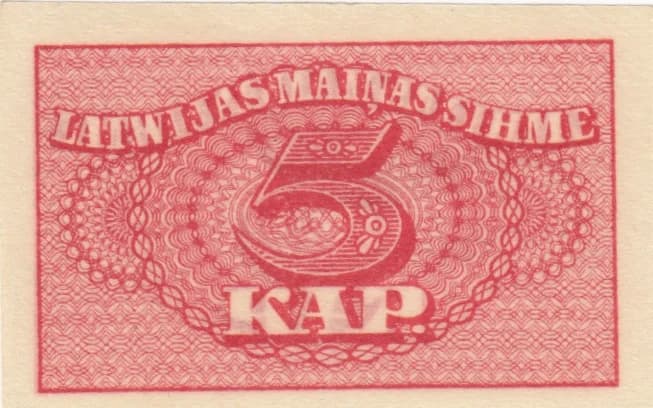
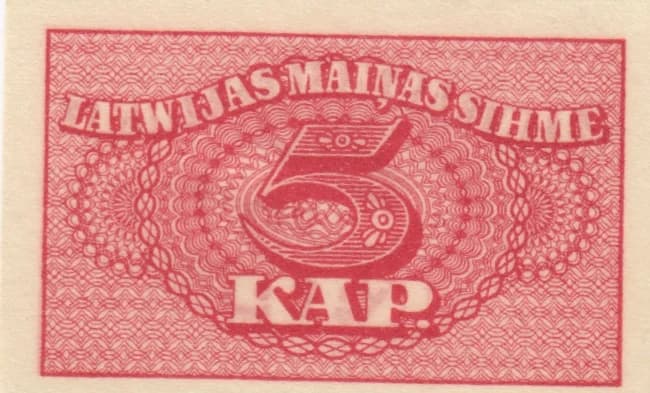
This 1920 Latvia 5 Kapeikas note presents in AU (Almost Uncirculated) condition with exceptional clarity and pristine margins. The design features a striking ornate numeral 5 as the dominant focal point, surrounded by intricate geometric and floral patterns in red and pink tones against a cream background. The complex engraved line work and decoration throughout demonstrates the sophisticated security printing of early Latvian State currency during the nation's first independent period.
Common. Despite its historical significance as an early Latvian State issue, eBay transaction data shows consistent availability with prices ranging from $1.29 to $13.48 depending on condition grade (2013-2020 sales). The 2016 catalog value for UNC is listed at $20, and typical sales in AU-UNC grades command $7-13. No evidence of low mintage, recall, or extreme scarcity exists. The Pick catalog lists only 2 variants (P-9a and P-9s), suggesting straightforward production without significant rarity factors.
Issued in 1920 by the Latvian Government Treasury during Latvia's emergence as an independent nation following World War I and the collapse of the Russian Empire, this banknote represents the early monetary sovereignty of the newly formed state. The ornate design with geometric and floral patterns reflects the Art Nouveau and early modernist aesthetic popular in Eastern European currency design of the period. The inscription 'LATVIJAS MĀJAS STHME' (Latvian State) asserts national identity during a crucial formative period in Latvian independence.
This is a single-design banknote (both sides appear identical based on visual analysis) featuring a large ornate numeral 5 positioned centrally and dominantly. The numeral is surrounded by a decorative wreath or circular frame with radiating ornamental flourishes. The entire design is composed of intricate interlocking geometric patterns and fine line work that creates a complex background texture. The palette consists primarily of red and pink hues with cream/beige ground. No portraits or architectural landmarks are depicted; instead, the design emphasizes geometric ornamental security printing typical of early 20th-century Eastern European currency.
Front/Obverse: 'LATVIJAS MĀJAS STHME' (Latvian State) - primary state inscription; 'KAP' (Kapeikas) - currency denomination abbreviation. No reverse inscriptions distinctly noted in visual analysis.
Intaglio engraving (recess printing), evidenced by the deep, precise line work and complex geometric pattern fill observed throughout. The fine detail, consistent ink coverage, and intricate border work are characteristic of high-security banknote engraving production typical of early Latvian state currency. The printer is not definitively identified from available catalog data, though early Latvian notes were often produced by established European security printers.
PMG has identified two variants: P-9a and P-9s. Based on standard Pick nomenclature, P-9a likely represents the standard issue while P-9s may indicate a specimen or special printing. The visual analysis does not reveal signature variations, overprints, or serial number prefixes that would definitively assign this specific note to either variant, though the pristine AU condition and lack of wear-indicating marks suggest this could be a specimen example (P-9s) rather than a circulated note (P-9a).