3 rubli 1919
Market Prices
25 salesAbout This Note
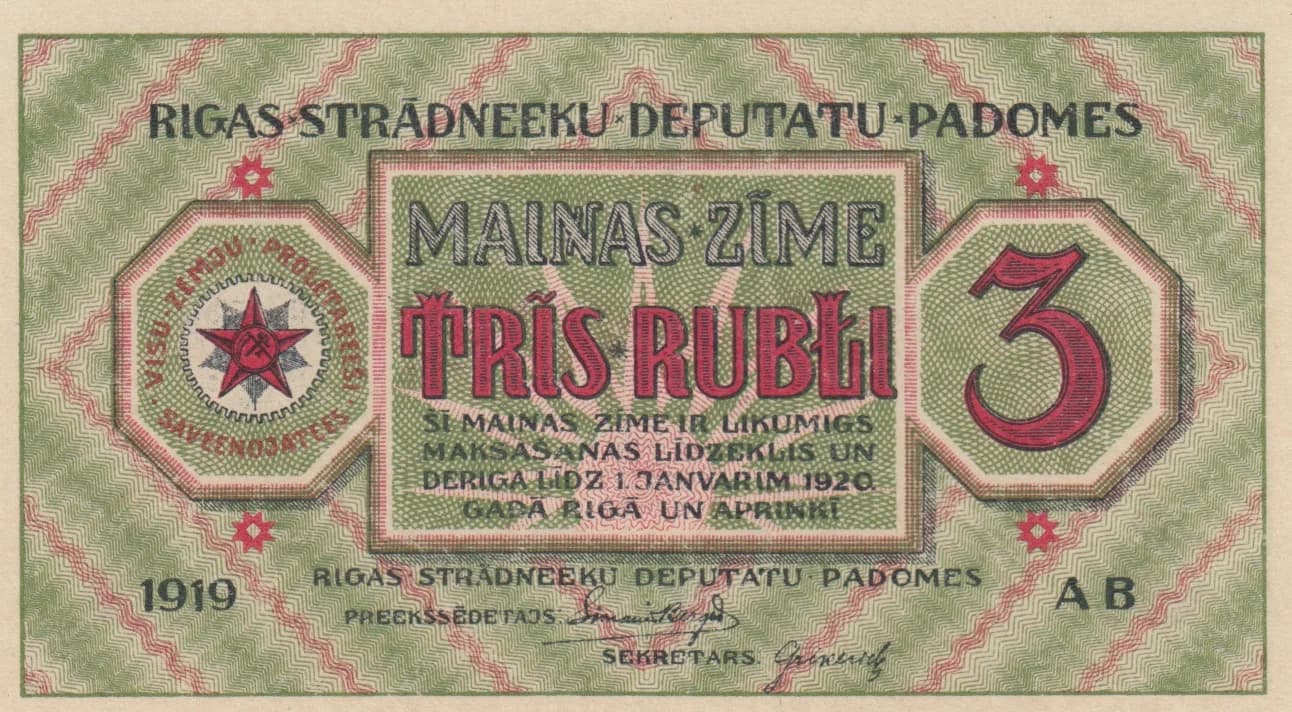
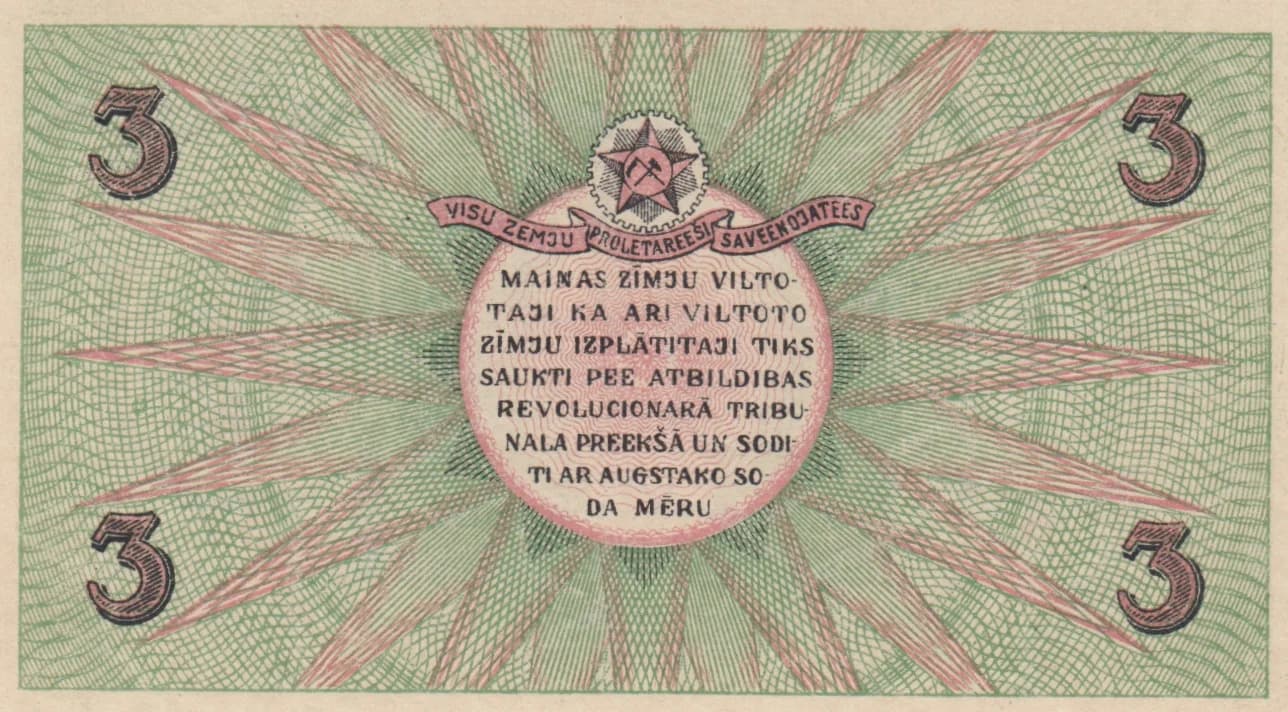
This exceptional UNC example of the Latvia 3 Rubli 1919 regional banknote issued by Riga's Workers Deputies Soviet presents vibrant red, green, and cream coloring with sharp, crisp printing throughout. The note features bold communist iconography including dual hammer-and-sickle emblems within octagonal medallions and a radiating sunburst design on the reverse, all rendered with intricate guilloche work and fine line security printing. As an uncirculated specimen of this historically significant Soviet-era regional note, it represents an important artifact of Latvia's brief Soviet period in near-pristine condition.
common
This banknote was issued during the tumultuous period of 1919 when Soviet forces briefly controlled Riga following the Russian Revolution. The prominent hammer-and-sickle symbols and the inscription 'Workers of All Lands Unite' directly reflect the revolutionary communist ideology of the issuing authority, the Riga Council of Workers' Deputies. The note's validity was deliberately limited to January 1, 1920, and circulation restricted to Riga and environs, indicating the temporary and localized nature of this Soviet administration before its eventual collapse.
The obverse displays a symmetrical design dominated by two prominent octagonal medallions positioned left and right of a central rectangular panel. Each medallion contains a red five-pointed star with hammer-and-sickle symbol, with the numeral '3' positioned in the right medallion. The background features a green field with red geometric patterns and decorative floral rosettes at cardinal points, all integrated within a complex guilloche border pattern. Text identifying the issuer and denomination occupies the central rectangular panel in a formal, official typeface. The reverse features a radial sunburst design emanating from a central circular medallion containing the revolutionary slogan, with the hammer-and-sickle symbol prominently positioned at the apex. Large red denomination numerals appear in all four corners. The green and red color scheme and intricate line work create a visually dynamic composition emphasizing communist revolutionary imagery.
FRONT SIDE: 'RIGAS STRADNEEKU DEPUTATU PADOMES' (Riga Council of Workers' Deputies) / 'MAINAS ZIME' (Exchange Note) / 'TRIS RUBLI' (Three Rubli) / 'ST MAINAS ZIME IR LIKUMIGS MAKSAS SANAS LIDZERKLLS UN DERIGA LIDZ 1.JANUARIM 1920' (This exchange note is legal tender and valid until January 1, 1920) / 'CAPA RIGA UN APRAUNI' (Riga and environs) / '1919' (year) / 'AB' (initials, likely printer or engraver marks) / 'PREKSSEDETAOS' (President) / 'SEKRETARS' (Secretary). REVERSE SIDE: 'VISU ZEMJU PROLETARIESU SAVIENOTEES' (Workers of All Lands Unite) / 'MAINAS ZIMIU VILTO-TAJI KA ARI VILTOTO ZIMIU IZPLATITAJI TIKS SAUKTI PEE ATBILDIBAS REVOLUCIONARA TRIBU NALA PREEKSA UN SODI TI AR AUGSTAKO SO DA MERU' (Counterfeiting of exchange notes as well as distribution of counterfeit notes will be prosecuted before the Revolutionary Tribunal and punished with the highest penalty) / '3' (denomination).
This note was produced using intaglio (engraved) printing, evidenced by the fine, precise guilloche patterns, detailed line work, and sharp registration of the multi-color design visible throughout both sides. The complex radiating lines on the reverse and the intricate decorative borders on the obverse are characteristic of intaglio security printing techniques employed for currency production. The depth and crispness of the impression, particularly evident in the uncirculated condition of this specimen, confirms professional currency printing rather than lithography.
PMG records indicate one catalogued variant (P-R2a) for this base Pick number. The visual analysis shows signatures designated as 'PREKSSEDETAOS' (President) and 'SEKRETARS' (Secretary) with initials 'AB' appearing in the bottom right, likely representing the engraver or printer. No additional overprints or date variants are apparent from this specimen, which appears to be the standard 1919 issue.