25 latu 1928
Market Prices
16 salesAbout This Note
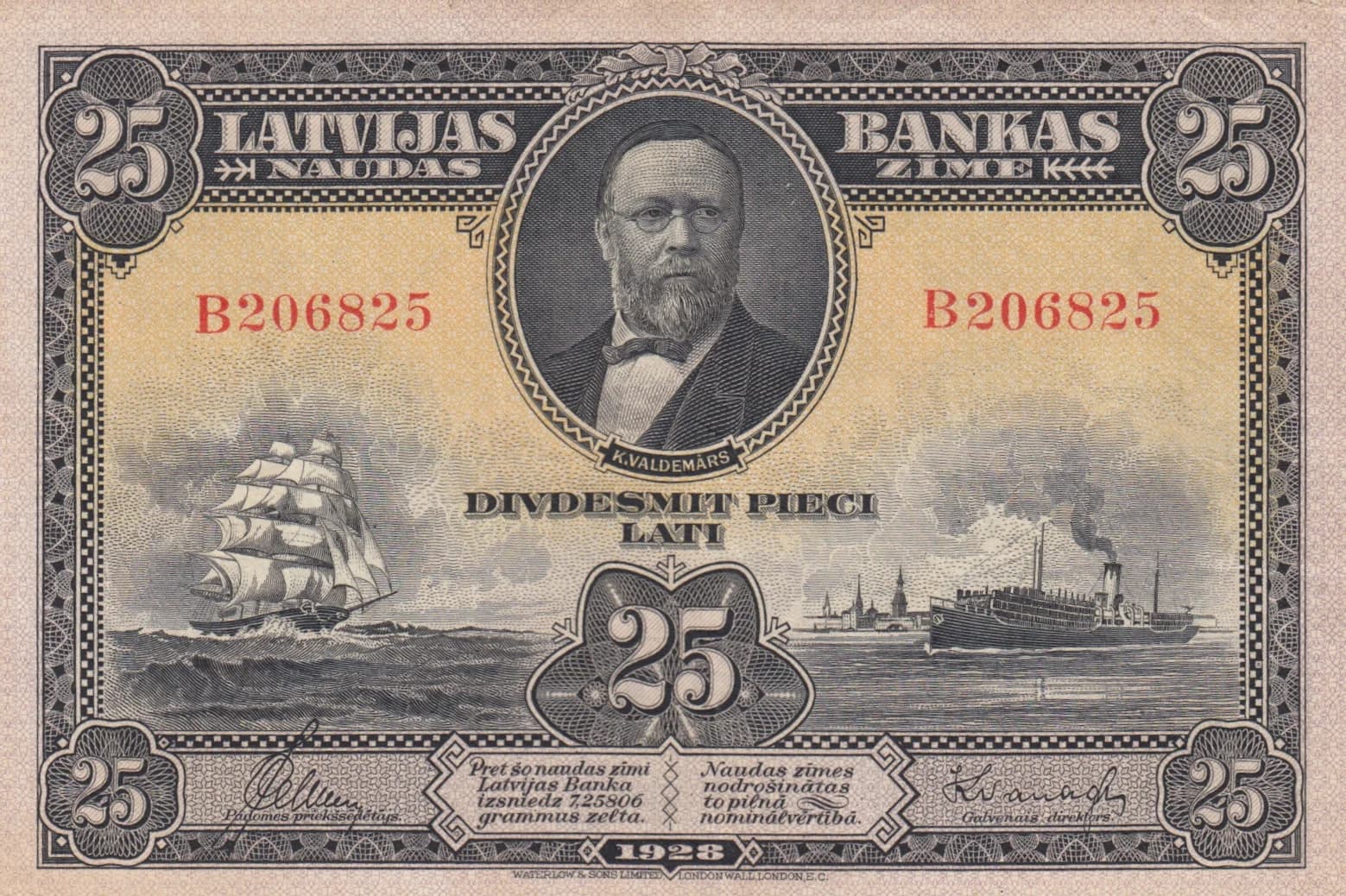
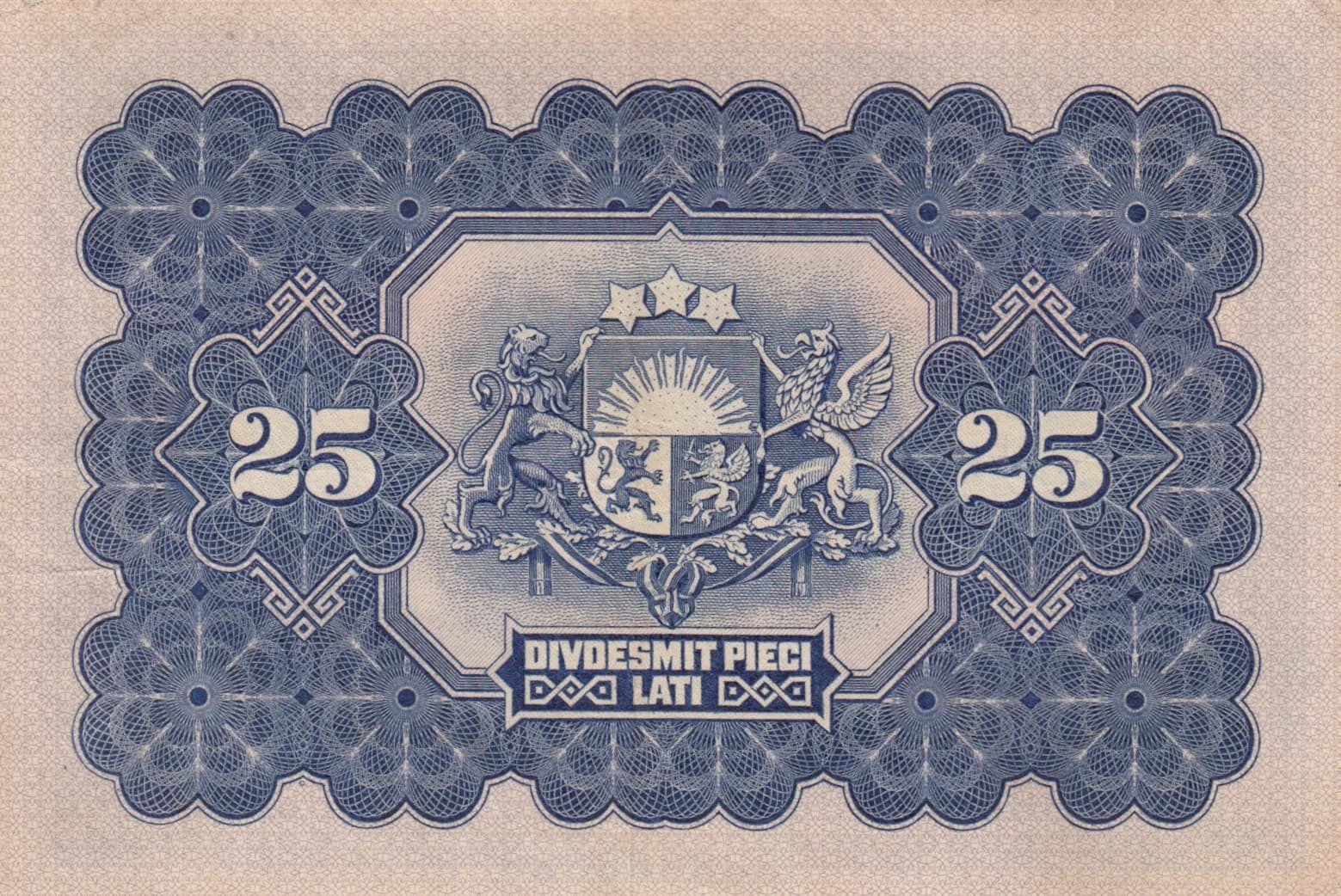
This is a VF-grade 25 Lati banknote from Latvia's 1928 regular issue, printed by Waterlow & Sons in London. The note displays excellent condition with sharp, clean printing throughout, featuring a striking beige/tan background with dark blue and black ornamental borders. The front showcases a portrait of K. Valdemars (the noted Latvian maritime figure) flanked by two maritime vessels—a sailing ship and a steam-powered vessel—while the reverse displays Latvia's coat of arms with its distinctive rising sun and heraldic shield, all rendered in fine line engraving.
Common. The eBay market data provided shows consistent sales over multiple years (2011-2023) at modest prices, with VF-grade examples typically selling in the $20-$50 range and F-grade notes considerably lower ($14-$36). The 2016 catalogue valuation of $200 for VF condition appears optimistic relative to actual market performance, suggesting the note is readily available. This denomination and issue date represent a standard regular-issue banknote from Latvia's interwar period with no evidence of limited mintage or recall status.
Issued during Latvia's period of independence between the world wars (1918-1940), this 25 Lati note reflects the nation's maritime heritage and national pride through its prominent depiction of K. Valdemars, a significant figure in Latvian seafaring history. The dual ship imagery—representing both traditional sailing and modern steam-powered vessels—symbolizes Latvia's connection to the Baltic Sea and its strategic position as a trading nation. The note's inscriptions reference the gold standard backing ('grammes of gold'), demonstrating Latvia's commitment to currency stability during the interwar period.
The obverse features a formal portrait of Krišjānis Valdemars, a prominent Latvian maritime explorer and naval officer, rendered in an ornate oval security frame at the top center. The portrait depicts him as a bearded gentleman with spectacles wearing formal attire with a bow tie. Flanking the portrait are two distinct maritime vessels: on the left, a traditional multi-masted sailing ship depicted on rough seas, and on the right, a modern steam-powered icebreaker (identified as the 'Krišjānis Valdemars'), symbolizing the progression from traditional to modern maritime technology. The reverse displays the Latvian coat of arms as the central design element, featuring a shield divided into heraldic sections beneath a rising sun and surmounted by two stars, all enclosed within an elaborate geometric border with repeating floral/quatrefoil patterns. The color scheme combines beige/tan backgrounds with navy blue and black ornamental elements, creating strong visual contrast throughout.
FRONT: 'Latvijas Bankas' (Bank of Latvia); 'Naudas Zīme' (Banknote); '25' (denomination); 'Dividesmit Pieci Lati' (Twenty-five Lati); 'K. Valdemars' (name of portrait subject); '1928' (year of issue); 'Pret šo naudas zīmi Latvijas Banka izsniegusi grammus zelta.' (For this banknote the Latvian Bank has issued grammes of gold.); 'Naudas zīmes nodrosinatas to pilnai nominālvērtībā.' (The banknote is secured at its full nominal value.); 'WATERLOWS & SONS LIMITED LONDON WALL LONDON E.C.' (printer identification). BACK: 'Dividesmit Pieci Lati' (Twenty-five Lati); '25' (denomination).
This note was produced using intaglio (steel engraving) printing by Waterlow & Sons Limited, a renowned London-based security printer. The fine line engraving is evident throughout the note in the intricate decorative borders, the portrait rendering, the ship imagery, and the heraldic design. The sharp detail, complex background patterns, and security features such as the finely engraved geometric borders and the ornate frame around the portrait are characteristic of high-quality intaglio printing from this era. The consistent print quality observed across both sides indicates professional-grade security printing.
The PMG Population Report indicates Pick catalog number P-18a as the primary catalogued variant. The observed note displays serial number B206825 in red. The note is the standard regular issue from 1928 with no evident overprints, date variations, or signature varieties that would distinguish it as a notable sub-variant. The Waterlow & Sons printing is consistent with the standard production of this Pick number.