20 latu 1925
Market Prices
8 salesAbout This Note
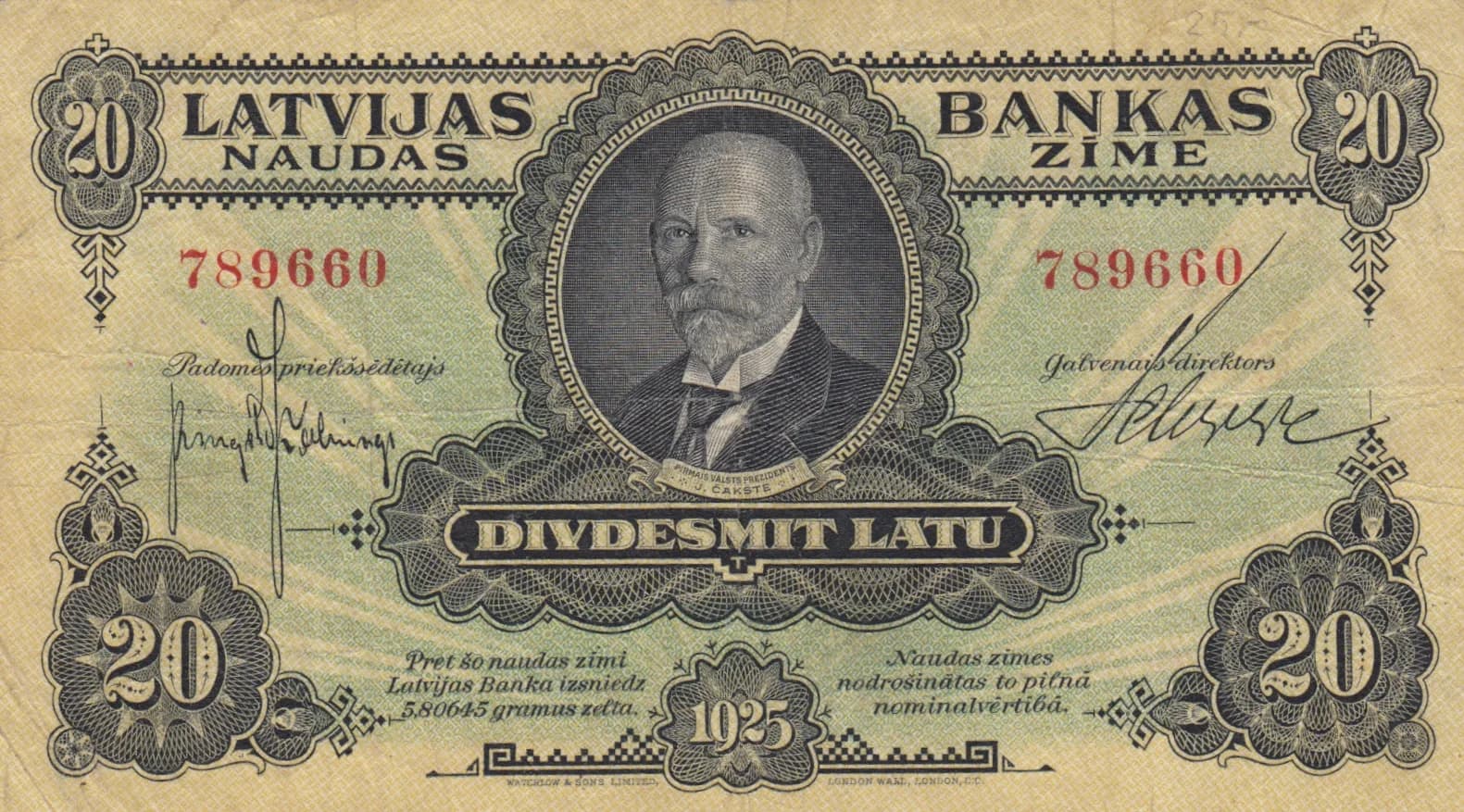
This 20 Latu note from 1925 represents an important early issue from the newly independent Latvian state, featuring a portrait of President Jānis Čakste in an ornate circular frame. The note displays moderate circulation wear with visible foxing and creasing consistent with its VF grade, yet retains excellent detail in the intricate engraved borders and heraldic design. The tan and green color scheme with black intaglio printing creates a distinctive aesthetic characteristic of interwar Baltic currency.
Common. eBay market data shows consistent sales in the $37-88 range for F-VF grades between 2013-2021, with a VF example selling for $54.31 in 2021. Catalog values list VF at $300 and VG at $200, but actual realized prices on secondary markets are substantially lower, indicating good availability. This was a regular issue from a major Baltic central bank during a period of significant currency circulation, suggesting a reasonably large print run. No evidence of scarcity or special rarity factors.
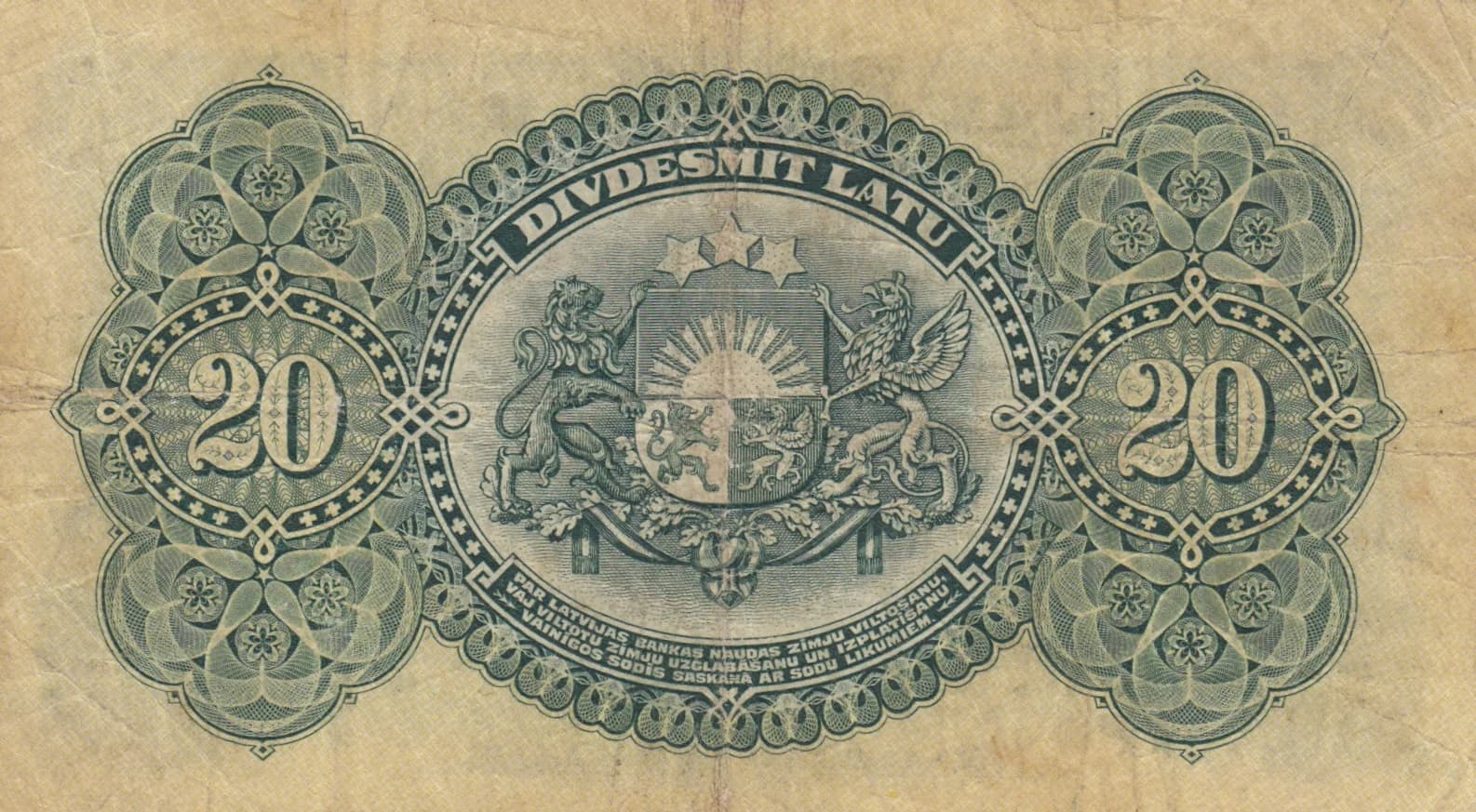
Issued during Latvia's first decade of independence (1918-1940), this 1925 banknote reflects the young republic's efforts to establish a stable national currency under Latvijas Banka. The prominent portrait of President Jānis Čakste, who served as Latvia's first president and led the nation through its formative years, symbolized state authority and stability. The reverse coat of arms featuring the rising sun motif and heraldic supporters (lion and griffin) represented Latvia's sovereignty and cultural heritage during this period of nation-building.
The obverse features a dignified engraved portrait of President Jānis Čakste centered within an ornate scalloped circular frame, dressed formally in suit and tie with characteristic beard. The surrounding design employs elaborate Art Nouveau-influenced decorative elements with floral motifs in all four corners and shield-like emblems in the bottom corners, with 'LATVIJAS NAUDAS BANKAS ZĪME' arching across the top. The reverse displays Latvia's national coat of arms—a shield bearing the rising sun motif (representing hope and new beginnings) flanked by heraldic supporters identified as a lion and griffin, crowned with ornamental elements above. The denomination '20' appears in circular frames on both sides. Multiple signature lines below the portrait indicate authorization by bank officials. The color scheme of tan/beige underprint with black intaglio engraving and light green accents creates the characteristic appearance of this note.
FRONT: 'Latvijas Naudas Bankas Zīme' (Latvian Bank Currency Note) / 'Dividesmit Latu' (Twenty Lats) / '1925' (date of issue) / 'Pašomesprieksšedētājs' (Chairman) / 'Gotvenablīdirektors' (Main Director) / Serial number: 789660 / Gold backing clause: 'Pret 80 naudas zīmi Latvijas Banka izsniedzā 5,80645 grammus zelta' (For 80 currency notes the Latvian Bank issues 5.80645 grams of gold) / 'Naudas zīmes nodrošinātas to pilnā nominālvērtībā' (Currency notes are secured at their full nominal value). BACK: 'Dividesmit Latu' (Twenty Lats) / '20' (denomination numeral) / Heraldic inscriptions in circular frame (partially legible in image).
Intaglio engraving (recess printing), executed by Waterlow & Sons of London, one of the world's foremost security printers of the era. The fine detail visible in the portrait, decorative borders, and heraldic design demonstrates the high quality and security standards of professional banknote production. The black engraved work on tan/green colored paper with multiple signature lines was standard practice for European central bank currency of the 1920s.
Pick catalog identifies this as P-17 with one known variant (P-17a). The observed specimen carries serial number 789660 with black intaglio printing on tan and green underprint, consistent with the standard 1925 regular issue. PMG population data confirms minimal variant distinction for this Pick number. The specific signatures visible on this note would be consistent with Latvijas Banka's authorization officials of 1925, but without clearer signature legibility, definitive official identification cannot be made from the images alone.